The kitchen floor takes more punishment than almost any other surface in your home, heat, dropped pots, spills, foot traffic, and daily scrubbing. Getting the material right from the start saves you from costly replacements and ongoing frustration. I’ve worked on enough Sydney kitchen renovations to know that the wrong floor choice is one of the most common and most avoidable mistakes renovators make.
Choosing the wrong material costs you time, money, and resale appeal. The right floor handles your kitchen’s real conditions without demanding constant attention.
In this guide, I cover tiles, timber, vinyl, and concrete, costs, pros, cons, and which option suits your situation best.
What to Look for in Kitchen Flooring Before You Choose
Before comparing materials, you need a clear set of criteria. The best kitchen floor for a family of five with two dogs is not the same as the best floor for a single-person apartment or a rental investment property. These three factors separate a smart choice from an expensive regret.
Durability and Foot Traffic Tolerance
The kitchen is the highest-traffic room in most homes. Your floor needs to handle daily foot traffic, chair scraping, dropped utensils, and the occasional heavy pot without showing serious wear within a few years.
Hardness ratings matter here. Porcelain tile and polished concrete sit at the top of the durability scale. Timber and vinyl sit in the middle, with timber requiring more care to avoid surface scratches. The harder the material, the longer it holds up under real kitchen conditions.
Water and Moisture Resistance
Kitchens produce constant moisture, from cooking steam, sink splashes, and spills that don’t always get wiped up immediately. A floor that absorbs water or swells at the edges becomes a hygiene and structural problem fast.
Fully waterproof options include porcelain tile, vinyl, and sealed concrete. Timber is the most vulnerable to moisture and needs careful sealing and prompt spill management. This is the single most important factor for Sydney kitchens, where open-plan layouts often connect the kitchen directly to outdoor entertaining areas.
Maintenance Requirements and Long-Term Upkeep
Some floors look great on day one and become a maintenance burden within a year. Grout lines in tile floors trap grease and require regular cleaning. Timber needs periodic resealing or refinishing. Vinyl is the lowest-maintenance option across the board.
Think about how much time and money you’re willing to spend on upkeep over a ten-year period, not just the installation cost. The cheapest floor to install is not always the cheapest floor to own.
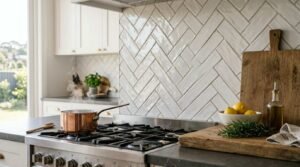
Tiles, The Hardworking Classic for Sydney Kitchens
Tile is the most popular kitchen flooring choice in Sydney, and for good reason. It handles moisture, heat, and heavy use better than almost any other material. The trade-off is a harder, colder surface underfoot and grout lines that need regular attention.
Types of Kitchen Tiles (Ceramic, Porcelain, Stone)
Ceramic tile is the entry-level option, affordable, widely available, and suitable for lower-traffic kitchens. Porcelain tile is denser, harder, and more water-resistant, making it the better choice for busy family kitchens. Natural stone tiles, marble, travertine, slate, offer premium aesthetics but require sealing and more careful maintenance.
For most Sydney kitchens, I recommend rectified porcelain. It’s dimensionally precise, allows for tighter grout lines, and holds up to serious daily use without fading or chipping under normal conditions.
Pros and Cons of Tile Flooring in the Kitchen
Tile is genuinely hard to beat on durability and water resistance. A well-laid porcelain floor lasts decades with minimal structural degradation. It’s also heat-resistant, hygienic, and available in an enormous range of sizes, finishes, and colours.
The downsides are real, though. Tile is cold and hard underfoot, uncomfortable for anyone who spends long periods standing in the kitchen. Grout lines collect grease and require consistent cleaning to stay hygienic. And if a tile cracks, matching replacements can be difficult to source years later.
Cost of Kitchen Tiles in Sydney
For ceramic tile, expect to pay roughly $50–$90 per m² supply and install. Porcelain tile typically runs $80–$150 per m² depending on the format and finish. Large-format rectified porcelain and natural stone can push $150–$300+ per m² once you factor in substrate preparation, adhesive, and grout.
Labour accounts for a significant portion of the total cost. A skilled tiler in Sydney charges $50–$80 per hour, and complex layouts with feature tiles or diagonal patterns add time and cost. Budget for waste, typically 10–15% extra material for cuts and breakage.
Timber, Warmth and Character With Real Trade-Offs
Timber flooring brings warmth, texture, and a premium feel to a kitchen that no other material quite replicates. It’s also the most debated choice among renovators, because timber and kitchens have a complicated relationship when moisture is involved.
Solid Timber vs. Engineered Timber for Kitchens
Solid timber is milled from a single piece of hardwood. It looks beautiful, can be sanded and refinished multiple times, and adds genuine resale value. But it moves with humidity and temperature changes, which makes it vulnerable in kitchens where moisture levels fluctuate.
Engineered timber is a layered product, a real timber veneer bonded over a stable plywood or HDF core. It handles moisture movement significantly better than solid timber, making it the more practical choice for kitchen environments. I always recommend engineered over solid for kitchen installations in Sydney’s climate.
Pros and Cons of Timber Kitchen Flooring
The appeal is obvious, timber floors photograph beautifully, feel warm underfoot, and consistently rank as a top feature for homebuyers. Engineered timber, properly sealed, handles everyday kitchen spills when they’re wiped up promptly.
The risks are real, though. Timber scratches. It dents. Standing water left on the surface causes swelling and staining. It needs periodic resealing, and in a rental property, tenant wear can degrade the surface faster than you’d expect. Timber is a high-reward, higher-maintenance choice.
Cost of Timber Flooring in Sydney Kitchens
Engineered timber flooring in Sydney typically costs $80–$150 per m² for supply and install, depending on the species, board width, and finish. Premium wide-board engineered products push toward $180–$250 per m². Solid hardwood flooring runs $100–$200+ per m² installed.
Factor in underlay, moisture barriers, and any subfloor levelling required. Timber installation is not a DIY job in most cases, an uneven subfloor causes boards to flex, squeak, and fail at the joints over time.
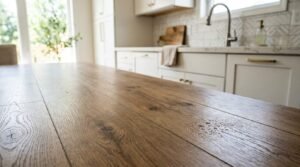
Vinyl, The Practical Performer Most Renovators Overlook
Vinyl has a reputation problem it doesn’t deserve. The vinyl flooring of twenty years ago, thin, cheap-looking sheet material, is not what’s available today. Modern luxury vinyl plank (LVP) is a genuinely impressive product that outperforms timber and tile on several practical measures.
Luxury Vinyl Plank vs. Sheet Vinyl
Luxury vinyl plank is a rigid or semi-rigid click-lock product that installs as a floating floor. It looks convincingly like timber or stone, handles full waterproofing, and sits comfortably underfoot thanks to its built-in underlayer. It’s the product I recommend for most budget-conscious kitchen renovations and virtually all rental properties.
Sheet vinyl is a single continuous piece of material that covers the floor without seams. It’s even more waterproof than LVP because there are no joints for water to penetrate. It’s less visually impressive but extremely practical for wet areas and high-traffic rentals.
Pros and Cons of Vinyl Kitchen Flooring
Vinyl’s strengths are hard to argue with. It’s fully waterproof, comfortable underfoot, quiet, warm, and available in a wide range of realistic timber and stone looks. It’s the easiest kitchen floor to maintain, sweep, mop, done. And it’s the most budget-friendly option of the four materials covered here.
The limitations are lifespan and perception. Quality LVP lasts 15–25 years with normal use, but it doesn’t refinish or repair the way timber does. It can be damaged by heavy furniture dragged across the surface. And despite its improved quality, some buyers still perceive vinyl as a lower-end finish, which matters if resale value is your primary concern.
Cost of Vinyl Flooring for Sydney Kitchens
Sheet vinyl starts at around $25–$50 per m² supply and install, the most affordable kitchen flooring option available. Quality LVP runs $50–$100 per m² installed, depending on the wear layer thickness and brand. Premium rigid-core LVP products sit at $80–$130 per m².
Vinyl is also the most DIY-friendly of the four options. Click-lock LVP can be installed by a competent DIYer over a flat, clean subfloor, which reduces the total cost further. That said, professional installation ensures a flat, gap-free result that lasts the full product lifespan.
Concrete, The Bold, Low-Maintenance Option for Modern Kitchens
Polished or sealed concrete is the most distinctive kitchen flooring choice on this list. It suits industrial, contemporary, and minimalist kitchen designs, and it delivers genuinely low maintenance once it’s properly sealed. It’s also the most misunderstood option, people assume it’s cold, grey, and uncomfortable, but a well-finished concrete floor is none of those things.
Polished Concrete vs. Sealed Concrete Floors
Polished concrete involves mechanically grinding the slab to expose aggregate and achieve a smooth, reflective finish. The level of polish, from a matte grind to a high-gloss mirror finish, determines the final look. It’s a specialist process that requires professional equipment and skill.
Sealed concrete is a simpler process, the existing slab is cleaned, repaired, and coated with a penetrating or surface sealer. It’s less visually dramatic than polished concrete but significantly more affordable. Concrete overlays are a third option, a thin layer of cementitious material applied over an existing floor to create a fresh concrete look without grinding the original slab.
Pros and Cons of Concrete Kitchen Flooring
Concrete is genuinely low maintenance once sealed. It doesn’t scratch, it doesn’t swell with moisture, and it doesn’t harbour allergens. It handles heat, heavy use, and dropped objects without visible damage in most cases. And in a modern open-plan kitchen, it creates a seamless, architectural look that’s hard to achieve with any other material.
The downsides are comfort and cracking. Concrete is hard and cold underfoot, harder than tile, with no give whatsoever. Radiant underfloor heating solves the cold problem but adds significant cost. Concrete also cracks over time as the slab moves, and while hairline cracks are normal and manageable, larger cracks require professional repair. It’s not a forgiving material.
Cost of Concrete Flooring in Sydney
Polished concrete in Sydney typically costs $80–$150 per m² for a standard residential finish, with high-gloss or custom aggregate finishes pushing $150–$250+ per m². Sealed concrete is more affordable at $40–$80 per m² depending on the condition of the existing slab and the sealer used. Concrete overlays sit at $60–$120 per m².
These costs assume an existing concrete slab. If your kitchen sits on a timber subfloor, a concrete overlay or topping slab adds significant structural and cost complexity. Get a professional assessment before committing to concrete on a suspended floor.
Side-by-Side Comparison, Which Kitchen Floor Wins for Your Situation?
No single material wins across every category. The right choice depends on your priorities, your budget, and how you actually use your kitchen. Here’s how the four options stack up against the criteria that matter most.
Best for Durability and Heavy Use
Porcelain tile and polished concrete are the clear leaders here. Both handle decades of heavy use without structural degradation. Engineered timber and quality LVP perform well under normal conditions but show wear faster in genuinely high-traffic kitchens.
For a family kitchen with kids, pets, and constant cooking, I’d put porcelain tile first, polished concrete second, and engineered timber third, with vinyl as a strong budget alternative.
Best for Budget-Conscious Renovators
Vinyl wins this category outright. Sheet vinyl and entry-level LVP deliver a functional, waterproof, attractive kitchen floor at the lowest total cost of any option here. Ceramic tile is the next most affordable option, particularly for smaller kitchens where the total m² cost stays manageable.
Timber and polished concrete are the most expensive options once installation complexity is factored in. They’re worth the investment in the right context, but not the right starting point for a tight renovation budget.
Best for Resale Value and Buyer Appeal
Engineered timber consistently performs best on resale. Buyers respond to the warmth and premium feel of a timber floor in a way they simply don’t respond to vinyl or concrete. Quality porcelain tile, particularly large-format, rectified product, is a strong second.
Concrete appeals to a specific buyer profile and can be a drawcard in the right property. Vinyl, despite its practical strengths, still carries a perception gap with many buyers that affects its resale contribution.
Best for Rental Properties and Investment Kitchens
Vinyl is the clear winner for rental properties. It’s waterproof, durable under tenant use, easy to clean, and cheap enough to replace at the end of a tenancy without significant financial pain. Sheet vinyl or mid-range LVP is the standard recommendation for investment kitchen renovations in Sydney.
Porcelain tile is a solid second choice for rentals, it’s virtually indestructible and easy to clean, though grout maintenance adds some ongoing cost. Timber and concrete are generally not recommended for rental kitchens due to their sensitivity to tenant wear and the cost of repairs.
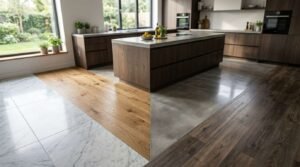
How to Choose the Right Kitchen Floor for Your Home
The comparison above gives you the framework. Now it comes down to your specific situation, your kitchen layout, your lifestyle, your budget, and your long-term goals for the property.
Match Your Floor to Your Kitchen Layout and Lifestyle
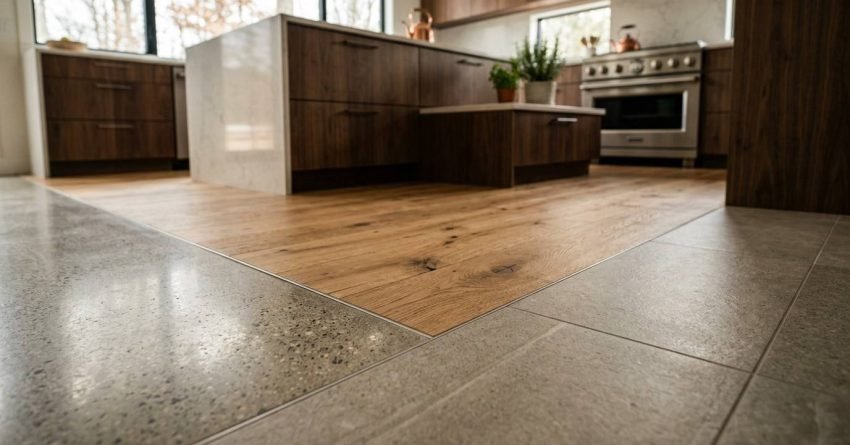
An open-plan kitchen that flows into a living area benefits from a consistent flooring material across both spaces, engineered timber or large-format tile works well here. A galley kitchen with heavy cooking use needs maximum durability and easy cleaning, porcelain tile or vinyl is the practical answer.
Think about who uses the kitchen and how. A household with young children and pets needs a forgiving, waterproof surface. A design-focused renovation targeting premium buyers needs a material that photographs well and signals quality. A rental property needs a floor that survives tenant turnover without expensive repairs.
When to Bring in a Professional for Kitchen Flooring
Every material on this list benefits from professional installation, but some require it. Polished concrete is a specialist trade. Large-format rectified tile demands a perfectly flat substrate and precise adhesive application. Engineered timber needs correct moisture barrier installation and acclimatisation before laying.
We handle kitchen flooring installations across Sydney, from subfloor preparation through to final finish. Getting the substrate right before a single board or tile goes down is what separates a floor that lasts twenty years from one that fails in five.
Conclusion
Tiles, timber, vinyl, and concrete each bring genuine strengths to a Sydney kitchen renovation. The right choice connects your material to your lifestyle, your budget, and your long-term property goals, not just the look you like in a showroom.
Durability, moisture resistance, and maintenance requirements are the three criteria that separate a smart floor decision from an expensive one. Every material on this list works, in the right context, with the right installation.
At Sydney Home Renovation, we help homeowners and investors choose and install kitchen flooring that performs for the long term. Contact us to discuss your kitchen renovation and get a clear, honest assessment of which floor suits your home.
Frequently Asked Questions
What is the most durable kitchen flooring option?
Porcelain tile and polished concrete are the most durable kitchen flooring options available. Both handle decades of heavy use, moisture, and heat without structural degradation. For most Sydney kitchens, rectified porcelain tile is the practical first choice for durability.
Is timber flooring suitable for kitchens in Sydney?
Engineered timber is suitable for Sydney kitchens when properly sealed and maintained. It handles moisture movement better than solid timber and adds genuine resale value. Solid timber is riskier in kitchen environments due to its sensitivity to humidity and spills.
How much does kitchen flooring cost in Sydney?
Kitchen flooring in Sydney ranges from $25–$50 per m² for sheet vinyl up to $150–$300+ per m² for large-format porcelain or polished concrete. Engineered timber and quality LVP typically fall in the $80–$150 per m² range supply and installed.
What kitchen flooring is easiest to maintain?
Vinyl is the easiest kitchen flooring to maintain. It’s fully waterproof, requires no sealing or refinishing, and cleans with a standard mop. Porcelain tile is a close second, durable and hygienic, though grout lines need regular attention to stay clean.
Is vinyl flooring a good choice for a kitchen renovation?
Yes, modern luxury vinyl plank is a genuinely strong kitchen flooring choice. It’s fully waterproof, comfortable underfoot, available in realistic timber and stone looks, and the most budget-friendly option of the four materials. It’s the top recommendation for rental properties and budget-conscious renovations.