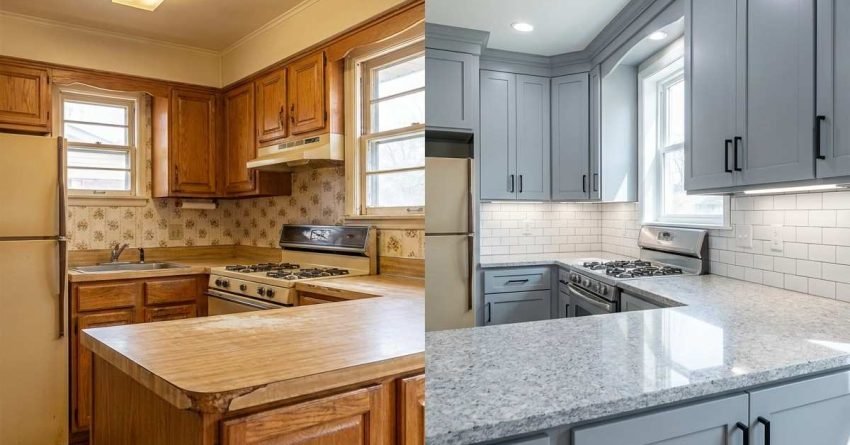
Updating a 20-year-old kitchen in Sydney typically costs between $15,000 and $45,000. The final figure depends on the scope of work, materials selected, and whether structural changes are involved.
After two decades, most kitchens show significant wear across cabinetry, benchtops, appliances, and electrical systems. We see this pattern in almost every older Sydney home we assess, and it makes a targeted update one of the highest-return investments a homeowner can make.
Outdated kitchens suppress property values, increase energy costs through ageing appliances, and create daily frustrations that compound over time. A well-planned update resolves all three. This guide covers cost tiers, what to prioritise, hidden expenses, layout decisions, and how to plan a kitchen update that stays on budget and delivers lasting value.
Kitchen Update Cost at a Glance
| Tier | Cost Range | Best Suited For |
| Budget Update | $10,000–$20,000 | Sound cabinets, working layout, compliant systems |
| Mid-Range Renovation | $20,000–$40,000 | Full cosmetic and functional transformation |
| Premium Overhaul | $40,000–$70,000+ | Custom finishes, layout changes, high-value properties |
What Does Updating a 20-Year-Old Kitchen Actually Involve?
Updating a kitchen that is two decades old is rarely a single task. It is a layered process spanning cosmetic improvements, functional upgrades, and sometimes structural changes. Understanding what is actually involved before committing to a budget or a contractor is the most important step you can take.
A 20-year-old kitchen carries specific challenges newer kitchens do not. Cabinetry from the early 2000s was typically built from particleboard with laminate finishes that delaminate, swell, and discolour over time. Benchtops from that era are often laminate or low-grade stone that has stained, chipped, or aged poorly.
Appliances are approaching or past their functional lifespan. Electrical systems may not meet current Australian Standards, and plumbing fixtures are often corroded or inefficient. The scope of your update depends on how many of these elements need attention and how deeply you want to address them.
Cosmetic Updates vs. Structural Renovation. What’s the Difference?
A cosmetic kitchen update focuses on surface-level changes that improve appearance without altering the underlying structure. This includes repainting or refacing cabinet doors, replacing benchtops, installing a new splashback, updating tapware, and swapping out light fittings. Cosmetic updates are faster, less disruptive, and significantly cheaper, typically ranging from $10,000 to $20,000 for a standard Sydney kitchen.
A structural renovation goes further. It involves removing and replacing cabinetry entirely, reconfiguring the layout, moving plumbing or electrical services, opening walls for an open-plan conversion, or addressing compliance issues uncovered during demolition. Structural work adds both cost and time, but it also delivers a fundamentally different kitchen one that functions better, not just looks better.
Most 20-year-old kitchens benefit from a combination of both. We find that identifying which elements genuinely need structural intervention, and which can be resolved cosmetically, is the key decision point early in the process.
How to Assess the Current Condition of Your Kitchen Before You Start
Before engaging a contractor or setting a budget, walk through your kitchen with a critical eye. Open every cabinet door and check for swelling, delamination, or hinge failure. Run your hands across benchtops and look for chips, stains, and joins that have lifted.
Check under the sink for signs of water damage, mould, or corroded pipes. Test every appliance and note which ones are slow, unreliable, or energy-inefficient.
Look at the floor. Vinyl flooring from 20 years ago often contains asbestos-based backing materials, a critical consideration for any Sydney renovation involving floor removal.
Check the ceiling for water stains that may indicate a plumbing leak above, and assess whether the lighting provides adequate task coverage. This self-assessment gives you a realistic picture of what needs addressing.
It also helps you have a more productive conversation with a renovation contractor and reduces the risk of budget surprises once work begins.

How Much Does It Cost to Update a 20-Year-Old Kitchen in Sydney?
Kitchen renovation costs in Sydney vary significantly based on scope, materials, and labour. Most kitchen updates fall into three tiers: budget, mid-range, and premium. Understanding what each tier delivers, and where the money actually goes, is essential for setting realistic expectations before committing to a project.
Labour typically accounts for 30 to 40 percent of the total renovation cost in Sydney. The remainder is split across cabinetry, benchtops, appliances, plumbing, electrical, and finishes. Material quality has the single largest impact on where your project lands within each tier.
Kitchen size also shifts these figures. A compact galley kitchen under 8 square metres often sits at the lower end of each tier, while an open-plan kitchen with an island bench can push toward the upper end even within the same tier.
Budget Kitchen Update: $10,000–$20,000
A budget kitchen update in Sydney focuses on high-impact cosmetic changes that refresh the space without a full structural overhaul. At this price point, expect cabinet door replacement or repainting, a new laminate or engineered stone benchtop, a new splashback, updated tapware and sink, basic lighting upgrades, and one or two new appliances.
This tier suits kitchens where the cabinet carcasses are structurally sound, the layout works well, and the plumbing and electrical systems are compliant. It is the most cost-efficient approach for homeowners wanting meaningful visual improvement without the disruption of a full renovation.
A budget update does not address underlying structural issues. Cabinets beyond cosmetic repair, an inefficient layout, or non-compliant electrical systems are not resolved at this tier.
Mid-Range Kitchen Renovation: $20,000–$40,000
A mid-range kitchen renovation in Sydney delivers a complete transformation of the space. At this price point, full cabinet replacement becomes viable, along with quality stone benchtops such as engineered stone or reconstituted stone, a tiled or glass splashback, new flooring, a full appliance package, updated plumbing fixtures, and improved lighting design.
This is the most common renovation tier we see among Sydney homeowners updating a 20-year-old kitchen. It addresses both cosmetic and functional shortcomings, delivers a kitchen that feels genuinely new, and provides strong return on investment, particularly for owner-occupiers planning to sell within five years.
Mid-range renovations typically take three to five weeks from demolition to completion, depending on the complexity of the work and lead times on cabinetry and appliances.
Premium Kitchen Overhaul: $40,000–$70,000+
A premium kitchen overhaul in Sydney involves custom cabinetry, high-end stone benchtops such as natural marble or premium Caesarstone, integrated appliances, bespoke joinery, structural changes including wall removal or layout reconfiguration, and high-specification finishes throughout.
At this level, the kitchen becomes a design statement as much as a functional space. Premium renovations suit high-value properties, homeowners planning a long-term stay, or investors targeting the top end of the Sydney rental or resale market.
The cost at this tier reflects the complexity of the work, the quality of materials, and the level of project coordination required. Custom cabinetry alone can account for $15,000 to $25,000 of the total budget.
Where to Start. Prioritising Updates That Add the Most Value
Not every element of a 20-year-old kitchen deserves equal investment. The most effective kitchen updates focus budget on components delivering the greatest visual impact, functional improvement, and return on investment. Spreading budget too thinly across every element often results in a kitchen that looks partially updated rather than genuinely transformed.
The three highest-impact areas in any kitchen update are cabinetry, benchtops, and the combination of splashbacks, flooring, and lighting. Addressing these three areas strategically delivers the most significant improvement for the investment. Renovation industry data consistently shows kitchen upgrades returning 70 to 80 percent of project cost at resale, among the strongest returns of any home improvement category, according to Domain’s cost guide research.
Energy-Efficient Upgrades Worth Considering
A 20-year-old kitchen is also an opportunity to cut ongoing running costs, not just improve appearance. Induction cooktops, high star-rated dishwashers, and LED lighting circuits reduce electricity use meaningfully compared to the appliances they replace.
We recommend checking the Energy Rating Label system when comparing new appliances, since a jump from an old model to a 4-star-plus rated equivalent compounds into real savings over a decade of daily use.
Kitchen Cabinets and Joinery. Reface, Repaint, or Replace?
Cabinetry is the dominant visual element in any kitchen, and typically the highest single cost in a renovation. For a 20-year-old kitchen, the decision between refacing, repainting, or fully replacing cabinets depends on the structural condition of the existing carcasses.
Refacing involves replacing cabinet doors and drawer fronts while retaining the existing carcass structure. It costs significantly less than full replacement, typically $3,000 to $8,000 for a standard kitchen, and delivers a strong visual result when the carcasses are sound. Repainting is even more affordable, often $1,500 to $4,000 with professional preparation, but only appropriate when cabinet surfaces are smooth, stable, and free from delamination.
Full cabinet replacement is the most expensive option but delivers the best functional outcome. We generally recommend full replacement for most 20-year-old kitchens when budget allows, since carcasses from that era are typically at or near the end of their useful life.
Benchtops. The Single Biggest Visual Upgrade
After cabinetry, benchtops have the greatest impact on how a kitchen looks and feels. A new benchtop can transform the perception of an entire kitchen, even when surrounding elements remain unchanged.
Engineered stone brands such as Caesarstone, Silestone, and Quantum Quartz are the most popular benchtop choices in Sydney renovations. It offers durability, a wide range of colours and finishes, and a premium appearance at a mid-range price point. Engineered stone benchtops typically cost between $400 and $800 per linear metre installed, depending on the profile, thickness, and complexity of the cut.
Laminate benchtops remain a viable budget option, particularly for investment properties where durability and cost efficiency take priority over aesthetics. Natural stone marble, granite, and travertine sit at the premium end and suit high-specification renovations where the investment is justified by property value.
Splashbacks, Flooring, and Lighting. High-Impact, Lower-Cost Wins
Splashbacks, flooring, and lighting are the three elements most often underestimated in a kitchen update. Each contributes significantly to the overall feel of the space and can be upgraded at a relatively modest cost compared to cabinetry and benchtops.
A new splashback, whether subway tile, large-format porcelain, or glass, typically costs between $1,500 and $4,000 installed. It is one of the most cost-effective ways to introduce colour, texture, and personality into the space.
Flooring in a 20-year-old kitchen is often vinyl, ceramic tile, or timber that has aged or become uneven. Replacing it with modern hybrid flooring or large-format tiles costs between $50 and $120 per square metre installed.
Lighting is frequently overlooked but has an outsized impact on how a kitchen functions and feels. Replacing outdated fluorescent fittings with recessed LED downlights, under-cabinet strip lighting, and a statement pendant typically costs between $1,500 and $3,500.
Common Mistakes When Updating an Older Kitchen
We see the same avoidable errors repeat across many older kitchen projects in Sydney. Recognising them early protects both your budget and your timeline.
Underestimating hidden conditions is the most common mistake. Homeowners set a budget based only on visible finishes and get caught out when demolition reveals corroded pipes or non-compliant wiring.
Choosing finishes before confirming structural scope is another frequent issue. Falling in love with a benchtop or cabinetry style before knowing whether the carcasses need full replacement leads to costly re-planning.
Skipping the licensed trade inspection carries real consequences. Plumbing and electrical issues in a 20-year-old kitchen are rarely visible until walls or cabinetry are opened up, and discovering them without a contingency budget in place causes the most stress we see homeowners experience.
Kitchen Appliances. What to Replace After 20 Years
Appliances from 20 years ago are operating well beyond their optimal lifespan. Most kitchen appliances are designed for 10 to 15 years of reliable use. After two decades, efficiency has declined, repair costs have increased, and replacement parts are often no longer available.
The decision of which appliances to replace depends on their current condition, energy rating, and how central they are to daily kitchen use.
Ovens, Cooktops, and Rangehoods. When Age Becomes a Liability
Ovens, cooktops, and rangehoods are the workhorses of any kitchen, and after 20 years, they typically show the first significant decline. Older ovens are often poorly insulated and slow to reach temperature. Cooktops from that era, particularly gas models, may have corroded burners or worn seals that create safety concerns.
Replacing an oven and cooktop with a modern integrated set typically costs between $2,000 and $6,000 for mid-range appliances, including installation. Induction cooktops have become the preferred choice in Sydney renovations due to their speed, precision, and energy efficiency.
Rangehoods are often the most neglected appliance in an older kitchen. A 20-year-old rangehood is likely operating at a fraction of its original extraction capacity due to clogged filters and motor wear. A new rangehood costs between $500 and $2,500 installed.
Dishwashers and Refrigerators. Efficiency vs. Replacement Cost
Dishwashers and refrigerators from 20 years ago consume significantly more water and electricity than modern equivalents. A 20-year-old dishwasher may use noticeably more water per cycle than a current energy-efficient model, and the cumulative cost difference over several years is substantial.
Replacing a dishwasher costs between $800 and $2,500 for a quality mid-range model installed. Refrigerators are typically not included in a kitchen renovation budget unless the layout changes or integrated cabinetry is installed.
If an appliance is more than 15 years old and showing signs of unreliability, we recommend replacing it during the renovation. The cost is lower when bundled into a broader project, and it avoids the disruption of a separate later replacement.
Plumbing and Electrical in a 20-Year-Old Kitchen. What Needs Attention?
Plumbing and electrical systems in a 20-year-old kitchen are among the most important, and most frequently underestimated, elements of any update. Unlike cabinetry or benchtops, these systems are not visible, so their condition is often unknown until demolition begins. Addressing them proactively is far less expensive than discovering problems mid-renovation.
Kitchen Sink, Tapware, and Plumbing Upgrades
Kitchen sinks and tapware from 20 years ago typically show corrosion, mineral build-up, and wear. Older tapware often uses ceramic disc cartridges that have degraded, resulting in dripping taps or reduced flow.
Replacing a kitchen sink and tapware is a straightforward upgrade costing between $800 and $2,500 installed. Undermount sinks, which sit below the benchtop for a seamless finish, are the most popular choice in Sydney renovations.
A licensed plumber should inspect the under-sink plumbing during any kitchen renovation. Corroded copper pipes and outdated flexible hoses are common findings that are far cheaper to address proactively than as emergencies.
Electrical Compliance, Powerpoints, and Lighting Circuits
Electrical systems in kitchens built 20 years ago were designed to different standards than those required today. Current Australian Standards for electrical installations mandate a minimum number of double powerpoints in kitchen work zones, dedicated circuits for high-draw appliances, and RCD protection on all kitchen circuits.
Many older Sydney kitchens do not meet these requirements. Upgrading the electrical system to current standards typically costs between $1,500 and $4,000, and this is a compliance requirement any licensed electrician will flag during a renovation.
Beyond compliance, a kitchen update is an ideal opportunity to add power points suited to modern use, including USB charging points and dedicated circuits for coffee machines or other high-use appliances.

Layout Changes: Is It Worth Moving Walls or Reconfiguring the Kitchen?
Layout is the most consequential decision in any kitchen renovation. A kitchen that functions poorly will frustrate its users every day, regardless of how beautiful the finishes are. The original layout of a 20-year-old kitchen was designed around early-2000s conventions that may not reflect how you actually use the space today.
The decision to change the layout depends on three factors: how poorly the current layout functions, what structural changes are required to improve it, and whether the cost is justified by the outcome.
Open-Plan Kitchen Conversions in Older Sydney Homes
One of the most common layout changes we manage is removing a wall between the kitchen and an adjacent living or dining area to create an open-plan space. Homes built 20 years ago frequently had enclosed kitchens that feel disconnected from the rest of the living area.
Opening a kitchen to an adjacent space typically costs between $5,000 and $20,000, depending on whether the wall is load-bearing. A non-load-bearing wall removal costs $3,000 to $6,000, including patching and painting. A load-bearing wall requires a structural engineer’s assessment and steel beam installation, pushing the cost to $10,000 to $20,000 or more.
Open-plan living is one of the most consistently valued features by Sydney buyers and tenants, and the transformation it delivers to the feel of a home is significant.
The Cost and Complexity of Changing Your Kitchen Layout
Beyond wall removal, reconfiguring a layout, moving the sink, relocating the cooktop, or adding an island bench involves moving plumbing and electrical services. Each service relocation adds cost and complexity.
Moving a kitchen sink requires a licensed plumber to extend or reroute water supply lines, typically costing $1,500 to $4,000. Moving a cooktop requires an electrician or gas fitter to relocate the service connection, adding $800 to $2,500 to the project cost.
We recommend moving services only when the functional improvement genuinely justifies the cost. When the current layout works reasonably well, investing that money in better materials typically delivers a stronger outcome.
Hidden Costs When Updating an Older Kitchen
Older homes contain surprises. A 20-year-old kitchen has had two decades for problems to develop behind walls, under floors, and inside cabinets problems invisible until demolition begins. Budgeting for hidden costs is sound financial planning, not pessimism.
A contingency allowance of 10 to 15 percent of your total renovation budget is the standard recommendation for any kitchen update in an older Sydney home. For a $30,000 renovation, that means setting aside $3,000 to $4,500 for unexpected costs before starting.
Asbestos, Waterproofing, and Structural Surprises
Asbestos is a significant concern in Sydney homes built before 1990. Kitchens built 20 years ago, particularly those renovated in the 1980s or early 1990s, may contain asbestos-containing materials in floor backing, wall sheeting, or ceiling tiles. An asbestos inspection by a licensed assessor is strongly recommended before any demolition work begins, in line with SafeWork NSW asbestos guidance.
If asbestos is found, licensed removal is required under NSW Work Health and Safety regulations. Budgeting $2,000 to $6,000 for removal in a kitchen renovation is a reasonable precaution.
Water damage is another common discovery. Leaking pipes and inadequate waterproofing can damage wall framing, flooring substrates, and cabinetry carcasses. Repairing water damage discovered during demolition typically adds $1,500 to $5,000 to the project cost.
Council Approvals and DA Requirements in Sydney
Most kitchen renovations in Sydney do not require a Development Application. Work classified as exempt development, including internal renovations that do not affect the building’s structure, footprint, or heritage status, can proceed without council approval.
Exceptions apply. Removing a load-bearing wall, altering the building’s external appearance, or working on a heritage-listed property may trigger a DA or Complying Development Certificate requirement.
Budgeting $2,000 to $5,000 for application, documentation, and professional fees is a reasonable starting point where approval is required. Engaging a contractor who understands Sydney’s planning requirements is essential for navigating this correctly.
How Long Does a Kitchen Update Take in Sydney?
The timeline for a kitchen update depends on the scope of work, material and appliance lead times, and trade availability.
A cosmetic kitchen update cabinet repainting, new benchtop, splashback, and tapware typically takes one to two weeks of active work, plus two to four weeks for procurement and scheduling.
A mid-range renovation involving full cabinet replacement, new benchtops, flooring, appliances, and updated services typically takes three to five weeks of active work. Add four to eight weeks for cabinetry fabrication, the most common cause of project delays.
A premium overhaul with custom cabinetry and structural changes typically takes six to twelve weeks of active work, with a total project timeline of three to six months from initial design to completion. Custom cabinets are fabricated to order and typically have lead times of four to ten weeks, so ordering before demolition begins is the most effective way to keep the project on schedule.
DIY vs. Hiring a Professional Kitchen Renovation Contractor in Sydney
The appeal of a DIY kitchen update is understandable. Labour costs in Sydney are high, and saving $10,000 to $20,000 by doing the work yourself is attractive. The reality of a renovation in a 20-year-old home, though, involves licensed trades, compliance requirements, and coordination complexity that makes full DIY impractical for most homeowners.
Painting cabinet doors, installing a splashback, or replacing tapware are tasks a competent DIYer can manage. Electrical work, plumbing, gas fitting, and structural changes all require licensed tradespeople under NSW law. Unlicensed work creates safety risks, voids insurance, and can create problems at the point of sale.
We find the practical approach for most Sydney homeowners is a hybrid model: engage a professional for the licensed and complex work, and handle cosmetic tasks yourself where skills and time allow.
What a Full-Service Kitchen Renovation Contractor Manages for You
A full-service kitchen renovation contractor manages every element of the project from initial design through to final handover. This includes design consultation, cabinetry specification, trade coordination across carpentry, plumbing, electrical, and tiling, project scheduling, compliance management, and quality control at every stage.
The value of a full-service contractor is not only in the work performed but in the problems prevented. An experienced contractor knows where older kitchens hide their surprises and how to sequence trades to avoid delays. For a 20-year-old kitchen with unknown conditions behind the walls, that experience is genuinely valuable.
Popular Kitchen Styles Sydney Homeowners Are Choosing in 2026
We are seeing a clear shift toward warm minimalism in Sydney kitchen updates: matte cabinetry finishes, textured stone benchtops, and mixed-metal tapware replacing the high-gloss looks common a decade ago. Timber-look joinery details paired with soft-close hardware are also a consistent request.
These style choices tend to age well precisely because they favour texture and material quality over trend-driven colour, which matters when you are planning a kitchen to last another 15 to 20 years.

How to Plan Your Kitchen Update Without Blowing the Budget
Budget overruns are the most common source of frustration in kitchen renovations. They are also largely preventable. The homeowners who stay on budget are not the ones who spend the least; they are the ones who plan the most thoroughly before work begins.
Setting a Realistic Kitchen Renovation Budget
Start by establishing your total available budget, including your contingency allowance, before engaging any contractors. Knowing your ceiling prevents the scope creep that occurs when you fall in love with materials beyond your means.
A rough allocation for a mid-range Sydney kitchen renovation looks like this: cabinetry 35 to 40 percent, benchtops 10 to 15 percent, appliances 10 to 15 percent, labour 25 to 30 percent, and finishes 10 to 15 percent. This gives you a framework for evaluating quotes and making trade-off decisions.
We recommend prioritising elements with the greatest impact on daily use and long-term value. Invest in quality cabinetry and benchtops, the elements you interact with every day, and save on elements that can be upgraded later, such as light fittings.
For larger projects, ask your contractor about staged payment structures tied to project milestones rather than a single lump sum. Homeowners without full cash reserves also often explore renovation-specific loan products or redraw facilities as part of this planning stage. This approach spreads cash flow and gives you natural checkpoints to review progress before releasing further funds.
Getting Accurate Quotes from Sydney Kitchen Renovation Contractors
Getting accurate quotes requires providing contractors with accurate information. Prepare a clear brief that includes your kitchen’s dimensions, the work you want done, preferred materials, and your timeline.
Obtain at least three quotes from licensed contractors. Compare them on scope of work, materials specified, allowances for variations, payment terms, and warranty provisions, not just the bottom-line price.
A quote significantly cheaper than others is often cheaper because it excludes items that get added as variations once work begins. Ask each contractor for references from recent kitchen renovations, proof of workmanship warranty, and where possible, visit completed projects.
Conclusion
Updating a 20-year-old kitchen in Sydney is one of the most impactful home improvement investments you can make. It delivers daily functional benefits, meaningful property value uplift, and a space that genuinely reflects how you live today.
The key is approaching it with clear priorities, realistic cost expectations, and a plan that accounts for the hidden complexities older kitchens inevitably present.
We specialise in end-to-end kitchen updates for Sydney homeowners, from transparent cost planning and detailed scoping through to skilled workmanship and finishes built to last. We invite you to reach out to Sydney Home Renovation for a detailed consultation and an accurate quote tailored to your home, your budget, and your goals.
Frequently Asked Questions
Is it worth updating a 20-year-old kitchen before selling?
Yes, in most cases, a kitchen update delivers a strong return on investment before a Sydney property sale. A well-executed mid-range renovation can add significantly more to the sale price than it costs, particularly in competitive suburbs.
What is the most cost-effective kitchen update?
Replacing the benchtop and repainting or refacing cabinet doors delivers the highest visual impact for the lowest cost. Combined with a new splashback and updated tapware, this can transform a kitchen for $8,000 to $15,000.
Can I update my kitchen without replacing the cabinets?
Yes, if the cabinet carcasses are structurally sound and free from water damage or delamination. Repainting or refacing doors, replacing hardware, and adding new internal fittings can significantly extend cabinetry life at a fraction of full replacement cost.
How do I know if my kitchen needs a full renovation or just a refresh?
If cabinet carcasses are swollen, delaminated, or water-damaged, the layout is genuinely inefficient, or plumbing and electrical systems are non-compliant, a full renovation is appropriate. If the structure is sound and issues are cosmetic, a targeted refresh delivers strong results at lower cost.
Do I need council approval to update my kitchen in Sydney?
Most standard kitchen renovations in Sydney are exempt development and do not require council approval. Exceptions apply for structural changes, heritage-listed properties, or work affecting the building’s external appearance.
How much does labour cost for a kitchen renovation in Sydney?
Labour typically accounts for 30 to 40 percent of the total kitchen renovation cost. For a mid-range renovation budgeted at $30,000, expect to allocate $9,000 to $12,000 for labour across carpentry, plumbing, electrical, and tiling trades.
What kitchen updates add the most value to a Sydney home?
New cabinetry, quality stone benchtops, and modern integrated appliances consistently deliver the strongest value uplift. Open-plan conversions, where structurally feasible, also add significant perceived value for buyers and tenants.