
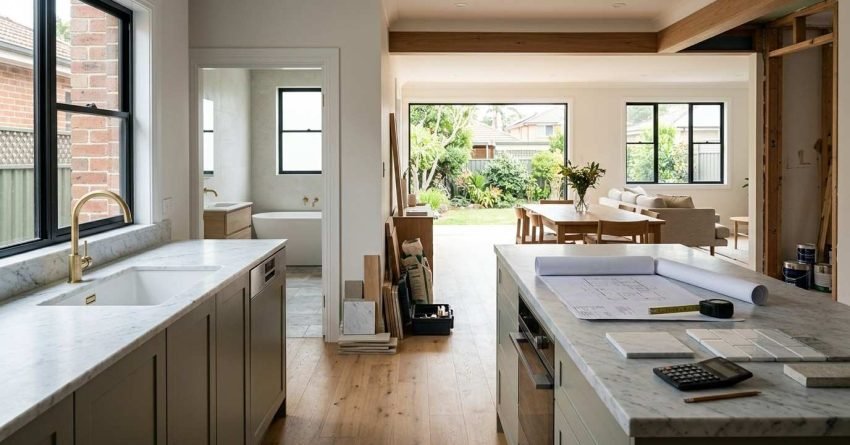
Renovating a house in Sydney costs between $20,000 and $500,000+ in 2026, depending on scope, finishes and the condition of the property. A cosmetic refresh starts near $1,000 per square metre, and full structural work reaches $4,500 per square metre in premium suburbs.
I price these jobs every week, and the pattern never changes. Owners who understand the real numbers before they start protect their budget and spend where the return actually sits.
This guide breaks down room-by-room costs, current Sydney trade rates, property-type differences, financing, hidden expenses and the planning moves we use to keep projects on budget in 2026.
Sydney House Renovation Costs at a Glance (2026)
Before I break down individual rooms, here is what we tell Sydney homeowners and investors to budget this year. These ranges come from live 2026 pricing across metropolitan Sydney rather than national averages.
Quick Cost Summary Table
Renovation Type | Cost Range | Cost Per m² |
Light cosmetic refresh | $20,000–$50,000 | $1,000–$1,500 |
Mid-range renovation | $50,000–$150,000 | $1,500–$2,500 |
Major structural renovation | $150,000–$500,000+ | $2,500–$4,500+ |
Full knockdown rebuild | $400,000–$1,000,000+ | $2,800–$5,500+ |
These figures reflect Sydney metropolitan pricing, which runs 15–25% higher than regional NSW. Elevated labour rates, stricter council requirements and premium material expectations drive the difference.
Once a project climbs past $400,000, the knockdown rebuild versus renovation decision becomes the more important calculation. I run that comparison for owners before design work starts, not after.
What Cost Per Square Metre Actually Covers
Cost per square metre covers labour, materials, trade coordination and site costs across the renovated floor area. The figure excludes council fees, design and engineering, temporary accommodation and contingency.
I quote those exclusions as separate line items so owners see the true total instead of a headline rate. That single habit prevents most of the budget shocks I see on other people’s projects.
What’s Changed in 2026 Pricing
Sydney renovation costs sit roughly 8–12% above 2024 figures. Residential building activity and cost movement of this scale show up clearly in the construction data published by the Australian Bureau of Statistics.
Labour drives most of that increase. Electricians, plumbers and carpenters now command $80–$120 per hour, up from $70–$100 two years ago, because skilled trades remain in heavy demand across residential construction.
Material costs have stabilised after the pandemic-era volatility, though imported fixtures and specialty items still carry premium pricing. Locally sourced materials deliver better value and shorter lead times.
Council approval timelines have stretched across many Sydney LGAs, and holding costs follow. We budget 8–16 weeks for a determination on structural work.
Average House Renovation Costs in Sydney
Total investment depends primarily on scope. Sydney renovations fall into three categories based on complexity, and each one carries a different risk profile.
Light Renovation ($20,000–$50,000)
Light renovations focus on cosmetic updates without structural change. This scope suits a property that needs presentation lifted rather than a full transformation.
Typical inclusions cover interior painting, new flooring, updated lighting, and minor bathroom or kitchen upgrades such as tapware and cabinet hardware. Window treatments, landscaping and exterior painting sit comfortably inside the same budget.
At this level owners retain existing layouts, cabinetry and major fixtures. The work improves liveability without touching walls, plumbing runs or electrical infrastructure, and it takes 2–6 weeks depending on property size and trade availability.
Mid-Range Renovation ($50,000–$150,000)
Mid-range renovations deliver real transformation inside the existing structural footprint. This budget funds complete room overhauls and meaningful lifestyle improvements.
Common projects include a full kitchen with new cabinetry and appliances, a complete bathroom, combined living area updates and outdoor entertaining space. Storage solutions, improved natural light and energy efficiency upgrades fit the same band.
This scope involves some electrical and plumbing modification while major structural work stays off the table. Council approval applies to changes that affect external appearance or add floor area, and timelines run 6–16 weeks depending on the number of rooms involved.
Major Renovation ($150,000–$500,000+)
Major renovations involve structural modification, extensions or a whole-home renovation. This scope suits properties that need genuine reconfiguration or additional living space.
Work typically includes removing internal walls, relocating kitchens and bathrooms, complete rewiring and replumbing, and new roofing or cladding. Room additions and second-storey extension costs sit at the top of this band, alongside heritage properties and homes needing remediation.
Development approval is mandatory for structural work. I budget 3–6 months for approvals ahead of construction, plus 4–12 months on site, and every project at this scale needs architectural plans, engineering certification and specialist contractors working in sequence.
Renovate or Rebuild: Making the Call
Owners reach this fork once the quote passes roughly half the cost of new construction. I run the numbers before design fees start, because the answer changes the entire budget structure.
Renovating wins while the slab, framing and roof structure remain sound and the existing layout supports the changes. Retained structure is retained money, and it also protects the character that inner-Sydney buyers pay for.
Rebuilding wins once renovation costs reach 50–60% of a new build, or once remediation, subsidence and asbestos stack together. A rebuild also resets compliance, thermal performance and warranty cover across the whole dwelling.
Heritage controls change the maths again. In a conservation area the rebuild option often disappears entirely, which makes disciplined renovation costing the only viable path.
Sydney Renovation Costs by Property Type
Two houses with identical floor areas produce very different quotes once the building type changes. Access, shared walls and approval pathways move the number more than finishes do.
Property Type | Typical Full Renovation | Primary Cost Driver |
Inner-city terrace (2 bed) | $180,000–$350,000 | Access, party walls, heritage controls |
Semi-detached (3 bed) | $150,000–$300,000 | Shared wall works, rear extension scope |
Freestanding house (3–4 bed) | $200,000–$500,000+ | Floor area, roofing, structural scope |
Apartment or unit | $60,000–$180,000 | Strata approval, waterproofing, lift access |
Terraces and Semis
Terraces carry the highest cost-per-square-metre penalty in Sydney. Materials arrive through the front door, waste leaves the same way, and scaffolding competes with the footpath.
Conservation-area controls add another layer to any street-facing work. A heritage home renovation in Paddington, Balmain or Glebe attracts specialist trades and longer approval periods that add 10–20% to comparable non-heritage scopes.
Freestanding Houses
Freestanding homes give trades room to work, which lowers the per-square-metre rate on cosmetic and mid-range scopes. Side access for a skip bin alone saves thousands over a full project.
The trade-off arrives with scale. Larger roof areas, longer service runs and bigger external envelopes push total spend higher even at a friendlier rate.
Apartments and Units
Apartment renovations look cheaper on paper and carry constraints that houses never face. Waterproofing standards, noise windows, lift bookings and building-manager coordination all consume programme time.
Owners also need strata renovation approval before major work begins. I factor 4–8 weeks into the schedule for committee sign-off on any wet-area or structural change.
Extension, Second-Storey and Granny Flat Costs
Adding floor area prices differently to reworking existing rooms, because every square metre carries new structure, roofing and services. These are the 2026 ranges I quote across metropolitan Sydney.
Addition Type | Typical Sydney Cost | Cost Per m² |
Ground-floor rear extension | $150,000–$350,000 | $3,000–$4,500 |
Second-storey addition | $250,000–$550,000 | $3,500–$5,000 |
Detached granny flat (60m²) | $150,000–$250,000 | $2,500–$4,000 |
Garage or under-house conversion | $60,000–$120,000 | $1,800–$3,000 |
Ground-floor home extension costs stay lower because the work sits at grade and existing footings often extend without demolition. Rear extensions also open the living area to the garden, which is where Sydney buyers assign the most value.
Second-storey additions cost more per square metre for three reasons: existing footings usually need underpinning, the roof comes off, and the household relocates during construction. I price temporary accommodation into every one of these jobs.
Detached granny flat build costs follow a complying development pathway in most Sydney LGAs, which shortens approval and tightens the price. Rental return makes this the strongest yield play in the guide for investors.
Room-by-Room Renovation Cost Breakdown
Understanding individual room costs helps owners prioritise spending and build a realistic total. These Sydney figures reflect 2026 pricing for quality workmanship and mid-to-upper range finishes.
Kitchen Renovation Costs
Kitchens carry the highest per-square-metre investment in the house and return strong lifestyle and resale value.
Kitchen Renovation Level | Cost Range |
Budget refresh (cosmetic) | $15,000–$25,000 |
Mid-range complete renovation | $30,000–$55,000 |
Premium custom kitchen | $55,000–$100,000+ |
Budget kitchens resurface existing cabinets and add new benchtops, appliances and splashbacks. Mid-range kitchen renovation costs cover custom cabinetry, stone benchtops and improved layouts inside the existing footprint.
Premium kitchens feature butler’s pantries, integrated appliances, natural stone and custom joinery. Relocating plumbing or gas adds $5,000–$15,000 to any kitchen budget.
Bathroom Renovation Costs
Bathrooms deliver excellent return on investment, particularly in properties with dated or poorly functioning wet areas.
Bathroom Renovation Level | Cost Range |
Basic update | $15,000–$25,000 |
Mid-range full renovation | $25,000–$45,000 |
Luxury bathroom | $45,000–$80,000+ |
Basic updates cover a new vanity, toilet, tapware and tiling inside the existing layout. Mid-range bathroom renovation costs in Sydney include a complete strip-out, fresh waterproofing, quality fixtures, frameless screens and better storage.
Waterproofing deserves particular attention because it sits behind every other finish. A compliant membrane costs $800–$2,000 and protects the entire investment above it.
Luxury bathrooms incorporate freestanding baths, heated flooring, custom vanities and premium tile. Ensuite addition costs typically run $35,000–$60,000 including new plumbing infrastructure.
Small bathrooms surprise owners most. A 4 square metre room costs nearly as much as an 8 square metre room, because trade call-outs, waterproofing and fixtures barely scale down.
Bedroom and Living Area Costs
Bedrooms and living areas offer cost-effective transformation because they rarely involve plumbing.
Work Type | Cost Range |
Single bedroom refresh | $5,000–$12,000 |
Living area update | $8,000–$20,000 |
Built-in wardrobes (per room) | $3,500–$8,000 |
New flooring (per m²) | $80–$250 installed |
Costs cover painting, flooring, lighting, window treatments and built-in storage. Opening up a living area by removing a non-structural wall adds $3,000–$8,000 per wall including plastering and finishing.
Architectural features such as coffered ceilings, feature walls and custom joinery lift budgets and create the distinctive spaces that hold value at resale.
Laundry Renovation Costs
Laundries receive minimal attention and contribute heavily to daily functionality and buyer perception.
Laundry Renovation Level | Cost Range |
Basic functional update | $8,000–$15,000 |
Mid-range renovation | $15,000–$25,000 |
Premium laundry | $25,000–$40,000 |
A basic laundry renovation covers new cabinetry, benchtops, tiling and tapware. Mid-range projects add custom storage, quality fixtures and a better working layout.
Premium laundries integrate with a butler’s pantry and include drying cabinets and high-end finishes. Relocating the room means new drainage falls and water runs, which adds $8,000–$15,000 to the base cost.
Outdoor and Exterior Costs
Outdoor living extends usable floor area and suits Sydney’s indoor-outdoor lifestyle better than almost any internal upgrade.
Outdoor Project | Cost Range |
Deck construction (per m²) | $350–$800 |
Patio or pergola | $15,000–$45,000 |
Outdoor kitchen | $20,000–$60,000 |
Pool installation | $50,000–$150,000+ |
Landscaping | $10,000–$50,000 |
Exterior painting | $8,000–$25,000 |
Timber decking costs more than composite and delivers the natural finish preferred across most Sydney suburbs. I walk owners through deck and pergola costs early, because the structure often triggers approval where a paved area does not.
Covered outdoor areas require council consent in most LGAs, and anything attached to the dwelling brings BASIX and stormwater considerations with it.
Key Factors That Affect Your Renovation Budget
Identical scopes vary by 30–50% on property-specific factors alone. Understanding these variables keeps a budget honest.
Property Age and Condition
Older Sydney homes conceal issues that surface the moment work starts. Properties built before 1990 contain asbestos in walls, ceilings, flooring or eaves, and asbestos removal costs add $3,000–$30,000 on top of the $300–$600 testing fee.
Pre-1970s homes almost always need rewiring to meet current safety standards. A full house rewiring runs $10,000–$25,000 for an average-sized Sydney house.
Structural problems including termite damage, foundation movement and deteriorated framing demand remediation before any cosmetic work begins. I budget $5,000–$50,000 for structural repair depending on severity.
Sydney Location and Suburb Variations
Costs vary sharply across Sydney’s suburbs. Eastern Suburbs, Lower North Shore and Inner West contractors charge 15–25% premiums that reflect higher operating costs and client expectations.
Western Sydney and outer suburban areas price more competitively, though quality contractors stay busy everywhere. Booking ahead matters more than location for securing the right team.
Access difficulties in dense areas add cost for skip bins, scaffolding and material handling. Properties without rear lane access face additional logistical expense on every delivery.
Scope and Complexity of Work
Room-by-room renovations cost less per square metre than whole-house projects that need coordinated trades over extended timelines. Sequencing is where money leaks on complex jobs.
Living in the property during works adds complexity and extends timelines by 20–30%. Trades work around occupied spaces and rebuild protection every morning.
Staged renovations spread cost over time and raise total expenditure through repeated mobilisation and price movement between stages.
Material and Finish Quality
Material selection moves budgets dramatically. Entry-level finishes cost 40–60% less than premium alternatives and compromise longevity in high-traffic areas.
Material Category | Budget Option | Mid-Range | Premium |
Benchtops (per m²) | $200–$400 laminate | $600–$1,200 engineered stone | $1,200–$2,500+ natural stone |
Floor tiles (per m²) | $30–$60 | $80–$150 | $200–$500+ |
Timber flooring (per m²) | $80–$120 laminate | $150–$250 engineered | $300–$500+ solid hardwood |
I tell owners to invest where hands and feet make contact: benchtops, tapware and flooring. Spreading a budget thinly across premium finishes everywhere delivers worse long-term value than concentrating it.
Structural Changes and Council Approvals
Work affecting structural elements, external appearance or floor area requires consent. Applications lodged through the NSW Planning Portal attract fees of $500–$5,000 depending on project value and LGA.
Owners planning walls, extensions or a second storey benefit from understanding the development application process before design fees start accumulating. Structural engineering certification adds $2,000–$8,000 for beam calculations, footing design and compliance documentation.
Heritage-listed properties and conservation areas face additional requirements and often need a heritage architect, adding $5,000–$20,000 to professional fees.
Labour Costs vs Material Costs in Sydney
Understanding the split between labour and materials shows exactly where savings exist and where cutting corners creates problems.
Current Trade Rates in Sydney (2026)
Sydney trade rates reflect strong demand and limited skilled labour. These are the hourly rates I see across qualified, licensed professionals this year.
Trade | Hourly Rate | Day Rate |
Carpenter | $70–$100 | $560–$800 |
Electrician | $80–$120 | $640–$960 |
Plumber | $90–$130 | $720–$1,040 |
Tiler | $60–$90 | $480–$720 |
Painter | $50–$80 | $400–$640 |
Plasterer | $60–$90 | $480–$720 |
Builder / Project Manager | $80–$120 | $640–$960 |
Labour represents 40–50% of total renovation cost on mid-range projects. Premium renovations with expensive materials push labour down to 30–35% of total spend.
Booking trades 8–12 weeks ahead secures better availability and sometimes preferential pricing. Last-minute bookings attract premium rates every time.
Material Price Trends and Supply Considerations
Material costs have stabilised after the significant 2021–2023 increases. Imported products remain exposed to currency movement and shipping delays.
Locally manufactured products including Australian-made tiles, locally milled timber and domestic appliances offer pricing stability and faster delivery. Imported specialty items carry 8–16 week lead times that quietly extend programmes.
Bulk purchasing through a builder saves 10–20% against retail pricing, because established contractors hold trade accounts with major suppliers. I pass that margin straight through on our jobs.
Longevity belongs in the calculation alongside the upfront price. Quality fixtures prove more economical across a 10–15 year horizon despite the higher initial outlay.
DIY vs Professional: Where the Savings Are Real
Owner labour saves money on demolition, painting, landscaping and simple tiling. I have seen owners strip a bathroom over a weekend and cut $1,500–$3,000 from the quote.
Everything touching water, electricity, gas or structure requires a licensed tradesperson under NSW law. Unlicensed work voids insurance, fails certification and costs far more to rectify than it ever saved.
The hidden cost of DIY is time. An owner-managed demolition that runs three days late pushes every following trade back and creates re-mobilisation charges across the whole programme.
Hidden Renovation Costs You Need to Budget For
Experienced renovators budget for known unknowns. These are the expenses that catch first-time renovators off guard.
Council and Compliance Fees
Council-related costs accumulate well beyond the application fee. Construction certificates cost $1,000–$3,000 depending on project value, and occupation certificates add $500–$1,500.
Some councils require bonds for hoarding, driveway crossings or tree protection. Building surveyor and certifier inspections through construction run $2,000–$6,000 on typical residential renovations.
BASIX certificates for energy and water efficiency cost $300–$600 and apply to most Sydney renovations of any real scale.
Asbestos Removal and Testing
Properties built before 1990 need asbestos assessment before work begins. Comprehensive sampling costs $300–$600 and takes a few days to return.
Licensed removal becomes mandatory the moment asbestos is confirmed, and SafeWork NSW sets the licensing and disposal requirements. Costs vary with material type and quantity.
Asbestos Removal | Typical Cost |
Small area (eaves, small bathroom) | $1,500–$5,000 |
Medium area (multiple rooms) | $5,000–$15,000 |
Extensive (whole house) | $15,000–$50,000+ |
Never attempt DIY asbestos removal, because penalties are severe and the health risk is permanent.
Insurance, Warranties and Compliance Cover
Residential building work above $20,000 in NSW requires Home Building Compensation cover, and the scheme is administered through icare NSW. The premium sits inside the builder’s price and typically adds 1–2% of contract value.
Owners also need to confirm contract works and public liability cover before the first trade arrives. I provide certificates of currency with every contract so there is no gap between demolition and completion.
Extended manufacturer warranties on appliances, membranes and roofing add small amounts to the budget and protect large amounts later.
Temporary Accommodation and Storage
Major renovations often require vacating the property. Alternative accommodation belongs in the budget whenever the work removes a kitchen or the only bathroom.
Short-term rental in Sydney costs $500–$1,500 weekly depending on location and property type. Extended programmes justify a longer-term lease at better rates.
Furniture storage runs $200–$500 monthly for typical household contents. Some contractors, including our team, include temporary protection and on-site storage inside the quote.
Contingency Buffer Recommendations
Every renovation budget needs a contingency allowance for discoveries and scope changes.
Renovation Type | Recommended Contingency |
Cosmetic refresh | 10% of budget |
Mid-range renovation | 15% of budget |
Major structural work | 20% of budget |
Heritage properties | 25% of budget |
Contingency funds absorb unforeseen structural issues, price variations, design changes and the minor additions that arise on every site. Unused contingency upgrades finishes at the end of the job.
Inadequate contingency creates stress, compromises decisions and produces the half-finished projects I get called in to rescue.
How to Finance a Sydney Renovation
Funding structure affects total cost as much as material selection. Interest, fees and payment timing all belong in the renovation budget rather than beside it.
Equity Release and Renovation Loans
Most Sydney owners fund renovations by redrawing against existing home equity. Lenders typically release funds up to 80% of the property’s current value less the outstanding loan balance, which suits budgets under $150,000.
Construction loans suit major structural work above that threshold. These release money in stages against completed work and require fixed-price contracts, council approval and a valuation of the finished property.
Personal loans and unsecured renovation finance carry materially higher rates and suit small cosmetic scopes with fast repayment horizons.
Progress Payments and Cash Flow
Structured renovation budget planning matters most in the middle third of a project, where deposits, fixture purchases and progress claims stack up together. A deposit of 10% followed by staged claims at frame, lock-up, fit-out and completion keeps cash flow predictable.
I never ask for payment ahead of completed work. Owners keep leverage, and the builder keeps momentum, which is exactly the balance a good contract creates.
Fixture and appliance purchases usually land before the final claim. Owners hold $10,000–$25,000 in accessible funds for those items on a mid-range job.
How to Reduce Renovation Costs Without Cutting Quality
The largest savings arrive during design, not during construction. Once trades are on site, every change costs more than the original decision would have.
Keeping wet areas in place is the single biggest lever. Retaining existing plumbing and drainage positions in kitchens, bathrooms and laundries protects $8,000–$15,000 per room on a mid-range job.
Standard sizes save money quietly. Off-the-shelf cabinetry widths, stock tile formats and standard window openings avoid custom fabrication premiums that add 20–30% for no visible gain.
Locking the scope before demolition prevents variations, which carry the worst pricing in the industry. I ask owners to make every selection during documentation so the contract price holds from start to finish.
How to Plan Your Sydney Renovation Budget
Strategic planning maximises value and removes most of the financial stress from the process. These are the steps we run with every client.
Getting Accurate Quotes
Obtain a minimum of three detailed quotes from licensed, insured contractors covering identical scopes. Comparable scopes are the only way to read the numbers honestly.
Comprehensive quotes itemise labour, materials, allowances and exclusions. Owners who compare renovation quotes line by line spot the missing waterproofing allowance or the $2,000 tile budget long before a variation arrives.
Verify every contractor licence through NSW Fair Trading, confirm insurance currency and call two recent Sydney references.
Treat quotes well below market rate as a warning rather than a win. Unrealistic pricing signals corner-cutting, hidden extras or a contractor who walks away mid-project.
Prioritising High-Value Upgrades
Not all renovations return equally. Spending belongs where it improves daily living and supports the sale price.
Kitchens and bathrooms deliver the strongest returns and recover 60–80% of investment at resale. The renovations that add the most value in this market also include outdoor living, which Sydney’s climate rewards more heavily than most cities.
Structural improvements including new roofing, updated electrical and modern plumbing excite nobody at an open home. They prevent value erosion and support premium pricing all the same.
Over-capitalising remains the most expensive mistake in this market. Research comparable sales in the street, establish the ceiling price for the block, and keep total investment comfortably beneath it.
Staged Renovation Strategies
Spreading work across stages suits tight budgets and allows owners to remain in the property. The sequence decides whether staging saves money or wastes it.
Logical staging minimises disruption and rework, so wet areas finish before adjacent rooms and structural work precedes every cosmetic finish. Mapping a realistic renovation timeline across all three stages prevents the double-handling that erases the savings.
Stage one addresses critical function: bathroom, kitchen and electrical. Stage two covers living areas and bedrooms, and stage three tackles outdoor spaces and final detailing.
Allow 6–12 months between stages for financial recovery and refined planning based on what stage one taught you.
Conclusion
Renovating a house in Sydney rewards careful budgeting, realistic expectations and disciplined prioritisation. From $20,000 cosmetic refreshes to $500,000+ transformations, understanding the true cost prevents financial stress and protects the value you create.
The projects that finish well share three traits: thorough planning, genuinely comparable quotes from licensed contractors, and a contingency that never gets spent early. Sydney’s 2026 market punishes guesswork and rewards preparation.
At Sydney Home Renovation, we turn these numbers into a fixed, transparent plan for your property, with every exclusion named upfront. Contact our team today for a detailed cost breakdown built around your home and your budget.
Frequently Asked Questions
How much does a full house renovation cost in Sydney?
A full house renovation in Sydney costs $150,000 to $500,000+ depending on size, condition and finish quality. I budget $2,000 to $4,000 per square metre for comprehensive work.
What is the most expensive room to renovate?
Kitchens cost the most, at $30,000 to $100,000+ in Sydney. Cabinetry, appliances, benchtops, plumbing, electrical and ventilation all concentrate into a relatively small floor area.
How long does a house renovation take in Sydney?
Timelines range from 4 weeks for cosmetic updates to 12+ months for major structural work. Mid-range whole-house projects take 3 to 6 months, plus 2 to 4 months for approvals.
Do I need council approval for renovations in Sydney?
Approval applies to structural changes, extensions, external alterations and heritage properties. Internal cosmetic work such as painting, flooring and fixture replacement proceeds without consent in most Sydney councils.
How can I reduce renovation costs without compromising quality?
Prioritise high-impact rooms, keep plumbing and electrical in place, choose quality mid-range materials and book trades early. Layout changes create the largest avoidable cost increases.
Should I renovate or rebuild my Sydney house?
I recommend renovating while the structure stays sound and the budget sits under $400,000. Rebuilding wins once renovation costs reach 50 to 60% of new construction.
What renovation adds the most value to a Sydney home?
Kitchen and bathroom renovations add the most value and recover 60 to 80% of costs at resale. Outdoor living improvements perform strongly across Sydney’s climate.
How do most Sydney owners fund a renovation?
Most owners redraw against home equity for budgets under $150,000. Larger structural projects use construction loans that release funds in stages against completed work.
Does renovating a terrace cost more than a freestanding house?
Yes. Terraces cost 10 to 20% more per square metre because of restricted access, party walls, waste handling constraints and heritage controls across inner Sydney.


