Bathroom renovation is one of the most financially significant and value-generating home improvement projects an Australian homeowner can undertake. Whether you are updating a tired ensuite, transforming a family bathroom, or preparing an investment property for the rental market, the decisions you make before a single tile is removed will determine whether your renovation comes in on budget, on time, and built to last.
Sydney’s renovation market is active, competitive, and expensive for the unprepared. Labour rates, material costs, compliance requirements, and hidden structural issues all interact in ways that can push a project well beyond its original budget if you do not know what to plan for.
This guide covers everything you need to know: what a bathroom renovation actually involves, how much it costs in Sydney across different budget tiers, how labour and materials are priced, what hidden costs to anticipate, how to build a realistic budget, which upgrades deliver the strongest return on investment, and how to choose the right contractor to deliver the result you are paying for.
What Does a Bathroom Renovation Actually Involve?
A bathroom renovation is the process of removing and replacing some or all of the existing fixtures, fittings, surfaces, and within a bathroom to improve its function, appearance, compliance, or value. In practice, the scope of a renovation ranges from a cosmetic refresh replacing tapware, repainting, and updating accessories to a full structural overhaul involving plumbing relocation, new waterproofing, complete retiling, and the installation of all new fixtures.
Understanding the difference between these scope levels is critical before you set a budget or approach a contractor. The gap in cost and complexity between a cosmetic update and a full renovation is substantial.
Full Renovation vs. Partial Refresh
A full bathroom renovation typically involves demolishing the existing bathroom back to the substrate, installing new waterproofing, relaying all tiles, replacing all plumbing fixtures, and fitting new vanities, shower screens, and accessories. This is the most comprehensive and most expensive approach, but it also delivers the most complete result and the strongest long-term value.
A partial refresh focuses on updating visible elements without touching the underlying structure. Replacing a vanity, regrouting tiles, installing new tapware, or adding a frameless shower screen can meaningfully improve the look of a bathroom at a fraction of the cost of a full renovation. The trade-off is that underlying issues ageing waterproofing, outdated plumbing, or non-compliant layouts remain unaddressed.
Structural vs. Cosmetic Work
Structural work includes anything that affects the building fabric: moving walls, relocating plumbing, replacing waterproofing membranes, or addressing subfloor damage. This work requires licensed tradespeople, may require inspections, and carries compliance obligations under the National Construction Code and NSW Fair Trading regulations.
Cosmetic work painting, replacing accessories, updating tapware is lower risk, lower cost, and in many cases completed without licensed trades. Any work involving plumbing, electrical, or waterproofing in a wet area must be carried out by licensed contractors in NSW.
Knowing which category your planned renovation falls into shapes every subsequent decision, from budgeting to contractor selection to timeline expectations.
What Are the Stages of a Bathroom Renovation?
Understanding the renovation sequence helps you set realistic timeline expectations and ask the right questions when reviewing a contractor’s schedule. A full bathroom renovation in Sydney typically moves through seven stages.
Stage 1: Design and Planning. This is where scope, budget, and material selections are locked in. Decisions made here determine every cost that follows. Rushing this stage is one of the most common causes of mid-project variations.
Stage 2: Demolition. Existing tiles, fixtures, vanities, and wall linings are removed. This is when hidden conditions, such as waterproofing failure, asbestos, and subfloor damage, are first visible. A good contractor documents everything found and communicates it immediately.
Stage 3: Rough-In Plumbing and Electrical. Licensed plumbers and electricians complete any service relocations or upgrades before walls are closed. This is the most expensive stage to change your mind about relocating a waste line; after rough-in is a costly variation.
Stage 4: Waterproofing. The waterproofing membrane is applied to all wet areas in compliance with AS 3740, Australia’s mandatory waterproofing standard for wet areas. The membrane must cure fully before tiling begins, typically 24 to 48 hours.
Stage 5: Tiling. Floor and wall tiles are laid, grouted, and siliconed. Large-format tiles and complex patterns add time to this stage. Tiling quality is one of the most visible indicators of overall renovation quality.
Stage 6: Fixture and Fitting Installation. Vanities, shower screens, tapware, toilet suites, mirrors, and accessories are installed. This stage requires coordination between the plumber, electrician, and carpenter.
Stage 7: Final Inspection and Certification. Licensed trades certify their work. The contractor conducts a defects inspection and rectifies any issues before handover. Compliance certificates for plumbing and electrical work are issued to the homeowner.
A standard full renovation moves through these stages in two to four weeks. Structural changes, custom joinery, or hidden condition rectification extend the timeline.
How Much Does a Bathroom Renovation Cost in Sydney?
Bathroom renovation costs in Sydney vary significantly depending on bathroom size, scope of work, finish level, and the specific trades required. As a general benchmark, Sydney homeowners should expect to budget within the following tiers:
| Renovation Tier | Typical Cost Range | What It Includes |
| Budget/Entry-Level | $8,000 – $15,000 | Basic fixtures, standard tiles, cosmetic updates, minimal plumbing changes |
| Mid-Range | $15,000 – $30,000 | Quality fixtures, feature tiles, full retile, new vanity and shower screen, updated plumbing |
| Premium | $30,000 – $60,000+ | Designer fixtures, custom joinery, premium tiles, full structural renovation, high-end finishes |
These ranges reflect full bathroom renovations in the Sydney metro area. Smaller bathrooms, ensuites and powder rooms typically sit at the lower end of each tier, while larger family bathrooms or those requiring significant structural work push toward the upper end.
Cost by Bathroom Type
Room type has a direct impact on where your renovation lands within these tiers. We see consistent cost patterns across bathroom types in Sydney:
| Bathroom Type | Typical Size | Mid-Range Cost | Full Renovation Cost |
| Powder Room | 2–3 sqm | $5,000 – $10,000 | $10,000 – $18,000 |
| Ensuite | 4–6 sqm | $10,000 – $20,000 | $18,000 – $35,000 |
| Family/Main Bathroom | 6–10 sqm | $15,000 – $30,000 | $25,000 – $55,000 |
| Large/Master Bathroom | 10+ sqm | $25,000 – $45,000 | $40,000 – $70,000+ |
Powder rooms cost less because they involve no shower or bath waterproofing requirements, are reduced and the tiling area is smaller. Ensuites are the most common renovation scope we handle, and the $18,000 – $35,000 range covers the vast majority of full ensuite renovations in Sydney at a mid-to-premium finish.
What Drives Cost Variation
Several factors determine where your renovation lands within or beyond these ranges. Bathroom size is the most obvious; more floor area means more tiles, more waterproofing, and more labour hours. But size is rarely the dominant cost driver.
Plumbing complexity has a disproportionate impact on cost. Keeping fixtures in their existing positions is significantly cheaper than relocating them. Moving a toilet, repositioning a shower, or relocating a vanity requires a licensed plumber to reroute supply and waste lines, work that adds $2,000 to $8,000 or more depending on the extent of the relocation and the accessibility of the existing pipework.
Finish level is the other major variable. The difference between a $200 vanity and a $2,000 vanity, or between $40-per-square-metre tiles and $150-per-square-metre tiles, compounds quickly across a full bathroom. Material selection alone shifts a renovation by $5,000 to $15,000 without changing a single element of the labour scope.
Access and site conditions also matter. Bathrooms in older homes, particularly those built before 1990, frequently reveal asbestos-containing materials, deteriorated waterproofing, or subfloor damage once demolition begins. These discoveries add cost and time that cannot always be anticipated in an initial quote.
According to the Housing Industry Association, bathroom renovations consistently rank among the top three most common home improvement projects undertaken by Australian homeowners, reflecting both the high frequency of bathroom upgrades and the strong return they deliver when executed well.
Understanding Labour Costs in a Bathroom Renovation
Labour is the largest single cost component in most bathroom renovations, typically accounting for between 40% and 60% of the total project budget. Understanding how labour is structured, which trades are involved, how they price their work, and how they interact with each other is essential for building an accurate budget and avoiding cost surprises.
Trades Involved and Their Typical Rates
A full bathroom renovation in Sydney typically requires the following licensed trades:
- Licensed plumber: Responsible for all water supply and waste connections, fixture installation, and compliance certification. Day rates in Sydney typically range from $800 to $1,500 per day depending on experience and the complexity of the work.
- Licensed electrician: Required for any electrical work including exhaust fans, lighting, heated towel rails, and underfloor heating. Day rates typically range from $700 to $1,200 per day.
- Waterproofer: Applies the waterproofing membrane to all wet areas before tiling. This is a licensed trade in NSW and a mandatory step in any bathroom renovation. Waterproofing a standard bathroom typically costs $600 to $1,500 depending on size and complexity.
- Tiler: Installs floor and wall tiles, including preparation, adhesive, grouting, and silicone. Tiling rates in Sydney typically range from $50 to $120 per square metre for supply and lay, depending on tile size, format, and pattern complexity.
- Carpenter/joiner: Required for vanity installation, mirror installation, and any custom joinery. Day rates typically range from $600 to $1,000 per day.
- Plasterer: Required if walls need patching, resetting, or if new plasterboard is installed. Day rates typically range from $500 to $900 per day.
Labour as a Percentage of Total Budget
In a $20,000 mid-range bathroom renovation, labour costs will typically account for $9,000 to $12,000 of the total. In a $40,000 premium renovation, labour may represent $18,000 to $24,000. These figures reflect the Sydney market, where trade rates are among the highest in Australia due to demand, licensing requirements, and cost of living.
Project management, whether provided by a renovation contractor or a separate project manager, adds a further 10% to 20% to the total project cost. It delivers significant value through trade coordination, scheduling, compliance oversight, and quality control.
Materials and Fittings: Where Your Budget Goes
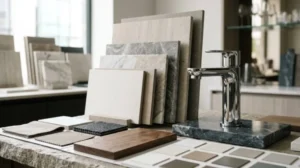
After labour, materials and fittings represent the second largest cost component in a bathroom renovation and the area where homeowners have the most direct control over their budget. The choices you make on tiles, vanities, tapware, shower screens, and accessories shape both the final cost and the long-term quality of the result.
Tiles, Waterproofing, and Fixtures
Tiles are typically the most visible material investment in a bathroom renovation. Standard ceramic tiles suitable for floor and wall applications start from around $30 to $50 per square metre for supply only. Mid-range porcelain tiles, which offer superior durability and a wider range of finishes, typically cost $60 to $120 per square metre. Premium large-format tiles, natural stone, or designer ranges reach $150 to $400 per square metre or more.
When selecting floor tiles, slip resistance matters as much as aesthetics. The Australian Standard AS 4586 classifies tiles by slip resistance rating; wet areas require a minimum P3 rating for floors. We always specify compliant tiles for wet area floors; it is a safety and compliance requirement, not a preference.
Waterproofing membrane is a non-negotiable cost in any wet area renovation. The material itself is relatively inexpensive, typically $200 to $500 for a standard bathroom, but the licensed labour required to apply it correctly and certify the work adds to the total. Cutting corners on waterproofing is one of the most common and costly renovation mistakes, as failures result in structural damage, mould, and the need to completely redo the renovation.
Vanities, Tapware, and Accessories
Vanity units range from $300 for a basic freestanding unit to $3,000 or more for a custom-built wall-hung vanity with integrated basin and stone top. Tapware, including basin mixers, shower mixers, and bath fillers, ranges from $150 per piece for entry-level chrome fittings to $800 or more per piece for premium European brands.
Shower screens range from $400 for a basic semi-frameless screen to $2,000 or more for a fully frameless custom-sized enclosure. Toilet suites range from $300 for a standard close-coupled unit to $1,500 or more for a wall-hung suite with concealed cistern.
Accessories towel rails, toilet roll holders, hooks, mirrors, and exhaust fans are often underestimated in budget planning. A complete set of quality accessories for a standard bathroom typically costs $500 to $1,500 depending on brand and finish.
Hidden and Unexpected Bathroom Renovation Costs
One of the most consistent sources of budget stress in bathroom renovations is the discovery of problems that were not visible and therefore not priced before demolition began. These hidden costs are not the result of poor quoting. They are an inherent feature of renovating existing buildings where the condition of the substrate and structure cannot be fully assessed until the existing finishes are removed.
Waterproofing Failures and Structural Issues
Waterproofing failure is the most common hidden cost in bathroom renovations, particularly in homes built before the 1990s when waterproofing standards were less rigorous. When existing tiles are removed, it is common to find that the original waterproofing membrane has failed, that moisture has penetrated the substrate, or that the subfloor has been damaged by long-term water ingress.
Rectifying these issues, which may involve replacing the subfloor, treating mould, and applying new waterproofing compliant with AS 3740, adds $1,500 to $8,000 or more to the project cost depending on the extent of the damage.
Asbestos is another significant hidden cost risk in Sydney homes built before 1990. Asbestos-containing materials were commonly used in bathroom wall sheeting, floor adhesives, and ceiling materials. If asbestos is discovered during demolition, licensed asbestos removal is legally required before work can continue. Removal costs typically range from $1,500 to $5,000 depending on the quantity and type of material involved.
Compliance, Permits, and Inspections
Most bathroom renovations in NSW do not require a Development Application (DA) from council, as they fall within the scope of exempt or complying development. Any work involving structural changes, changes to the building footprint, or work in heritage-listed properties may require council approval. Compliance costs, including building permits, inspection fees, and certification, add $500 to $3,000 to a project depending on the scope of work and the local council’s requirements.
Plumbing and electrical work must be certified by the relevant licensed trade upon completion. These certifications are a legal requirement in NSW and are the homeowner’s protection against non-compliant work. Ensure your contractor includes certification costs in their quote; if they do not, ask why.
Common Bathroom Renovation Mistakes (and How to Avoid Them)
We see the same mistakes repeated across renovation projects in Sydney. Most are avoidable with the right planning, and most are expensive to fix after the fact.
Mistake 1: Skipping or underspecifying waterproofing. Waterproofing is invisible once tiling is complete, which makes it tempting to cut costs here. A failed membrane discovered five years later means a full strip-out and redo. We never compromise on waterproofing specification or application time.
Mistake 2: Changing the layout mid-project. Moving a toilet or shower after rough-in plumbing is complete is one of the most expensive variations a homeowner can request. Lock in the layout before demolition begins and treat it as fixed.
Mistake 3: Selecting tiles before confirming sizes. Tile format affects grout joint width, adhesive type, substrate preparation, and labour time. Selecting tiles before your tiler has assessed the substrate and confirmed the layout leads to costly surprises. We recommend finalising tile selections in consultation with the tiler, not before.
Mistake 4: Underbudgeting for accessories. Towel rails, toilet roll holders, robe hooks, mirrors, exhaust fans, and shaving cabinets are often treated as afterthoughts. A full accessory set for a mid-range bathroom costs $800 to $1,500; budget for it from the start.
Mistake 5: Choosing a contractor on price alone. The cheapest quote is rarely the best value. A contractor who wins on price by cutting corners on waterproofing, using unlicensed trades, or omitting compliance certifications creates liability that falls on the homeowner. We always recommend comparing at least three detailed, itemised quotes before making a decision.
How to Plan and Manage Your Bathroom Renovation Budget
A well-structured budget is the most effective tool for keeping a bathroom renovation on track. The most common cause of cost overruns is not unexpected problems; it is the absence of a financial framework that accounts for the full scope of costs, including those that are predictable but often overlooked.
Setting a Realistic Budget
Start by establishing your total available budget: the maximum you are willing and able to spend before you approach a single contractor or select a single tile. This figure should include all costs: labour, materials, fittings, compliance, project management, and contingency. Working backwards from a total budget is far more effective than building up from individual line items, because it forces you to make trade-off decisions early rather than mid-project.
Research Sydney-specific cost benchmarks for your bathroom size and renovation scope. The cost tiers outlined in this guide provide a starting framework, but your specific bathroom’s size, condition, layout, and the finish level you want will determine where within those ranges your project sits.
Contingency Allowances
Every bathroom renovation budget should include a contingency allowance of 10% to 20% of the total project cost. This is not a pessimistic assumption; it is a standard financial planning practice that reflects the reality of renovating existing buildings where hidden conditions cannot be fully assessed before work begins.
A 15% contingency on a $20,000 renovation is $3,000. If no hidden issues are discovered, that $3,000 remains in your pocket. If waterproofing failure, asbestos, or subfloor damage is found, that contingency is the difference between a manageable cost adjustment and a financial crisis.
Pre-Renovation Planning Checklist
Before demolition begins, work through this checklist to reduce the risk of mid-project surprises:
- Confirm your total budget including contingency
- Lock in the bathroom layout fixture positions, door swing, window placement
- Obtain at least three itemised written quotes
- Verify contractor licences on the NSW Fair Trading licence check
- Confirm which trades are licensed and who holds the waterproofing certification
- Finalise all material and fitting selections before demolition
- Confirm the payment schedule is milestone-based, not time-based
- Establish a clear communication protocol with your contractor for variation approvals
Completing this checklist before work begins is the single most effective way to avoid the variations and disputes that derail renovation budgets.
Prioritising Spend for Maximum Value
Not all renovation spend delivers equal value. The highest-value investments in a bathroom renovation are those that affect function, compliance, and longevity: waterproofing, quality tiling, and reliable plumbing fixtures rather than purely aesthetic upgrades.
For homeowners renovating to live in the property, prioritise durability and functionality. Choose materials and fixtures that perform well over a 10 to 15-year horizon rather than chasing the most fashionable finish at the expense of quality.
For investors renovating a rental property, prioritise durability, ease of maintenance, and neutral aesthetics that appeal to the broadest possible tenant pool. Avoid over-capitalising on premium finishes that will not translate into proportionally higher rental returns.
Bathroom Renovation ROI: Which Upgrades Add the Most Value?
Bathroom renovations consistently rank among the highest-return home improvement projects in the Australian property market. CoreLogic research has found that well-executed bathroom renovations add between 10% and 20% to a property’s market value, depending on the quality of the renovation, the property type, and the local market conditions.
Return on investment is not automatic. The relationship between renovation spend and property value uplift is not linear; spending more does not always mean earning more. Understanding the difference between value-adding upgrades and over-capitalising is one of the most important financial decisions a renovating homeowner or investor makes.
Value-Adding vs. Over-Capitalising
Value-adding upgrades are those that bring the bathroom up to the standard expected by buyers or tenants in your specific market. In a $700,000 Sydney apartment, a clean, functional, well-finished bathroom with quality tiles, a modern vanity, and reliable fixtures will meet market expectations and support the property’s value. Spending $60,000 on a designer bathroom in that same apartment is unlikely to generate a proportional return; this is over-capitalising.
The benchmark for value-adding spend is the median standard of comparable properties in your suburb. Renovating to that standard or modestly above it is where the strongest ROI is typically found. Renovating significantly above that standard rarely recovers the additional cost at sale.
Which Specific Upgrades Deliver the Best ROI?
Not every upgrade delivers the same financial return. Based on our experience across Sydney renovation projects, these upgrades consistently deliver the strongest return relative to cost:
| Upgrade | Typical Cost | ROI Signal |
| Frameless shower screen (replacing framed) | $800 – $1,800 | High visual impact, low cost |
| Wall-hung vanity with stone top | $1,500 – $3,500 | High perceived quality uplift |
| Rectified large-format floor tiles | $60 – $120/sqm | High modern aesthetic, durability |
| Matte tapware set (basin + shower) | $600 – $1,500 | Medium-High visible finish upgrade |
| Heated towel rail | $300 – $800 | Medium comfort feature, low cost |
| Underfloor heating | $800 – $2,500 | Medium strong appeal, higher cost |
| Wall-hung toilet suite | $900 – $2,000 | Medium premium signal, cleaning ease |
| Custom mirror with integrated lighting | $500 – $1,500 | Medium functional and aesthetic |
The upgrades at the top of this list deliver the highest perceived value relative to their cost. A frameless shower screen and a wall-hung vanity with a stone top transform the look of a bathroom for under $5,000 combined, a return that consistently exceeds the spend in Sydney’s property market.
Renovating to Sell vs. Renovating to Live
The optimal renovation strategy differs depending on your objective. Renovating to sell prioritises broad market appeal: neutral colour palettes, durable materials, clean lines, and functional layouts that photograph well and appeal to the widest possible buyer pool. The goal is maximum perceived value at minimum cost.
Renovating to live prioritises personal preference, long-term durability, and functional improvements that enhance daily use. Spending more on quality fixtures, heated floors, or custom storage is justified by the years of enjoyment and reduced maintenance costs it delivers even if the full cost is not recovered at resale.
How to Choose a Bathroom Renovation Contractor in Sydney
The contractor you choose will have more impact on the outcome of your renovation than any other single decision. A skilled, experienced, and transparent contractor delivers a quality result on budget and on schedule. An inexperienced, poorly organised, or dishonest contractor turns a straightforward renovation into a prolonged, expensive, and stressful ordeal.
What to Look for in a Contractor
The minimum requirements for any bathroom renovation contractor in NSW are a valid contractor licence issued by NSW Fair Trading, public liability insurance, and the ability to coordinate or directly employ all required licensed trades. Verify the contractor’s licence number on the NSW Fair Trading licence check before signing any contract.
Beyond licensing, look for a contractor who provides a detailed, itemised written quote that clearly separates labour, materials, and project management costs. Vague or lump-sum quotes make it impossible to compare contractors fairly or to understand where your money is going. A contractor who is reluctant to provide a detailed breakdown is a contractor who is not confident in their pricing.
References and completed project examples are essential. Ask for references from clients whose projects were similar in scope and budget to yours, and follow up with those clients directly. Ask specifically about whether the project was delivered on budget, on time, and whether the contractor communicated clearly throughout.
How to Compare Renovation Quotes
Comparing quotes accurately requires more than looking at the bottom-line figure. We recommend a four-point comparison framework:
- Scope alignment: does each quote cover exactly the same scope of work? A lower quote that excludes waterproofing certification or project management is not cheaper; it is incomplete.
- Labour vs. materials split: a quote that is unusually low on labour often signals unlicensed trades or underestimated hours. Ask each contractor to break out labour and materials separately.
- Allowances vs. fixed prices: some quotes use provisional sums (allowances) for materials. These are not fixed prices. Confirm which line items are fixed and which are subject to variation.
- Variation process: ask each contractor how variations are approved and priced. A contractor with a clear, written variation process is a contractor who manages cost transparency seriously.
Questions to Ask Before Signing
Before committing to any contractor, ask these questions directly:
- Is your quote fixed price or subject to variations? If variations, under what circumstances?
- Which trades will you use, and are they all licensed?
- Who is responsible for waterproofing certification and compliance sign-off?
- What is your process for managing hidden costs if they are discovered during demolition?
- What does your payment schedule look like, and is it tied to project milestones?
- Can you provide a written project timeline with key milestones?
A contractor who answers these questions clearly, confidently, and in writing is a contractor who understands their obligations and respects yours.
Conclusion
Bathroom renovation in Sydney is a significant financial commitment that rewards careful planning, realistic budgeting, and informed decision-making. Understanding the full cost structure from labour and materials through to hidden expenses and contingency is the foundation of every successful project.
The sections in this guide go deeper into every dimension of bathroom renovation budgeting, from detailed cost breakdowns and labour rate analysis to budget planning frameworks and ROI strategy for both owner-occupiers and investors.
At Sydney Home Renovation, we combine transparent cost planning, licensed tradespeople, and end-to-end project management to deliver bathroom renovations that meet your goals, respect your budget, and are built to last. When you are ready to move forward, we are here to help you plan and build with confidence.
Frequently Asked Questions
How long does a bathroom renovation take in Sydney?
A standard full bathroom renovation in Sydney typically takes two to four weeks from demolition to completion, depending on scope, trade availability, and whether hidden issues are discovered. Complex renovations involving structural changes or custom joinery may take four to six weeks.
Do I need council approval for a bathroom renovation in Sydney?
Most bathroom renovations in NSW do not require a Development Application, as they fall within exempt or complying development provisions. Structural changes, heritage properties, or work that alters the building footprint may require council approval. Always confirm with your local council before commencing work.
What is the cheapest way to renovate a bathroom?
The most cost-effective approach is a cosmetic refresh: replacing tapware, regrouting tiles, updating accessories, and repainting rather than undertaking a full structural renovation. Keeping fixtures in their existing positions avoids costly plumbing relocation and significantly reduces labour costs.
How much should I budget for a small bathroom renovation in Sydney?
A small bathroom or ensuite renovation in Sydney typically costs between $8,000 and $18,000 for a mid-range finish, depending on the scope of work and the condition of the existing bathroom. Budget an additional 15% contingency for hidden costs.
What adds the most value in a bathroom renovation?
The highest-value upgrades are those that bring the bathroom to the standard expected by buyers or tenants in your market: quality tiling, a modern vanity, reliable plumbing fixtures, and compliant waterproofing. Functional improvements and neutral aesthetics consistently outperform purely decorative upgrades in terms of resale return.
Can I live at home during a bathroom renovation?
In most cases, yes, particularly if you have more than one bathroom. A standard bathroom renovation typically takes two to four weeks, during which the bathroom being renovated is inaccessible. Your contractor should provide a clear timeline so you can plan accordingly.
What is the difference between a bathroom renovation and a bathroom remodel?
A renovation restores or updates an existing bathroom within its current layout and structure. A remodel involves changing the layout, moving walls, or significantly altering the room’s configuration. Remodels are more complex, more expensive, and more likely to require compliance approvals than renovations.
What is AS 3740 and why does it matter for my bathroom renovation?
AS 3740 is Australia’s mandatory waterproofing standard for wet areas in residential buildings. It specifies how waterproofing membranes must be applied, where they must extend, and how they must be certified. Any bathroom renovation that does not comply with AS 3740 is non-compliant and creates liability for the homeowner. Always confirm your contractor includes waterproofing certification in their scope.