
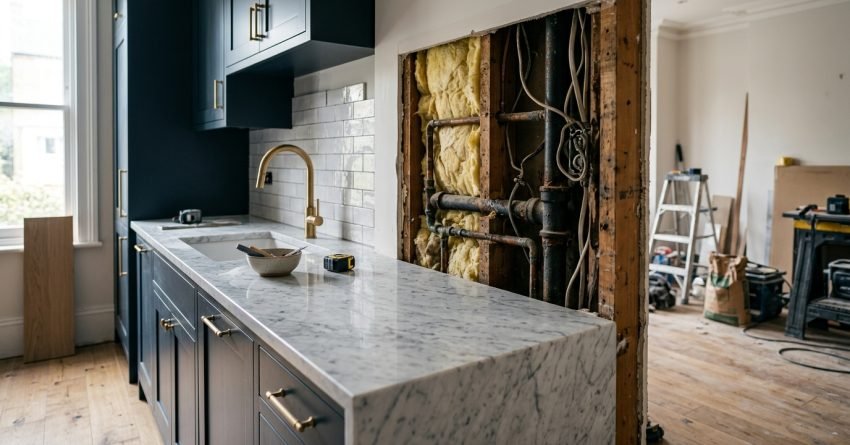
Most Sydney kitchen renovations run 15–25% over budget, not because of poor planning, but because of costs that never appear in the original quote. Structural surprises, compliance requirements, plumbing relocations, and site fees are among the most common budget blowouts, and they catch even experienced renovators off guard.
These hidden costs are not rare exceptions. They are predictable patterns that appear in kitchens across Sydney, particularly in homes built before 1990 and in properties where previous renovations were completed without proper documentation.
This guide identifies every major hidden cost category, explains what drives each one, and shows you how to build a budget that accounts for the full picture.
Hidden Cost Quick-Reference: What to Budget For
| Cost Category | Typical Range (Sydney) | Discovery Risk |
| Structural repairs | $2,000–$8,000 | High in pre-1990 homes |
| Asbestos removal | $1,500–$10,000+ | High in pre-1990 homes |
| Subfloor repairs | $800–$3,500 | Medium |
| Flooring and tiling surprises | $500–$3,000 | Medium |
| Plumbing relocation | $1,500–$6,000 | Medium to High |
| Electrical/switchboard upgrade | $1,200–$3,500 | High in older homes |
| Cabinetry allowance gap | $3,000–$18,000 | High |
| Appliance connection fees | $150–$400 per appliance | Low to Medium |
| Rangehood ducting | $500–$2,000 | Medium |
| Waste removal | $700–$2,500+ | Low to Medium |
| Council approvals/DA | $1,000–$3,000 | Low (most kitchens exempt) |
| Heritage property uplift | $2,000–$10,000+ | High if heritage-listed |
Why Kitchen Renovation Budgets Run Over
The gap between an initial quote and a final invoice almost always comes down to scope creep and discovery costs. A quote covers what a contractor can see; it cannot account for what is hidden behind walls, under floors, or inside the existing electrical and plumbing systems until demolition begins.
Sydney homes present specific challenges. Older terrace houses, federation-era properties, and post-war brick homes frequently have substandard original construction, outdated services, and materials that require specialist handling before any new work can proceed.
The most reliable way to protect your budget is to understand which cost categories carry the highest discovery risk before you commit to a project scope.

Structural and Building Work Surprises
Structural issues are the most unpredictable hidden cost in any kitchen renovation. They are invisible until demolition exposes them, and they cannot be deferred once discovered; building codes require rectification before new work proceeds.
Common structural discoveries in Sydney kitchens include rotted wall framing from long-term moisture exposure, undersized or non-compliant load-bearing elements, and deteriorated subfloor systems beneath older vinyl or tile finishes. Even minor structural repairs typically add $2,000–$8,000 to a project budget.
Asbestos and Hazardous Material Removal
Homes built or renovated before 1990 in Sydney have a high probability of containing asbestos-containing materials in wall sheeting, ceiling tiles, floor adhesives, and pipe lagging. Identification, removal, and disposal must be carried out by a licensed asbestos removalist under NSW SafeWork regulations, and the cost is entirely separate from your renovation contract.
Removal costs depend on the volume and type of material; friable asbestos carries significantly higher removal costs than bonded asbestos sheeting. Budget a minimum of $1,500–$4,000 for a standard kitchen, with larger or more complex jobs reaching $10,000 or more.
Waterproofing and Subfloor Repairs
Kitchens with a history of leaks, dishwasher overflows, or plumbing failures often have compromised subfloor structures. Particleboard flooring is particularly vulnerable to moisture damage and frequently requires full replacement before new flooring can be installed.
The extent of subfloor damage determines the repair approach. Localised particleboard replacement is the least costly option, typically $800–$1,500 for a standard kitchen area. Bearer and joist damage requires structural carpentry and sits in the $1,500–$3,500 range, while concrete slab remediation for ground-floor kitchens adds further cost depending on the depth and area of deterioration.
Flooring and Tiling Cost Surprises
Existing floor tiles are a common source of hidden cost, particularly in kitchens where multiple layers of flooring have been installed over decades. Removing ceramic or porcelain tiles from a concrete slab requires grinding adhesive residue and applying a levelling compound before new flooring can go down, adding $500–$1,500 to the floor preparation budget.
Homes with vinyl or cork flooring installed before 1990 may also contain asbestos-based adhesives beneath the surface layer, which triggers licensed removal requirements before any new floor finish is laid. Budget $1,000–$3,000 for adhesive testing, removal, and surface preparation in these cases.
Plumbing and Electrical Costs You May Not Expect
Plumbing and electrical work are two of the most consistently underestimated cost categories in kitchen renovations. Both trades are licensed and regulated in NSW, and both carry significant cost implications when the existing infrastructure does not meet current standards or when the new layout requires service relocation.
Relocating Pipes and Drainage
Moving the kitchen sink, dishwasher connection, or gas supply to a new position requires licensed plumbing work that goes well beyond a standard connection fee. Drainage relocation in particular involves cutting into concrete slabs or accessing subfloor cavities, both of which add labour time and material costs that are rarely included in a base renovation quote.
Plumbing relocation costs in Sydney kitchens typically range from $1,500 to $6,000 depending on the distance of relocation, the type of flooring system, and whether the existing drainage gradient is adequate for the new position.
Upgrading Electrical Circuits and Switchboards
Modern kitchens require dedicated circuits for high-draw appliances including ovens, rangehoods, dishwashers, and refrigerators. Older Sydney homes frequently have switchboards that cannot accommodate additional circuits without a full upgrade, and the cost of a switchboard replacement, typically $1,200–$3,500, is rarely anticipated in an initial kitchen budget.
Additional circuit installation costs range from $300 to $800 per circuit depending on the distance from the switchboard and the complexity of the cable run. Homes with an older fuse box rather than a circuit breaker panel should budget for a full switchboard upgrade as a near-certain cost.

Cabinetry, Joinery, and Fitting Costs That Add Up
Builder’s allowances for cabinetry are one of the most common sources of budget shock in kitchen renovations. A standard allowance in a renovation contract may be set at $8,000–$12,000 for cabinetry, but a mid-range custom kitchen in Sydney typically costs $15,000–$30,000 once benchtops, hardware, and installation are included.
The gap between allowance and actual cost is driven by several factors: the choice between flat-pack, semi-custom, and fully custom joinery; benchtop material selection (laminate, stone, or engineered surfaces); handle and hardware specifications; and the complexity of the layout including island benches, overhead cabinetry, and integrated appliance panels.
Fitting costs are also frequently excluded from cabinetry quotes. Installation of overhead cabinets, scribing to uneven walls, and integration with rangehood ducting all carry separate labour charges that can add $1,500–$3,000 to the joinery total.
Appliance Installation and Connection Fees
Appliance costs are typically quoted separately from installation, and the connection fees for gas, electrical, and plumbing appliances are rarely included in either the appliance price or the renovation contract. A licensed gasfitter is required for cooktop and oven connections in NSW, and a licensed electrician must connect hardwired appliances at additional cost.
Typical connection fees in Sydney range from $150 to $400 per appliance depending on the trade required and the complexity of the connection. For a kitchen with a gas cooktop, electric oven, rangehood, dishwasher, and refrigerator with a plumbed water connection, total connection fees can reach $1,200–$2,000 before a single appliance is switched on.
Rangehood ducting is a particularly common oversight. Ducting a rangehood to an external wall or roof penetration requires carpentry, sheet metal work, and in some cases council approval for external penetrations, adding $500–$2,000 to the project depending on the route and distance.
Waste Removal, Access, and Site Costs
Demolition waste removal is a cost that many renovation quotes either exclude entirely or significantly underestimate. A full kitchen strip-out generates substantial volumes of cabinetry, flooring, wall sheeting, and appliances that require licensed disposal, particularly if asbestos-containing materials are present.
Skip bin hire in Sydney typically costs $350–$700 per bin depending on size and location, and a full kitchen demolition may require two or more bins. Restricted site access common in terrace houses, apartments, and properties with narrow side access adds manual cartage charges on top of bin hire, typically $500–$1,500 depending on the volume and distance involved.
Scaffolding, hoarding, and protection of adjacent areas are additional site costs that apply in specific circumstances, particularly in apartment buildings or attached dwellings where common areas must be protected during the works.
Council Approvals, Permits, and Compliance Costs
Most kitchen renovations in Sydney fall under complying development or exempt development provisions and do not require a full development application. However, specific circumstances trigger approval requirements that add both cost and time to a project.
Approval is typically required when structural changes are involved, when the kitchen is in a heritage-listed property or heritage conservation area, or when the renovation involves changes to the building envelope. Development application fees in NSW vary by council and project value, but budget $1,000–$3,000 for a standard DA including preparation costs.
Owner-builder permits, principal contractor licences, and home building compensation fund insurance are additional compliance costs that apply depending on the project value and the contracting arrangement.
Heritage Property Renovation Costs
Kitchens in heritage-listed properties or within heritage conservation areas face a separate layer of approval requirements that standard renovations do not. Heritage Impact Statements, additional council review periods, and restrictions on materials and finishes all add cost and time to the project.
Heritage approval pathways in NSW typically add $2,000–$5,000 in preparation and assessment costs on top of standard DA fees. Material restrictions such as requirements to match existing joinery profiles or use period-appropriate finishes can also increase cabinetry and fitting costs by $3,000–$10,000 depending on the scope of the heritage conditions.

How to Budget for Hidden Kitchen Renovation Costs
The most effective way to manage hidden costs is to build a structured contingency into your budget before the project begins, not as an afterthought, but as a planned line item. Industry practice for kitchen renovations in Sydney recommends a contingency of 15–20% of the total project value for properties built before 1990, and 10–15% for newer homes with documented renovation history.
Understanding provisional sums is equally important. A provisional sum (PS) is a budget allowance included in a contract for work that cannot be fully priced until demolition reveals the actual conditions. Subfloor repairs, asbestos removal, and drainage relocation are the most common examples. Unlike fixed-price line items, provisional sums carry price risk: the final cost can be higher or lower than the allowance. Asking your contractor to identify every provisional sum in the quote, and to explain the realistic range for each, is one of the most effective ways to understand your true budget exposure before signing.
Beyond contingency and provisional sums, the following steps reduce the risk of budget surprises:
- Request a pre-renovation inspection covering structural assessment, asbestos survey, and electrical and plumbing condition reports before finalising your scope.
- Ask your contractor to itemise provisional sums and PC (prime cost) items separately so you understand which line items carry price risk.
- Confirm that your quote includes waste removal, connection fees, and permit costs or get a separate written estimate for each.
- Clarify the process for managing variations so you understand how discovery costs will be communicated and approved during the project.
Conclusion
Hidden costs in kitchen renovations follow predictable patterns: structural discoveries, service upgrades, compliance requirements, and site logistics that fall outside the visible scope of work. Identifying these categories before a project begins is the difference between a budget that holds and one that blows out.
For Sydney homeowners and property investors, the age and construction type of the property are the strongest predictors of hidden cost risk, with pre-1990 homes carrying the highest exposure across structural, asbestos, and services categories.
At Sydney Home Renovation, we build transparent cost planning into every project from the first consultation, so you know what to expect, what is included, and how variations will be managed before a single wall comes down. Contact us to discuss your kitchen renovation and get a detailed, itemised quote.
Frequently Asked Questions
What is the most common hidden cost in a kitchen renovation?
Plumbing and electrical upgrades are the most consistently overlooked hidden costs in Sydney kitchen renovations. Outdated switchboards, non-compliant drainage, and service relocations regularly add $3,000–$8,000 to project budgets.
How much should I add to my kitchen renovation budget for unexpected costs?
We recommend a contingency of 15–20% for Sydney homes built before 1990, and 10–15% for newer properties with documented renovation history. Treat it as a planned budget line, not a last resort.
Do I need council approval for a kitchen renovation in Sydney?
Most standard kitchen renovations qualify as exempt or complying development and do not require a DA. Approval is typically required when structural changes are involved, when the property is heritage-listed, or when the renovation affects the building envelope.
Can I avoid hidden costs by getting a fixed-price quote?
A fixed-price contract reduces your exposure to cost variations but does not eliminate it entirely. Most fixed-price contracts include provisional sums for items that cannot be fully scoped until demolition. Understanding which items are fixed and which are provisional is essential before signing.
What hidden costs apply specifically to older Sydney homes?
Older Sydney homes, particularly those built before 1990, carry elevated risk across four categories: asbestos-containing materials, outdated electrical switchboards, substandard subfloor systems, and original plumbing that does not meet current standards.
Are appliance installation costs included in renovation quotes?
Appliance connection fees are frequently excluded from both renovation quotes and appliance purchase prices. Budget $150–$400 per appliance for licensed connection costs, plus additional costs for rangehood ducting if an external penetration is required.
How do I know if my kitchen needs structural work before renovating?
Signs that structural work may be required include uneven or bouncy floors, doors or windows that no longer close properly, visible cracks in walls or ceilings near the kitchen, and evidence of past water damage. A pre-renovation structural inspection by a licensed builder is the most reliable way to identify issues before your budget is committed.


