
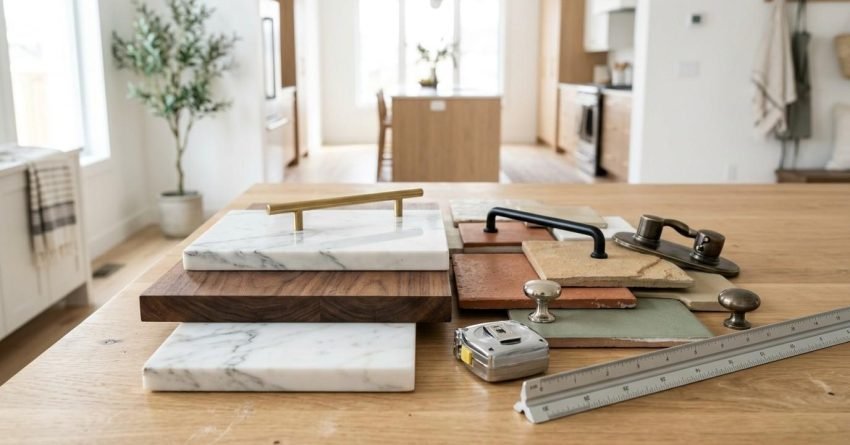
The right renovation materials determine whether a Sydney project delivers lasting value or becomes an expensive lesson in what not to do.
Choosing the right renovation materials is one of the most consequential decisions in any home improvement project, and in Sydney, where labour costs are high and material quality directly affects long-term value, getting it right from the start saves thousands. This guide covers every major material category, from structural and wet area materials through to flooring, kitchen finishes, and hidden costs that most renovation budgets overlook.
Whether you are planning a bathroom update, a full kitchen renovation, or a whole-home refresh, understanding your material options, realistic cost ranges, and the factors that drive price variation will help you make confident, informed decisions.
This guide walks through material types, Sydney cost benchmarks, selection frameworks, and the ROI considerations that matter most for homeowners, first-time renovators, and property investors.
What Are Home Renovation Materials? Types, Categories, and How to Choose
Home renovation materials are the physical components used to construct, finish, and fit out a residential property during a renovation project. They span a wide range, from structural elements like concrete and steel framing through to surface finishes like tiles, timber flooring, and painted plasterboard, and each category carries its own cost structure, performance requirements, and selection criteria.
For planning purposes, renovation materials are best understood across three broad categories: structural materials, surface and finishing materials, and wet area materials. Each category plays a different role in the renovation, carries different compliance requirements, and demands a different approach to budgeting.
Understanding which material decisions are fixed by structural or compliance requirements, and which are genuinely flexible, is the first step toward building a renovation budget that reflects reality rather than wishful thinking.
Structural Materials: Foundations, Framing, and Load-Bearing Elements
Structural materials include concrete, steel, timber framing, and masonry, the elements that form the bones of a building. In most renovation projects, structural material choices are constrained by engineering requirements, council approvals, and the existing structure of the home. Homeowners rarely have significant discretion over structural material specifications, but they do need to budget for them accurately.
In Sydney, structural work is typically priced as part of a builder’s or contractor’s scope rather than as a direct material purchase. However, understanding what structural work involves and what it costs helps homeowners evaluate quotes accurately and avoid being surprised by scope additions mid-project.
Common structural material costs in Sydney renovations include concrete slab repairs ($80–$150 per square metre), steel lintel installation ($400–$900 per opening), and timber framing for wall additions or alterations ($120–$200 per linear metre, installed). These figures vary significantly based on access, site conditions, and the complexity of the existing structure.
Surface and Finishing Materials: Flooring, Walls, and Ceilings
Surface and finishing materials are where most renovation budgets are spent and where most of the visible value is created. This category includes flooring (timber, tiles, vinyl, carpet, hybrid), wall finishes (plasterboard, paint, tiles, cladding), and ceiling treatments (plasterboard, cornices, insulation).
Unlike structural materials, surface finishes offer genuine flexibility. The same room can be finished with $30-per-square-metre vinyl plank or $180-per-square-metre engineered timber, and the visual and functional difference between those choices is significant. Understanding the cost range within each finish category, and what drives the price variation, is essential for making decisions that align with both your budget and your renovation goals.
Surface finish decisions also have a compounding effect on labour costs. More complex materials, large-format tiles, intricate parquetry, or custom joinery require more skilled installation and longer labour hours, which increases the total project cost beyond the material price alone.
Wet Area Materials: Bathrooms, Kitchens, and Waterproofing
Wet area materials are subject to the most stringent compliance requirements of any renovation category. In Australia, bathrooms and any area exposed to water must be waterproofed to AS 3740 standards before any surface finish is applied. This is not optional, and it is not a cost that can be reduced by choosing cheaper materials: the waterproofing membrane itself must meet minimum performance standards regardless of what tiles or finishes go on top.
Beyond waterproofing, wet area materials include tiles, grout, shower screens, vanities, tapware, baths, and all associated fixtures and fittings. The cost range within this category is wider than almost any other renovation material category. A functional bathroom can be completed for $8,000–$12,000 in materials, while a premium renovation can easily exceed $25,000 in materials alone before a single hour of labour is counted.
It is also worth noting that structural changes to wet areas, such as moving walls or relocating plumbing, typically require a Development Application (DA) with your local council. Heritage-listed properties and strata-titled apartments carry additional approval requirements that affect both material choices and installation methods. We always recommend confirming your compliance obligations before finalising material specifications.
How Much Do Home Renovation Materials Cost in Sydney?
Material costs in Sydney sit at the higher end of the national range, driven by supplier pricing, freight costs, and the premium that Sydney’s competitive renovation market places on quality finishes. Understanding the three broad price tiers budget, mid-range, and premium helps homeowners allocate their budget strategically rather than spreading it evenly across every material category.
As a general benchmark, material costs typically represent 40–55% of a total renovation budget in Sydney, with labour, waste removal, and compliance costs making up the remainder. This ratio shifts depending on the renovation type: bathroom renovations tend to be more labour-intensive relative to materials, while flooring renovations are more material-heavy.
Material Cost Comparison: Budget, Mid-Range, and Premium by Category
The table below summarises typical Sydney material costs across the most common renovation categories. These are material-only figures and exclude installation labour.
| Material Category | Budget | Mid-Range | Premium |
| Floor tiles (per m²) | $25–$45 | $55–$95 | $120–$250 |
| Wall tiles (per m²) | $20–$40 | $55–$95 | $120–$250 |
| Engineered timber flooring (per m²) | $80–$100 | $100–$130 | $130–$160 |
| Vinyl / hybrid flooring (per m²) | $25–$45 | $45–$65 | $65–$85 |
| Laminate benchtop (per lm) | $150–$300 | $300–$500 | N/A |
| Engineered stone benchtop (per lm) | $600–$700 | $700–$950 | $950–$1,200 |
| Natural stone benchtop (per lm) | N/A | $1,200–$1,800 | $1,800–$2,500 |
| Flat-pack cabinetry (standard kitchen) | $3,000–$7,000 | N/A | N/A |
| Semi-custom cabinetry (standard kitchen) | N/A | $8,000–$18,000 | N/A |
| Custom joinery (standard kitchen) | N/A | N/A | $20,000–$45,000 |
| Vanity (bathroom) | $400–$800 | $800–$1,500 | $1,500–$4,000 |
| Tapware set (bathroom) | $150–$400 | $400–$800 | $800–$2,500 |
| Shower screen | $400–$800 | $800–$1,500 | $1,500–$3,000 |
Budget-Grade Materials: What You Get and Where to Use Them
Budget-grade materials are not synonymous with poor quality: they are materials that prioritise function and value over aesthetics or longevity. In the right application, budget materials deliver excellent outcomes. In the wrong application, they create maintenance problems and reduce the long-term value of the renovation.
Typical budget-grade material price points in Sydney include ceramic floor tiles at $25–$45 per square metre, laminate benchtops at $150–$300 per linear metre, vinyl plank flooring at $25–$45 per square metre, and flat-pack cabinetry at $3,000–$6,000 for a standard kitchen. These materials are appropriate for investment properties, rental renovations, and areas of the home that receive low traffic or are unlikely to be scrutinised by buyers or tenants.
The risk with budget materials is not the materials themselves: it is applying them in high-visibility or high-wear areas where they will underperform relative to expectations. A budget tile in a laundry is a sensible choice. The same tile in a master bathroom of a $1.5 million Sydney home is a value-destroying decision.
Mid-Range Materials: The Best Value for Most Sydney Renovations
Mid-range materials represent the best value proposition for most Sydney renovation projects. They offer significantly better aesthetics, durability, and finish quality than budget options, without the diminishing returns that come with premium pricing.
Mid-range benchmarks in Sydney include porcelain floor tiles at $55–$95 per square metre, engineered stone benchtops at $600–$900 per linear metre, engineered timber flooring at $80–$130 per square metre, and semi-custom cabinetry at $8,000–$15,000 for a standard kitchen. These materials perform well in owner-occupier renovations, properties being prepared for sale, and investment properties in higher-yield suburbs.
For most homeowners and property investors, allocating the majority of the material budget to mid-range finishes, with selective upgrades to premium in high-impact areas, delivers the strongest combination of visual outcome and financial return.
Premium and Luxury Materials: When the Investment Is Worth It
Premium materials command a significant price premium and are appropriate in specific circumstances: high-end owner-occupier renovations where personal enjoyment justifies the cost, properties in premium Sydney suburbs where buyer expectations demand quality finishes, and targeted upgrades in high-impact areas like master bathrooms and kitchen benchtops.
Premium material benchmarks include natural stone tiles at $120–$250 per square metre, marble or granite benchtops at $1,200–$2,500 per linear metre, solid hardwood flooring at $150–$280 per square metre, and custom joinery at $20,000–$40,000 for a full kitchen. These figures are for materials only; installation costs for premium materials are also higher due to the skill and time required.
The critical discipline with premium materials is selectivity. Applying premium finishes across an entire renovation rarely delivers proportional value. Concentrating premium spend on the two or three elements that buyers and occupants notice most benchtops, tapware, and floor tiles-while using mid-range materials elsewhere is the approach that consistently delivers the best financial outcome.
Bathroom Renovation Materials: A Complete Cost and Selection Guide
Bathroom renovations are the most material-intensive renovation category relative to room size, and they carry the highest compliance burden of any residential renovation type. Every material decision in a bathroom, from the waterproofing membrane beneath the tiles to the tapware on the vanity, affects both the functional performance and the long-term value of the space.
A standard Sydney bathroom renovation uses materials across six primary categories: waterproofing, tiles, vanity and cabinetry, tapware and fittings, shower screen or bath, and accessories. Understanding the cost range and selection criteria for each category is essential for building a bathroom renovation budget that is both realistic and strategically allocated.
Tiles and Waterproofing: Costs, Options, and What to Prioritise
Tiles and waterproofing together represent the largest material cost in most bathroom renovations, and they are the two categories where cutting corners creates the most significant long-term problems. Waterproofing failures are the leading cause of bathroom renovation defects in Australia, and they are almost always the result of using non-compliant membranes, inadequate coverage, or skipping the waterproofing layer entirely to reduce costs.
Waterproofing membrane costs in Sydney range from $15–$35 per square metre for the membrane itself, with application labour adding $25–$50 per square metre. A standard bathroom of 5–8 square metres will require $200–$700 in waterproofing materials, plus labour. This is a non-negotiable cost; it cannot be reduced below the minimum required by AS 3740, and any contractor who suggests otherwise should be treated with caution.
Tile costs vary enormously. Ceramic wall tiles start at $20–$40 per square metre; mid-range porcelain tiles run $55–$95 per square metre; large-format porcelain (600x1200mm and above) costs $90–$180 per square metre; and natural stone tiles range from $120–$250 per square metre. Grout, adhesive, and tile trim add a further $15–$30 per square metre to the material cost.
Vanities, Tapware, and Fittings: Budgeting for Quality
Vanities, tapware, and fittings are the most visible elements of a bathroom renovation and the category where personal taste has the greatest influence on cost. A functional vanity can be purchased for $400–$800; a premium wall-hung vanity with integrated basin costs $1,500–$4,000. Tapware ranges from $150–$400 for a budget set to $800–$2,500 for a premium mixer and shower set.
The key budgeting principle in this category is to prioritise tapware quality over vanity cost. Tapware is touched every day; it is highly visible, and cheap tapware fails faster and looks dated sooner than almost any other bathroom fitting. Allocating $600–$1,200 to a quality tapware set while choosing a mid-range vanity at $800–$1,500 is a more effective use of budget than the reverse.
Toilet suites range from $350–$600 for a standard close-coupled suite to $1,200–$3,000 for a wall-hung suite with concealed cistern. The wall-hung option adds installation complexity and cost but delivers a cleaner aesthetic and easier cleaning, a worthwhile upgrade in bathrooms where the visual outcome matters.
Shower Screens, Baths, and Accessories: Balancing Cost and Finish
Shower screens range from $400–$800 for a standard framed screen to $1,200–$3,000 for a frameless glass panel. Frameless screens are the dominant choice in Sydney renovations because they are easier to clean, more visually open, and significantly more appealing to buyers and tenants. The price premium over framed screens is modest relative to the visual impact.
Freestanding baths have become a popular feature in master bathroom renovations, with prices ranging from $800–$1,500 for an acrylic freestanding bath to $3,000–$8,000 for a stone resin or cast iron option. In most Sydney bathrooms, a freestanding bath is a lifestyle choice rather than a value-adding investment; it works best in larger bathrooms where it does not compromise the functional layout.
Accessories, towel rails, toilet roll holders, robe hooks, and mirrors are frequently underbudgeted. A complete set of quality accessories costs $400–$1,200 and has a disproportionate impact on the finished feel of the bathroom. Mismatched or cheap accessories undermine the quality of every other material decision in the room.
Kitchen Renovation Materials: Costs, Choices, and Value Considerations
Kitchen renovations involve the widest range of material categories of any single-room renovation, and they carry the highest average material cost. A standard Sydney kitchen renovation uses materials across cabinetry, benchtops, splashbacks, flooring, appliances, and fixtures, each with its own cost structure and selection criteria.
Material costs for a standard Sydney kitchen renovation range from $12,000–$18,000 at the budget end to $30,000–$60,000 for a premium full renovation. Understanding how those costs are distributed across material categories is essential for making strategic decisions about where to invest and where to save.
Cabinetry and Joinery: Material Options and Price Ranges
Cabinetry is typically the largest single material cost in a kitchen renovation, representing 30–45% of the total material budget. The three main options are flat-pack cabinetry, semi-custom cabinetry, and fully custom joinery, each with a significantly different price point and quality outcome.
Flat-pack cabinetry from major retailers costs $3,000–$7,000 for a standard kitchen in materials, plus $1,500–$3,000 for professional installation. It is a legitimate choice for investment properties and budget renovations, but the finish quality, hardware, and longevity are noticeably inferior to semi-custom options.
Semi-custom cabinetry, manufactured to standard dimensions but with a wider range of door profiles, finishes, and hardware options, costs $8,000–$18,000 for a standard kitchen in materials. This is the most common choice for owner-occupier renovations in Sydney and delivers a strong balance of quality, customisation, and value.
Fully custom joinery, designed and built to the exact dimensions and specifications of the space, costs $20,000–$45,000 for a standard kitchen. It is appropriate for premium renovations, unusual floor plans, or homeowners who require specific storage solutions that standard cabinetry cannot accommodate.
Benchtops: Stone, Laminate, Timber, and Cost Comparisons
Benchtops are the highest-impact single material decision in a kitchen renovation. They are the most visible surface in the room; they are used constantly, and they have a significant effect on both the aesthetic quality and the resale value of the renovation.
Laminate benchtops cost $150–$350 per linear metre and are appropriate for budget renovations and investment properties. They are durable, easy to maintain, and available in a wide range of finishes, including convincing stone-look options, but they do not carry the same perceived value as stone.
Engineered stone such as Caesarstone, Silestone, or Quantum Quartz costs $600–$950 per linear metre and is the dominant choice for mid-range and premium Sydney kitchen renovations. It is non-porous, highly durable, available in a wide range of colours and finishes, and consistently valued by buyers and tenants.
Natural stone, including marble, granite, and travertine, costs $1,200–$2,500 per linear metre and is appropriate for premium renovations where the aesthetic and tactile quality of natural stone justifies the cost and the maintenance requirements. Natural stone requires sealing and is more susceptible to staining than engineered alternatives.
Splashbacks, Flooring, and Kitchen Fixtures
Splashbacks range from $200–$600 for a painted or laminate option to $800–$2,500 for a full-height tile or glass splashback. Subway tiles remain the most popular mid-range choice in Sydney kitchens, with costs of $40–$80 per square metre for the tile itself. Large-format porcelain splashbacks cost $90–$180 per square metre and deliver a more contemporary aesthetic with fewer grout lines to maintain.
Kitchen flooring should be selected for durability and ease of cleaning above all other criteria. Porcelain tiles ($55–$95 per square metre) and hybrid vinyl plank ($45–$80 per square metre) are the two most practical choices for Sydney kitchens. Timber flooring in kitchens is possible but requires careful selection; engineered timber with a durable coating is more appropriate than solid hardwood in a high-moisture environment.
Kitchen fixtures, sink, tapware, and rangehood add $1,500–$5,000 to the material budget depending on specification. A quality undermount sink ($400–$900) and mixer tap ($300–$800) are worthwhile investments that are used daily and noticed by buyers. The rangehood is a functional requirement and a visual feature; budget $600–$2,000 for a quality unit that suits the kitchen’s scale and style.
Flooring Materials for Home Renovations: Costs, Durability, and Best Uses
Flooring is one of the most impactful renovation decisions in any home; it covers more surface area than any other single material, it is noticed immediately by anyone entering a room, and it has a significant effect on both the feel of the space and the long-term maintenance requirements of the property.
In Sydney, the most common flooring choices for renovation projects are timber and engineered timber, porcelain and ceramic tiles, vinyl plank and laminate, hybrid flooring, and carpet. Each has a different cost structure, durability profile, and appropriate application, and choosing the wrong flooring for a specific room or use case is one of the most common and costly material mistakes in residential renovation.
Timber and Engineered Timber Flooring: Costs and Considerations
Solid hardwood flooring costs $120–$280 per square metre for materials, with installation adding $40–$80 per square metre. It is the premium choice for living areas and bedrooms in high-end Sydney renovations, offering unmatched warmth, character, and longevity. Solid timber can be sanded and refinished multiple times over its lifespan, making it a genuinely long-term investment.
Engineered timber flooring costs $80–$160 per square metre for materials, with installation at $35–$65 per square metre. It uses a real timber veneer over a stable plywood or HDF core, which makes it more dimensionally stable than solid timber in Sydney’s variable humidity conditions. Engineered timber is appropriate for most rooms in a Sydney home, including areas over concrete slabs where solid timber is not suitable.
Tiles, Vinyl, and Laminate: Budget-Friendly Flooring Options
Porcelain floor tiles cost $45–$120 per square metre for materials, with installation at $55–$90 per square metre. They are the most durable flooring option available, appropriate for any room in the house including wet areas, and available in a wide range of formats and finishes including wood-look and stone-look options. The installation cost is higher than most other flooring types, but the lifespan is effectively unlimited with proper maintenance.
Vinyl plank flooring (LVP) costs $25–$65 per square metre for materials, with installation at $20–$40 per square metre. It is 100% waterproof, comfortable underfoot, and available in convincing timber and stone looks. It is the most practical choice for investment properties and rental renovations where durability and ease of replacement are priorities.
Laminate flooring costs $20–$50 per square metre for materials, with installation at $20–$35 per square metre. It is the most budget-friendly option but is not waterproof and is not appropriate for wet areas or high-moisture environments. In dry living areas and bedrooms, quality laminate delivers a reasonable aesthetic outcome at a low cost.
Carpet and Hybrid Flooring: Where Each Works Best
Carpet costs $30–$90 per square metre for materials (including underlay), with installation at $15–$30 per square metre. It remains the preferred choice for bedrooms in Sydney homes; it is warm, quiet, and comfortable underfoot in a way that hard flooring cannot replicate. In living areas, carpet is less popular than it was a decade ago, but it remains a practical and cost-effective choice for family homes where comfort is prioritised over aesthetics.
Hybrid flooring, a rigid core vinyl plank with a more substantial construction than standard LVP, costs $45–$85 per square metre for materials, with installation at $25–$45 per square metre. It combines the waterproof performance of vinyl with greater dimensional stability and a more substantial feel underfoot. Hybrid flooring has become the most popular flooring choice for whole-home renovations in Sydney over the past five years, offering a strong balance of durability, aesthetics, and cost.
How Long Do Different Flooring Materials Take to Install?
Installation timelines matter as much as material costs when planning a renovation schedule. Vinyl plank and hybrid flooring are the fastest to install, typically 1–3 days for a standard home, because they are floating systems that require no adhesive curing time. Engineered timber flooring takes 2–4 days for installation, plus an acclimatisation period of 48–72 hours before work begins.
Porcelain tile installations are the most time-intensive flooring option. A standard living area or kitchen floor takes 3–5 days for laying and grouting, plus a mandatory 24-48 hour curing period before foot traffic is permitted. Carpet installation is fast, typically 1–2 days for a whole home, but requires the subfloor to be clean and level before the installer arrives.
We factor these timelines into every project schedule we build, because flooring sequencing affects every other trade on site.
Hidden Material Costs in Home Renovations: What Most Budgets Miss
Hidden material costs are the most common cause of budget overruns in Sydney renovation projects. They are not hidden in the sense of being deliberately concealed. They are simply costs that homeowners do not know to ask about, and that some contractors do not include in initial quotes because they are genuinely unknown until work begins.
Understanding the main categories of hidden material costs, and building appropriate allowances for them into the renovation budget from the start, is one of the most practical things a homeowner can do to protect their project from financial surprises.
Waterproofing, Adhesives, and Substrate Preparation Costs
Substrate preparation is the work required to make a surface ready to receive the finish material, and it is consistently underestimated in renovation budgets. In bathrooms, this includes removing existing tiles, repairing damaged substrate, applying waterproofing membrane, and allowing adequate curing time before tiling begins. In kitchens, it includes levelling the floor, repairing damaged plasterboard, and preparing surfaces for new cabinetry installation.
Substrate preparation costs in Sydney range from $500–$2,500 for a standard bathroom renovation, depending on the condition of the existing substrate and the extent of damage found once the old finishes are removed. This cost cannot be accurately estimated until demolition is complete, which is why experienced contractors include a contingency allowance rather than a fixed price for this scope.
Adhesive and grout costs are frequently omitted from material quotes. For a standard bathroom renovation, adhesive and grout add $400–$900 to the material cost. For a kitchen renovation, adhesive, sealants, and fixings add $300–$700. These are not optional costs; they are required for every tiled or bonded surface in the renovation.
Waste Removal, Delivery Fees, and Supplier Minimums
Waste removal is a direct cost of renovation that is often excluded from material quotes and sometimes excluded from contractor quotes as well. In Sydney, skip bin hire for a bathroom renovation costs $350–$600 for a 3–4 cubic metre bin. A full kitchen renovation generates more waste and typically requires a 6–8 cubic metre bin at $500–$900. Council tip fees and recycling levies are included in most skip bin prices but should be confirmed.
Delivery fees for renovation materials in Sydney range from $80–$250 per delivery depending on the supplier, the volume of materials, and the site access conditions. For a renovation that requires multiple material deliveries, tiles, cabinetry, flooring, fixtures, delivery costs can add $400–$1,000 to the total material cost.
Supplier minimums are a less obvious hidden cost. Many tile suppliers, flooring distributors, and joinery manufacturers have minimum order quantities that exceed the exact amount required for the renovation. Combined with the standard 10–15% wastage allowance that should be added to every material order, supplier minimums can add 15–25% to the stated material cost for smaller renovation projects.
Material Wastage Allowances: How to Calculate and Budget Correctly
Material wastage is not a mistake; it is an inherent characteristic of renovation work. Tiles are cut to fit around obstacles, flooring boards are trimmed at walls, and cabinetry panels are cut to size. The standard wastage allowance for most renovation materials is 10% for straight-lay installations and 15% for diagonal or pattern installations.
For a bathroom renovation using 30 square metres of tiles (walls and floor combined), a 10% wastage allowance adds 3 square metres to the order, which at $80 per square metre adds $240 to the material cost. For a kitchen renovation using 20 square metres of flooring, a 10% allowance adds $100–$200 depending on the flooring type. These are small numbers individually, but across all material categories in a renovation, wastage allowances add 8–15% to the total material cost.
The correct approach is to calculate the exact area required, add the appropriate wastage percentage, and order to that quantity. Ordering short to save money and then needing to reorder is more expensive than ordering correctly the first time, particularly for tiles and flooring where batch numbers affect colour consistency.
Material Lead Times and Supply Chain Considerations in Sydney
Lead times are one of the most overlooked variables in Sydney renovation budgeting, and they have a direct effect on project timelines and cash flow. Standard in-stock tiles and hybrid flooring from local distributors are typically available within 3–7 business days. Imported tiles, particularly large-format porcelain from Italian or Spanish manufacturers, carry lead times of 6–12 weeks from order to delivery.
Custom and semi-custom cabinetry lead times in Sydney currently run 8–14 weeks from order confirmation to delivery, depending on the manufacturer and the complexity of the specification. Engineered stone benchtops are typically templated after cabinetry installation and fabricated within 7–14 days of templating. Ordering materials before the project start date, and sequencing deliveries to match the installation schedule, is essential for avoiding costly delays.
We build material lead times into every project programme we prepare, and we recommend confirming lead times with all suppliers before signing a construction contract.
How to Choose the Right Renovation Materials for Your Sydney Home
Choosing renovation materials is not simply a matter of selecting what looks best in a showroom. The right material for any renovation depends on the home’s age and construction type, the specific demands of the space being renovated, the budget available, and the intended outcome, whether that is personal enjoyment, rental yield, or resale value.
A structured approach to material selection, one that starts with the functional requirements of the space and works outward to aesthetics and cost, consistently produces better outcomes than starting with a visual preference and working backward to fit the budget.
Matching Materials to Your Home’s Style, Age, and Structure
Sydney’s housing stock spans a wide range of construction periods and styles, from Federation-era brick homes in the inner suburbs to 1970s brick veneer in the middle ring to contemporary apartment buildings across the city. The materials that work well in each context are different, and choosing materials that are inconsistent with the home’s age, style, or construction type creates a result that feels disconnected and reduces rather than adds value.
In Federation and Interwar homes, materials that reference the period perform better aesthetically and financially than contemporary materials that clash with the home’s character. Encaustic floor tiles in a Paddington terrace bathroom, VJ panelling in a Balmain kitchen, and solid hardwood flooring in a Glebe living room are all period-appropriate choices that buyers in those markets actively seek out. In post-war brick veneer homes in suburbs like Ryde or Blacktown, the material palette is more flexible, but proportions and scale matter; large-format tiles and high-gloss finishes can feel out of place in smaller rooms with lower ceilings.
In contemporary apartments and townhouses across the inner city and north shore, clean lines, large formats, and minimal grout lines are consistent with the architectural language of the building. A 600x1200mm porcelain tile in a matte stone finish reads as intentional in a Pyrmont apartment; the same tile in a 1960s Sutherland Shire brick home reads as incongruous.
Prioritising Durability vs. Aesthetics: A Practical Framework
The most common material selection mistake in renovation projects is prioritising aesthetics over durability in high-wear areas. A beautiful natural marble floor in a family bathroom looks exceptional on day one and requires constant maintenance, stains easily, and shows wear within a few years. A quality porcelain tile in a stone-look finish costs a fraction of the price, requires minimal maintenance, and looks as good in ten years as it does on installation day.
The practical framework for balancing durability and aesthetics is to apply the highest durability standard to the areas of the home that receive the most traffic and moisture, including bathrooms, kitchens, laundries, and entry areas, and to allow more aesthetic flexibility in lower-wear areas like bedrooms and formal living spaces. Within each area, select the most aesthetically appealing option that meets the durability standard.
How to Read and Compare Renovation Material Quotes
Material quotes from different suppliers are rarely structured the same way, and comparing them without understanding the line items is one of the most common sources of budget confusion for Sydney renovators. The key distinction to look for is whether a quote is based on a fixed material specification or an allowance.
A fixed specification quote lists the exact product, brand, format, and quantity for each material category. An allowance-based quote provides a dollar figure per category, such as $80 per square metre for floor tiles, and leaves the specific product selection open. Allowance-based quotes are common in early-stage budgeting but carry significant risk if the allowance does not reflect the actual cost of the materials you want.
When comparing quotes, we recommend requesting itemised breakdowns that separate material cost, wastage allowance, delivery, and installation labour. A quote that bundles all of these into a single line item makes it impossible to identify where cost differences between contractors actually originate.
Sustainable and Low-Impact Material Options for Sydney Homes
Sustainability considerations are increasingly influencing material selection in Sydney renovations, driven by both environmental values and the growing recognition that low-impact materials often perform better over the long term. FSC-certified timber flooring and cabinetry ensure the wood is sourced from responsibly managed forests, and it is now available at price points comparable to non-certified alternatives from most Sydney trade suppliers.
Low-VOC paints and adhesives are a straightforward upgrade that improves indoor air quality with no meaningful cost premium. Recycled content tiles, particularly those made from post-consumer glass or reclaimed ceramic, are available from specialist Sydney importers and carry a modest price premium of 10–20% over standard equivalents. Double-glazed windows and acoustic underlay beneath flooring are liveability upgrades that also reduce energy consumption, making them appropriate for owner-occupiers with a long-term horizon.
Where to Source Renovation Materials in Sydney
Sydney has a well-developed renovation materials supply market, with options ranging from major national retailers to specialist tile importers, flooring distributors, and trade-only suppliers. The right sourcing strategy depends on the renovation type, the material category, and the budget.
For tiles, Sydney’s best value is typically found at specialist tile importers in the western suburbs and inner south, where direct-import pricing can be 30–50% below major retailer prices for equivalent quality. For flooring, trade-focused distributors offer better pricing and a wider range than retail flooring chains for most renovation budgets. For cabinetry and joinery, the choice between flat-pack retail, semi-custom trade suppliers, and custom joiners is primarily a function of budget and the complexity of the space.
Working with an experienced renovation contractor who has established supplier relationships is one of the most effective ways to access trade pricing, reduce material costs, and ensure that the materials specified are appropriate for the installation conditions. Our team at Sydney Home Renovation works with a network of trusted Sydney suppliers across every material category, and we pass trade pricing directly to our clients.
Renovation Materials and Return on Investment: What Adds Value in Sydney
Not all renovation materials add equal value to a Sydney property. The relationship between material cost and property value uplift is not linear; spending more does not always mean gaining more, and the materials that add the most value are often not the most expensive ones.
Understanding which material upgrades consistently deliver measurable return on investment, and which ones represent personal preference spending that does not translate to higher sale prices or rental yields, is essential for homeowners and property investors who want their renovation spend to work as hard as possible.
High-ROI Material Upgrades for Bathrooms and Kitchens
Bathrooms and kitchens are consistently identified as the two renovation categories that deliver the strongest return on investment in Sydney residential property. Within those categories, the specific material upgrades that drive value are more targeted than most homeowners expect.
In bathrooms, the highest-ROI material upgrades are: replacing dated tapware with a quality contemporary set ($600–$1,200 in materials), retiling the floor and shower with a clean, neutral porcelain tile ($2,000–$4,500 in materials for a standard bathroom), and replacing a dated vanity with a wall-hung or freestanding unit in a neutral finish ($800–$2,000 in materials). These three upgrades, combined with fresh paint and new accessories, can transform the perceived quality of a bathroom for $5,000–$8,000 in materials, a fraction of a full renovation cost.
In kitchens, the highest-ROI material upgrades are: replacing laminate benchtops with engineered stone ($3,000–$6,000 in materials for a standard kitchen), replacing cabinet doors and hardware without replacing the carcasses ($2,000–$5,000 in materials), and updating the splashback ($500–$1,500 in materials). These targeted upgrades deliver a significant visual improvement at a fraction of the cost of a full kitchen renovation.
Materials That Improve Liveability Without Overcapitalising
Liveability improvement materials that make a home more comfortable, functional, and enjoyable to live in do not always translate directly to higher sale prices, but they are a legitimate and valuable renovation objective for owner-occupiers. The key is to make liveability improvements that are also consistent with the property’s price ceiling, so that the renovation does not result in overcapitalisation.
Insulation, double-glazed windows, and acoustic flooring are liveability materials that improve comfort significantly but are rarely visible to buyers or tenants. They are appropriate investments for long-term owner-occupiers but should be weighed carefully against their cost when renovating for sale or rental. Hybrid flooring, quality tapware, and good lighting are liveability improvements that are both felt by occupants and noticed by buyers, making them the most efficient use of renovation budget for most Sydney homeowners.
What Sydney Buyers and Renters Actually Notice
Sydney buyers and renters notice a consistent set of material quality signals when inspecting a property: the condition and quality of the bathroom tiles and tapware, the benchtop material in the kitchen, the flooring type and condition throughout the home, and the quality of the paint finish on walls and ceilings. These are the materials that drive first impressions and influence price and rental decisions.
What buyers and renters do not notice, or do not value proportionally to cost, includes custom joinery details, premium appliance brands, exotic natural stone, and bespoke lighting fixtures. These are materials that owners value highly, but that rarely translate to a proportional increase in sale price or rental yield in most Sydney suburbs.
Conclusion
Home renovation materials span a wide range of categories, cost tiers, and performance characteristics, and the decisions made at the material selection stage have a direct and lasting effect on the quality, cost, and value of the finished renovation. Understanding the cost structure of each material category, the compliance requirements that apply to wet areas, and the hidden costs that most budgets overlook is the foundation of a renovation that stays on track financially.
For Sydney homeowners and property investors, the strongest outcomes consistently come from matching material quality to the specific demands of each space, prioritising durability in high-wear areas, and concentrating premium spend on the materials that buyers and tenants actually notice.
Sydney Home Renovation is here to help you navigate every material decision with confidence, from transparent cost planning and supplier sourcing to skilled installation and quality finishes that deliver lasting value. Contact our team today to start planning your renovation with honest pricing and practical expertise.
Frequently Asked Questions
What is the average cost of renovation materials for a bathroom in Sydney?
Material costs for a standard Sydney bathroom renovation typically range from $8,000 to $18,000, depending on the size of the bathroom and the quality tier of materials selected. This includes tiles, waterproofing, vanity, tapware, shower screen, and accessories but excludes labour.
How much should I budget for material wastage in a renovation?
A standard wastage allowance of 10% applies to straight-lay tile and flooring installations, and 15% applies to diagonal or pattern installations. Always order to the calculated quantity plus the wastage allowance; reordering from a different batch can result in colour inconsistencies.
What renovation materials add the most value to a Sydney property?
Engineered stone benchtops in the kitchen, quality porcelain tiles in the bathroom, and hybrid or engineered timber flooring throughout the home consistently deliver the strongest return on investment in Sydney renovations. These materials are noticed by buyers and tenants and influence price and rental decisions.
What is the difference between budget, mid-range, and premium renovation materials?
Budget materials prioritise function and cost over aesthetics and longevity. Mid-range materials offer significantly better quality and finish at a moderate price premium and represent the best value for most Sydney renovations. Premium materials deliver the highest aesthetic and performance outcomes but carry diminishing financial returns in most Sydney suburbs.
Do I need waterproofing in a bathroom renovation, and what does it cost?
Waterproofing is legally required in all Australian bathrooms under AS 3740 and cannot be omitted or substituted with a cheaper alternative. Waterproofing membrane costs $15–$35 per square metre for materials, with application labour adding $25–$50 per square metre. A standard bathroom requires $200–$700 in waterproofing materials plus labour.
What are the hidden costs of renovation materials that most budgets miss?
The most commonly missed material costs are substrate preparation ($500–$2,500 for a bathroom), adhesive and grout ($400–$900 for a bathroom), waste removal ($350–$600 for a skip bin), delivery fees ($80–$250 per delivery), and supplier minimums that require ordering more material than the exact quantity needed.
How do I choose between engineered stone and natural stone for a kitchen benchtop?
Engineered stone is the better choice for most Sydney kitchens; it is non-porous, requires no sealing, is more resistant to staining, and costs $600–$950 per linear metre compared to $1,200–$2,500 for natural stone. Natural stone is appropriate for premium renovations where the aesthetic and tactile quality of marble or granite justifies the higher cost and maintenance requirements.
What flooring material is best for a Sydney renovation?
Hybrid flooring is the most versatile choice for whole-home renovations in Sydney; it is waterproof, dimensionally stable, durable, and available in a wide range of timber and stone looks at $45–$85 per square metre. Porcelain tiles are the most durable option for wet areas and high-traffic zones. Engineered timber is the premium choice for living areas and bedrooms where warmth and character are priorities.


