
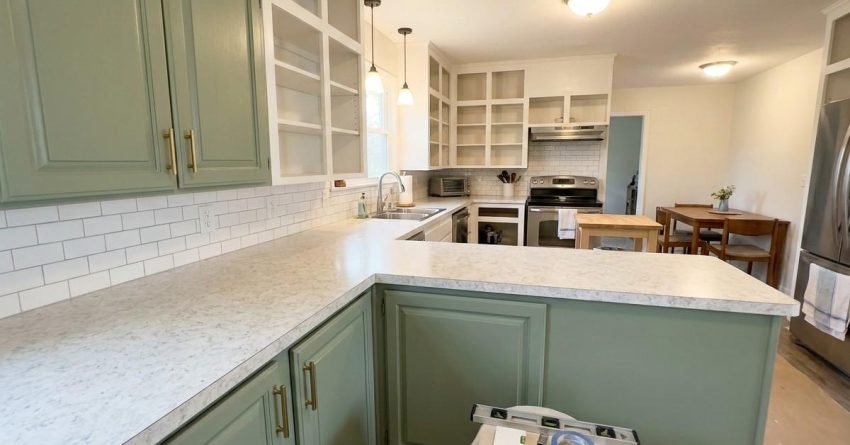
Yes, you can renovate a kitchen for $10,000 in Sydney. What that budget delivers depends entirely on the scope of work, the condition of your existing kitchen, and how strategically you allocate every dollar. A $10,000 budget is workable for a cosmetic refresh or a like-for-like update. It leaves little room for structural changes, full cabinet replacements, or premium finishes.
Understanding exactly where that money goes is what separates a successful renovation from a costly blowout. Labour, materials, compliance costs, and hidden expenses all compete for the same pool of funds. Without a clear plan, that $10,000 disappears faster than most homeowners expect.
In this guide, we break down what a $10,000 kitchen renovation realistically covers in Sydney, how to allocate your budget across labour, joinery, benchtops, and appliances, where the hidden costs lurk, and how to prioritise spending for maximum impact and long-term value.
What Does a $10,000 Kitchen Renovation Actually Include?
A $10,000 kitchen renovation in Sydney is best understood as a targeted upgrade rather than a full transformation. At this price point, you’re working within the constraints of your existing kitchen footprint, existing plumbing and electrical rough-in positions, and a material allowance that favours mid-range rather than premium selections.
The scope that fits within $10,000 typically covers cabinet door replacements or a full flat-pack cabinet installation in a small kitchen, a new benchtop, updated tapware and sink, basic appliance upgrades, and fresh paint or splashback tiling. It doesn’t comfortably cover a full structural reconfiguration, custom joinery, stone benchtops across a large kitchen, or high-end integrated appliances.
Setting this expectation early is critical. Many homeowners approach a $10,000 budget hoping for a showroom-quality result. The reality is that $10,000 buys a clean, functional, and noticeably improved kitchen, not a magazine feature.
Layout Changes vs. Like-for-Like Replacements
The single biggest cost driver in any kitchen renovation is whether you’re changing the layout or keeping everything in the same position. Moving a sink, relocating a cooktop, or shifting cabinetry to a new wall requires a licensed plumber and electrician to reposition services. In Sydney, that work alone can consume $2,000 to $4,000 of a $10,000 budget before a single cabinet is installed.
A like-for-like replacement, where the new kitchen mirrors the existing layout exactly, is the most budget-efficient approach. Plumbing connections stay in place, electrical circuits remain unchanged, and the bulk of your budget goes toward visible upgrades rather than behind-the-wall compliance work. For anyone working with $10,000, a like-for-like approach isn’t a compromise. It’s the financially sound strategy.
What You Can Realistically Expect at This Budget
At $10,000, a realistic kitchen renovation outcome in Sydney includes a flat-pack or semi-custom cabinet installation for a small to medium kitchen (roughly 10 to 15 linear metres of cabinetry), a laminate or reconstituted stone benchtop, a new undermount or drop-in sink with quality tapware, a tiled or glass splashback, and basic freestanding or built-under appliances.
The finish will be clean and functional. The materials will be durable and appropriate for everyday use.
What you won’t get at this budget is 40mm stone benchtops, custom-built cabinetry, integrated appliances, or elaborate tile work. Knowing this upfront lets you make deliberate choices rather than discovering limitations mid-project.

How Is a $10,000 Kitchen Renovation Budget Typically Broken Down?
Understanding how a $10,000 kitchen renovation budget is distributed across its major cost categories is the foundation of effective planning. Labour typically consumes the largest share, followed by cabinetry, benchtops, and then appliances and fixtures.
The table below provides a realistic cost breakdown for a $10,000 kitchen renovation in Sydney, based on a small to medium kitchen with a like-for-like layout.
| Cost Category | Estimated Allowance | Notes |
| Labour (installation, trades) | $3,500 – $4,500 | Carpenter, plumber, electrician |
| Cabinetry (flat-pack or semi-custom) | $2,000 – $3,000 | Supply and install |
| Benchtop | $800 – $1,500 | Laminate to reconstituted stone |
| Sink and tapware | $300 – $600 | Mid-range selections |
| Splashback (tiles or glass) | $400 – $800 | Basic tile or glass panel |
| Appliances | $500 – $1,200 | Freestanding or built-under |
| Contingency | $500 – $800 | For unexpected costs |
| Total | ~$10,000 | Small kitchen, like-for-like |
These figures reflect Sydney market rates and assume a straightforward installation without structural complications. Any deviation from a like-for-like layout, discovery of asbestos, or need for additional compliance work will shift these numbers significantly.
Labour Costs for a Budget Kitchen Renovation in Sydney
Labour is consistently the highest single cost in a Sydney kitchen renovation. At the $10,000 budget level, it typically accounts for 35 to 45 percent of the total spend. For a small kitchen renovation, expect to allocate between $3,500 and $4,500 for the combined trades required: a licensed carpenter or kitchen installer, a licensed plumber for sink and dishwasher connections, and a licensed electrician for rangehood wiring and appliance circuits.
Sydney trade rates rank among the highest in Australia. According to the Fair Work Ombudsman’s pay guides, licensed tradespeople command premium hourly rates reflecting high demand and the cost of living in metropolitan Sydney. A licensed carpenter typically charges between $80 and $120 per hour, plumbers range from $120 to $180 per hour, and electricians sit in a similar range.
Even a straightforward kitchen installation requires a minimum of two to three days of combined trade time, which explains why labour costs accumulate quickly even on a modest project.
One of the most effective ways we’ve found to protect your labour budget is to engage a renovation contractor who coordinates all trades under a single project management structure. Disjointed trade scheduling, where a plumber can’t attend until the carpenter finishes, causing delays, is one of the most common causes of budget overruns on small kitchen renovations.
Cabinet and Joinery Allowances at $10,000
Cabinetry is the most visible element of any kitchen renovation and typically the second-largest cost after labour. At a $10,000 total budget, the realistic allowance for cabinetry supply and installation sits between $2,000 and $3,000 for a small kitchen.
Flat-pack cabinetry from suppliers such as IKEA, Kaboodle (Bunnings), or Polytec-based flat-pack ranges offers the best value at this price point. These products have improved significantly in quality over the past decade. When installed correctly by an experienced carpenter, they deliver a result that’s difficult to distinguish from semi-custom joinery at a fraction of the cost.
Custom-built cabinetry isn’t a realistic option at $10,000. Custom joinery for even a small kitchen typically starts at $8,000 to $12,000 for supply alone, before installation. When custom joinery is a priority, the total renovation budget needs to increase accordingly, or the scope needs to shrink to a partial kitchen update rather than a full replacement.
Benchtop Material Options Within Budget
The benchtop is one of the highest-impact visual elements in a kitchen renovation. At the $10,000 level, the realistic benchtop allowance is $800 to $1,500.
Laminate benchtops are the most budget-friendly option, starting from around $150 to $300 per linear metre installed. Modern laminate products replicate the look of stone and timber convincingly and hold up well for everyday kitchen use.
Reconstituted stone (engineered stone) benchtops offer a step up in appearance and durability, with pricing typically ranging from $400 to $700 per linear metre installed for standard thicknesses and profiles. A small kitchen with three to four linear metres of benchtop can be fitted with reconstituted stone within the $1,000 to $1,500 allowance when selections stick to standard profiles and colours.
Natural stone, including granite, marble, or premium quartzite, sits outside the realistic range for a $10,000 total budget. These materials start at $600 to $1,200 per linear metre installed and suit renovation budgets of $20,000 and above.
Appliances, Fixtures, and Fittings Allowance
Appliances, sink, and tapware collectively represent the functional core of a kitchen. At the $10,000 budget level, the combined allowance for these items is typically $800 to $1,800.
For appliances, freestanding or built-under options from mid-range brands such as Westinghouse, Simpson, or Euromaid offer reliable performance at accessible price points. A freestanding 60cm oven and cooktop combination can be sourced for $600 to $1,000. A rangehood in the $200 to $400 range provides adequate ventilation for a standard kitchen.
For the sink and tapware, a stainless steel undermount or drop-in sink paired with a quality mixer tap from brands such as Caroma or Methven can be achieved for $300 to $600. We recommend avoiding the temptation to over-invest in designer tapware at this budget level. The functional difference between a $150 mixer and a $600 mixer is minimal, and the budget is better directed toward cabinetry or benchtop quality.
What Are the Hidden Costs in a $10,000 Kitchen Renovation?
Hidden costs are the most common reason kitchen renovations exceed their original budget. In Sydney, where building compliance requirements are strict and older housing stock frequently conceals outdated services, the gap between a quoted price and a final invoice can be significant.
The most important thing any homeowner can do before committing to a $10,000 kitchen renovation budget is arrange a thorough pre-renovation inspection with an experienced contractor. Identifying potential hidden costs before work begins is far less expensive than discovering them mid-project.
Electrical and Plumbing Compliance Costs
Electrical and plumbing compliance is one of the most frequently underestimated cost categories in a kitchen renovation. In New South Wales, all electrical and plumbing work must be carried out by licensed tradespeople and must comply with current Australian Standards, regardless of whether the existing installation was compliant when originally installed. NSW Fair Trading requires verified licensing for all electrical and plumbing work performed in residential renovations.
In older Sydney homes, particularly those built before the 1980s, it’s common to discover outdated wiring that doesn’t meet current standards, insufficient circuit capacity for modern appliances, or galvanised steel plumbing that requires replacement before new fixtures can be connected. Upgrading a single electrical circuit can cost $300 to $600. Replacing a section of galvanised plumbing can add $500 to $1,500 to the project cost.
These aren’t optional expenses. They’re compliance requirements, and a licensed contractor is obligated to bring the work up to current standards. Budget a minimum of $500 as a contingency for compliance-related discoveries. Be prepared for this figure to increase in homes built before 1985.
Waterproofing, Tiling, and Flooring Surprises
Waterproofing is a mandatory requirement in wet areas such as bathrooms. It’s less commonly discussed in kitchen renovations, but flooring-related costs frequently catch homeowners off guard.
Removing existing floor tiles to install new ones is a labour-intensive process. Tile removal in a standard kitchen can cost $300 to $600 in labour alone, before the cost of new tiles and installation. When the subfloor beneath the existing tiles turns out damaged, a common discovery in older homes, subfloor repairs can add a further $500 to $1,500 to the project.
If your existing kitchen has vinyl or timber flooring you plan to retain, have your contractor inspect it for levelness and condition before cabinetry installation begins. Uneven subfloors require levelling compounds before cabinet installation, adding $200 to $500 to the project cost.
Waste Removal, Permits, and Project Management Fees
Three cost categories frequently omitted from initial budget estimates are waste removal, council permits, and project management fees.
Waste removal for a kitchen renovation, including old cabinetry, benchtops, appliances, and packaging, typically costs $300 to $600 for a skip bin hire in Sydney. Some contractors include this in their quoted price. Many don’t. Confirm this with your contractor before signing any agreement.
Council development approval generally isn’t required for a like-for-like kitchen renovation that doesn’t involve structural changes. When your renovation involves removing a wall, changing the roofline, or altering the building footprint, a DA may be required. According to NSW Planning Portal, DA fees in Sydney vary by council but typically start at $500 to $1,500 for minor works applications.
Project management fees, where a contractor coordinates all trades and manages the project timeline, are sometimes charged separately at 10 to 15 percent of the total project cost. On a $10,000 renovation, this represents $1,000 to $1,500. Clarify whether project management is included in your contractor’s quote or charged as an additional line item.
Common Mistakes That Blow a $10,000 Kitchen Budget
Even a well-planned $10,000 budget can unravel quickly through a handful of predictable mistakes. We see these patterns repeat across almost every overspent kitchen project we’ve reviewed.
Skipping the pre-renovation inspection is the single biggest mistake. Homeowners who commit to a fixed budget without checking for outdated wiring, damaged subfloors, or non-compliant plumbing routinely discover thousands in unplanned costs mid-project.
Choosing a contractor based on the lowest quote alone is another common trap. A quote that’s $1,000 to $2,000 cheaper than competitors often reflects lower-quality materials, unlicensed trade work, or excluded line items that surface later as extras.
Changing the layout after work has started is a costly mistake. Once plumbing and electrical rough-in decisions are locked in, relocating a sink or cooktop can add $2,000 to $4,000 in rework, well beyond what a $10,000 budget can absorb.
Finally, failing to hold a contingency reserve leaves no buffer for compliance discoveries or material price changes. A minimum $500 to $800 contingency should be treated as non-negotiable, not optional.
Where Should You Prioritise Spending in a $10,000 Kitchen?
With a fixed budget of $10,000, every dollar needs to work as hard as possible. The most effective approach concentrates spending on the elements that deliver the greatest visual impact and functional improvement, while making deliberate savings in areas where quality differences are less noticeable.
High-Impact Upgrades That Add the Most Value
The three highest-impact investments in a $10,000 kitchen renovation are cabinetry, benchtops, and lighting. These elements define the visual character of the kitchen more than any other component.
Cabinetry replacement, even with flat-pack products, transforms the entire look of a kitchen. New cabinet doors, drawer fronts, and hardware can make a dated kitchen feel contemporary without requiring a full structural renovation. If a full cabinet replacement is outside the budget, replacing only the cabinet doors and drawer fronts, known as a cabinet reskin or facelift, can achieve a significant visual improvement for $1,500 to $2,500, freeing up budget for other upgrades.
Benchtop replacement is the second-highest impact upgrade. A new benchtop in reconstituted stone or quality laminate immediately elevates the kitchen’s appearance and functionality.
Lighting is frequently overlooked in kitchen renovation budgets but delivers exceptional value for money. Replacing a single overhead fitting with recessed LED downlights or under-cabinet task lighting costs $300 to $600 installed and dramatically improves both the functionality and ambience of the space.
Where to Save Without Compromising Quality
The areas where budget savings have the least impact on quality or longevity are appliances, hardware, and splashbacks.
Mid-range appliances from reputable Australian brands perform comparably to premium European brands for everyday cooking tasks. Allocating $600 to $900 for appliances rather than $1,500 to $2,000 frees up $600 to $1,100 for higher-impact categories.
Cabinet hardware, including handles, hinges, and drawer runners, is an area where mid-range products perform as well as premium options. Soft-close hinges and drawer runners from mid-range suppliers cost $3 to $8 per unit and are functionally equivalent to premium European hardware at $15 to $30 per unit.
For splashbacks, a simple subway tile or large-format ceramic tile in a neutral colour is both cost-effective and timeless. A tiled splashback for a standard kitchen can be completed for $400 to $700 installed, compared to $1,200 to $2,500 for a custom glass or stone splashback.
What Can You NOT Do With a $10,000 Kitchen Renovation Budget?
Being clear about the limitations of a $10,000 budget is as important as understanding what it can achieve. Attempting to stretch a $10,000 budget across a scope that requires $20,000 or more is the most reliable path to a stalled project or a significant cost overrun.
Scope Limitations and When You Need a Bigger Budget
A $10,000 kitchen renovation budget cannot comfortably accommodate the following.
Full structural reconfiguration, including removing walls, relocating the kitchen to a different room, or significantly expanding the kitchen footprint, requires structural engineering, council approval in many cases, and substantial additional trade work. These projects typically start at $25,000 and above in Sydney.
Custom-built joinery sits outside the $10,000 budget range. Custom cabinetry for a standard kitchen starts at $8,000 to $15,000 for supply alone, before installation costs.
Premium stone benchtops, including Calacatta marble, Carrara marble, or high-end quartzite, aren’t achievable within a $10,000 total budget. These materials start at $700 to $1,500 per linear metre installed and suit budgets of $25,000 and above.
Integrated appliances, where the dishwasher, refrigerator, and oven are concealed behind matching cabinet panels, require custom cabinetry and significantly higher appliance budgets. This level of finish typically appears in renovations with a total budget of $30,000 to $50,000 and above.
When your renovation goals include any of these elements, a realistic budget conversation is essential before work begins. A $10,000 budget applied to a $25,000 scope doesn’t produce a $10,000 result. It produces an incomplete renovation.
Is $10,000 Enough for a Kitchen Renovation in Sydney?
$10,000 is enough for a kitchen renovation in Sydney when the scope is clearly defined, the layout stays like-for-like, and the budget is allocated strategically across labour, cabinetry, benchtop, and fixtures. It isn’t enough for a full structural reconfiguration, custom joinery, or premium material selections across a large kitchen. For a small kitchen in good structural condition, $10,000 is a workable and realistic budget for a clean, functional, and visually improved result.
How to Make a $10,000 Kitchen Renovation Budget Work in Sydney
Turning a $10,000 budget into a successful kitchen renovation outcome requires a disciplined approach to contractor selection, material sourcing, and project sequencing.
Getting Accurate Quotes and Comparing Contractors
The most important step in protecting a $10,000 kitchen renovation budget is obtaining detailed, itemised quotes from at least three licensed contractors before committing to any agreement. A quote listing only a single total figure, without breaking down labour, materials, and inclusions, provides no visibility into where the money is being spent.
When comparing quotes, look for contractors who provide a clear scope of works document alongside their pricing. This document should specify exactly what’s included: cabinet supply and installation, benchtop fabrication, plumbing and electrical connections, waste removal, and any exclusions.
In Sydney, the difference between the highest and lowest quote for the same scope of kitchen renovation work can be $2,000 to $4,000. The lowest quote isn’t always the best value. It may reflect lower-quality materials, unlicensed trade work, or a scope that excludes items the other quotes include.
Choosing the Right Materials for Budget and Longevity
Material selection at the $10,000 budget level balances upfront cost and long-term durability. The goal is to select materials that perform well over a 10- to 15- year lifespan.
For cabinetry, flat-pack products with moisture-resistant board construction and quality soft-close hardware are the most durable option at this price point. Avoid the cheapest flat-pack options, which use standard particleboard susceptible to moisture damage in kitchen environments.
For benchtops, reconstituted stone in a standard thickness (20mm) and a neutral colour offers the best combination of durability, appearance, and cost. Avoid ultra-thin profiles (12mm), which crack more easily, and highly patterned or veined designs, which carry a premium price without a proportional durability benefit.
For flooring, large-format porcelain tiles (600x600mm or larger) offer exceptional durability and a contemporary appearance at a cost of $40 to $80 per square metre supplied. Luxury vinyl plank flooring is a cost-effective alternative at $30 to $60 per square metre supplied, with the added benefit of being warmer underfoot.
Planning Sequencing to Avoid Cost Blowouts
The sequence in which kitchen renovation work is completed has a direct impact on both cost and quality. Incorrect sequencing, such as installing flooring before cabinetry or painting before tiling, creates rework costs that can consume a significant portion of a tight budget.
The correct sequencing for a kitchen renovation runs as follows: demolition and waste removal first, followed by any structural or rough-in work, then cabinetry installation, then benchtop fabrication and installation, then splashback tiling, then appliance installation, then flooring, and finally painting and finishing.
Engaging a contractor who manages this sequencing as part of their service, rather than leaving the homeowner to coordinate individual trades, is one of the most effective ways to protect a $10,000 budget from sequencing-related cost overruns.
$10,000 Kitchen Renovation vs. Higher Budget Options: What’s the Difference?
Understanding where a $10,000 kitchen renovation sits relative to higher budget options helps homeowners make informed decisions about whether to proceed at this price point or invest more.
Cost Comparison Table: $10K vs. $20K vs. $30K+ Kitchens
| Feature | $10,000 Budget | $20,000 Budget | $30,000+ Budget |
| Cabinetry | Flat-pack, standard range | Semi-custom or quality flat-pack | Custom-built joinery |
| Benchtop | Laminate or reconstituted stone (standard) | Reconstituted stone (premium) | Natural stone or premium engineered stone |
| Appliances | Freestanding, mid-range | Built-under, mid to upper-range | Integrated, premium European brands |
| Splashback | Ceramic tile or glass panel | Large-format tile or glass | Custom tile, stone, or designer glass |
| Layout | Like-for-like only | Minor layout adjustments possible | Full reconfiguration possible |
| Flooring | Retained or basic replacement | Quality tile or LVP | Premium tile, stone, or timber |
| Lighting | Basic replacement | Recessed LED, under-cabinet | Full lighting design and installation |
| Finish quality | Functional and clean | Noticeably improved | High-end, showroom quality |
| Typical kitchen size | Small (up to 10 linear metres) | Small to medium | Medium to large |
The jump from $10,000 to $20,000 delivers a meaningful improvement in material quality, finish level, and scope flexibility. The jump from $20,000 to $30,000 and above opens the door to custom joinery, premium appliances, and full layout reconfiguration.
For homeowners renovating to sell, a well-executed $10,000 kitchen renovation in a property where the kitchen is the primary detractor from value can deliver a strong return. For homeowners renovating their long-term family home, investing in a higher budget tier is often the more financially sound decision over a 10 to 15 year horizon.
Conclusion
A $10,000 kitchen renovation in Sydney is achievable, but only when the scope is realistic, the budget is allocated strategically, and the right contractor is engaged to deliver the work. The key variables are layout, material selection, and hidden cost management.
At Sydney Home Renovation, we work with homeowners and property investors every day who are navigating exactly this challenge: a fixed budget, a clear vision, and the need for honest, experienced guidance on what’s genuinely achievable. Our approach combines transparent cost planning, detailed scope documentation, and coordinated trade management to ensure your $10,000 kitchen renovation delivers a result you’re proud of.
If you’re ready to move forward with a kitchen renovation in Sydney and want a detailed, itemised quote based on your specific kitchen and goals, we invite you to contact Sydney Home Renovation today. We’ll give you a clear picture of what your budget can achieve and the confidence to make the right decision for your home.
Frequently Asked Questions
Can you renovate a kitchen for $10,000 in Sydney?
Yes, a kitchen renovation for $10,000 is achievable in Sydney for a small kitchen with a like-for-like layout. The budget covers flat-pack cabinetry, a laminate or reconstituted stone benchtop, new sink and tapware, a basic splashback, and mid-range appliances.
What is included in a $10,000 kitchen renovation?
A $10,000 kitchen renovation typically includes flat-pack cabinet supply and installation, a new benchtop, sink and tapware replacement, a tiled or glass splashback, basic appliance upgrades, and associated labour for a licensed carpenter, plumber, and electrician.
How long does a $10,000 kitchen renovation take?
A $10,000 kitchen renovation in Sydney typically takes five to ten business days from demolition to completion, depending on scope and trade availability. Delays in material delivery or trade scheduling can extend this timeline.
What are the highest hidden costs in a kitchen renovation?
The most common hidden costs are electrical and plumbing compliance upgrades in older homes, subfloor repairs discovered after tile removal, waste removal fees, and project management charges not included in the initial quote.
Should I renovate my kitchen before selling?
Renovating a kitchen before selling can add value, but only if the cost is proportionate to the expected increase in sale price. A well-executed $10,000 kitchen renovation in a dated property can deliver a strong return in Sydney’s market.
Can I do parts of the kitchen renovation myself to save money?
In New South Wales, electrical and plumbing work must be carried out by licensed tradespeople. Homeowners can legally undertake painting, cabinet hardware installation, and some tiling work, saving $500 to $1,500 on a $10,000 budget.
How do I find a reliable kitchen renovation contractor in Sydney?
Look for a licensed contractor with a current NSW Fair Trading contractor licence, verifiable references from recent kitchen renovation projects, and a willingness to provide a detailed, itemised quote with a clear scope of works document.


