

The best way to pay for renovations depends on your financial position, your renovation scope, and how long you plan to stay in the home. Cash removes interest entirely, refinancing delivers the lowest rate on substantial projects, and personal loans give you speed without touching your equity.
I have watched the funding decision change the outcome of a build more often than the tile selection ever does. Choose wrong and you add thousands in interest, or worse, you run short at waterproofing stage and start cutting the things that matter.
With Sydney bathroom renovations running from $15,000 to $50,000 and beyond, the payment method you pick shapes your total spend and your flexibility for years. Below we break down each option with real cost comparisons, eligibility requirements, and a decision framework you can actually use.
Understanding Your Renovation Financing Options
Renovation financing falls into three categories: spending savings you already hold, leveraging the equity in your home, or borrowing unsecured. Each pathway carries a different rate, a different approval timeline, and a different level of risk to your property.
One axis organises every product on this page. Secured lending attaches the debt to your house and buys you a lower rate, while unsecured lending leaves the property alone and charges you for that separation.
Here is the short version before we get into detail.
Option | Typical Rate | Speed | Best For |
Cash | 0% | Immediate | Projects under $20,000 with a healthy buffer |
Refinance | 6–7% | 4–8 weeks | Projects over $30,000 with 20%+ equity |
Personal loan | 7–20% | 1–3 days | Projects $10,000–$40,000 needing speed |
Australians spent $14.2 billion on home alterations and additions across the 2024–25 financial year, according to Australian Bureau of Statistics building activity data, with kitchens and bathrooms leading the spend. The method you choose decides whether a $25,000 renovation costs you $25,000 or drifts toward $35,000 once interest lands.
Your current mortgage position, available equity, credit score, and timeline all push the answer in different directions. We work through those factors before you approach a lender or drain a savings account, because reversing either decision is expensive.
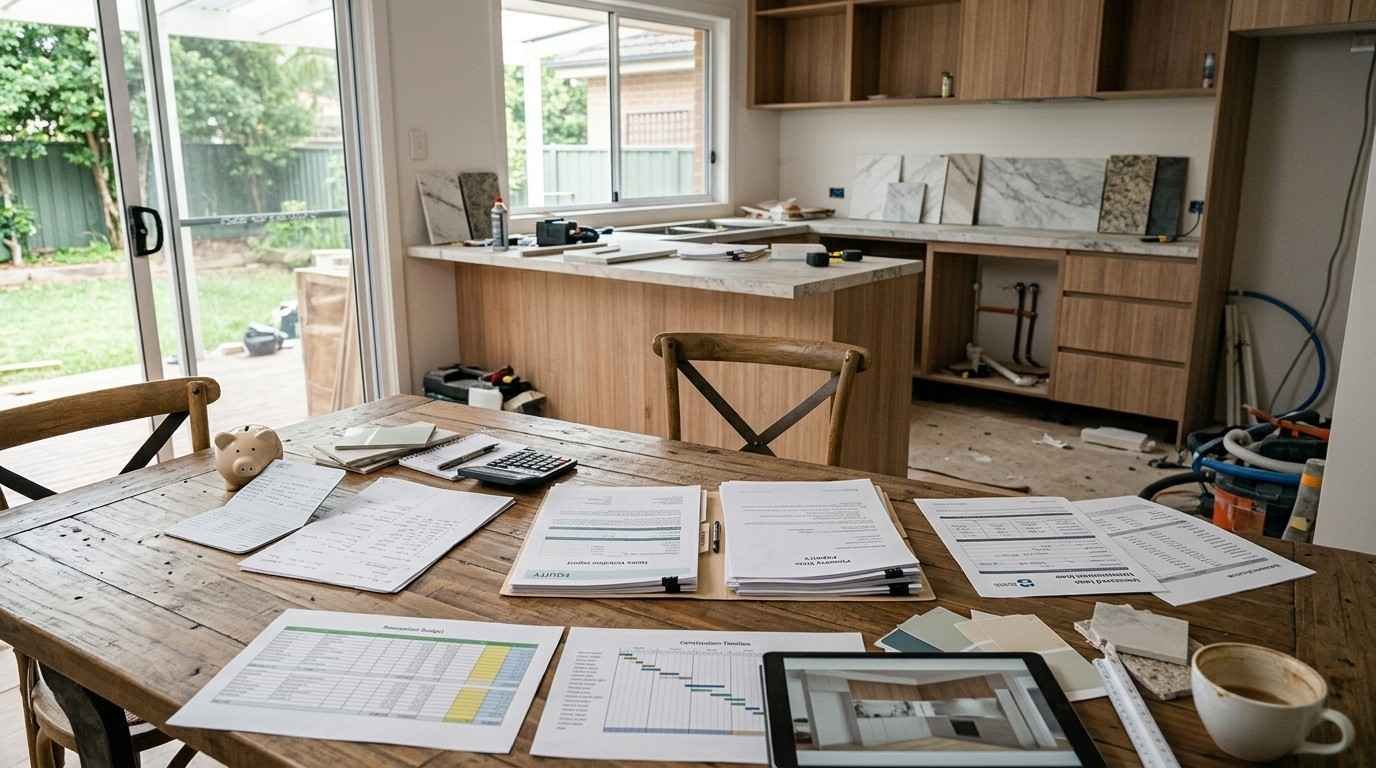
Paying for Renovations with Cash
Advantages of Cash Payment
Paying cash eliminates interest completely. A $30,000 bathroom renovation paid upfront costs exactly $30,000, while the same project financed over five years at 8% costs closer to $36,500.
Cash also buys you negotiating room. Plenty of renovation companies discount 5–10% for upfront or milestone-heavy payment, and you sidestep application fees, establishment charges, and ongoing account keeping costs entirely.
Budget control improves the moment repayments disappear from the equation. There is no rate rise waiting to reshape your household budget in eighteen months.
Disadvantages of Cash Payment
Draining savings creates real exposure. Emergency funds exist for job loss, medical bills, and the hot water system that fails the week after handover, and a renovation that swallows the buffer leaves you defenceless.
Opportunity cost matters more than most people calculate. That $30,000 in a high-interest savings account at 5% earns $1,500 a year, and invested across diversified funds it historically returns 7–10% over long horizons.
Cash also caps your scope. Savings that cover a cosmetic refresh fall short of a full reconfiguration, which forces you to compromise the bathroom renovation cost breakdown you actually need or delay the job.
When Cash Payment Makes Sense
Cash works best when you hold savings beyond six months of living expenses, your budget sits under $20,000, and you carry no higher-interest debt worth clearing first. It suits cosmetic updates far better than structural change.
Homeowners approaching retirement generally prefer cash to avoid carrying debt into non-working years. The same logic applies to anyone on variable income, where fixed monthly repayments create pressure in the quiet months.
Refinancing Your Mortgage for Renovations
How Mortgage Refinancing Works
Refinancing replaces your existing home loan with a new, larger one that absorbs the renovation cost. A homeowner owing $400,000 on a property worth $700,000 who needs $50,000 for the build refinances to a $450,000 loan.
Lenders assess your loan-to-value ratio, income stability, and credit history before approval. Most want LVR under 80% to avoid lenders mortgage insurance, though several accept higher ratios once you absorb the extra cost.
The process runs 4–8 weeks including valuation, document verification, and settlement. Building that window into your renovation project timeline prevents the scheduling collision we see most often.
Benefits of Refinancing for Renovations
Home loan rates sit well below personal loan rates. Mortgages currently run 6–7% against 8–15% on personal lending, and across a $50,000 renovation that spread saves thousands over the term.
Spreading the cost across 20 to 30 years keeps monthly repayments comfortable. A $50,000 addition at 6.5% over 25 years adds roughly $340 a month, against $1,000 or more monthly on a five-year personal loan.
Refinancing also reopens your entire mortgage for negotiation, not just the new portion. Switching lenders often trims your headline rate and offsets part of the renovation financing cost outright.
Drawbacks of Refinancing
Stretching the term means paying interest for far longer. That $50,000 renovation over 25 years at 6.5% costs about $85,000 in total repayments, against roughly $60,800 across five years at 8%.
Refinancing fees stack up fast:
- Discharge fee from your current lender: $150–$400
- Application fee on the new loan: $200–$600
- Property valuation: $200–$500
- Lenders mortgage insurance once LVR exceeds 80%: thousands
Your home secures the debt. Circumstances change, repayments stop, and the property carries that risk directly, which is exposure a personal loan simply does not create.
Ideal Candidates for Refinancing
Refinancing suits homeowners holding at least 20% equity, planning work above $30,000, and comfortable carrying long-term debt. It performs best when current market rates undercut the loan you already hold.
Property investors lean toward refinancing because renovation interest becomes deductible against rental income. Owner-occupiers renovating to sell inside two to three years usually find the long-term interest cost erases the benefit.
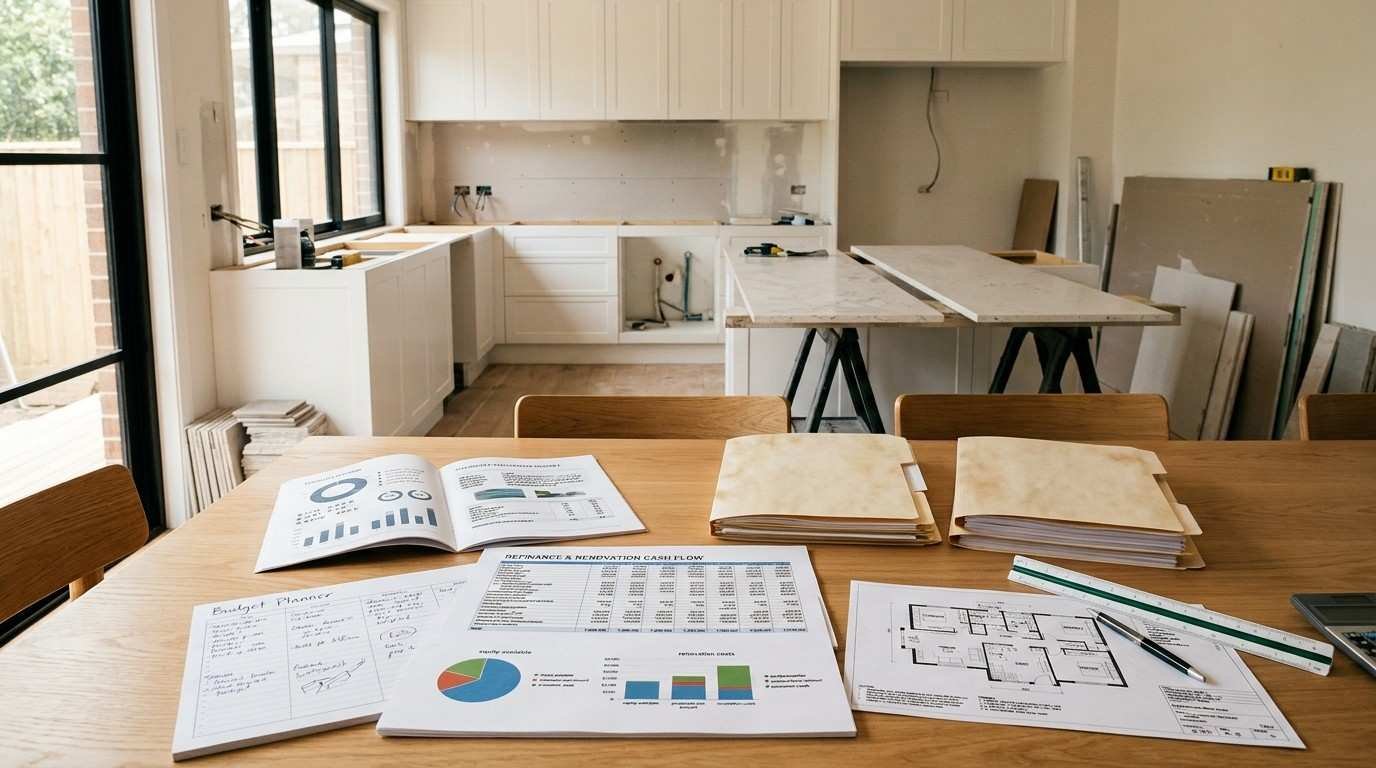
Using Personal Loans for Renovations
Personal Loan Fundamentals
Personal loans fund the work against your income and credit history rather than your property equity. Amounts typically run $5,000 to $75,000 across terms of one to seven years.
Approval moves fast, often inside 24–48 hours for strong credit profiles. Funds land directly in your account, so you pay contractors and suppliers without waiting on a settlement date.
Rates swing hard on credit score, loan size, and lender. Expect 7% at the excellent-credit end and 20% or more where there is credit history to explain.
Personal Loan Advantages
Speed is the whole argument.
A bathroom with active plumbing failure cannot wait six to eight weeks for a refinance to settle, and a personal loan puts money in place within days. Your home stays unencumbered, so missed payments damage your credit file while the lender holds no claim over the property.
Fixed terms create certainty. You know the exact end date and the exact payment, with none of the variable-rate drift that reshapes a mortgage mid-project.
Personal Loan Disadvantages
Higher rates inflate the total meaningfully. A $30,000 personal loan at 12% over five years costs around $40,000 in total repayments, against roughly $36,000 through a mortgage at 6.5%.
Borrowing caps restrict scope. Mortgages fund six-figure work comfortably while personal loans generally stop between $50,000 and $75,000, which rules out major structural or whole-home projects.
Shorter terms mean heavier monthly payments. That same $30,000 across five years demands about $670 a month, and household budgets feel that far more than a $340 mortgage increase.
When Personal Loans Work Best
Personal loans suit renovations between $10,000 and $40,000 where speed matters and you prefer to leave equity untouched. They fit homeowners with limited equity, those selling soon, and anyone unwilling to secure debt against the house.
First-time renovators frequently start here on smaller projects before considering refinancing for major work. The defined end date also appeals to anyone who wants the debt genuinely gone within a set window.
Comparing Total Costs Across Payment Methods
Cost Comparison: $25,000 Bathroom Renovation
Method | Total Cost | Monthly | Interest Paid | Fees | Best For |
Cash | $25,000 | $0 | $0 | $0 | Strong buffer, no competing debt |
Refinance (6.5%, 25 yrs) | ~$42,500 | ~$170 added | ~$17,500 | $800–$1,500 | Cash-flow priority over total cost |
Personal loan (10%, 5 yrs) | ~$31,800 | ~$530 | ~$6,800 | $200–$400 | Fast start, debt cleared quickly |
Cash also carries an opportunity cost of roughly $6,900 over five years at a 5% return, which is the number most people forget to put on the page.
Cost Comparison: $50,000 Major Renovation
Method | Total Cost | Monthly | Interest Paid | Fees | Best For |
Cash | $50,000 | $0 | $0 | $0 | Rare at this scale without draining reserves |
Refinance (6.5%, 25 yrs) | ~$85,000 | ~$340 added | ~$35,000 | $1,000–$2,000 | Long-term owners, staged major work |
Personal loan (10%, 7 yrs) | ~$69,600 | ~$830 | ~$19,600 | $300–$500 | Mid-term owners avoiding equity use |
Opportunity cost on the cash option climbs to roughly $13,800 across five years at 5%. At this scale the refinance total looks alarming, but the $340 monthly figure is what actually determines whether a household can carry it.
Hidden Costs to Consider
Interest is the visible cost. The ones that catch people out sit underneath it:
- Application and establishment fees: $200–$600 depending on lender
- Property valuation for equity-based products: $200–$500
- Lenders mortgage insurance once LVR passes 80%: often several thousand
- Break costs on exiting a fixed-rate mortgage early: potentially thousands
- Progress-draw or inspection fees on construction lending: $150–$400 per release
- Ongoing account keeping fees across the full loan term
Break costs deserve particular attention. Exiting a fixed-rate mortgage before term regularly runs into the thousands and wipes out every dollar of saving the new arrangement promised.
Your rate structure carries its own trade-off. Fixed rates lock your repayment for certainty during a build, variable rates keep extra repayments and redraw available, and splitting the loan across both gives you a portion of each.
Some lenders advertise fee-free products at slightly higher rates. Run both to total cost rather than comparing headline rates, because the cheaper rate loses surprisingly often on short terms.
Factors That Determine Your Best Option
Your Current Financial Position
Assess your emergency fund, existing debts, and monthly cash flow before you commit. Holding $50,000 in savings means little when only $10,000 of it sits beyond your emergency buffer, and a $30,000 cash renovation from that position is reckless.
Calculate your debt-to-income ratio. Lenders prefer it under 30–35%, and adding a personal loan or a larger mortgage pushes you past comfortable limits and dents future borrowing capacity.
Lenders also stress-test your application above the actual rate. Most assess your repayments at roughly 3% above the offered rate, so a 6.5% mortgage gets serviceability-tested near 9.5%, and that buffer decides your real borrowing ceiling.
Review your credit score before you apply anywhere. Scores above 700 unlock the best personal loan pricing, while anything under 600 narrows you to secured lending or high-rate products.
Your Renovation Timeline
Urgent repairs favour cash or a personal loan. Planned work with a flexible start date leaves room to refinance properly and shop rates.
Contractor availability is the constraint people underestimate. Your renovator holds a slot in three weeks, your refinance needs six, and you either lose the slot or pay a deposit you cannot yet fund.
Here is the seam where jobs actually go wrong. Trades need deposits and progress payments on a build schedule, lenders release funds on a settlement schedule, and those two calendars do not naturally align.
We map funding milestones against the bathroom renovation process before demolition starts, so nobody is waiting on a bank while a stripped room sits idle.
Your Property Plans
Homeowners selling within two to three years need to calculate whether the renovation plus financing charges returns in the sale price. Long-term financing against short-term ownership rarely stacks up.
Owners staying put spread the cost across a longer horizon, which makes refinancing far more attractive. Lower monthly payments preserve cash flow for other investments and everyday living.
Tax Implications
Investment property owners claim renovation financing costs as tax deductions. Interest on loans funding income-producing property renovations reduces taxable income and lowers the real cost of borrowing.
The distinction that catches investors out is repairs against capital improvements. Repairs restore something to its original condition and deduct immediately, while a new bathroom is a capital improvement that depreciates across decades instead.
Owner-occupiers receive nothing. The full interest cost comes out of after-tax income, which makes the true expense higher than the nominal rate suggests.
Alternative Financing Options Worth Considering
Home Equity Line of Credit (HELOC)
A line of credit gives you flexible access to equity without a full refinance. You are approved to a limit, draw funds as required, and pay interest only on what you have actually used.
This suits staged work where costs arrive progressively. Rather than borrowing $50,000 upfront, you draw $15,000 for demolition, $20,000 through construction, and the balance at fit-off.
Rates usually sit slightly above standard mortgage pricing and well below personal loans, with variable rate exposure and property security as the trade-offs.
Mortgage Redraw and Offset Funds
Homeowners ahead on mortgage repayments frequently hold renovation money they have forgotten about. Redraw pulls back the extra principal you have already paid, and it costs nothing beyond the interest you resume paying on that balance.
Offset funds work similarly without the paperwork. Money sitting in an offset account reduces the interest charged on your mortgage, and spending it on a renovation simply restores your interest bill to where it was.
Both options beat every other product on cost, because there is no application, no establishment fee, no valuation, and no new credit assessment. Check your redraw balance and offset position before you speak to a single lender.
The limit is availability. Redraw only holds what you have overpaid, so it covers a $12,000 refresh far more often than a $45,000 rebuild.
Government Rebates and Assistance Schemes
Some renovation work attracts government support that reduces what you need to borrow. Energy-efficiency programs across several states subsidise hot water system upgrades, insulation, and efficient appliances, and those rebates apply directly against components you were already funding.
Accessibility modifications carry separate assistance pathways. Homeowners renovating bathrooms for ageing in place or disability access frequently qualify for support that never appears in a standard renovation budget.
Check current state and federal programs before you finalise your loan amount. A $3,000 rebate on a hot water and insulation upgrade changes the borrowing figure, and applying after the work is complete usually disqualifies you.
Construction Loans
Purpose-built construction loans release funds in stages as milestones complete. The lender inspects progress before each release, which adds oversight and protects you against paying ahead of the work.
Progress draws typically follow slab, frame, lock-up, fit-off, and completion. On a bathroom that structure compresses awkwardly, because a bathroom moves from demolition to completion in three to five weeks rather than nine months.
These loans genuinely fit major structural renovations above $100,000. For a standard bathroom or kitchen upgrade the inspection requirements cost more in delay than they save in oversight.
Contractor Payment Plans and Buy Now Pay Later
Some renovation companies offer staged payment plans directly, spreading the cost across the build without a third-party lender. Terms vary widely, so confirm whether the plan carries interest, an admin fee, or a price loading built into the quote.
Buy now pay later products now extend to renovation-scale spending through several providers. They suit fixtures, tapware, and tiling purchases under $10,000 far better than whole-project funding.
Read the default terms carefully on any BNPL arrangement. Missed payments trigger fees that compound quickly, and several providers report defaults to credit bureaus.
We flag payment plan options at quoting stage rather than after contracts are signed, because the plan changes what scope you can realistically afford.
Credit Cards for Small Renovations
An interest-free period on a credit card funds minor work under $10,000 cleanly, provided you clear the balance inside the promotional window. A 12-month interest-free card effectively delivers free short-term finance.
This strategy demands discipline. Missing the promotional deadline triggers retrospective interest at rates regularly exceeding 20%, and the cheap option becomes the most expensive one on the list.
Making Your Final Decision
Decision Framework Questions
Work through these to clarify your position:
- Do you hold savings beyond six months of expenses?
- Is your renovation budget under $20,000 or over $40,000?
- Do you hold at least 20% equity in your property?
- Is your timeline flexible or urgent?
- Are you comfortable carrying long-term debt?
- Do you plan to stay in the property for five or more years?
Yes to questions 1 and 2 with a smaller budget points to cash. Yes across questions 3 to 6 with a larger budget points to refinancing. Mixed answers or genuine urgency points to a personal loan.
Matching Your Funding Method to Renovation ROI
Funding cost only matters against what the renovation returns. A well-executed bathroom typically recovers a strong share of its cost at sale, and the finishes that drive that return are waterproofing, layout, and tiling quality rather than tapware brand.
This is where cash funding quietly damages outcomes. Homeowners paying cash routinely trim the budget mid-project to protect their buffer, and the first casualties are the invisible items that determine whether the room lasts fifteen years.
Financing a slightly larger scope frequently returns more than paying cash for a compromised one. Weighing $6,800 of personal loan interest against skipping proper waterproofing makes the interest the cheaper line item.
We size funding to the scope the room actually needs, then work backward to the product that carries it. Getting that order right protects both the long-term value of the renovation and the finish quality you paid for.
Common Mistakes to Avoid
Underestimating cost causes mid-project funding shortfalls. Add 15–20% contingency before you select a financing method, so a $30,000 estimate gets funded as a $35,000 project.
Choosing on interest rate alone ignores total cost. A lower rate across 25 years costs far more than a higher rate across five, so calculate total repayments rather than comparing monthly figures.
Failing to compare lenders leaves money on the table. Rate differences of 0.5–1% between lenders translate to thousands across the term, and an afternoon of shopping pays for itself many times over.
Steps to Take Next
- Finalise your renovation scope and obtain detailed itemised quotes
- Add 15–20% contingency to the total before you approach any lender
- Check eligibility for any government rebate that offsets your borrowing
- Assess your savings, equity, redraw balance, and credit position
- Compare at least three lenders for your chosen financing method
- Calculate total cost including every fee, not just the headline rate
- Align funding approval dates with your contractor’s build schedule
Conclusion
Selecting the right payment method balances immediate cost against long-term financial impact. Cash removes interest but drains reserves, refinancing delivers low rates while extending the debt, and personal loans buy speed at premium pricing.
Your optimal choice comes down to renovation scale, available equity, timeline urgency, and your comfort with debt. Most Sydney homeowners we work with land on refinancing for major renovations above $40,000, and personal loans for mid-range projects that need to start quickly.
At Sydney Home Renovation, we build the funding schedule and the construction schedule together, so your money arrives when the trades do and your scope never gets cut at waterproofing stage. Talk to our team about your bathroom renovation and we will give you the itemised, transparent pricing you need before you commit to any lender.
Frequently Asked Questions
Is it better to pay cash or finance a renovation?
Cash removes interest entirely and strengthens your negotiating position. Financing protects your emergency fund and often returns more if those savings stay invested. Compare your buffer against opportunity cost.
Can I refinance my mortgage just for renovations?
Yes. Most lenders refinance specifically to release equity for renovations. You need roughly 20% equity, stable income, and acceptable credit. Expect four to eight weeks including valuation and verification.
What credit score do I need for a renovation loan?
Personal loan approval generally starts around 600, with the sharpest rates reserved for scores above 700. Refinancing applies similar thresholds. Check your credit file and fix errors before applying.
How much can I borrow for home renovations?
Limits depend on the product. Personal loans generally cap between $50,000 and $75,000, while refinancing accesses your full available equity. Lenders weigh income, existing debts, and repayment capacity.
Should I use a HELOC or personal loan for renovations?
A line of credit offers lower rates and flexible drawdown but secures against your home. Personal loans cost more and stay unsecured. Choose the line of credit for staged work, the loan for defined projects.
What happens if renovation costs exceed my loan amount?
Mid-project shortfalls cause serious problems. Prevent them by adding 15 to 20% contingency before financing. Remaining options include additional borrowing, credit cards for small gaps, or reducing finish specifications.
Can I claim tax deductions on renovation financing?
Investment property owners deduct interest on loans funding rental property renovations. Owner-occupiers receive no deduction. Speak with an accountant about deductions that apply to your specific ownership situation.