A full bathroom renovation in Sydney costs between $15,000 and $35,000, and most of the homeowners we work with land around $20,000 to $25,000 for a standard family bathroom. The final figure comes down to four things: the size of the room, the quality of materials, whether the layout changes, and what we find once the walls come off. Small cosmetic refreshes start near $8,000, and luxury builds with premium finishes pass $50,000.
We wrote this because budget blowouts almost always trace back to a number nobody explained at the start. Knowing the real breakdown before you commit is what keeps a project on track.
Below we break down every cost component, the hidden expenses that catch people out, the week-by-week payment schedule, and where we tell clients to spend and where to save.
Average Bathroom Renovation Costs in Sydney
Sydney bathroom costs move with size, scope, and finish quality. Here is the quick reference we give clients at the first site visit.
| Bathroom Type | Size | Budget Tier | Mid-Range | Premium |
| Small / ensuite | Under 5m² | $8,000–$12,000 | $15,000–$18,000 | $20,000–$25,000 |
| Medium family | 5–8 m² | $18,000–$22,000 | $22,000–$28,000 | $28,000–$35,000 |
| Large | Over 8 m² | $25,000–$32,000 | $32,000–$42,000 | $45,000–$60,000 |
| Ensuite (standalone) | 3–6 m² | $12,000–$16,000 | $16,000–$19,000 | $19,000–$22,000 |
Small Bathroom Renovation Costs (Under 5m²)
Small bathrooms in apartments and ensuites cost $12,000 to $20,000 for a complete renovation. The compact footprint saves on materials, but it demands sharper planning to keep the room functional.
Labour barely moves. We still complete full waterproofing, full tiling, and full fixture installation regardless of how small the room is.
Budget refreshes covering new tiles, vanity, toilet, and tapware start near $8,000 to $12,000. Mid-range work with quality fixtures and semi-frameless screens lands at $15,000 to $18,000, and premium small bathrooms with designer tiles, wall-hung toilets and frameless glass reach $20,000 to $25,000.
Plumbers, electricians and tilers charge the same day rate in a 4m² room as an 8m² one. That makes labour the dominant cost in every small bathroom we quote.
Medium Bathroom Renovation Costs (5–8m²)
Medium bathrooms are the most common job on our books, running $18,000 to $30,000 for a full transformation. These rooms include a shower, bath, vanity, toilet, and storage, which is the standard family configuration.
Builder-grade materials and standard fixtures cost $18,000 to $22,000. Quality tiles, semi-custom vanities and good fixture brands run $22,000 to $28,000, and premium materials with custom joinery reach $28,000 to $35,000 or more.
This is also the most competitive bracket in Sydney, which works in your favour when you collect quotes. Contractors compete hardest here, particularly through the quieter winter months.
Large Bathroom Renovation Costs (Over 8m²)
Large bathrooms over 8m² cost $25,000 to $50,000 and above, driven by layout complexity more than floor area. These rooms usually separate the shower and bath, add a double vanity, and sometimes carve out a separate toilet.
Standard finishes start at $25,000 to $32,000. Mid-to-high projects with premium tiles, stone benchtops and custom cabinetry cost $32,000 to $42,000, and luxury builds with underfloor heating and smart controls pass $45,000 to $60,000.
Materials scale with size, but labour does not scale evenly. A bathroom twice the size never costs twice as much, because demolition setup, waterproofing mobilisation and compliance work stay fixed.
Bathroom Renovation Cost Per Square Metre
Per-square-metre pricing is the fastest way to sanity-check a quote. Across the Sydney jobs we price, full renovations run $3,000 to $4,500 per square metre for standard work and $5,000 to $7,000 per square metre at the premium end.
A 6m² family bathroom at $3,800 per square metre works out to roughly $22,800, which matches the mid-range figure in the table above.
Use this as a cross-check, not a quoting method. Per-metre rates fall as rooms get larger because the fixed costs spread further, so a 10m² bathroom rarely hits the same rate as a 4m² ensuite.
Full Renovation vs Partial Update: Cost Comparison
Not every dated bathroom needs a strip-out. We split the decision on whether the waterproofing membrane is still sound.
| Scope | What It Covers | Typical Cost | Lifespan |
| Cosmetic refresh | Paint, tapware, vanity, accessories, mirror | $4,000–$8,000 | 5–8 years |
| Partial update | Above plus new shower screen, retile shower recess only | $8,000–$14,000 | 8–12 years |
| Full renovation | Complete strip-out, new waterproofing, full retile, all fixtures | $18,000–$35,000 | 20+ years |
A partial update makes sense when the membrane passes inspection, and the layout works. Once we find failed waterproofing, and we find it often in bathrooms over fifteen years old, a partial job becomes a false economy because we tear out the new tiles within a few years.
Ensuite vs Main Bathroom Cost Differences
Ensuites cost 10 to 20 percent less than main bathrooms of the same size. A standard ensuite runs $12,000 to $22,000 against $15,000 to $28,000 for a comparable main bathroom.
The savings come from three places. Ensuites are usually shower-only, which removes $800 to $3,000 of bath purchase and installation; single basins save $500 to $1,500 against doubles, and the plumbing runs shorter with less pipe relocation.
Master ensuites sometimes flip that logic. When clients match the ensuite finish to a premium bedroom, the cost equals or passes the main bathroom.
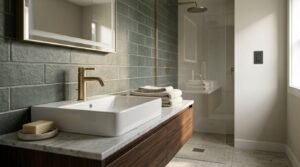
Complete Bathroom Renovation Cost Breakdown
Here is where the money actually goes on a typical Sydney bathroom.
Labour Costs and Trade Pricing
Labour is 40 to 50 percent of the total, or $8,000 to $15,000 on a standard bathroom. Six trades pass through the room in sequence: demolition, plumbing, electrical, waterproofing, tiling and painting.
Sydney trade rates run roughly $80 to $120 per hour for plumbers, $75 to $110 for electricians, $45 to $80 for tilers and $50 to $90 for waterproofers, according to ServiceSeeking’s Australian trade pricing data. Most of us quote per job rather than hourly.
Priced by task, plumbing rough-in and installation runs $2,500 to $4,500, electrical $1,500 to $3,000, waterproofing $1,200 to $2,000, and tiling $3,000 to $6,000.
Sequencing is where money quietly disappears. When trades arrive out of order or overlap badly, rework and call-backs add 15 to 25 percent to the labour line, and that is the cost nobody puts in a quote.
Demolition and Preparation Costs
Demolition and site prep cost $1,500 to $3,500 depending on size and what sits behind the walls. That covers fixture removal, tile stripping, cabinetry removal, and waste disposal.
Basic strip-out of a standard bathroom runs $1,500 to $2,000. Complex demolition involving full wall and floor tile removal, a cast iron bath, or built-in joinery costs $2,500 to $3,500.
Waste disposal is the line clients forget. Skip bins for bathroom waste cost $300 to $600, and some contractors bundle it while others bill separately, so we always confirm it in writing before work starts.
Prep work covers substrate repair, floor levelling, and wall correction before the membrane goes down. Skimping here is what causes cracked tiles and failed waterproofing two years later, so we budget $500 to $1,500 for it every time.
Plumbing and Electrical Work Expenses
Plumbing costs $2,500 to $5,000 across rough-in, fixture installation, and final connections. Keeping fixtures in their existing positions is the single biggest saving available on this line.
Basic work installing new tapware, toilet, and shower without moving pipes costs $2,500 to $3,500. Relocating a vanity or switching to a wall-hung toilet pushes it to $3,500 to $4,500, and moving the shower or adding a bath runs $4,500 to $6,000 and above.
Electrical costs $1,500 to $3,000 for lighting, exhaust wiring, heated towel rails, and bringing the circuit up to current standards. New lights and a fan alone cost $1,500 to $2,000, while downlights, underfloor heating, or smart controls take it to $2,500 to $3,500.
Bathrooms carry specific electrical zoning rules under the National Construction Code, covering IP ratings for wet areas and RCD protection. That work is not negotiable, and unlicensed electrical work voids your home insurance.
Waterproofing and Tiling Costs
Waterproofing costs $1,200 to $2,500, and it is the most important money you spend in the room. A failed membrane means water in the subfloor, mould in the framing, and a repair bill in the tens of thousands.
Shower and wet-zone waterproofing costs $1,200 to $1,800. Full floor and wall coverage to required heights runs $1,800 to $2,500.
The work is governed by AS 3740, the Australian Standard for waterproofing domestic wet areas, which sets minimum membrane heights, fall to waste, and substrate requirements. Your waterproofer must be licensed and must issue a compliance certificate on completion.
Keep that certificate. Without it, you have no warranty claim, no insurance position, and a problem at resale.
Tiling costs $3,000 to $8,000 depending on tile format, pattern, and coverage. Budget tiles with standard layout cost $3,000 to $4,500, feature walls and decorative patterns run $4,500 to $6,500, and large-format or complex patterns reach $6,500 to $10,000 and above.
Fixtures and Fittings Budget Allocation
Fixtures and fittings cost $3,000 to $12,000 depending on tier. This is the most elastic line in the whole budget and the first place we look when a quote needs to come down.
| Tier | Vanity | Toilet | Shower Screen | Tapware | Total |
| Budget | $500–$1,200 | $200–$400 | $400–$800 | $300–$600 | $3,000–$5,000 |
| Mid-range | $1,200–$2,500 | $400–$700 | $800–$1,500 | $600–$1,200 | $5,000–$8,000 |
| Premium | $2,500–$5,000 | $700–$1,500 | $1,500–$3,000 | $1,200–$2,500 | $8,000–$15,000 |
Budget fixtures work reliably; they just lack refinement and water-saving features. Mid-range is where we send most owner-occupiers, because the durability jump from budget is large and the jump to premium is mostly aesthetic.
Finishing Touches and Paint Costs
Finishing work costs $800 to $2,000, and it is what separates a professional job from an obvious one.
Painting ceilings and non-tiled walls costs $500 to $1,000, using moisture-resistant paint. Silicone sealing around fixtures, screens, and tile junctions adds $200 to $400, and poor sealing is a leading cause of early mould.
Final cleaning to remove dust and tile haze costs $150 to $400. Small adjustments like door trimming, hardware fitting, and mirror hanging add $200 to $500.
Bathroom Renovation Timeline and Payment Stages
Cost and schedule are the same conversation, because money leaves your account as each stage is completed. A standard bathroom takes two to four weeks, and here is how the spending sequences against it.
| Stage | Timing | Work Completed | Typical Payment |
| Contract | Day 0 | Signing, ordering, scheduling | 10–20% deposit |
| Demolition and prep | Days 1–3 | Strip-out, waste removal, substrate repair | — |
| Rough-in | Days 4–7 | Plumbing and electrical in walls, inspection | 30% progress payment |
| Waterproofing | Days 8–10 | Membrane applied, cured, certified | — |
| Tiling | Days 10–15 | Floor and wall tiling, grouting | 30% progress payment |
| Fit-off | Days 16–20 | Fixtures, screens, tapware, joinery | — |
| Completion | Days 20–25 | Painting, sealing, cleaning, certificates | 10–20% final |
On a $25,000 bathroom, that means roughly $4,000 at signing, $7,500 around day seven, another $7,500 at tiling completion, and $3,750 held back until every certificate is in your hand.
We tell clients to plan cash flow against this table, not against the total. The stall we see most often is a homeowner with the full budget available in three months but not in week two.
Weather rarely delays interior bathroom work, but material lead times do. Custom vanities and imported tiles add two to six weeks before demolition starts, so order early and stage the job around delivery.
Material Quality and Budget Tiers
Material choice drives both the upfront figure and how the room looks in eight years.
| Material | Budget | Mid-Range | Premium |
| Wall and floor tiles (per m²) | $25–$45 | $50–$90 | $100–$250+ |
| Tile installation (per m²) | $45–$60 | $60–$75 | $75–$100 |
| Vanity unit | $300–$800 | $1,200–$2,500 | $2,500–$6,000+ |
| Vanity top | $200–$400 | $400–$800 | $1,200–$2,500 |
| Total material spend | $4,000–$7,000 | $7,000–$12,000 | $12,000–$25,000+ |
Budget-Friendly Materials ($8,000–$15,000)
Budget-tier work uses reliable materials without design refinement, and total materials land at $4,000 to $7,000.
Entry-level ceramic and porcelain tiles cost $25 to $45 per square metre. On a bathroom needing 20 to 25 m² of tiling, that is $500 to $1,100 in tile alone.
Flat-pack and basic pre-assembled vanities cost $300 to $800 in melamine or laminate. Entry-level toilets, tapware and framed screens add $1,500 to $2,500 combined.
We specify this tier for rental properties and quick turnarounds where function beats finish. Expect five to ten years of reliable service before wear shows.
Mid-Range Quality Materials ($15,000–$25,000)
Mid-range is where we send most owner-occupiers, with materials at $7,000 to $12,000.
Quality porcelain at $50 to $90 per square metre delivers real durability and design range, and a feature wall at $100 to $150 per square metre over a small area adds impact cheaply. Semi-custom vanities at $1,200 to $2,500 bring stone tops, soft-close drawers and better carcass construction.
Quality toilets, good tapware brands and semi-frameless screens run $4,000 to $7,000 combined. This tier holds its appearance for ten to fifteen years.
Mid-range renovations also return the strongest share of investment in added property value, according to the Housing Industry Association.
Premium and Luxury Materials ($25,000+)
Premium work uses large-format tiles, natural stone and custom joinery, with materials from $12,000 to $25,000 and up.
Large-format porcelain, stone and designer ceramics cost $100 to $250 per square metre, and marble or terrazzo feature walls reach $200 to $400 per square metre. Custom vanities built to your exact opening cost $4,000 to $8,000 and above.
Designer toilets, luxury tapware and frameless screens run $8,000 to $15,000 and above. Luxury extras stack on top: underfloor heating at $1,500 to $3,000, demisting smart mirrors at $800 to $2,000, and designer lighting at $1,000 to $3,000.
This tier suits high-value properties where the bathroom materially affects the sale price, and it holds up for fifteen to twenty years and beyond.
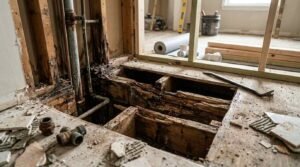
Hidden Costs That Blow Bathroom Budgets
Unexpected costs derail more bathroom budgets than any other factor. Every item below sits behind a wall or under a floor, invisible until demolition day.
Structural Issues and Unexpected Repairs
Structural problems found during demolition add $2,000 to $8,000 and above. Nobody prices these accurately upfront, because nobody can see them.
Water damage from old leaks is the most common find, and it concentrates in subfloors and wall framing. Rotted floor joists cost $1,500 to $4,000 to repair, wall framing runs $800 to $2,500, and damage needing an engineer’s assessment adds $3,000 to $8,000 and above.
In our experience, a meaningful share of bathrooms over twenty years old carry some level of concealed water damage, and pre-1990 homes carry more because membrane standards were weaker.
Freestanding baths bring their own problem. Filled, they weigh 300 to 500kg, and older floor structures need reinforcement costing $1,000 to $3,000 before we install one.
Asbestos Removal and Remediation
Asbestos removal costs $1,500 to $5,000 depending on material and extent. Homes built before 1990 commonly carry it in wall sheeting, floor tiles, and tile adhesive.
Testing costs $150 to $400 per sample. A single wall sheet removal runs $1,500 to $2,500, and multiple walls plus floor tiles reach $3,000 to $5,000 and above.
SafeWork NSW prohibits unlicensed removal of bonded asbestos above 10 m², and even small quantities require correct procedure, licensed disposal and a clearance certificate.
Budget the time as well as the money. Testing, removal and clearance add one to two weeks to the program, which matters if you have booked temporary accommodation.
Compliance and Council Approval Fees
Compliance costs add $500 to $2,000. Frustrating, and completely unavoidable.
Structural changes, plumbing alterations and electrical upgrades trigger approval. A Complying Development Certificate costs $800 to $1,500 and moves faster than a full Development Application.
Certificates come separately: plumbing at $150 to $300, electrical at $100 to $250, and waterproofing at $200 to $400. Independent inspections during the build cost $300 to $600 and are worth it on any job over $20,000.
Strata adds another layer. Application fees run $200 to $500, insurance updates are common, and we check the bylaws before quoting any apartment.
How Sydney Location Affects Renovation Cost
Where the bathroom sits in Sydney changes the price by 10 to 15 percent on otherwise identical jobs.
Inner-city and eastern suburbs carry higher trade rates and tighter site access. Terrace houses with no off-street parking, narrow hallways and no side access mean every tile and every bag of waste moves by hand, and that adds labour hours to demolition and delivery.
Apartments above the ground floor add lift bookings, restricted work hours and building manager sign-off, which extends the program by days. Western and south-western suburbs generally price lower on labour with easier access and parking.
Waste disposal also shifts by council area. Skip placement on a busy inner-city street sometimes needs a permit that a suburban driveway does not.
Temporary Bathroom Arrangements
Losing your only bathroom for two to four weeks carries real cost.
Portable toilet hire runs $150 to $250 per week. Gym memberships for shower access cost $20 to $40 per week, which is the cheapest workable option for most households.
Moving out costs the most: $500 to $2,000 and above per week with family, friends, or a short-term rental. Eating out more because the house is chaos adds another $200 to $500 weekly for a family.
Plan this before demolition day, not during it.
The Five Mistakes That Cost Renovators the Most
Across the jobs we take over from other builders, the same five errors repeat. Moving plumbing without a structural reason adds $2,000 to $3,000 for a layout change nobody notices afterwards.
Choosing tiles after the trades are booked stalls the program and burns call-out fees. Accepting a quote without a written scope creates variation disputes at the worst possible moment.
Skipping the independent inspection saves $400 and costs far more when a defect surfaces after final payment. Paying more than 20 percent upfront removes every piece of leverage you have.
Cost-Saving Strategies Without Compromising Quality
Good budget management is about where you cut, not how much.
What to Splurge On for Long-Term Value
Spend on anything that fails expensively or that you touch every day.
Waterproofing takes priority over everything. Quality work at $1,800 to $2,500 protects against $20,000 to $50,000 in water damage repair, and we never let a client trim this line.
Tapware justifies the spend. Quality tapware at $600 to $1,500 lasts 15 to 20 years against five to eight years for budget alternatives, and it is a genuine false economy at the bottom end.
Shower screens earn their premium too. Frameless and semi-frameless units at $1,200 to $2,500 stay clear and square far longer than budget framed screens.
Vanities sit in the same category at $1,500 to $3,000. You open those drawers twice a day for a decade.
Where You Can Safely Cut Costs
Savings live in the decorative layer, not the structural one.
Use premium tile as a feature wall and budget tile elsewhere. That single move delivers most of the visual impact at 30 to 40 percent less than premium tile throughout.
Accessories are pure flexibility. Mid-range towel rails, roll holders, and hooks at $300 to $500 function identically to premium versions at double the price.
Vanity tops save well through material choice. Laminate or engineered stone at $300 to $800 replaces natural stone at $1,200 to $2,500 with similar appearance and better stain resistance.
Standard downlights at $400 to $800 do the same job as designer fittings at $1,200 to $2,000. Mid-range bathroom paint at $60 to $100 per 4L performs almost identically to premium at $100 to $150.
DIY vs Professional Work: The Real Cost Comparison
DIY saves labour and costs time. The split is about risk, not skill.
Safe DIY covers demolition, saving $1,000 to $2,000, painting at $500 to $1,000, and basic prep at $300 to $600. These tasks forgive mistakes.
Tiling, waterproofing, plumbing, and electrical do not. Errors cost $3,000 to $10,000 and above to rectify, void insurance, and breach licensing requirements, and licensed trades carry warranties that DIY never will.
Tools add $300 to $1,000 for one-time use. Hiring cuts that, though it adds scheduling pressure.
The hybrid approach works best. Handle demolition and painting yourself, hire licensed trades for everything technical, and save $2,000 to $4,000 without risking compliance.
Timing Your Renovation for Better Pricing
Timing moves the number more than most people expect.
Late autumn and winter, roughly May through August, prices are 10 to 20 percent better because contractor demand falls. Trades value consistent work over peak rates and negotiate accordingly.
Supplier promotions cut 15 to 30 percent off fixtures, tiles, and accessories, and planning purchases around them saves $1,000 to $3,000. End-of-range clearances go further at 30 to 50 percent off when you stay flexible on style.
Trade accounts save another 10 to 15 percent on materials, which is a saving your contractor passes on. Spring and early summer, September through December, are the expensive window with the longest waits.
How to Budget and Plan Your Bathroom Renovation
Good budgeting starts before any design decision.
Setting a Realistic Renovation Budget
Set the number against your finances, not your Pinterest board.
The working rule is 5 to 10 percent of property value. An $800,000 home supports $40,000 to $80,000 across bathrooms, and a $500,000 property supports $25,000 to $50,000.
Fund it from savings, an offset, or a home equity facility at 5 to 7 percent. Credit cards at 15 to 25 percent add a quarter to the total project cost, and we have watched that turn a good renovation into a bad financial year.
Collect three to five quotes to establish real market pricing and expose the outliers. Then split your list into must-haves like waterproofing, functional fixtures, and storage, against nice-to-haves like underfloor heating and designer tapware.
Track everything in one spreadsheet: estimate, quote, actual. That document is what stops overspending.
Building in a Contingency Fund (15–20%)
Contingency is not optional. Every bathroom produces at least one surprise.
Standard contingency is 15 to 20 percent of the total. A $25,000 renovation needs $3,750 to $5,000 set aside for structural repair, extra materials, and small scope changes.
Older homes, heritage properties, and any job with structural changes need 20 to 30 percent. These uncover more.
Ring-fence it. Contingency is not an upgrade budget, and the moment it funds a better vanity, it stops protecting the project.
Whatever remains at completion goes to furnishings or back to savings.
Getting Accurate Quotes from Contractors
A vague quote is the origin of most renovation disputes.
Every quote we issue itemises labour, materials and inclusions. A single line reading “bathroom renovation: $25,000” gives you nothing to hold anyone to.
Ask for the breakdown across demolition, plumbing, electrical, waterproofing, tiling, fixtures, painting and project management. Then compare like with like, because a $20,000 budget-material quote is not comparable to a $25,000 premium-fixture quote.
Check the exclusions hardest. Waste removal, council fees, compliance certificates, and warranty terms hide $1,500 to $3,000 of real cost when they sit outside the quoted figure.
How to Verify a Bathroom Renovator’s Licence
Licence verification takes four minutes and protects the entire spend.
NSW Fair Trading maintains a public licence check where you enter the contractor’s name or licence number and see the class, expiry, and any disciplinary history. Confirm the licence class actually covers the work, because a general builder’s licence and a plumbing licence are different things.
Any residential work over $20,000 in NSW requires home building compensation cover, and the certificate must be in your name before work starts. Ask for the certificate of currency on public liability insurance too.
Unlicensed work voids your insurance and leaves you with no statutory warranty. There is no recourse worth having after the fact.
Get the contract in writing covering scope, timeline, payment schedule, and how variations get approved and priced. Verbal agreements protect nobody.
Payment Schedules and Milestone Planning
Structured payments protect both sides.
The standard structure runs a 10 to 20 percent deposit at signing, progress payments of 30 to 40 percent at defined milestones, and a 10 to 20 percent final payment on completion.
Tie every payment to completed work rather than a calendar date. Demolition done, rough-in passed, waterproofing certified, fixtures installed and functional.
Never pay more than 20 percent upfront. A contractor asking for 50 percent before starting has a working capital problem, and that becomes your problem.
Hold the final payment until every certificate is delivered and the punch list is closed. That retention is your only real leverage.
Photograph each milestone and confirm approvals in writing.
Accessible Bathroom Renovation Costs
Accessible and ageing-in-place bathrooms cost $3,000 to $8,000 above a standard renovation of the same size.
The main additions are a hobless or level-entry shower requiring floor recessing at $1,500 to $3,000, structural noggins and compliant grab rails at $400 to $1,200, and widened doorways at $800 to $2,000. Slip-resistant tiling and a wall-hung vanity with clearance underneath add another $500 to $1,500.
We recommend building in the wall reinforcement even when rails are not going in yet. Adding noggins during the strip-out costs almost nothing, and retrofitting them later means opening finished tiled walls.
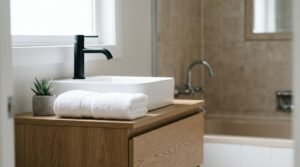
Return on Investment: What Adds Property Value
Bathroom renovations are among the most reliable home improvements for recovering spend.
Renovations That Increase Resale Value
Strategic bathroom work returns 60 to 85 percent of the investment in added value.
Dated properties return the most. Updating a bathroom from the 1980s or 1990s adds materially more value than refreshing something already contemporary, because the buyer is pricing in a renovation they no longer have to do.
Mid-range quality attracts the broadest buyer pool. Excessive luxury narrows it, and it rarely returns the full spend.
Functional wins matter as much as finishes. Storage, lighting and ventilation solve the complaints buyers actually voice at inspections, and a bathroom that reads as cramped or dark drags the whole property.
Adding a second bathroom to a one-bathroom home is the strongest move available. In Sydney markets, that addition adds well beyond the $25,000 to $40,000 it costs to build, and it often unlocks a different buyer bracket entirely. Expanding the footprint to fit one is a larger project, and home extension costs follow different planning and structural rules than a bathroom fit-out.
Owner-Occupier vs Investment Property Considerations
The right renovation depends entirely on who uses the room.
Owner-occupiers buy daily satisfaction. You use that bathroom every morning for a decade, so quality and layout outrank pure ROI, and mid-to-premium work at $20,000 to $35,000 balances enjoyment against value retention.
Investors buy durability and low maintenance. Tenants want function, landlords want nothing to break, and budget-to-mid work at $12,000 to $22,000 delivers both while protecting yield.
Renovated bathrooms command higher rent and shorter vacancy. A $15,000 renovation lifting weekly rent by $30 to $50 returns 10 to 17 percent annually on the renovation spend alone.
Investment renovations also carry depreciation benefits. Talk to your accountant about the schedule before you start, because timing the work across financial years changes the outcome.
Schedule investor work between tenancies. Renovating during a vacancy costs nothing in lost rent and hands the new tenant a finished room.
Over-Capitalisation Risks to Avoid
Over-capitalisation destroys the return, and it happens quietly.
A $60,000 luxury bathroom in a $700,000 suburb adds perhaps $30,000 to $40,000 in value. That is a $20,000 to $30,000 loss written into the property.
Heavy customisation narrows your buyer pool. Unusual layouts and niche features please you and deter everyone else.
Mismatched quality is the most common version. A premium bathroom in a house with a dated kitchen and worn flooring returns almost nothing, because buyers price the property as a whole. A staged whole home renovation spreads the same budget across the rooms that actually move the valuation.
Every suburb has a ceiling price. Research recent comparable sales before committing, because renovations that push past that ceiling meet buyer resistance no matter how good the work is.
Keep the bathroom spend at 5 to 10 percent of property value, and the proportions stay sensible.
Conclusion
Bathroom renovation costs in Sydney run from $12,000 for basic updates to $50,000 and above for luxury transformations, with most homeowners landing at $20,000 to $30,000 for quality mid-range work. Understanding the breakdown across labour, materials, fixtures, and hidden costs is what turns a guess into a budget.
The planning does the heavy lifting. Protect the waterproofing line, spend on the fixtures you touch daily, hold 15 to 20 percent contingency, and tie every payment to verified completed work rather than a date on a calendar.
We built Sydney Home Renovation around transparent pricing and honest scope, because we would rather explain a number upfront than defend a variation later. Contact us for a detailed, itemised quote on your bathroom, and we will walk you through exactly where every dollar goes before you commit to anything.
Frequently Asked Questions
How much does it cost to renovate a bathroom in Sydney in 2026?
A complete bathroom renovation costs $15,000 to $35,000. Small bathrooms start near $12,000, and large or premium bathrooms reach $50,000 and above depending on materials and structural changes.
What is the most expensive part of a bathroom renovation?
Labour, at 40 to 50 percent of the budget or $8,000 to $15,000. That covers plumbers, electricians, tilers, waterproofers, and painters working in sequence across two to four weeks.
How long does a full bathroom renovation take?
Two to four weeks from demolition to completion. Straightforward jobs finish in 10 to 14 days, and complex projects with structural work or custom joinery run four to six weeks.
Do I need council approval for a bathroom renovation in Sydney?
Structural changes, plumbing relocation, and electrical upgrades require approval, usually through a Complying Development Certificate. Straight fixture swaps and retiling without moving plumbing generally do not.
Can I renovate a bathroom for under $10,000?
Yes, for cosmetic work only: paint, tapware, vanity, toilet and accessories. That budget excludes full retiling, waterproofing renewal, and any plumbing relocation.
Should I move out during a bathroom renovation?
Only if it is your sole bathroom. Most clients stay put using another bathroom, a gym membership at $20 to $40 weekly, or portable toilet hire at $150 to $250 weekly.
How much should I budget for unexpected costs?
Set aside 15 to 20 percent of the total, or 20 to 30 percent for homes built before 1990. On a $25,000 job, that means $3,750 to $5,000 held in reserve.
What fixtures should I prioritise in my budget?
Waterproofing first at $1,800 to $2,500, then tapware at $600 to $1,500 and shower screens at $1,200 to $2,500. Save on decorative tiles, accessories, and lighting instead.
Is it worth hiring a project manager for a bathroom renovation?
Project management costs $2,000 to $5,000 and suits complex jobs or first-time renovators. Most quality contractors, ourselves included, build coordination into the quote already.
Is it cheaper to renovate or replace a bathroom?
Renovating an existing bathroom always costs less than building a new one. A new bathroom adds framing, new plumbing runs, and often structural work, pushing costs to $25,000 to $45,000.