
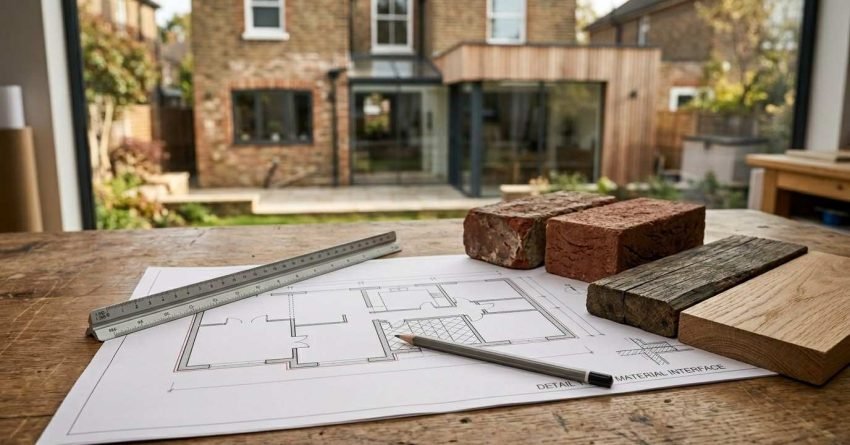
Designing a home extension that looks like it was always there requires deliberate decisions about architectural style, materials, proportion, and detailing, made in the right order before a single wall goes up. When these decisions are made well, the result is a home that feels cohesive, adds genuine value, and earns compliments rather than questions. When they are made poorly, the extension looks exactly like what it is: something added on.
Getting this right matters more than most homeowners realise at the planning stage. A mismatched extension reduces street appeal, complicates future sales, and costs significantly more to correct than to prevent.
This guide walks through every major design decision, from reading your home’s architectural style to matching materials, managing scale, and coordinating with your design and build team, so your extension integrates rather than intrudes.
Why Matching Your Extension to Your Existing Home Matters
A home extension that clashes with the original structure does not just look out of place. It signals to buyers, neighbours, and councils that the work was done without care. In Sydney’s competitive property market, visual cohesion between old and new construction is one of the clearest indicators of quality workmanship and considered design.
Beyond aesthetics, blending matters for structural and regulatory reasons. Extensions that ignore the original home’s proportions, setbacks, or material palette attract council scrutiny, complicate development approval, and create long-term maintenance problems where two different material systems meet.
Getting the blending strategy right from the start is the foundation of every successful project.
The Real Cost of Getting Blending Wrong
A mismatched extension is not just an aesthetic problem. Correcting a visible material mismatch after construction typically involves re-cladding, re-roofing, or repainting at full cost, with no offsetting value gain.
In our experience working on Sydney extensions, remediation work on a poorly blended addition routinely costs $15,000 to $40,000 depending on the material involved and the extent of the mismatch. That figure does not include the impact on property value or the cost of re-engaging a designer.
The investment in getting blending right at the design stage is a fraction of the cost of fixing it later.
Start with Your Home’s Architectural Style
Before selecting materials, colours, or roof forms, you need to understand what you are working with. Your home’s architectural style sets the rules, and the extension needs to follow them, or deliberately and confidently break them in a way that reads as intentional contrast rather than careless mismatch.
Identifying Your Home’s Period and Style
Most Sydney homes fall into recognisable periods: Federation (1890s–1915), Californian Bungalow (1920s–1940s), Post-War Brick Veneer (1945–1970s), or contemporary builds from the 1980s onward. Each period has defining characteristics. Federation homes feature ornate timber fretwork, return verandahs, and face brick with terracotta roof tiles. Californian Bungalows use low-pitched roofs, exposed rafter tails, and tapered porch columns. Post-War homes rely on simple brick forms with minimal ornamentation.
Identifying your home’s period correctly is the starting point for every material and design decision that follows. If you are unsure, a heritage consultant or experienced architect can assess the property and provide a clear classification.
Common Architectural Styles in Sydney and How to Match Them
Sydney’s housing stock is diverse, and the matching strategy changes significantly depending on the style. Federation homes require careful sourcing of matching face brick, often from reclaimed suppliers, and demand that any new roofing match the original terracotta pitch and profile. Californian Bungalows benefit from extensions that continue the low-pitched roofline and use timber detailing that echoes the original porch and fascia work.
Contemporary homes from the 1980s and 1990s offer more flexibility, but still require attention to brick colour, mortar joint style, and window proportions to avoid a visible join between old and new.
When Your Home Is in a Heritage Conservation Area
Heritage conservation areas add a layer of design obligation that goes beyond standard blending principles. In Sydney, councils including Inner West, North Sydney, and Woollahra have extensive heritage overlays that govern what extensions look like from the street, what materials are permitted, and how the addition relates to the original structure.
Working in a heritage conservation area does not mean the extension must be invisible. It means the design must demonstrate that it respects the character of the original home and the streetscape. Councils assess this through a Statement of Heritage Impact, which your architect prepares as part of the Development Application process for home extensions.
The practical implications are significant. Reclaimed or heritage-matched materials are often mandatory rather than optional. Roof forms, window profiles, and setbacks are assessed against the original home’s character, not just the planning code. Engaging an architect with demonstrated heritage experience is not optional on these sites. It is the difference between approval and refusal.
Match the Materials Before You Draw a Single Line
Material matching is where most extensions succeed or fail visually. The gap between the original home and the extension is most visible at the material join, the point where old brick meets new cladding, or original roof tiles meet a new metal sheet. Closing that gap requires sourcing decisions made early, not after the design is locked.
Brick, Render, and Cladding: Getting the Finish Right
Matching existing brick is one of the most technically demanding aspects of extension design. Brick colour, texture, size, and mortar joint profile all need to align. Even a close match looks different if the mortar colour or joint style differs. Reclaimed brick from demolition suppliers is often the most reliable source for Federation and inter-war homes, though supply can be inconsistent.
Render is a more forgiving option when an exact brick match is not achievable. A rendered extension on a brick home reads as a deliberate design choice rather than a failure to match, particularly when the render colour is carefully selected to complement the original brick tone. Timber cladding and fibre cement panels also work well on contemporary homes when the profile and colour are chosen to complement rather than contrast.
Roofing Materials and Pitch: the Most Visible Mismatch Risk
The roofline is the most visible element of any extension from the street. A pitch that differs from the original by even a few degrees is immediately noticeable. Terracotta tiles on the original home demand terracotta on the extension. Concrete tiles in a similar colour read as a mismatch in texture and sheen, particularly as both age differently.
Metal roofing works as a deliberate contrast on contemporary homes, but on Federation or Bungalow-style properties it reads as a cost-cutting decision rather than a design one. If budget constraints make an exact tile match difficult, a concealed metal roof behind a parapet wall is a cleaner solution than a visible mismatch.
Structural Connection: Where Old Meets New
The physical junction between the original home and the extension is where blending becomes a structural question as well as a visual one. Footing systems need to be compatible, or differential settlement creates cracking at the join over time. Wall tie details, flashing, and expansion joint placement all affect how the two structures perform together.
We always specify a physical break at the junction, concealed behind a matching detail, to allow for independent movement. This is standard practice on quality extensions and invisible when done correctly. Skipping it to save cost is one of the most common sources of long-term cracking and water ingress at the old-to-new join.
Proportion, Scale, and Setbacks: the Design Rules That Make or Break Blending
An extension uses perfectly matched materials and still looks wrong if its proportions are off. Scale is the relationship between the extension and the original home. An addition that is too tall, too wide, or too dominant overpowers the original structure regardless of how well the materials match.
The general principle is that the extension reads as subordinate to or equal to the original home, not larger than it. This is particularly important for single-storey homes where a two-storey addition at the rear dramatically changes the character of the property when viewed from the garden or neighbouring properties.
Setback requirements are not just a design consideration. They are a regulatory one, and designing within compliant boundaries before committing to a final footprint protects the project from costly redesigns at the approval stage. Window and door openings also contribute to perceived proportion. An extension with larger or more numerous openings than the original home looks heavier and more dominant. Matching the window-to-wall ratio of the original structure, even approximately, helps the addition feel like a continuation rather than a replacement.
Windows, Doors, and Detailing: Where Blending Lives in the Details
Materials and proportion create the framework for blending, but detailing is where the integration is either confirmed or undermined. Window profiles, door styles, eave depth, fascia width, and decorative elements all carry the visual language of a home’s period and style.
On Federation homes, double-hung timber sash windows with divided lights are a defining feature. Replacing these with aluminium sliding windows on the extension, even in a matching colour, breaks the visual continuity immediately. Timber-look aluminium double-hung windows are a practical compromise that maintains the profile without the maintenance demands of timber.
Eave depth is frequently overlooked. Original homes from the Federation and Bungalow periods typically have deep eaves, 600mm to 900mm, that provide shade and define the roofline. An extension with shallow eaves looks lighter and less substantial, creating a visible inconsistency even when materials match.
Fascia boards, barge boards, and gutter profiles should also align with the original. These are low-cost elements that have a disproportionate impact on visual cohesion when they differ.
Working with Colour to Unify Old and New
Colour is one of the most powerful tools for unifying an extension with the original home, and one of the most commonly misused. The instinct to paint the extension the same colour as the original home is correct in principle, but the execution requires care.
Paint colours change in appearance depending on the surface they are applied to. A render finish reads differently from the same colour on timber weatherboards or brick. Testing colours on large sample patches in the actual light conditions of your home, morning, midday, and afternoon, is essential before committing.
A unified colour palette across the original home and the extension is the most reliable approach. This does not mean identical colours on every surface, but it does mean that the tones, undertones, and contrast levels are consistent. A warm-toned brick home paired with a cool-grey rendered extension always looks disconnected, regardless of how well the materials are matched in other respects. Undertone alignment, warm to warm or cool to cool, is the single most important colour decision on a blended extension.
Trim colours, on fascias, window frames, and doors, are an effective tool for drawing the eye across the join between old and new. A consistent trim colour applied to both the original home and the extension creates a visual thread that reduces the perception of discontinuity.
How to Work with Your Architect, Designer, and Builder to Get It Right
The quality of the blending outcome depends significantly on how well the design and construction team communicates and coordinates. An architect who understands heritage and period styles approaches material selection and detailing differently from one whose practice focuses on contemporary new builds, and the difference shows in the finished product.
Brief your architect explicitly on the blending objective from the first meeting. Provide photographs of the original home’s key features, brick colour and texture, window profiles, eave depth, roof pitch and tile profile, and ask specifically how the extension design addresses each of these. A good architect has a clear answer for every element.
Your builder’s role in blending is equally important. Material sourcing, mortar matching, and detailing execution are construction-phase decisions that undermine even the best design if the builder does not have experience with period-appropriate work. Ask for examples of previous extensions on similar home styles before appointing.
Choosing the right team is as important as the design itself.
Common Mistakes That Make Extensions Look Bolted On
The most common blending failures share a pattern: they result from decisions made too quickly, too late, or without reference to the original home’s defining characteristics.
Using the wrong brick is the single most frequent mistake. Builders and homeowners often select a brick that looks similar in a showroom sample but reads as a clear mismatch once laid at scale in natural light. Always test brick samples against the original home in situ before ordering.
Ignoring the roofline is the second most common error. A flat or skillion roof added to a pitched-roof home works as a deliberate contemporary contrast, but only when the design is confident, and the detailing is precise. When it is done as a cost-saving measure without design intent, it reads as an afterthought.
Changing the window style without justification is a detailing mistake that is immediately visible. Mixing window profiles, timber sash on the original and aluminium sliding on the extension, breaks the visual language of the home in a way that is difficult and expensive to correct after construction. Many of the most common blending failures come down to decisions made before construction even begins, and the early-stage extension planning decisions that are hardest to fix once building is underway are almost always the ones that were rushed.
Conclusion
Designing an extension that blends with your existing home is a process of careful observation, deliberate material selection, and precise detailing, applied consistently from the first design brief through to the final coat of paint. Architectural style, material matching, proportion, and colour are the four pillars that determine whether an extension integrates or intrudes.
The decisions that matter most are made before construction begins. Getting the brief right, choosing the right team, and sourcing materials with care are the investments that protect the outcome.
At Sydney Home Renovation, we work with homeowners across Sydney to design and build extensions that complement the original home, combining construction expertise with honest guidance on materials, costs, and design decisions to deliver results that add lasting value. Contact us to discuss your extension project.
Frequently Asked Questions
How do I know if my home extension needs council approval in Sydney?
Most extensions in Sydney require either a Development Application or a Complying Development Certificate, depending on size, height, and setback. We recommend checking with your local council or a qualified certifier before finalising your design.
What is the best way to match existing brick on a home extension?
We source reclaimed brick from demolition suppliers and test samples against the original home in natural light. Mortar colour and joint profile must also match, as a close brick in the wrong mortar still reads as a mismatch.
Can I use a different material on my extension if I cannot match the original?
Yes, but the contrast needs to be deliberate and well-executed. A rendered extension on a brick home works when the colour palette is unified, and the detailing is precise. The difference must read as a design choice, not a compromise.
How important is roof pitch when designing a home extension?
Roof pitch is one of the most visible elements from the street. We match the original pitch as closely as possible on period homes. A deliberate departure, such as a flat or skillion roof, works on contemporary homes when the design intent is clear and the detailing is clean.
How do I choose the right architect for a home extension that needs to blend?
Look for demonstrated experience on homes of a similar period and style. Ask to see completed projects and ask specifically how they approached material matching and detailing. An architect who articulates a clear blending strategy from the first meeting is the right fit.
Does the size of the extension affect how well it blends?
Yes. An extension that is disproportionately large looks dominant regardless of how well the materials match. We design extensions to read as subordinate to or equal to the original structure, with window-to-wall ratios that align with the existing home.
How much does it cost to design a home extension that blends with an existing home?
Design costs vary with project complexity and the architect’s experience. Extensions on period homes with heritage-sensitive detailing involve higher design fees than straightforward contemporary additions. A detailed brief and early material decisions help control costs across both design and construction phases.


