Medical clinic renovation is a specialist construction discipline that combines building code compliance, clinical design principles, and infection control requirements that a standard commercial fit-out does not address. For healthcare facility owners and practice managers in Sydney, getting the renovation right means satisfying multiple overlapping regulatory frameworks simultaneously, from the National Construction Code and Australian Standards to RACGP accreditation requirements, while delivering a functional, patient-centred environment that supports safe clinical practice.
The consequences of underestimating this complexity are significant. A non-compliant medical fit-out can fail accreditation, expose patients to infection risk, breach accessibility obligations, and require costly rectification works that dwarf the original renovation budget.
We cover every major dimension of medical clinic renovation in Sydney in this guide: the compliance framework, infection control design, accessibility requirements, spatial planning, materials and finishes, staged renovation planning, costs and budgeting, council approvals, and how to choose the right specialist contractor.
What Makes Medical Clinic Renovation Different from Standard Commercial Fit-Out
Medical clinic renovation is not a more complex version of a standard office fit-out. It is a fundamentally different construction discipline, governed by a different set of rules, driven by different design priorities, and carrying consequences for non-compliance that extend well beyond aesthetics or functionality.
Clinical Function Drives Every Design Decision
In a standard commercial fit-out, design decisions are guided primarily by brand, workflow efficiency, and occupant comfort. In a medical clinic renovation, every design decision from room adjacencies to door widths to surface materials is driven by clinical function and patient safety.
Consultation rooms must support specific clinical workflows. Treatment areas must separate clean and contaminated zones. Reception layouts must manage patient privacy and queue flow simultaneously.
These are not preferences. They are functional requirements the renovation must satisfy before any aesthetic consideration applies.
Regulatory Complexity Beyond Standard Building Codes
A standard commercial fit-out must comply with the National Construction Code and relevant Australian Standards. A medical clinic renovation must comply with all of those requirements and then satisfy an additional layer of healthcare-specific standards, accreditation body requirements, and NSW Health guidelines that interact with and sometimes exceed the base building code.
This layered compliance framework means that a contractor experienced in commercial construction but unfamiliar with healthcare fit-out will routinely miss requirements that are invisible to a non-specialist. Those missed requirements become rectification costs after practical completion.
The Consequences of Non-Compliant Medical Fit-Outs
The stakes of non-compliance in a medical clinic renovation are materially higher than in any standard commercial project. A non-compliant fit-out can result in failed accreditation assessments, which directly affects a practice’s ability to operate and bill under Medicare. Infection control failures expose patients and staff to preventable harm. Accessibility non-compliance creates legal exposure under the Disability Discrimination Act 1992.
The design of patient-facing spaces also directly affects how people experience your practice layout; acoustic privacy and wayfinding all shape the patient’s first impression and their confidence in the clinical environment.
The Compliance Framework Governing Medical Clinic Renovations in NSW
Medical clinic renovations in NSW operate within a layered compliance framework. No single document governs everything; instead, multiple standards and requirements interact, and a compliant renovation must satisfy all of them simultaneously.
National Construction Code and Building Code of Australia
The National Construction Code (NCC), which incorporates the Building Code of Australia (BCA), is the base layer of compliance for all construction work in Australia. For medical clinic renovations, the NCC governs structural performance, fire safety, energy efficiency, and the Deemed-to-Satisfy provisions that apply to healthcare occupancies.
Medical clinics typically fall under Class 5 or Class 9b occupancy classifications depending on their function, and the applicable NCC provisions vary accordingly. Understanding which classification applies to your facility and which provisions are triggered by the scope of your renovation is a foundational step in any compliant medical fit-out.
Australian Standards Relevant to Healthcare Facilities
Beyond the NCC, a range of Australian Standards apply specifically to healthcare environments. AS 4187 governs the reprocessing of reusable medical devices and has direct implications for the design of sterilisation and instrument processing areas. The AS 1428 series governs accessible design and applies to the full path of travel through the facility. AS/NZS 3000 governs electrical installations, and HB 260 provides healthcare design guidelines that inform best practice across the full fit-out scope.
These standards are not optional guidance. They are referenced compliance documents that accreditation bodies and certifiers will assess against.
RACGP Standards and Accreditation Body Requirements
For general practices, the RACGP Standards for General Practices set specific requirements for the physical environment, including consultation room dimensions, infection control infrastructure, and accessible design. AGPAL and other accreditation bodies assess compliance with these standards as part of the accreditation process, and a renovation that does not meet them will fail assessment regardless of its NCC compliance status.
Specialist practices including allied health, dental, and specialist medical have their own accreditation body requirements that overlay the base compliance framework.
Infection Control and Hygiene Design in Medical Clinic Renovations
Infection control is a design discipline, not a cleaning protocol. The decisions made during a medical clinic renovation about spatial layout, surface materials, ventilation systems, and fixture placement determine whether the built environment supports or undermines infection prevention for the life of the facility.
Zone Separation and Contamination Control
Effective infection control design in medical clinic renovations begins with zone separation. Clinical environments must physically separate clean zones (where sterile or clean equipment and supplies are stored and prepared), dirty zones (where contaminated instruments and waste are handled), and public zones (where patients and visitors move through the facility).
These zones must be separated in the floor plan, not just managed through procedure. A renovation that places a clean utility room adjacent to a dirty utility room without a physical separation barrier, or that routes patient traffic through a clinical preparation area, creates a structural infection risk that cannot be resolved through operational protocols alone.
Surface Specifications for Clinical Hygiene
Clinical surfaces must be seamless, non-porous, and resistant to the chemical cleaning agents used in healthcare environments. Grout lines, exposed joins, and porous materials create harbourage points for pathogens that cannot be adequately cleaned. This requirement applies to floors, walls, benchtops, joinery, and fixtures throughout clinical areas.
The surface specification decisions made during a renovation are permanent. Selecting non-compliant materials to reduce upfront cost creates ongoing infection risk and eventual rectification expense that far exceeds the initial saving.
Ventilation and Air Quality Requirements
Ventilation systems in medical clinics must prevent cross-contamination between clinical and public areas. Procedure rooms and treatment areas require specific air change rates, pressure differentials, and filtration standards that exceed standard commercial HVAC specifications. HEPA filtration, negative pressure configurations for isolation rooms, and exhaust air management are all design decisions that must be resolved at the renovation planning stage not retrofitted after practical completion.
Hand Hygiene Station Placement
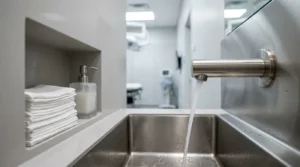
Hand hygiene station placement is a compliance requirement under both AS 4187 and RACGP standards, not an afterthought. Stations must be positioned at the point of care within arm’s reach of the clinical activity they serve rather than at room entries or corridors alone.
We plan hand hygiene infrastructure into the spatial layout before construction begins. Retrofitting stations after linings are closed requires hydraulic rough-in variations that add cost and program time.
Accessibility and Universal Design Requirements for Medical Clinics
Medical clinics serve a patient population that disproportionately includes people with disabilities, mobility impairments, chronic conditions, and age-related limitations. This makes accessibility compliance not just a legal obligation but a fundamental service quality requirement, and it makes any medical clinic renovation a trigger for a comprehensive accessibility review of the entire facility.
AS 1428 Compliance in Healthcare Environments
The AS 1428 series, primarily AS 1428.1 (Design for Access and Mobility) and AS 1428.2 (Enhanced and Additional Requirements), sets the minimum standards for accessible design in medical clinics. For medical clinic renovations, these standards govern path of travel dimensions, door clearances, ramp gradients, accessible parking, sanitary facilities, signage, and hearing augmentation systems.
A critical point for renovation planning: the accessibility obligation applies to the full path of travel from the street to the point of service, not just the area being renovated. A renovation that upgrades consultation rooms without addressing an inaccessible entry or non-compliant corridor will still fail an accessibility assessment.
Accessible Pathways, Entries, and Amenities
Accessible design in a medical clinic must address the complete patient journey: from accessible parking through the entry, along corridors, into waiting areas, through to consultation and treatment rooms, and to accessible amenities. Each transition point doors, level changes, reception counters, signage must meet AS 1428 minimum requirements.
Renovation planning must map the full path of travel and identify any existing non-compliance that the renovation triggers an obligation to address. This is a common source of scope creep in medical clinic renovations when it is not identified and budgeted at the planning stage.
NDIS and Inclusive Design Considerations
Clinics registered as NDIS providers, or those seeking to serve NDIS participants, have design obligations that extend beyond standard AS 1428 compliance. Inclusive design principles, which aim to create environments usable by the widest possible range of people without adaptation, are increasingly expected by accreditation bodies and are a meaningful differentiator for practices competing for NDIS referrals.
Spatial Planning and Functional Zone Design for Medical Clinics
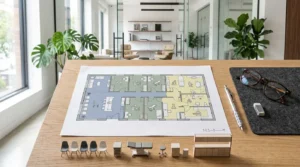
The spatial layout of a medical clinic is not an aesthetic exercise. It is a clinical planning discipline that determines whether the facility can support safe, efficient, and compliant healthcare delivery. Poor spatial planning creates infection control failures, operational inefficiencies, and compliance gaps that cannot be resolved through fit-out quality alone.
Reception, Waiting, and Patient Flow
The entry sequence of a medical clinic must simultaneously manage patient privacy, accessible pathways, queue flow, and visual separation between waiting patients and clinical areas. Reception counters must be positioned to allow staff to manage patient check-in without exposing clinical information to other waiting patients.
Patient flow, the route patients take from entry through to consultation and back to exit, must be planned to avoid crossing contamination zones and to minimise the distance between functionally related spaces. A poorly planned patient flow creates operational friction and infection control risks that compound over the life of the facility.
Consultation and Treatment Room Layouts
Consultation room dimensions, door placement, and equipment positioning are determined by clinical function, not by available space. A consultation room that cannot accommodate a standard examination table, a clinical workstation, and two chairs with adequate clearance for a mobility aid is functionally non-compliant regardless of its finish quality.
Treatment rooms and procedure rooms have additional spatial requirements driven by the clinical activities they support, the equipment they house, and the infection control zone separation they must maintain. Medical gas rough-ins, hand hygiene station placement, and clinical waste disposal points must all be resolved in the spatial plan before construction begins.
Sterilisation and Instrument Processing Room Design
Sterilisation rooms and instrument processing areas are among the most technically demanding spaces in a medical clinic fit-out. AS 4187 governs the physical environment for reprocessing reusable medical devices, including bench heights, sink configurations, separation of dirty and clean workflows within the room, and ventilation requirements.
We design sterilisation rooms as a distinct zone with a defined dirty-to-clean workflow direction. A room that does not physically enforce this workflow direction fails AS 4187 compliance regardless of the equipment installed in it.
Medical Gas and Specialist Infrastructure
Medical gas systems including piped oxygen, suction, and medical air require specialist design, installation, and commissioning that sits outside standard hydraulic and mechanical trades. In NSW, medical gas installations must comply with AS 2896 and are subject to independent verification before clinical use.
We coordinate medical gas rough-ins with the structural and hydraulic program from the earliest design stage. Retrofitting medical gas infrastructure after linings are closed is one of the most expensive variations we see in medical clinic renovations that were not planned by a specialist from the outset.
Staff Zones, Utilities, and Back-of-House Planning
The back-of-house areas of a medical clinic clean utility room, dirty utility room, staff room, medication storage, and equipment storage must be positioned to support clinical workflow without crossing contamination zones. The adjacency between clean and dirty utility rooms, and their relationship to consultation and treatment rooms, is a critical infection control planning decision.
Staff amenities must meet workplace health and safety requirements and be physically separated from clinical areas to prevent cross-contamination between staff personal items and clinical environments.
Materials, Finishes, and Clinical Surface Specifications
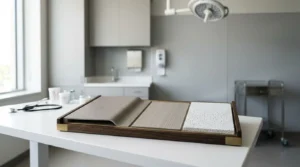
Material selection in a medical clinic renovation is governed by clinical hygiene requirements, durability under chemical cleaning, and compliance with infection control standards. Non-compliant finishes are one of the most common and costly mistakes in medical fit-outs, and they are often invisible until an accreditation assessment or infection control audit identifies them.
Flooring Requirements for Clinical Environments
Clinical areas require seamless, non-porous flooring with coved skirtings that eliminate the junction between floor and wall, a common harbourage point for pathogens. Sheet vinyl with heat-welded seams is the standard specification for consultation rooms, treatment areas, and corridors in most medical clinic renovations. Hard tiles with grout lines are non-compliant in clinical zones because grout cannot be adequately cleaned to infection control standards.
Flooring selection must also consider slip resistance, acoustic performance, durability under heavy foot traffic and equipment loads, and compatibility with the chemical cleaning agents used in the facility.
Wall Linings, Joinery, and Hygienic Surface Systems
Clinical joinery benchtops, cupboards, and storage units in consultation and treatment rooms must be sealed, chemical-resistant, and free of exposed joins, gaps, or porous materials that harbour pathogens. Laminate surfaces with sealed edges and integrated handles are standard; open-grain timber, exposed particleboard edges, and standard domestic joinery specifications are non-compliant in clinical areas.
Wall linings in clinical zones must be smooth, cleanable, and resistant to impact and chemical cleaning. Hygienic wall panel systems, epoxy coatings, and vinyl wall coverings are common specifications depending on the zone classification and cleaning frequency.
Ceilings, Lighting, and Acoustic Treatments
Acoustic privacy between consultation rooms is both a compliance requirement and a patient confidentiality obligation. Sound transmission class (STC) ratings for partition walls and ceiling systems must be sufficient to prevent patient conversations from being audible in adjacent rooms. This is a design decision made at the renovation planning stage; acoustic performance cannot be meaningfully improved after walls are built.
Lighting in clinical areas must meet minimum lux levels for examination and procedure tasks, with appropriate colour rendering for clinical assessment. LED systems with appropriate colour temperature and dimming capability are standard in modern medical fit-outs.
Staged Renovation Planning and Minimising Clinical Disruption
Most medical clinic renovations cannot be completed in a single uninterrupted construction period. Practices need to maintain patient appointments, protect revenue, and preserve staff continuity throughout the renovation, which means the construction program must be designed around clinical operations, not the other way around.
Planning Works Around Patient Appointments
Staged renovation planning begins with a detailed understanding of the practice’s appointment schedule, peak periods, and operational dependencies. Construction hours, noise-generating works, and access route changes must be coordinated with the practice manager to avoid disruption during consultation hours.
Out-of-hours works evenings, weekends, and public holidays are often necessary for high-disruption activities such as demolition, concrete cutting, and mechanical rough-ins. We price these into the program from the outset, not as variations when the schedule falls behind.
Infection Control During Construction
Construction activity generates dust, debris, and airborne particulates that are incompatible with a clinical environment. Hoarding between construction zones and operational clinical areas is mandatory, and the hoarding specification must be sufficient to prevent dust migration into areas where patients are being treated.
HEPA filtration units within the construction zone, negative pressure management to prevent dust migration into clinical areas, and daily cleaning protocols at the hoarding boundary are standard infection control measures during staged medical clinic renovations. These are not optional; they are a condition of maintaining clinical operations during construction.
Sequencing Trades for Minimal Downtime
The order in which trades work through a staged medical clinic renovation determines how quickly each zone is handed back to the practice and how long the overall program runs. Effective trade sequencing minimises the time any clinical zone is out of service and ensures that each trade’s work does not create rework for the next.
Mechanical, electrical, and hydraulic rough-ins must be completed and inspected before linings are closed. Flooring must be installed after all wall-mounted fixtures are complete. Joinery installation must follow flooring. Each dependency must be mapped in the construction program before works begin.
Preparing for Accreditation After Practical Completion
Practical completion is not the end of the compliance journey. For general practices, the post-renovation period includes an AGPAL or QPA accreditation assessment that evaluates the physical environment against RACGP Standards, and a renovation that meets NCC requirements but misses RACGP-specific physical environment criteria will fail that assessment.
We prepare a compliance handover package at practical completion that documents every compliance decision made during the renovation, from zone separation rationale to surface specification records so the practice manager has the evidence base needed for accreditation assessment. This is a step most general commercial contractors do not take, and its absence creates unnecessary risk in the post-renovation accreditation process.
Medical Clinic Renovation Costs and Budget Planning in Sydney
Medical clinic renovation costs in Sydney are substantially higher than equivalent commercial fit-out costs, and the gap is not arbitrary. Compliance requirements, medical-grade finish specifications, upgrades, and the complexity of staged construction all add cost that is non-negotiable if the renovation is to meet its compliance and functional objectives.
A full fit-out of a 200–400 sqm medical clinic in Sydney typically costs between $300,000 and $1,400,000, at a rate of $1,500 to $3,500 per square metre. Specialist fit-outs including imaging suites, procedure rooms, and sterile processing areas sit at the higher end of that range.
What Drives Cost in a Medical Clinic Renovation
The primary cost drivers in a medical clinic renovation are compliance works, upgrades, and finish specifications. Compliance works, including accessibility upgrades, fire safety systems, and structural modifications required to meet NCC provisions, are non-negotiable and must be budgeted in full regardless of their impact on the overall project cost.
Upgrades to hydraulic, electrical, mechanical, and medical gas are frequently the largest single cost category in a medical clinic renovation. Ageing infrastructure in existing clinics often requires full replacement to support modern clinical operations and meet current code requirements.
Tenant Fit-Out vs. Owner-Occupier Considerations
The cost and scope of a medical clinic renovation differ significantly depending on whether the practice owns or leases the premises. Tenant fit-outs require landlord consent for structural and works, must comply with lease make-good obligations at the end of the term, and may be subject to base building standards that limit the specification of certain finishes or systems.
Owner-occupier renovations carry greater design freedom but also full responsibility for compliance works that a landlord might otherwise fund as a base building upgrade. We review lease terms and ownership structure at the briefing stage to ensure the renovation scope and budget reflect the correct obligations from the outset.
Budgeting for Compliance, Contingency, and Fit-Out Quality
A realistic medical clinic renovation budget must include full allowances for compliance works, design and documentation fees, council approval costs, and a contingency of 15–20% of the construction budget. Contingency allowances in healthcare fit-outs are higher than in standard commercial construction because compliance requirements and existing building conditions frequently generate scope variations that cannot be fully anticipated at the planning stage.
These figures are orientation-level benchmarks. Actual project costs depend on the existing condition of the building, the scope of compliance works required, the finish specification, and the complexity of staged construction.
Council Approvals and DA Requirements for Medical Clinic Renovations in Sydney
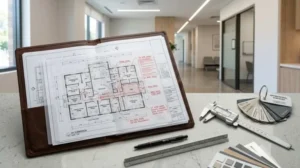
The approvals pathway for a medical clinic renovation in Sydney depends on the scope of works, the existing use classification of the building, and whether the renovation involves a change of use, structural modifications, or heritage-listed elements. Getting the approvals pathway right at the planning stage prevents costly delays and program disruptions during construction.
When a Development Application Is Required
A Development Application (DA) is required when a medical clinic renovation involves a change of use, for example, converting a retail tenancy to a medical use, or when the works include structural modifications, external alterations, or works to a heritage-listed building or within a heritage conservation area.
DA assessment timelines in Sydney vary by council and by the complexity of the application, but a realistic planning allowance for DA determination is 3–6 months from lodgement. This timeline must be factored into the overall project program, as construction cannot commence until a Construction Certificate is issued following DA approval.
Complying Development and CDC Pathways
Many internal fit-out works for medical clinic renovations can proceed as Complying Development under the State Environmental Planning Policy (Exempt and Complying Development Codes) 2008. The Complying Development Certificate (CDC) pathway is assessed by a private certifier rather than council, and determination timelines are typically 10–20 business days, significantly faster than the DA pathway.
The CDC pathway is available when the works meet the applicable development standards and do not involve a change of use, structural modifications, or heritage impacts. A pre-application consultation with a private certifier is the most efficient way to confirm which pathway applies to a specific project.
Working with Certifiers and Council in NSW
A private certifier issues the Construction Certificate (CC) that authorises construction to commence and the Occupation Certificate (OC) that authorises the completed works to be occupied. For most medical clinic renovations proceeding via the CDC pathway, the private certifier manages the full approvals process from CC to OC.
For DA-required projects, the certifier works alongside council through the assessment process and issues the CC following DA approval. Early engagement with a certifier, ideally during the design development phase, ensures that the documentation package is complete and compliant before lodgement, reducing the risk of information requests that extend the assessment timeline.
Choosing the Right Contractor for a Medical Clinic Renovation in Sydney
The contractor you select for a medical clinic renovation will determine whether the project is delivered on time, on budget, and to a standard that satisfies compliance requirements and supports accreditation. General commercial construction experience is not sufficient; medical clinic renovation requires specialist knowledge that most contractors do not possess.
Why Healthcare Fit-Out Experience Matters
A contractor without demonstrated healthcare fit-out experience will not understand the infection control design requirements that govern material selection and spatial planning. They will not know which Australian Standards apply to clinical environments, how to manage infection control during staged construction, or what accreditation bodies assess during a post-renovation inspection.
The result is a renovation that looks complete but fails compliance assessment. The rectification costs of bringing a non-compliant fit-out up to standard after practical completion are invariably higher than the cost of getting it right the first time.
What to Look for in a Medical Renovation Contractor
A specialist medical clinic renovation contractor should be able to demonstrate a portfolio of completed healthcare fit-outs of comparable scope and complexity. They should hold a current NSW builder’s licence, carry appropriate public liability and professional indemnity insurance, and be able to provide references from healthcare clients who can speak to their compliance knowledge and project delivery performance.
Transparent, fixed-price contracting is a meaningful indicator of contractor confidence in their own scope management. A contractor who cannot provide a fixed-price contract for a well-documented scope is signalling uncertainty about their ability to manage the project within budget.
Questions to Ask Before Signing a Contract
Before engaging a contractor for a medical clinic renovation, ask: Have you completed medical clinic renovations of this scope and complexity? How do you manage infection control during staged construction? What is your process for identifying and resolving compliance requirements during design development?
The answers to these questions will quickly distinguish a specialist healthcare fit-out contractor from a general commercial builder who has taken on a medical project without the necessary expertise.
Conclusion
Medical clinic renovation in Sydney demands a specialist approach that integrates compliance, clinical design, infection control, accessibility, and project management into a single coordinated program. Every decision from spatial layout to surface materials to trade sequencing carries compliance and clinical consequences that standard commercial construction experience does not prepare a contractor to manage.
The sections of this guide cover each dimension of the compliance and design framework in depth, from infection control specifications and accessibility standards to cost planning and contractor selection. The goal is to give you the detailed guidance you need to plan and execute a compliant, functional renovation with confidence.
We at Sydney Home Renovation deliver end-to-end medical clinic renovations across Sydney. Contact our team to discuss your project scope, compliance requirements, and budget, and start your renovation with a contractor who understands what a compliant medical fit-out actually requires.
Frequently Asked Questions
What is the difference between a medical clinic renovation and a standard commercial fit-out?
A Medical clinic renovation requires compliance with healthcare-specific building standards, infection control design principles, and accreditation body requirements that standard commercial construction does not address. Clinical function, patient safety, and zone separation drive every design decision.
Do I need council approval to renovate a medical clinic in Sydney?
Whether council approval is required depends on the scope of works and the existing use classification of the building. Internal fit-out works that do not change the building’s use class may proceed as Complying Development, while change-of-use or structural works require a Development Application.
What compliance standards apply to a medical clinic renovation in NSW?
Medical clinic renovations in NSW must comply with the National Construction Code, relevant Australian Standards including AS 4187 and the AS 1428 accessibility series, and accreditation body requirements such as the RACGP Standards for General Practices.
Can a medical clinic remain open during a renovation?
Yes, medical clinic renovations can be staged to allow the practice to remain operational, provided construction zones are properly hoarded, infection control protocols are maintained during works, and trades are sequenced to minimise disruption to clinical areas.
How much does a medical clinic renovation cost in Sydney?
Medical clinic renovation costs in Sydney typically range from $1,500 to $3,500 per square metre depending on the scope of compliance works, upgrades, and finish quality, with full fit-outs of 200 to 400 sqm commonly ranging from $300,000 to $1,400,000.
What flooring is required in a medical clinic?
Clinical areas require seamless, non-porous flooring with coved skirtings to eliminate pathogen harbourage points. Sheet vinyl with heat-welded seams is the standard specification for consultation rooms, treatment areas, and corridors. Hard tiles with grout lines are non-compliant in clinical zones.
What should I look for when choosing a medical clinic renovation contractor in Sydney?
Look for demonstrated experience in healthcare fit-outs, knowledge of NCC and Australian Standards compliance requirements, a transparent fixed-price contract, and a track record of delivering compliant medical renovations on time and on budget in Sydney.