
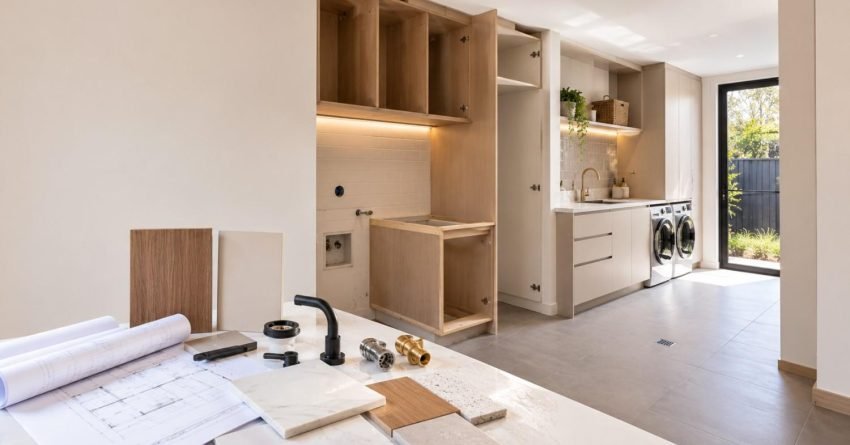
A laundry renovation is the structured process of redesigning, rebuilding, or upgrading your laundry space to improve function, durability, and long-term value. For Sydney homeowners, first-time renovators, and property investors, planning well is the single biggest factor that separates an on-budget project from a stressful one.
Sydney’s tight floor plans, strict plumbing standards, and trade pricing pressure make laundry renovations more complex than they look. Small missteps compound into thousands in avoidable costs.
This guide covers scope, budgeting, layout, materials, plumbing, contractors, timelines, hidden costs, and ROI everything needed to plan from the first decision to the final inspection.
Understanding What a Laundry Renovation Involves
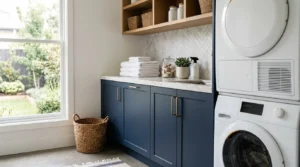
A laundry renovation ranges from a light cosmetic refresh new cabinetry, tapware, and paint through to a full structural rebuild that relocates plumbing, expands the footprint, or converts a butler’s pantry or under-stair space into a working laundry. Understanding which scope applies to your situation is the first decision that shapes every other one.
In Sydney homes, three project tiers dominate. A cosmetic refresh swaps surfaces and fittings while keeping the existing layout. A mid-tier renovation updates cabinetry, plumbing fixtures, and finishes, and relocates a sink or washing machine connection. A full renovation rebuilds the room entirely, involving new waterproofing, retiling, electrical upgrades, and structural changes.
The right scope depends on the condition of your existing laundry, your budget ceiling, your timeline, and whether your goal is owner-occupier comfort or rental-grade durability. Choosing the wrong tier over-investing in a rental or under-investing in a long-term home is one of the most expensive planning errors Sydney homeowners make.

Setting a Realistic Laundry Renovation Budget
Budget planning is where most Sydney laundry renovations succeed or quietly unravel. The most common mistake is anchoring to a single headline number “around $10,000” without breaking that figure into the line items that actually drive cost. A realistic budget is built from labour rates, material allowances, fittings, compliance work, and a contingency buffer.
In Sydney, a cosmetic laundry refresh typically lands between $5,000 and $10,000. A mid-tier renovation usually runs $10,000 to $20,000. A full renovation with new plumbing, electrical, waterproofing, and premium finishes commonly reaches $20,000 to $35,000+, particularly in older homes where rectification work is unavoidable.
A workable budget allocates roughly 35–45% to labour (plumber, electrician, tiler, builder, waterproofer), 25–30% to cabinetry and benchtops, 15–20% to tapware, sinks, and appliances, and 10–15% to compliance, disposal, and project management. Every Sydney homeowner should set aside a 10–15% contingency for the unexpected old pipework, hidden water damage, or variation requests.
How Much Does a Laundry Renovation Cost in Sydney?
A small cosmetic laundry refresh costs $5,000–$10,000, a mid-tier renovation $10,000–$20,000, and a full renovation $20,000–$35,000+ depending on size, fittings, and structural work required.
Sydney pricing varies widely based on size, fixtures, and trade rates. The laundry renovation cost breakdown covers every line item: labour, cabinetry, tapware, tiling, and contingency so you can build a budget that holds up under real-world conditions.
Financing Your Laundry Renovation
Most Sydney homeowners fund a laundry renovation through savings, a home loan redraw facility, or a renovation personal loan. Redrawing is the lowest-cost option for those with equity, as it draws on existing mortgage funds at the home loan interest rate.
Personal renovation loans are faster to access but carry higher rates, typically 8–15% p.a. in the current market. Whatever the funding source, confirm your total available budget before signing a contract; mid-build financing changes are one of the most common causes of project delays.
Choosing the Right Laundry Layout and Design
Layout is the decision that locks in your laundry’s daily function for the next 15–20 years. The right configuration moves laundry, drying, folding, and storage through a logical workflow without forcing you to step around your own appliances. In a Sydney terrace or apartment, where space is rarely generous, layout decisions become even more critical.
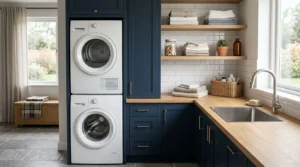
Four layouts dominate Australian laundry design. A galley layout runs cabinetry along one or both walls and works well in long, narrow spaces. An L-shape layout wraps the workflow around a corner and suits square rooms. A European-style laundry tucks washer, dryer, and storage behind cabinetry in a hallway or pantry, ideal for apartments. A stacked layout uses vertical space for washer and dryer, freeing benchtop room.
Beyond the basic footprint, smart planning includes a deep sink for handwashing, a benchtop for folding, dedicated storage for detergents and linen, and clearance for a stacked or side-by-side washer-dryer. Lighting, ventilation, and a clear path from washer to clothesline or drying cabinet round out a layout that genuinely works.
Minimum Laundry Dimensions for Sydney Homes
The National Construction Code sets a minimum usable floor area for laundries, and most Sydney builders work to a practical minimum of 1.8m x 1.8m for a functional single-wall layout. A galley laundry needs at least 900mm of clear walkway between opposing cabinets to meet accessibility and usability standards.
For a stacked washer-dryer configuration, plan for a minimum 600mm wide x 600mm deep appliance recess plus 50mm clearance on each side for ventilation and servicing. Tight conversions under-stair nooks or hallway laundries often require a custom cabinetry solution to meet these clearances without sacrificing storage.
Selecting Materials, Fittings and Finishes
Laundry materials face a brutal combination of moisture, heat, detergent splash, and constant wear. Choosing the wrong surfaces bargain laminate, untreated timber, low-grade tapware guarantees a tired-looking room within three to five years. The right specifications hold up for fifteen.
For benchtops, engineered stone, solid surface, or laminate with moisture-resistant cores outperform standard particleboard. For cabinetry, prioritise sealed, water-resistant board with soft-close hinges and quality drawer runners. Splashbacks should be fully tiled or use full-height glass or stone to stop water penetration behind appliances.
For fittings, a deep stainless steel or solid surface sink handles everything from handwashing to mop buckets. Tapware should be solid brass with ceramic disc cartridges; cheap tapware fails fastest in laundries. For flooring, choose slip-rated porcelain or ceramic tiles rated R10 or higher for wet-area safety.
For appliances, front-loader washers stack with dryers and fit a standard 600mm wide x 600mm deep footprint. Heat pump dryers cost more upfront but use 50–60% less energy than conventional vented dryers, a meaningful saving over a 10-year lifespan. Choose finishes with serviceability in mind: matte finishes hide water spots, but high-gloss surfaces clean faster.
Plumbing, Electrical and Structural Considerations
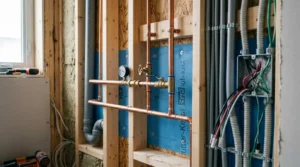
The unseen work plumbing, electrical, waterproofing, and structural changes is where laundry renovations earn their compliance value and where most cost surprises hide. In NSW, this work is legally regulated. Cutting corners here risks fines, insurance issues, and resale problems.
All plumbing work must be performed by a licensed plumber and meet the AS/NZS 3500 standard, the national plumbing code. Hot and cold water connections, drainage falls, trapped wastes, and washing machine stop-cocks must all comply. Drainage capacity matters; older Sydney homes often have undersized waste lines that need upgrading when a full-size washer is installed.
Electrical work: new circuits, additional power points, GPOs near water, or lighting upgrades must be completed by a licensed electrician with a Certificate of Compliance for Electrical Work (CCEW). Laundries also require waterproofing to AS 3740 standards before tiling, especially behind washers and around sinks. Some projects, particularly relocations or expansions, need council development approval depending on your Sydney LGA.
Ventilation and Drying Solutions
Ventilation is a compliance requirement, not an optional upgrade. The NCC requires laundries to have either natural ventilation (openable window or door to outside) or mechanical ventilation exhausting directly to the exterior. A recirculating fan does not meet the standard.
For drying, three solutions suit Sydney homes well. A heat pump dryer vents no moisture into the room and suits fully enclosed laundries. A drying cabinet uses low heat to dry garments on hangers, ideal for delicates. A retractable clothesline or ceiling-mounted airer works in laundries with direct outdoor access. Specifying the drying solution at the design stage prevents the common mistake of finishing a laundry with nowhere practical to dry clothes.
Hiring the Right Laundry Renovation Contractor
The contractor you choose determines whether your renovation runs on schedule, on budget, and to the standard you signed up for. In Sydney, where trade demand consistently outstrips supply, the wrong hire chosen on price alone creates the bulk of renovation horror stories.
Start by verifying credentials. In NSW, any residential renovation work valued over $5,000 requires a licensed builder registered with NSW Fair Trading. Your contractor should hold current public liability insurance (minimum $20 million), home building compensation cover for jobs over $20,000, and verifiable trade qualifications for any in-house trades.
Beyond licensing, look for fixed-price contracts, itemised quotes (not lump sums), clear inclusions and exclusions, payment schedules tied to progress milestones, and a written variations process. Avoid contractors who pressure deposits over 10%, refuse to put inclusions in writing, or cannot provide references from completed Sydney projects in the last 12 months. Three detailed quotes properly compared line by line almost always reveals which contractor is being honest about scope.
Project Timeline and Renovation Stages
A laundry renovation is not a weekend job. Most Sydney projects run two to five weeks from demolition to handover, with another two to six weeks of pre-build planning before tools hit the wall. Understanding each stage helps you sequence decisions, order materials in time, and avoid the costly delays that come from waiting on a backordered tap or a council approval.
The pre-renovation stage covers design, quoting, contract signing, council approvals (where required), and material selection. This phase typically runs two to six weeks. Skipping or rushing it is the single most common cause of mid-build variations.
The build stage breaks into demolition (1–2 days), rough-in plumbing and electrical (2–4 days), waterproofing and tiling (3–7 days), cabinetry installation (1–2 days), benchtop and splashback (1–3 days), fit-off of fittings and appliances (1–2 days), and final inspection and clean (1 day). Lead times on cabinetry, stone benchtops, and imported tapware stretch timelines by weeks if not ordered early.
Common Mistakes and Hidden Costs to Avoid
Most laundry renovation regret traces back to the same handful of mistakes and the same handful of hidden costs nobody warned the homeowner about. Avoiding them is the single highest-leverage thing you can do in your planning phase.
The biggest planning mistakes include: locking in a layout before checking plumbing relocation costs, choosing fittings before measuring final cabinet dimensions, skipping a contingency budget, hiring on the lowest quote without comparing inclusions, and changing the scope mid-build, which triggers variation charges that add 15–25% to the final invoice.
The hidden costs that catch Sydney homeowners off guard include: demolition and waste disposal fees ($500–$2,000), rectifying old non-compliant plumbing or wiring ($1,500–$5,000+), additional waterproofing where unexpected moisture damage is found, structural repairs to old timber or stud walls, council application fees, trade callout charges for return visits, freight on imported fittings, and Sydney parking permits for trade vehicles in inner-city LGAs.
DIY vs. Hiring a Professional: Where the Line Is
Some laundry renovation tasks are genuinely DIY-friendly. Painting walls, assembling flat-pack cabinetry, installing a new mirror, or swapping a showerhead are all legal for homeowners to do themselves in NSW. These tasks carry no licensing requirement and no compliance risk.
The line is drawn the moment work touches plumbing, electrical, waterproofing, or structural elements. In NSW, unlicensed plumbing or electrical work is illegal regardless of skill level, and insurance policies routinely void claims where unlicensed work contributed to damage. A DIY waterproofing failure behind a washing machine can cause $10,000–$30,000 in subfloor and wall damage before it becomes visible.
The honest cost comparison almost always favours licensed trades for regulated work. A licensed plumber charges $120–$180 per hour in Sydney, but a single call-back to fix a DIY drainage error costs the same rate plus the original repair. We recommend treating licensed trade work as non-negotiable and focusing DIY effort on the cosmetic finishes where it genuinely saves money without risk.
Your Pre-Renovation Planning Checklist
Getting these eight decisions locked in before signing a contract prevents the majority of mid-build variations and budget blowouts.
- Scope confirmed: cosmetic refresh, mid-tier, or full renovation
- Budget set: total ceiling plus 10–15% contingency allocated
- Layout chosen: galley, L-shape, European, or stacked configuration
- Plumbing relocation assessed: confirmed with a licensed plumber before finalising layout
- Materials and fittings selected: all specified and lead times confirmed
- Council approval checked: confirmed with your Sydney LGA whether DA or CDC is required
- Contractor licensed and insured: NSW Fair Trading licence verified, insurance certificates sighted
- Contract signed: fixed price, itemised inclusions, payment milestones, and variations process in writing
Completing this checklist before work begins is the single most reliable way to keep a Sydney laundry renovation on budget and on schedule.

Maximising Long-Term Value and ROI
For homeowners planning to stay, a laundry renovation pays back in daily function: less time spent, more storage, a room that does not feel like a chore. For investors and owners planning to sell within five years, the returns are different: a well-renovated laundry lifts property appeal and reduces the negotiating power buyers have over kitchen-and-bathroom-focused valuations.
The features that consistently add resale value in Sydney are: integrated washer and dryer space, a deep functional sink, ample bench and storage area, durable finishes that show well in photos, and energy-efficient fixtures and appliances. Avoid over-personalising bold colours and trend-led finishes that date fast and erode rather than add value.
Future-proofing matters too. Plan for slightly larger appliance footprints than today’s standard, leave accessible plumbing for future upgrades, and choose neutral, durable finishes that survive both daily use and changing design trends. A laundry built for the next 15 years is almost always a better investment than one built for next season’s trend.
Energy Efficiency and Running Costs
Energy-efficient choices in a laundry renovation reduce running costs for the life of the room. A heat pump dryer uses roughly 50–60% less electricity than a conventional vented dryer at Sydney’s current electricity rates; that translates to a meaningful annual saving for a household doing four or more loads per week.
Cold-wash cycles on modern front-loaders deliver equivalent cleaning performance to warm-wash cycles at a fraction of the energy cost. Water-efficient tapware with a WELS rating of 4 stars or higher reduces water consumption without affecting usability. Specifying these features at the design stage costs nothing extra and delivers compounding savings over a 10–15 year renovation lifespan.
Conclusion
A successful laundry renovation comes down to scope clarity, an honest budget, a layout that fits how you actually live, durable specifications, compliant trades, and a contractor you can trust. Every decision made well in the planning phase saves money and stress in the build phase.
The details matter, from minimum clearances and ventilation compliance to contractor licensing and contingency buffers. Getting them right before work begins is what separates a renovation that runs smoothly from one that doesn’t.
At Sydney Home Renovation, we deliver end-to-end laundry renovations across Sydney with transparent fixed-price quotes, licensed trades, and project management from first consultation to final inspection. Contact us today to start planning your renovation with confidence.
Frequently Asked Questions
How long does a laundry renovation take in Sydney?
Most Sydney laundry renovations take two to five weeks of on-site work, plus two to six weeks of pre-build design, quoting, and material ordering. Full renovations with council approvals take longer.
Do I need council approval for a laundry renovation?
Most cosmetic and like-for-like laundry renovations don’t need council approval. We recommend confirming with your local Sydney council whenever you relocate plumbing or alter load-bearing walls.
What is the cheapest way to renovate a laundry?
A cosmetic refresh painting cabinetry, replacing tapware, updating splashback tiles, and swapping the sink delivers the biggest visual change at the lowest cost, typically $5,000–$10,000 in Sydney.
Can I add a laundry to a space that doesn’t have one?
Yes. It requires plumbing, drainage, electrical, and ventilation brought to the new location, plus compliance approvals. Common conversions include butler’s pantries, under-stair nooks, and hallway European-style laundries.
What’s the difference between a laundry refresh and a full renovation?
A refresh updates surfaces and fittings without changing layout or plumbing. A full renovation rebuilds the room, relocating plumbing, retiling, rewiring, and rewaterproofing. Refreshes cost less but deliver less long-term value.
What features add the most resale value to a laundry?
Integrated washer-dryer space, deep functional sinks, generous storage, durable neutral finishes, and energy-efficient appliances consistently add the most resale value in Sydney homes.
Should I renovate my laundry and bathroom at the same time?
Often yes. Combining projects reduces trade callouts, mobilises waterproofing and tiling crews once, and typically saves 10–20% versus renovating each separately. It also minimises total household disruption.


