Torrens title gives each duplex owner full freehold ownership of their land and building, while strata title divides ownership into individual lots within a shared scheme. The right choice shapes your costs, control, and resale value.
Choosing the wrong title type can lock you into ongoing strata fees, limit renovation freedom, or reduce resale appeal across the Sydney duplex market. This guide breaks down both title types, compares costs and control, explains NSW subdivision rules, and helps you pick the right structure for your duplex.
What Is a Torrens Title for Duplexes?
A Torrens title is the most common form of freehold ownership in New South Wales. When applied to a duplex, each of the two dwellings sits on its own separately titled parcel of land, with clear, surveyed boundaries between them. The owner of each side holds full ownership of the land, the structure on it, and everything inside the lot line.
This title type is registered under the Real Property Act 1900 and administered through the NSW Land Registry, which guarantees ownership rights through a single state-backed register. There is no shared common property, no owners corporation, and no strata fees attached to the title.
How Torrens Title Works in NSW
To create two Torrens titles from a duplex, the original block must be physically subdivided. A registered surveyor prepares a plan of subdivision, the local council assesses it against zoning and minimum lot rules under the Local Environmental Plan, and once approved, the new plan is registered with the land registry. Two new titles are then issued, one for each dwelling.
Easements and Section 88B Instruments
When a Torrens subdivision is registered, the plan often includes a section 88B instrument that creates or records easements over the new lots. These easements commonly cover shared drainage lines, right-of-way access across one lot to reach the other, and party wall agreements. Each easement is registered on the individual title and binds every future owner, so understanding what is recorded on your title before purchase or subdivision is essential.
Common Uses for Duplex Properties
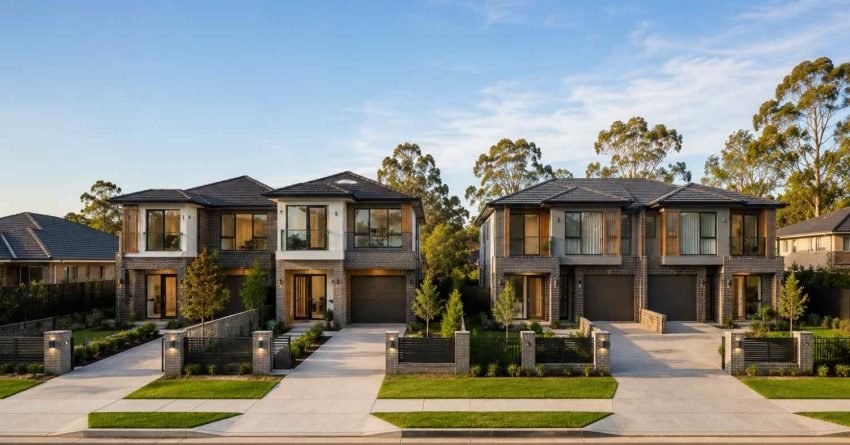
Torrens title duplexes are popular with investors splitting and selling each side individually, families building dual occupancy homes for adult children, and homeowners who want full long-term control. Because each side stands alone on the title, owners can renovate, extend, or sell independently without requiring agreement from the other party. This ownership model sits at the centre of most freestanding duplex projects in Sydney.
What Is a Strata Title for Duplexes?
A strata title divides a single parcel of land into individual lots, with each lot owner holding title to their specific dwelling and a share of the common property. For a duplex, the two dwellings become Lot 1 and Lot 2 under a strata plan, while shared elements such as the driveway, fences, external walls, or roof structure typically form part of the common property.
Strata title is registered under the Strata Schemes Development Act 2015. Every strata scheme creates an owners corporation, which is legally responsible for maintaining common property, holding insurance over the building, and managing shared finances through a strata levy.
How Strata Title Works in NSW
The site is not physically subdivided in the traditional sense. Instead, a strata plan is lodged that defines each lot in three dimensions, including floor, walls, and ceiling. The plan is registered, and individual strata titles are issued. Owners hold their lot outright but share governance of common property through the owners corporation.
The Role of the Owners Corporation
In a two-lot duplex strata scheme, the owners corporation is small but still active. Both owners must agree on building insurance, repairs to shared structures, and any major works affecting common property. Annual strata levies fund the insurance and a sinking fund for future maintenance.
Is There a Third Option? Community Title Explained
Community title is a less common but legally distinct ownership structure available in NSW under the Community Land Development Act 2021. It sits between Torrens and strata: the land is subdivided into individual lots like Torrens, but shared infrastructure such as driveways or landscaping is held as community property managed by a community association rather than an owners corporation.
For most standard duplex projects in Sydney, community title is rarely the right fit. It is more commonly used for larger staged developments, townhouse estates, or mixed-use projects where shared infrastructure is substantial. If your duplex project involves significant shared land or is beyond a simple driveway, a solicitor experienced in NSW property law can advise whether community title is worth exploring alongside the two primary options.
Key Differences Between Torrens and Strata Title
Both titles deliver legal ownership, but they behave very differently in daily ownership, maintenance, and resale.
Ownership and Boundaries
Torrens title gives each owner a defined parcel of land with surveyed boundaries on the ground. Strata title gives each owner a three-dimensional lot inside a building, with shared external structures held as common property. The practical effect is full independence under Torrens, and shared responsibility under strata.
Maintenance and Shared Responsibility
Under Torrens, each owner maintains their own roof, walls, gutters, driveway portion, and yard entirely at their own discretion and cost. Under strata, exterior maintenance, including external repainting, shared boundary fencing, and roof replacement, is managed collectively through the owners corporation. This reduces individual control but spreads the cost of major works across both owners, which can be an advantage when a large repair bill arrives unexpectedly.
Resale and Market Appeal
Many Sydney buyers prefer the freedom and simplicity of Torrens title duplexes, which often command stronger resale values, especially in detached duplex configurations. Lenders also treat Torrens title more straightforwardly; valuations are typically cleaner and loan-to-value ratio caps are less restrictive than on strata properties, which can widen the buyer pool at auction or private treaty. Strata title duplexes remain competitive for attached configurations and smaller Sydney sites where Torrens subdivision is not achievable.

Pros and Cons of Each Title Type for Duplex Owners
A clear comparison helps put the trade-offs in context.
| Factor | Torrens Title | Strata Title |
| Land ownership | Separate land parcel per dwelling | Shared lot with three-dimensional boundaries |
| Common property | None | Yes, managed by the owners corporation |
| Insurance | Each owner insures their own building | Single building insurance via owners corporation |
| Strata levies | None | Yes, ongoing |
| Renovation control | High, independent decisions | Restricted where common property is affected |
| Subdivision cost | Higher upfront, more council requirements | Lower upfront, faster to register |
| Resale appeal | Generally stronger for detached duplexes | Suitable for attached duplexes and small sites |
| Best suited to | Standard blocks meeting minimum lot size | Narrow lots, attached duplexes, sites failing subdivision rules |
Cost Implications of Torrens vs Strata Title
Cost is often the deciding factor, and the two title pathways carry very different price profiles.
Subdivision and Survey Costs
A Torrens subdivision in Sydney typically involves a surveyor preparing a plan of subdivision, council application fees, section 7.11 developer contributions that fund local infrastructure, and registration fees with the land registry. Sites that do not meet minimum lot width or area under the LEP cannot be Torrens subdivided at all.
A strata subdivision is usually cheaper and faster, because there is no need to physically divide the land or meet minimum lot sizes. The strata plan is prepared by a registered surveyor, certified, and lodged for registration. This makes strata title the only viable option on many narrow Sydney blocks.
Ongoing Fees and Insurance
Torrens title carries no ongoing scheme fees. Each owner pays their own council rates, water, and building insurance independently. Strata title introduces quarterly strata levies that fund the building insurance policy, common area maintenance, and a sinking fund. For a small two-lot duplex scheme, levies are modest compared with apartment buildings, but they remain a permanent ownership cost that never disappears.
How Lenders Treat Each Title Type
Lenders assess Torrens and strata title duplexes differently, and this affects both your borrowing capacity and your future buyer pool. Torrens title properties are valued as freestanding houses on their own land, which typically attracts standard residential lending terms and no strata-specific LVR restrictions. Strata title duplexes are assessed more like apartments; some lenders apply lower maximum LVR limits or require additional valuation scrutiny, particularly on small two-lot schemes. Understanding how your bank or broker views the title type before you commit to a subdivision pathway can prevent financing surprises later.
Stamp Duty and Transfer Costs
When you sell one side of a Torrens title duplex, the buyer pays transfer duty on the full freehold value of that lot, calculated on the purchase price or market value under the Duties Act 1997. For strata title, the buyer pays transfer duty on the strata lot value, which may be lower on a per-lot basis but still attracts the same duty rates. Neither title type is exempt from transfer duty, but the assessed value and therefore the duty payable can differ meaningfully between a freehold Torrens lot and a strata lot on the same site.
Council Approval and Subdivision Requirements in NSW
Title choice is not purely a financial decision. It is shaped by what your council and the NSW planning framework will allow on your specific site. Minimum lot size, frontage width, zoning, and overlays under the NSW Planning Portal all influence whether Torrens subdivision is possible.
Where Torrens subdivision fails the planning test, strata title becomes the practical alternative, because it does not require land to be split into separate parcels. Some duplex projects proceed under the NSW Housing Code as Complying Development, which uses a Complying Development Certificate (CDC) instead of a full Development Application. The CDC pathway has its own specific controls on lot size, setbacks, and building envelope, and these controls interact directly with which title type is achievable on your block. A project approved as Complying Development may still be eligible for either Torrens or strata subdivision, but the CDC conditions must be satisfied first before any subdivision plan is lodged.

How to Choose the Right Title for Your Duplex
Use these guiding questions to align the decision with your goals.
- Do you plan to sell one side? Torrens title generally delivers stronger resale value and fewer buyer questions.
- Is your block wide enough? Many Sydney sites fail minimum lot rules for Torrens subdivision and default to strata.
- Is the duplex attached or detached? Attached duplexes with shared walls often suit strata title. Detached pairs suit Torrens.
- Do you want full renovation freedom? Torrens removes owners corporation approvals from the picture entirely.
- Are you comfortable with ongoing fees? Strata levies are modest in two-lot schemes but never disappear.
- What is your investment horizon? Long-term holds often favour Torrens. Faster, cheaper subdivisions often favour strata.
- How will your buyer finance the purchase? If maximising your buyer pool matters, Torrens title typically attracts broader lender acceptance and fewer valuation complications.
- Does community title apply? For most standard Sydney duplexes, it does not, but if your project involves shared infrastructure beyond a driveway, confirm this with your solicitor early.
Match the answers against your council rules, builder advice, and a frank look at your budget for upfront subdivision costs versus ongoing strata levies. Getting this decision right before design begins saves significant time and money later in the process.
Planning Your Duplex Build or Renovation with Sydney Home Renovation
Choosing a title is only one piece of a successful duplex project. Site assessment, design, council pathway, construction quality, and finishing work all influence the final value of both dwellings. Working with an experienced team helps you avoid expensive title decisions made too late in the process, after design or council lodgement.
Sydney Home Renovation works with homeowners and property investors across Sydney to plan duplex builds and renovations with honest pricing, clear timelines, and skilled trades on the ground. Whether you are building new or upgrading an existing duplex, we coordinate design, trades, and council requirements under one accountable team.
Conclusion
Choosing between Torrens and strata title shapes how you own, manage, sell, and renovate your duplex across every stage of ownership.
From subdivision costs to long-term resale, the right title structure protects your investment and aligns with your broader Sydney property goals.
At Sydney Home Renovation, we help duplex owners plan, build, and renovate with confidence, combining honest pricing, skilled trades, and clear project coordination from first site assessment to final handover. Contact our team today to start your project.
Frequently Asked Questions
Is Torrens title better than strata title for duplexes in Sydney?
Torrens title usually delivers stronger resale value and full independence, but it is only possible where your site meets council minimum lot size and width rules under the LEP.
Can every duplex be Torrens title subdivided?
No. Many Sydney blocks fail minimum lot size, frontage, or zoning requirements, which means Torrens subdivision is refused and strata title becomes the only practical pathway.
How much does it cost to subdivide a duplex in NSW?
Costs vary by council, site complexity, and surveyor fees. Torrens subdivision is typically more expensive than strata, with extra contributions, registration fees, and physical lot creation requirements.
Do strata title duplexes have ongoing fees?
Yes. A two-lot strata scheme requires quarterly levies covering building insurance, common property maintenance, and a sinking fund managed by the owners corporation between both owners.
Can I change a strata title duplex to Torrens later?
Converting strata to Torrens is achievable but involves multiple steps: the site must meet current subdivision rules, the strata scheme must be formally terminated, and new Torrens titles must be created and registered.
Which title type is better for renovating one side of a duplex?
Torrens title gives you the most freedom, because renovations to your dwelling do not require owners corporation approval, only standard council or CDC pathways for the proposed work.
Does title type affect property value at resale?
Yes. Detached Torrens title duplexes generally attract stronger buyer demand and price premiums, while strata title duplexes remain competitive for attached configurations and smaller Sydney sites.