Applying for a granny flat grant in NSW starts with identifying the right program, confirming your eligibility, gathering the required documentation, and submitting a complete application through the relevant authority. We’ve guided homeowners through this exact process, and the short answer is this: match your property and tenancy plan to the correct scheme, confirm eligibility before you prepare documents, and submit a complete package the first time.
The process is structured but manageable once you understand what each stage requires. Sydney homeowners and property investors have access to several funding pathways. Knowing which one applies to your situation is the critical first step.
What Granny Flat Grants Are Available in NSW
No single universal grant covers every granny flat build in NSW. Funding instead comes through a combination of state government programs, federal initiatives, and local council incentives. Each carries distinct eligibility criteria, funding caps, and intended use cases.
The most relevant programs for Sydney homeowners include state-administered affordable housing schemes, which provide financial support to property owners who make granny flats available to social or affordable housing tenants. We’ve also seen federal incentive programs historically support secondary dwellings used as affordable rentals, though these change frequently. Some local councils additionally offer rebates or fast-tracked approval pathways tied to housing supply targets in their area.
State and Federal Programs to Know
The NSW Government’s primary grant pathway for secondary dwellings ties directly to affordable housing commitments. Homeowners who agree to lease their granny flat to eligible tenants at below-market rent can access capital contribution grants or rental subsidies through the NSW Department of Communities and Justice, which administers several of these arrangements alongside registered community housing providers.
At the federal level, programs under the National Housing Finance and Investment Corporation support community housing providers rather than individual homeowners directly. Direct homeowner grants at this level remain limited. We recommend checking with your local council first, since incentive structures shift more often at that level than most homeowners expect.

How Much Grant Funding Can You Actually Get?
Grant amounts vary significantly depending on the program, your property’s location, and your lease terms. We’ve broken down typical ranges below so you can weigh funding against your total build cost before committing to any scheme’s obligations.
| Program Type | Typical Funding Range | Key Condition |
| State capital contribution grants | $10,000–$60,000 | Below-market lease to approved tenant |
| Council rebate/incentive programs | $1,000–$5,000 | Fast-tracked DA or compliance rebate |
| Rental subsidy arrangements | Ongoing monthly support | Lease term commitment (often 3-5 years) |
Understanding these ranges relative to typical granny flat construction costs in Sydney helps you assess how much grant funding you actually need against your total build budget before you commit to any program’s lease obligations.
Grants vs. Rebates vs. Subsidies: What’s the Difference?
We find many homeowners use these terms interchangeably, but they work differently in practice. A grant is typically a one-off capital contribution toward construction costs. A rebate reduces fees you would otherwise pay, such as council application charges.
A subsidy, by contrast, is an ongoing payment tied to a lease arrangement rather than the build itself. Knowing which type you are applying for changes what documentation you need and how long you can expect to wait for funds.
Who Qualifies for a Granny Flat Grant in Sydney
Eligibility typically requires that you own the property where the granny flat will be built or already exists. The dwelling must meet minimum size and habitability standards under the NSW Affordable Housing SEPP. You also need to be willing to enter a formal lease agreement with an approved housing provider or eligible tenant.
Income thresholds, property zoning, and existing dwelling conditions all affect eligibility. Owner-occupiers, landlords, and property investors may all qualify depending on the specific program.
Grant funding only covers part of the picture. Matching that funding against realistic build costs is what determines whether a project actually stacks up financially.

Step-by-Step Application Process for a Granny Flat Grant
The application process follows a consistent sequence across most NSW grant programs. It runs through eligibility assessment, documentation preparation, formal application submission, property inspection, and funding agreement execution.
Start by contacting the administering authority directly. This might be your local council, a registered community housing provider, or the relevant state department. Request a pre-application eligibility check before investing time in full documentation.
This single step prevents the most common cause of wasted effort. Applying to a program your property or tenancy arrangement does not qualify for wastes weeks you don’t need to lose.
Documents You Need Before You Apply
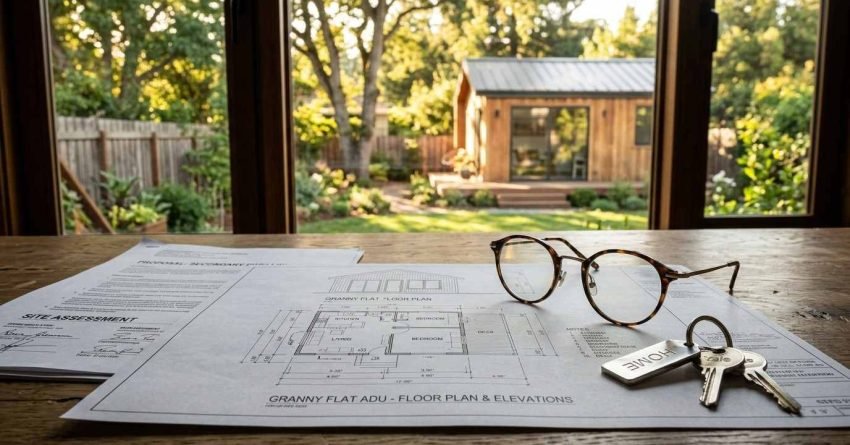
Most applications require proof of property ownership through a title search or council rates notice. You will also need a current site plan or approved DA showing the granny flat’s location and dimensions, plus evidence of compliance with the NSW Affordable Housing SEPP.
Some programs also require a building inspection report, a rental appraisal from a licensed agent, and confirmation of your intended tenancy arrangement. We recommend confirming your council approval requirements for a granny flat before compiling your full documentation package, since your DA status needs to align with what the grant program expects at submission.
How to Submit Your Application and What Happens Next
Submit your completed application directly to the administering authority. Online portals are available for most NSW programs, which speeds up initial processing considerably.
After submission, expect an acknowledgement within five to ten business days. A property inspection is typically scheduled within four to six weeks to verify the dwelling meets habitability and compliance standards.
If your application is approved, you will receive a formal funding agreement outlining grant conditions, lease obligations, and payment timelines. Funds are generally released in stages tied to lease commencement or construction milestones, rather than as a single lump sum. This staged release protects both the homeowner and the administering authority if circumstances change partway through.
Tips to Strengthen Your Grant Application
We’ve seen a few small adjustments make a real difference to approval speed. Submitting a rental appraisal from a licensed agent upfront, rather than waiting for the authority to request it, signals a well-prepared application.
Keeping your DA documentation current matters too. An approval that has lapsed or changed since submission is one of the easiest things to overlook, and one of the fastest ways to trigger delays.
Common Reasons Applications Are Rejected and How to Avoid Them
Incomplete documentation is the leading cause of grant application rejection. Missing a single required document, such as an unsigned lease agreement or an outdated site plan, results in automatic deferral or outright rejection in most programs.
The second most common issue is applying to a program that does not match your property’s zoning or your intended tenancy arrangement. A granny flat intended for a family member rather than an approved affordable housing tenant will not qualify under most grant schemes, regardless of how well the rest of the application is prepared.
Submitting before your DA is approved is another avoidable error. Most programs require a current, approved development application as a prerequisite. Applying with a pending DA stalls the process and often triggers rejection.
A fourth issue we see regularly is a missing or outdated rental appraisal. Programs tied to below-market leasing typically require current market evidence, and an appraisal older than a few months can be rejected outright.
What If You Don’t Qualify for a Grant?
Not every homeowner will meet the criteria for a formal grant program, and that’s worth planning for early. Council rebates tied to fast-tracked approvals remain available even when state-level grants are out of reach.
Some homeowners instead look at equity release or standard construction loans to fund their build, then revisit grant eligibility once the dwelling is complete and tenancy arrangements are finalized. We generally recommend treating grant funding as a bonus that improves your project’s economics rather than a requirement to start.
Conclusion
Applying for a granny flat grant in NSW is a structured process that rewards preparation. Matching the right program to your property, confirming eligibility early, and submitting complete documentation are the three factors that determine success.
For homeowners and investors in Sydney, grant funding can meaningfully reduce the financial barrier to adding a secondary dwelling, particularly when paired with a clear build plan and realistic cost expectations. A well-designed granny flat project stays financially and structurally ready to move forward when the funding pieces align.
At Sydney Home Renovation, we help homeowners and investors plan granny flat projects with confidence, from understanding grant eligibility through to delivering a compliant, quality build on budget.
Frequently Asked Questions
Is there a government grant for building a granny flat in NSW?
Yes. NSW offers grant programs through affordable housing schemes, primarily for homeowners who lease their granny flat to eligible tenants at below-market rent through an approved housing provider.
How long does a granny flat grant application take to process?
Processing typically takes six to twelve weeks from submission, including a property inspection. Incomplete applications extend this timeline significantly, so submitting a complete documentation package from the outset is essential.
Can I apply for a granny flat grant if I am renting out the space?
Yes, provided the tenancy meets the program’s affordable housing criteria. Most NSW grant schemes require a formal lease with an eligible tenant or approved community housing provider, not a standard private rental arrangement.
Do I need council approval before applying for a granny flat grant?
In most cases, yes. An approved development application or complying development certificate is a standard prerequisite document for NSW granny flat grant programs. Applying without it typically results in deferral.
What is the maximum grant amount available for a granny flat in NSW?
Grant amounts vary by program and property circumstances. Capital contribution grants under NSW affordable housing schemes have historically ranged from $10,000 to $60,000, depending on dwelling size, location, and lease agreement terms.
Is granny flat grant funding taxable income?
It can be, depending on the program structure and your individual circumstances. We always recommend confirming tax treatment with an accountant before accepting a funding agreement.