A well-designed powder room transforms a small footprint into one of the most memorable spaces in your home. This compact half-bathroom gives Sydney homeowners a rare opportunity to make bold design choices without overwhelming the renovation budget.
Powder rooms see daily guest use, which makes smart design decisions essential for first impressions, property value, and a polished, well-finished home feel. At roughly 1.5 to 3 square metres, every finish, fitting, and lighting choice sits within direct sightlines so even modest upgrades deliver outsized visual impact.
This guide covers the best powder room design ideas, layout options, style directions, colour palettes, planning requirements, and budget considerations to help Sydney homeowners renovate with confidence.
What Defines a Powder Room
A powder room is a compact guest bathroom containing only a toilet and a hand basin no shower, no bathtub. It sits near entryways or living zones so visitors never need to enter private bedroom areas.
Quick answer: A powder room (also called a half-bathroom or guest WC) is a 1.5–3 m² space with a toilet and basin only. It requires no full waterproofing or steam ventilation, which lowers build cost and opens up bolder design choices than a main bathroom allows.
Because every surface sits within direct sightlines, small upgrades shift the overall feel dramatically. This makes the powder room one of the highest-impact rooms per dollar spent in any Sydney home renovation.
Unlike main bathrooms, powder rooms do not require waterproofing across the full floor area or specialised ventilation for steam. That simplifies the build, lowers cost per square metre, and frees the design to go bold, dark, dramatic, or experimental in ways most homeowners avoid in a master ensuite.
Powder Room vs Ensuite: Key Differences
We get this question often, and the distinction matters for both planning and budget. A powder room contains only a toilet and basin no wet area, no shower, no bath. An ensuite is a full or semi-full bathroom attached to a bedroom, requiring complete waterproofing, exhaust ventilation, and a larger footprint.
The practical result is that a powder room costs significantly less to build and renovate. It also sits under different NCC waterproofing requirements, which affects your tiler’s scope and your overall budget. If you are deciding between adding a powder room or a second ensuite, the powder room almost always delivers better value per square metre for guest amenity.
Modern Powder Room Design Ideas
Modern powder rooms prioritise clean lines, refined materials, and uncluttered surfaces. The goal is calm visual order in a small footprint, achieved through three signature design moves.
Minimalist Floating Vanities
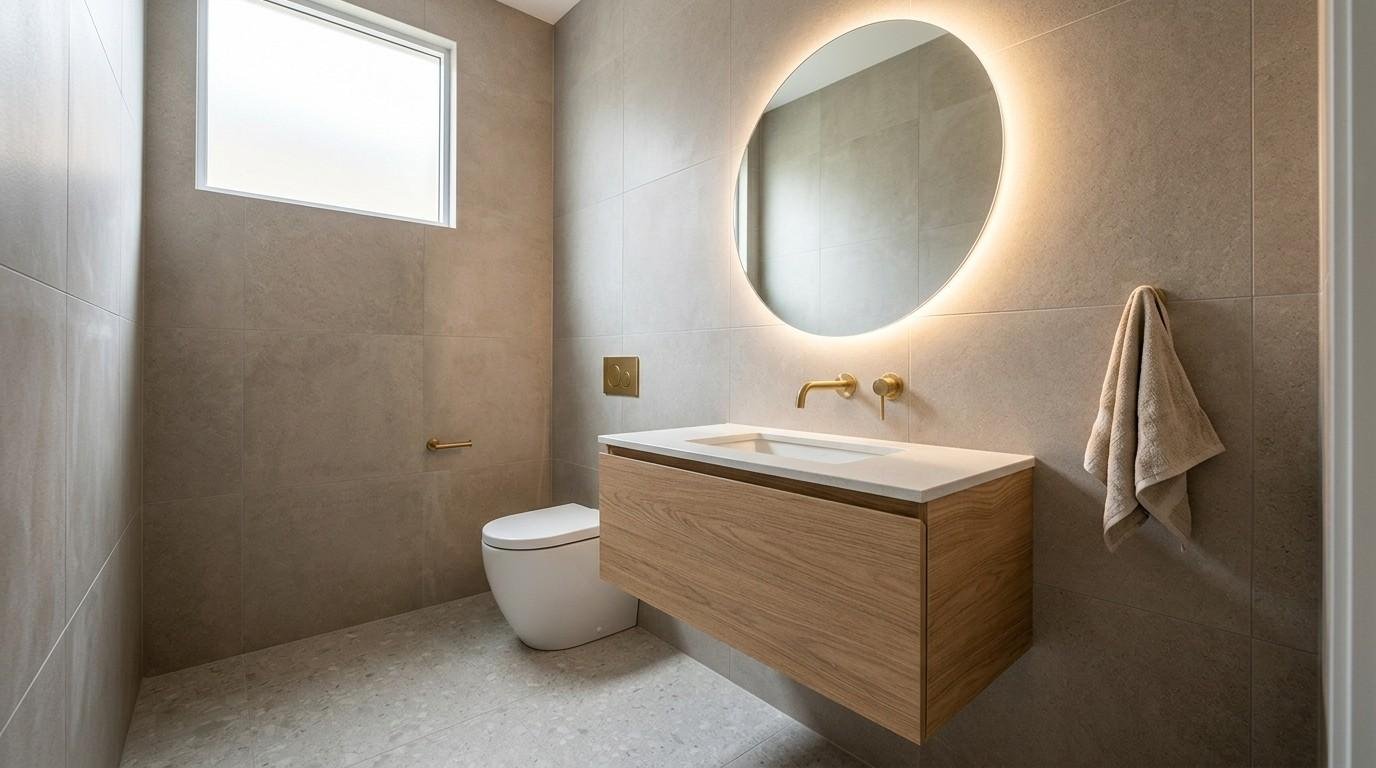
Wall-mounted vanities visually expand the floor area by exposing the tile beneath. We recommend a slimline cabinet between 450 mm and 600 mm wide with an integrated or above-counter basin. Natural timber veneers add warmth, while matte two-pack finishes in stone, charcoal, or warm white deliver a contemporary edge.
Frameless Mirrors and Clean Lines
A frameless or slim-framed mirror in brushed brass, black, or chrome anchors the vanity zone. Oversized round mirrors soften a square room, while tall rectangular mirrors lift the ceiling line visually. Pair with concealed LED strip lighting behind the mirror for a floating glow effect.
Monochrome Palettes
Tone-on-tone palettes warm white with limewash walls, or deep charcoal with matte black tapware create a deliberately curated mood. We suggest limiting the colour story to two or three tones across walls, floor, and joinery to maintain visual cohesion in a small space.
Powder Room Design Ideas by Home Style
Sydney homes span a wide range of architectural styles, and the best powder room design respects the character of the broader house. Here is how we approach each.
Hamptons Powder Room Design
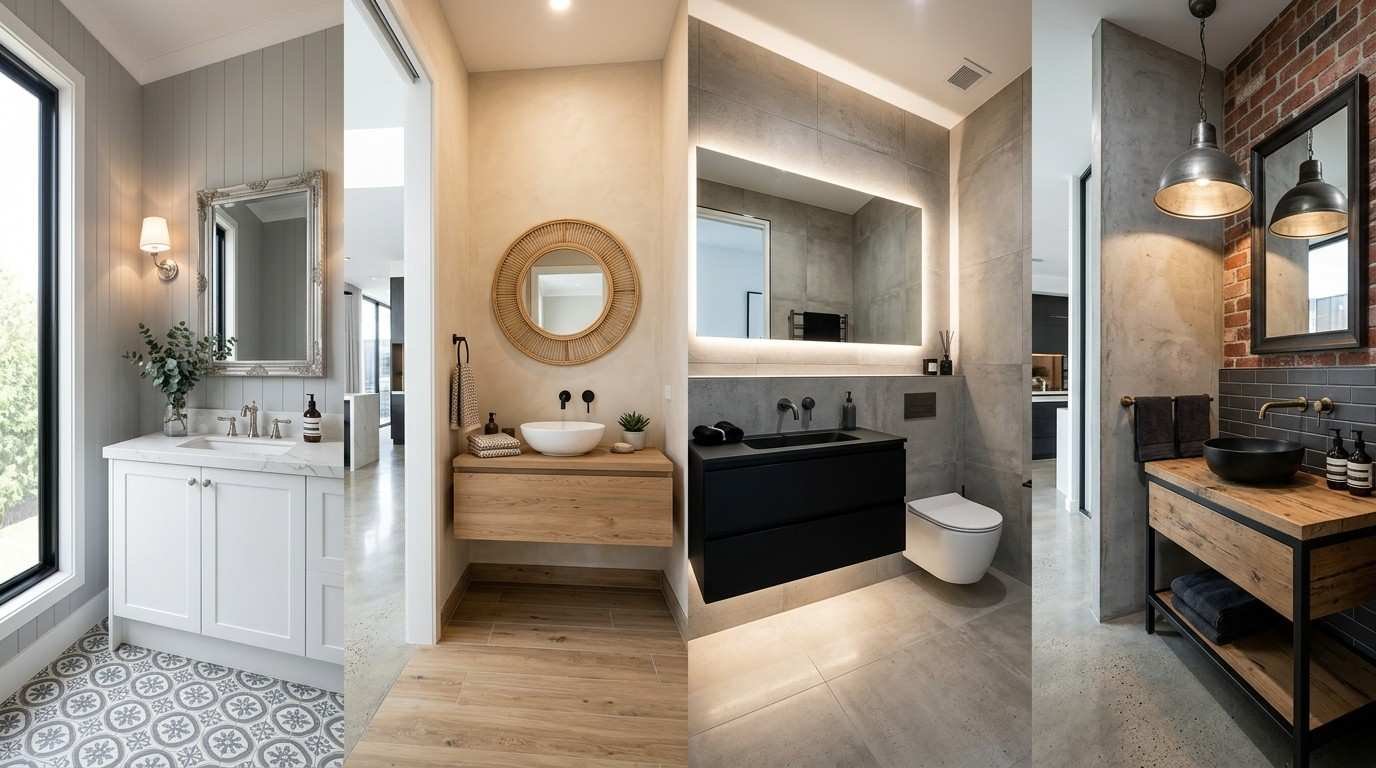
Hamptons style suits the North Shore, Northern Beaches, and Eastern Suburbs. We use tongue-and-groove panelling to dado height, painted in soft white or pale grey, with a marble or engineered stone vanity top. Brushed nickel or chrome tapware, a framed mirror with a classic profile, and a patterned encaustic floor tile complete the look. Shaker-style vanity doors and a pedestal basin are authentic alternatives when floor space is very tight.
Coastal Powder Room Design
Coastal interiors work well in beachside suburbs from Manly to Cronulla. We lean into natural textures: rattan mirror frames, timber-look porcelain floors, and limewash or textured render walls in sandy, warm white, or soft sage tones. Matte black tapware provides contrast without feeling heavy. Keep accessories minimal: a single piece of coastal artwork and a simple hand towel hook are enough.
Contemporary Powder Room Design
Contemporary suits inner-city terraces, new builds, and apartment renovations across Sydney. We favour wall-hung toilets with concealed cisterns, floating vanities in matte two-pack or micro-textured laminates, and large-format porcelain in concrete or stone looks. Matte black or gunmetal tapware, a backlit LED mirror, and a single dramatic pendant light create a hotel-quality finish in a compact footprint.
Industrial Powder Room Design
Industrial works well in warehouse conversions, inner-west terraces, and loft-style homes. Exposed brick or textured concrete render, a vessel basin on a raw timber or steel-framed vanity, and aged brass or matte black tapware set the tone. We often use a single oversized pendant with an Edison bulb and a dark grout with large-format tiles to reinforce the raw, considered aesthetic.
Bold Wall and Wallpaper Ideas
Because the powder room is a low-stakes space, it is the ideal room for design risk. Walls take up the largest visual surface, making them the most efficient place to deliver impact.
Statement Wallpaper
Botanical, geometric, art deco, and hand-painted mural wallpapers all perform well in powder rooms. We always specify vinyl-coated or wet-area-rated wallpaper to handle splashes and humidity. A single feature wall behind the vanity or toilet keeps the look intentional rather than overwhelming.
Textured Wall Panels
Fluted timber panelling, microcement, Venetian plaster, and vertical tongue-and-groove timber add depth and tactile interest. Panelling to dado height with paint above is a classic Hamptons or coastal Sydney look, while full-height microcement suits modern, European-inspired homes.
Feature Paint Colours
Deep navy, forest green, terracotta, and dusty rose all photograph beautifully in compact rooms. We recommend low-sheen or eggshell finishes to hide imperfections and reduce glare. Continuing the colour onto the ceiling creates a fully enveloped, cocoon-like atmosphere that guests consistently notice.
Powder Room Colour Palette Ideas
Colour is the single fastest way to shift a powder room’s mood. We group our Sydney recommendations into four palette directions.
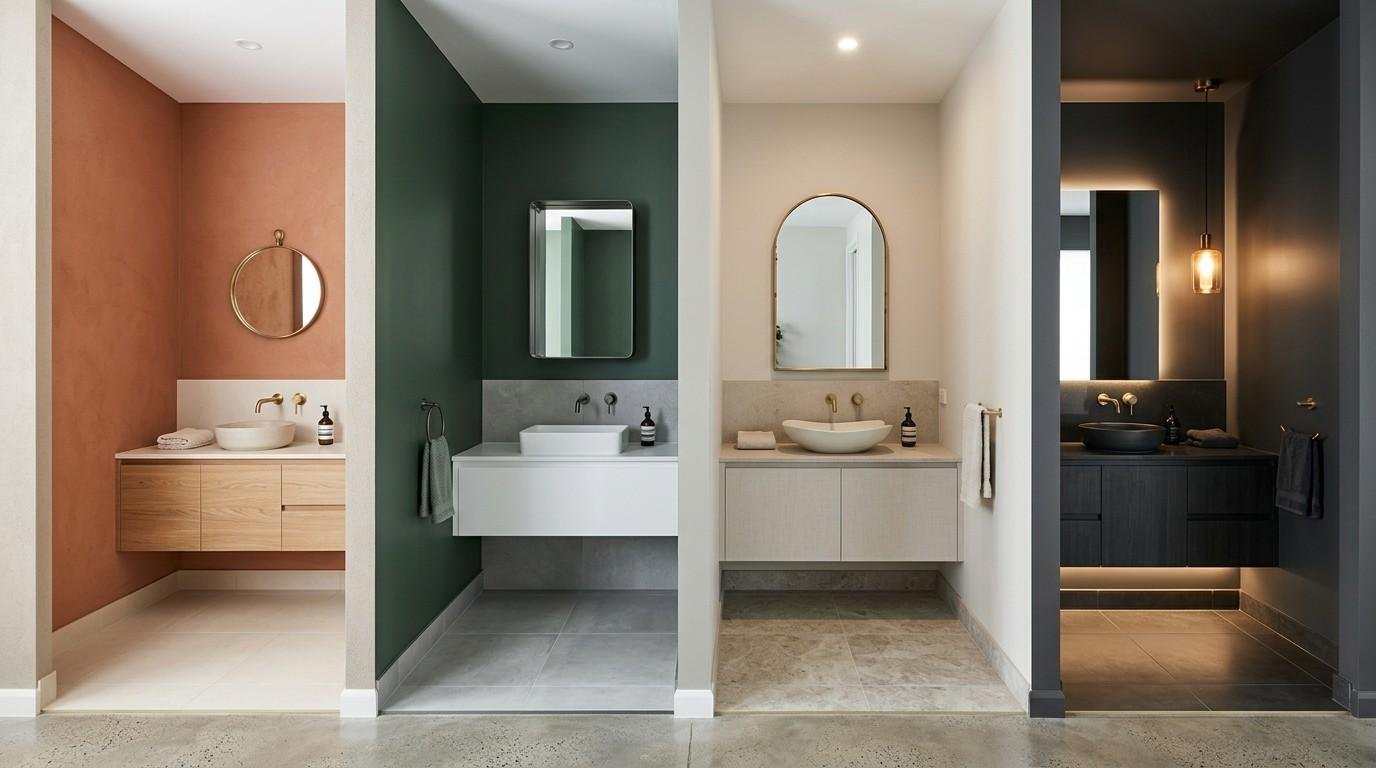
Warm palettes: aged brass tapware, terracotta or dusty rose walls, timber veneer joinery, and warm white stone tops. These suit Hamptons, coastal, and Federation-era homes. They photograph warmly and feel welcoming in a guest-facing space.
Cool palettes: matte black or gunmetal tapware, deep navy or forest green walls, white or light grey stone tops, and cool-toned porcelain floors. These suit contemporary, industrial, and inner-city terrace homes. The contrast is sharp and confident.
Neutral palettes: warm white, greige, or soft linen tones across walls, joinery, and floor. These are the safest choice for resale and suit almost every Sydney home style. Elevate a neutral palette with a single statement element: a patterned floor tile, a sculptural basin, or a dramatic mirror frame.
Bold palettes: full-room colour commitment in deep emerald, charcoal, or inky blue, carried across walls, ceiling, and joinery. This approach works best when the rest of the home is relatively neutral, letting the powder room act as a deliberate surprise. We see this trend growing strongly in Sydney’s inner suburbs.
Powder Room Design Trends for 2025
We track what is moving in Sydney showrooms and on completed projects, and these are the directions gaining the most momentum right now.
Fluted joinery continues to dominate. Fluted fronts on vanity doors, fluted stone basins, and fluted wall panels all add texture without pattern, which suits both warm and cool palettes.
Limewash and textured render are replacing flat paint on feature walls. The depth and movement of limewash suit both Hamptons and contemporary interiors, and it photographs exceptionally well.
Terrazzo is back on floors, basin tops, and even wall tiles. Sydney suppliers now stock terrazzo-look porcelain at accessible price points, making the look achievable at mid-range budgets.
Warm metals aged brass, unlacquered brass, and brushed bronze are replacing the matte black dominance of the previous five years. We are specifying warm metals across tapware, mirror frames, and towel hooks for a richer, more layered finish.
Curved forms round mirrors, oval basins, and curved vanity fronts soften the hard geometry of a small room and are appearing in both contemporary and coastal Sydney projects.
Vanity, Basin, and Tapware Ideas
The vanity is the functional centrepiece and sets the room’s character. We see Sydney homeowners increasingly choosing slimline 450 mm to 600 mm vanities with semi-recessed basins to free up bench space without sacrificing storage.
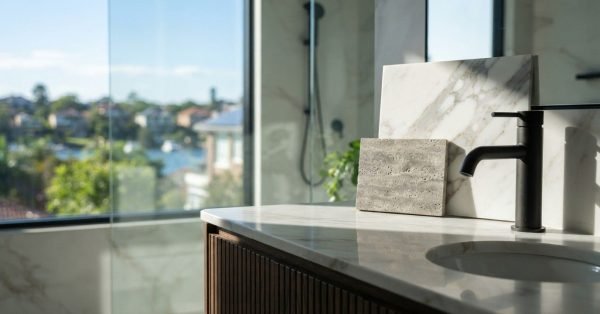
Stone tops in marble, engineered quartz, or terrazzo bring durability and a premium finish. For a softer look, fluted timber doors with stone or solid surface tops work in coastal, Hamptons, and contemporary homes. Wall-hung basins paired with floor-standing tapware deliver a dramatic, sculptural moment when budget allows.
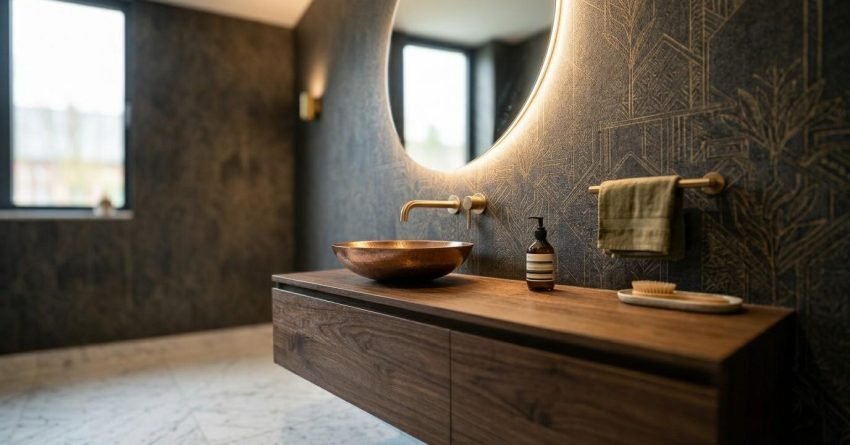
Vessel basins a bowl sitting above the vanity top, are a strong choice for contemporary and industrial styles. They read as a design feature in their own right and pair well with wall-mounted tapware to keep the bench surface clean. Semi-recessed basins are the practical middle ground: they project slightly over the vanity edge, freeing up bench space while keeping a lower profile than a full vessel.
Tapware finishes drive the overall mood. Brushed brass and aged brass suit warm palettes, while matte black, gunmetal, and chrome anchor cooler, modern schemes. We always match the toilet flush plate, towel rail, and door hardware to the tapware finish for a cohesive result.
Lighting and Mirror Design Ideas
Lighting in a powder room must do two jobs: provide accurate task light at the mirror and create ambient mood for evening use. A layered approach delivers both without overcrowding the ceiling.
Wall sconces flanking the mirror at eye level produce flattering, shadow-free face light ideal for guests checking their appearance. A single pendant centred over the vanity adds sculptural interest and works well with higher ceilings. Pair these with a recessed downlight near the toilet for general illumination.
We specify warm white globes between 2,700K and 3,000K to flatter skin tones. Dimmable circuits allow the room to shift from bright daytime use to softer mood lighting at dinner parties. Backlit LED mirrors are a popular Sydney upgrade because they combine task lighting and mirror into one clean fitting, especially useful when wall space is limited.
Flooring and Tile Design Ideas
Powder room floors take guest traffic but very little water exposure, which opens up flooring options well beyond standard wet-area tiles. The compact size also makes premium materials affordable since the total area is small.
Patterned encaustic-style tiles, terrazzo, and large-format porcelain in marble or stone all work beautifully. Hexagonal mosaics, fish-scale tiles, and chevron patterns add visual energy without overwhelming the room. We often continue floor tiles up the toilet wall for a half-height wainscoting effect that feels custom and considered.
For a designer touch, run the same stone or porcelain across the floor and onto the vanity splashback. Grout colour is a detail that makes a significant difference; a contrasting dark grout on light tiles emphasises the pattern and adds graphic energy, while a tone-matched grout creates a seamless, expansive feel. Slip-rated tiles with an R10 or R11 rating meet Australian Standards for residential wet areas and protect against accidental spills.
Small Powder Room Storage Ideas
Storage is the most common pain point in compact powder rooms. The trick is using vertical space, recessed cavities, and dual-purpose joinery to hide essentials without crowding the room visually.
Mirrored cabinets above the vanity store guest soap, toilet paper, and toiletries while doubling as the main mirror. Recessed wall niches behind the toilet add display and storage space without protruding into the floor area. Under-vanity drawers with soft-close runners hold cleaning supplies and spare rolls.
For ultra-small powder rooms under 2 square metres, we recommend a wall-hung toilet with a concealed cistern. This frees up roughly 200 mm of floor depth and creates a flat wall surface that visually enlarges the room.
Under-Stair Powder Room Design
Under-stair powder rooms are one of the most popular space-conversion projects we handle in Sydney terraces and double-storey homes. The challenge is working within a tapered ceiling height and limited floor depth, typically 900 mm to 1,200 mm, while still meeting the NCC’s minimum 800 mm clearance in front of the toilet.
We approach under-stair builds with a wall-hung toilet and concealed cistern as the default, since the cistern can be installed within the stair structure rather than projecting into the floor space. A compact wall-mounted basin 350 mm to 400 mm wide fits the narrow footprint without sacrificing function. Lighting is critical in these spaces: a recessed downlight directly above the basin and a small backlit mirror make the space feel intentional rather than cramped.
Plumbing access is the main planning consideration. We assess the existing drain locations and soil stack position before committing to a layout, since relocating plumbing in a confined under-stair space adds cost. Ventilation via a mechanical exhaust fan is required under the NCC where no operable window is present, which is almost always the case in under-stair builds.
Planning and Permits for a Sydney Powder Room
Most powder room renovations in Sydney do not require a Development Application (DA), provided the work is classified as exempt or complying development under the NSW Environmental Planning and Assessment Act. Cosmetic upgrades, retiling, new vanity, new tapware, and new lighting are almost always exempt.
Work that may trigger a DA or Complying Development Certificate (CDC) includes adding a new powder room where none existed, relocating plumbing beyond minor adjustments, or structural changes to walls. We always recommend confirming with your local council or a certifier before starting, particularly in heritage-listed properties or strata buildings where additional approvals may apply.
Licensed trades are non-negotiable for certain scopes. In NSW, all plumbing and drainage work must be carried out by a licensed plumber. All electrical work must be completed by a licensed electrician. Waterproofing in wet areas must be applied by a licensed waterproofer and must comply with AS 3740. These are not optional; unlicensed work can void your home insurance and create issues at resale.
We coordinate all licensed trades on every project, so our clients never need to manage compliance separately. The paperwork, inspections, and sign-offs are handled as part of the build.
Powder Room Renovation Costs in Sydney
Powder room renovation costs in Sydney typically range from $8,000 to $20,000 depending on size, finishes, and the scope of plumbing work. A cosmetic refresh sits at the lower end, while a full strip-out with relocated plumbing and premium finishes can exceed $25,000.
Budget breakdown for a mid-range powder room renovation:
- Demolition and waste removal: $800 to $1,500
- Plumbing and electrical: $2,500 to $5,000
- Waterproofing and tiling: $2,000 to $4,500
- Vanity, basin, and tapware: $1,500 to $4,000
- Toilet suite: $400 to $1,500
- Lighting and mirror: $400 to $1,200
- Painting and finishing: $600 to $1,500
Hidden costs that often surprise first-time renovators include relocating plumbing rough-ins, structural patching behind walls, asbestos testing in pre-1990s homes, and rubbish removal for tiles and old fittings. Choosing where to splurge matters in a small room; statement tapware, lighting, and wallpaper deliver the highest visual return per dollar, while the toilet suite and basic plumbing fittings are sensible places to choose mid-range options.
How Long Does a Powder Room Renovation Take?
A straightforward powder room renovation no plumbing relocation, no structural changes typically takes one to two weeks on site. This includes demolition, waterproofing cure time, tiling, joinery installation, plumbing and electrical fit-off, and painting.
Projects involving plumbing relocation, under-stair builds, or custom joinery extend the timeline to two to four weeks. The waterproofing cure period, a mandatory 24 to 48 hours before tiling can begin, is the most common cause of scheduling delays when trades are not properly sequenced.
We build a detailed programme for every project so our clients know exactly when each trade is on site and when the room will be handed over.
DIY vs Professional: What You Can and Cannot Do
In NSW, some powder room tasks are legally DIY-safe, and others are not. Understanding the boundary protects your home insurance and avoids compliance issues at resale.
DIY-safe (no licence required): painting, wallpaper installation, mirror hanging, accessory installation (towel rails, toilet roll holders), flat-pack vanity assembly where no plumbing connections are made.
Licensed trades only: all plumbing connections (basin, toilet, tapware), all electrical work (new circuits, light fittings, exhaust fans), waterproofing application in wet areas. Attempting these without a licence is illegal in NSW and can void your insurance.
We handle all licensed scopes in-house, which means one point of contact and no coordination risk for our clients.
Conclusion
A well-designed powder room delivers one of the strongest renovation returns per square metre in any Sydney home. Bold finishes, smart layouts, and considered lighting combine to create a space that guests notice and remember and that buyers value at inspection.
From modern floating vanities and statement wallpapers to layered lighting, clever storage, and style-matched colour palettes, the right design choices create lasting impact without requiring a large footprint or an outsized budget.
At Sydney Home Renovation, we plan, cost, and deliver powder room renovations built for long-term value, handling every licensed trade, every compliance requirement, and every design decision so you can renovate with complete confidence. Request your free design consultation today.
Frequently Asked Questions
How much does a powder room renovation cost in Sydney?
A standard powder room renovation in Sydney costs between $8,000 and $20,000, depending on finishes, fittings, and plumbing scope. Premium designs with stone, custom joinery, and relocated plumbing can reach $25,000 or more.
What is the minimum size for a powder room?
Australian building regulations require a minimum of about 1.5 square metres for a functional powder room, with at least 800 mm clearance in front of the toilet. Most Sydney powder rooms range between 1.5 and 3 square metres.
Do powder rooms add value to a home?
Yes. A well-designed powder room signals quality finishes across the property and improves buyer appeal, particularly in homes with multiple living zones. We consistently see stronger sale outcomes on properties with a considered guest WC.
Can I install a powder room under the stairs?
Yes. Under-stair powder rooms are popular in Sydney terraces and double-storey homes. We assess plumbing access, ceiling height, and ventilation requirements before committing to a layout, since these factors drive both cost and compliance.
Do I need council approval for a powder room renovation?
Most cosmetic renovations retiling, new vanity, new tapware are exempt development in NSW. Adding a new powder room or relocating plumbing may require a CDC or DA. We confirm the approval pathway before every project starts.
How long does a powder room renovation take?
A straightforward powder room renovation takes one to two weeks on site. Projects with plumbing relocation or custom joinery typically run two to four weeks, including mandatory waterproofing cure time.
What are the best finishes for a small powder room?
Reflective surfaces, polished tiles, mirrored cabinetry, and brushed metal tapware visually expand small powder rooms. We combine these with a bold feature wall in wallpaper or paint to add personality without making the space feel cramped.
What powder room design trends are popular in Sydney for 2025?
Fluted joinery, limewash walls, terrazzo floors, warm metal tapware in aged brass or brushed bronze, and curved basin forms are the strongest trends we are seeing across Sydney projects right now.