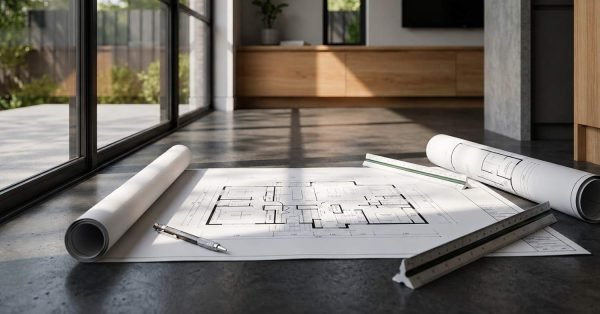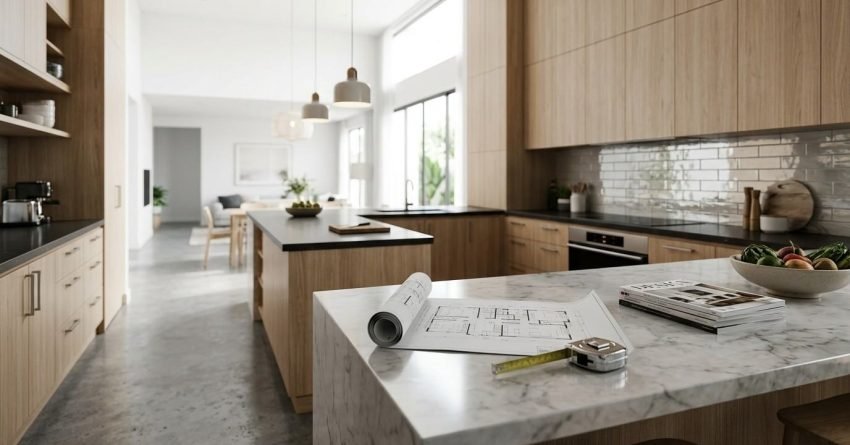
The most costly kitchen renovation mistakes in Sydney rarely come from choosing the wrong tiles or splurging on appliances. They come from getting the layout wrong before a single cabinet is installed. A poorly planned kitchen layout creates daily frustration, limits functionality, and can add thousands of dollars in rectification costs once the build is underway.
In our experience working with homeowners, first-time renovators, and property investors across Sydney, layout decisions are the foundation everything else is built on. Get them right, and your kitchen works effortlessly for years. Get them wrong, and no amount of premium finishes will fix the problem. This guide covers the most common kitchen layout mistakes we see, from ignoring the work triangle to misplacing appliances and underestimating storage, so you can plan with confidence and renovate smarter.
Why Kitchen Layout Planning Matters Before You Renovate
Kitchen layout planning is the single most important phase of any kitchen renovation. It determines how the space functions, how much the build costs, and how much value the finished kitchen adds to your property. Yet it is consistently the phase that homeowners rush through or skip entirely in favour of choosing finishes and fixtures.
In Sydney, kitchen renovations typically range from $15,000 for a basic refresh to well over $60,000 for a full structural redesign. Layout errors are expensive to correct mid-build. Changing the position of a sink after plumbing is roughed in, or relocating an island after cabinetry is ordered, can add thousands of dollars in variation costs and delay your project by weeks.
Planning the layout thoroughly before any work begins is not just good design practice. It is sound financial management.
How Poor Layout Decisions Drive Up Renovation Costs
Every layout decision in a kitchen has a downstream cost implication. Moving a sink requires relocating drainage and water supply lines. Repositioning an oven or cooktop may require new gas or electrical rough-in work.
These are not hypothetical scenarios in our line of work. They are among the most common variation requests we see mid-project, and they are almost always avoidable with proper upfront planning. The cost of a thorough layout review before construction begins is negligible compared to the cost of structural changes once walls are open and trades are on site.
What Makes a Kitchen Layout Functional vs. Frustrating
A functional kitchen layout is one where the three primary zones, cooking, preparation, and storage, are positioned logically relative to each other and to the entry points of the space. Movement between these zones should be intuitive, unobstructed, and efficient.
A frustrating kitchen layout is one where the refrigerator sits on the opposite side of the room from the prep bench, where the dishwasher opens into a main traffic path, or where there is no bench space adjacent to the oven for landing hot cookware. These are daily friction points that compound over years of use.
Functionality is not about aesthetics. It is about how the space performs under real-world cooking conditions.
Ignoring the Kitchen Work Triangle
The kitchen work triangle is one of the most enduring principles in residential kitchen design, and it remains one of the most frequently ignored during renovation planning. Homeowners focused on the visual appeal of their new kitchen often overlook the spatial logic that makes a kitchen genuinely usable.
Ignoring the work triangle does not just affect convenience. It affects how long the kitchen takes to work in, how much energy is wasted moving between zones, and how the space feels during everyday use.
What Is the Kitchen Work Triangle and Why Does It Still Matter?
The kitchen work triangle connects the three primary work zones: the refrigerator, the cooktop, and the sink. This long-standing design principle holds that the total distance of the three sides of this triangle should fall between 4 metres and 8 metres, with no single leg shorter than 1.2 metres or longer than 2.7 metres.
The logic is straightforward. These three points are where the majority of kitchen activity occurs, and minimising unnecessary travel between them reduces fatigue and improves workflow.
In modern open-plan kitchens, the work triangle has evolved into a work zone concept that accounts for multiple cooks and additional appliances. The underlying principle that primary work areas should be spatially logical and proximate remains as relevant as ever.
How to Apply the Work Triangle in Sydney Kitchen Renovations
Applying the work triangle in a Sydney kitchen renovation starts with identifying the fixed constraints of your space: the location of existing plumbing, gas lines, and electrical supply. These determine where your sink, cooktop, and refrigerator can be positioned without incurring significant relocation costs.
In a standard Sydney terrace or semi-detached home, the kitchen is often a galley or L-shaped configuration with limited flexibility. In these cases, the goal is to optimise the triangle within the existing footprint rather than redesign the entire space.
We always recommend mapping the triangle early in the design process, before cabinetry layouts are finalised. It is a simple step that prevents significant functional problems later.

Poor Placement of the Kitchen Island
The kitchen island has become one of the most requested features in Sydney kitchen renovations. It offers additional bench space, storage, and a social focal point for open-plan living. It is also one of the most commonly misplaced elements in residential kitchen design.
An island that is too large, too small, or positioned without adequate clearance on all sides creates more problems than it solves.
How Much Clearance Does a Kitchen Island Actually Need?
The minimum clearance between a kitchen island and surrounding cabinetry or walls is 900mm on working sides and 1,000mm on traffic sides. These are practical minimums that allow appliance doors to open fully, drawers to extend without obstruction, and two people to move through the kitchen simultaneously without collision.
In Sydney homes where kitchen footprints are often constrained by the existing structure, these clearance requirements are frequently underestimated. Homeowners see an island in a showroom or on a renovation platform and assume it will fit their space without checking the actual dimensions.
Before committing to an island, we always recommend producing a scaled floor plan that shows all clearances with appliance doors in the open position. This single step prevents one of the most common and costly kitchen layout mistakes.
When a Kitchen Island Hurts More Than It Helps
An island is not the right choice for every kitchen. In a galley kitchen under 2.4 metres wide, an island is physically impossible to accommodate safely. In an L-shaped kitchen under 12 square metres, an island will typically consume clearance space the kitchen cannot afford to lose.
The decision to include an island should be driven by the actual dimensions of the space, not by design trends. A well-designed kitchen without an island will always outperform a poorly planned kitchen with one.
If your kitchen cannot accommodate an island with proper clearances, we often suggest a peninsula, a counter extension attached to an existing run of cabinetry, which provides many of the same functional benefits without the clearance demands.
Not Planning Enough Storage From the Start
Insufficient storage is one of the most common complaints homeowners have about their existing kitchens, and it remains one of the most common mistakes made during kitchen renovations. The excitement of choosing benchtops, splashbacks, and appliances often overshadows the less glamorous but critically important task of planning storage capacity.
A kitchen that looks beautiful but lacks adequate storage will feel cluttered and dysfunctional within weeks of completion.
Common Cabinet and Drawer Placement Mistakes
The most frequent cabinet and drawer placement mistakes we see in Sydney kitchen renovations include:
- Placing overhead cabinets too high for practical daily access
- Installing base cabinets without deep drawers in the lower zone, forcing homeowners to crouch and reach into dark corners.
- Failing to include a dedicated pantry or tall cabinet run for dry goods storage
- Positioning the bin drawer away from the main prep and cooking zone
- Neglecting to plan for appliance storage, leaving bench-top appliances permanently on display and consuming valuable prep space
Each of these mistakes is easy to avoid with a detailed storage plan developed before cabinetry is ordered. The key is to inventory your actual storage needs and map those needs to specific cabinet locations before the design is finalised.
How to Maximise Storage Without Blowing Your Budget
Maximising kitchen storage does not require premium cabinetry or a large budget. The most effective storage improvements come from smart planning rather than expensive upgrades.
Deep drawers in the lower cabinet zone are more accessible than traditional hinged doors with shelves. Pull-out pantry units make better use of narrow spaces than fixed shelving. Corner cabinet solutions, whether a lazy Susan, a pull-out carousel, or a Le Mans unit, recover space that is otherwise wasted in L-shaped and U-shaped layouts.
Overhead cabinets that extend to the ceiling eliminate the dust-collecting gap above standard-height uppers and add meaningful storage for infrequently used items. These are practical decisions that improve the kitchen’s long-term functionality without significantly increasing the overall renovation budget.
Underestimating Bench Space and Prep Areas
Bench space is the working surface of the kitchen. It is where food is prepared, where appliances are used, and where the practical work of cooking happens. Yet it is consistently underestimated during kitchen renovation planning, particularly in smaller Sydney homes.
How Much Bench Space Do You Actually Need?
As a practical guide, a functional kitchen requires a minimum of 900mm of continuous bench space on at least one side of the cooktop for food preparation. A landing zone of at least 400mm should sit adjacent to the oven for placing hot cookware safely. A further 600mm of clear bench space near the refrigerator allows for unpacking groceries and staging ingredients.
These are minimums, not ideals. The mistake most homeowners make is measuring total bench length without accounting for the space consumed by permanently positioned appliances, which can reduce usable prep space by 600mm to 900mm in a typical kitchen.
Bench Space Mistakes That Affect Daily Kitchen Use
The most impactful bench space mistakes are positional rather than dimensional. A long run of bench space interrupted by the cooktop in the middle, for example, creates two short working surfaces rather than one usable long one.
Positioning the primary prep zone between the sink and the cooktop, in line with the work triangle, maximises the efficiency of the bench space you have. This simple positional decision makes a significant difference to how the kitchen functions in daily use.
Misplacing Appliances and Utilities
Appliance placement is one of the most technically consequential decisions in kitchen layout planning. Unlike cabinetry, which can be adjusted relatively easily, appliances are tied to fixed utility connections that are expensive to relocate once the build is underway.
Misplacing appliances creates both functional problems and cost problems.
Refrigerator, Oven, and Dishwasher Placement Errors
We recommend positioning the refrigerator at the entry point of the kitchen’s work zone, the first stop when bringing groceries in, and easily accessible without crossing the cooking zone. Placing the refrigerator at the far end of the kitchen forces unnecessary movement through the busiest part of the kitchen every time someone opens it.
The oven and cooktop should be positioned with clear bench space on both sides and away from the main traffic path. Placing the oven adjacent to a corner or at the end of a run without a landing zone is a safety issue as well as a functional one.
The dishwasher should sit immediately adjacent to the sink, ideally within 300mm, to minimise plumbing costs and allow efficient loading without carrying wet dishes across the kitchen.
How Appliance Placement Affects Plumbing and Electrical Costs
Every metre that a plumbing connection moves from its existing location adds cost to the renovation. In our experience, relocating a sink by 1.5 metres in a Sydney kitchen renovation can add roughly $800 to $2,500 in plumbing costs depending on the complexity of the existing drainage configuration.
Similarly, adding a new electrical circuit for an oven, rangehood, or dishwasher in a location that requires running cable through walls or under floors adds to the electrical budget. We always discuss appliance placement with clients before the design is finalised, so cost implications are understood upfront rather than discovered mid-build.
Overlooking Kitchen Ventilation and Rangehood Positioning
Kitchen ventilation is one of the most overlooked elements of kitchen layout planning. Homeowners focus on the visual impact of the rangehood without fully considering its functional requirements or the structural cost implications of positioning it incorrectly.
A rangehood that is too far from the cooktop, vented to the wrong location, or undersized will fail to remove cooking odours, grease, and moisture effectively.
Why Rangehood Placement Is a Structural and Cost Decision
The rangehood must sit directly above the cooktop, centred on the cooking surface, at a height of 650mm to 750mm above the cooktop for gas and 550mm to 650mm for induction or electric. These are functional requirements that determine how effectively the rangehood captures cooking emissions.
Ducted rangehoods, which vent cooking air to the exterior, require a duct run from the rangehood to an external wall or roof. In a Sydney terrace or apartment, this duct run may need to travel through cabinetry, ceiling cavities, or external walls, each adding complexity and cost.
Positioning the cooktop on an island requires a ceiling-mounted rangehood with a duct run through the ceiling structure. This is achievable but significantly more expensive than a wall-mounted rangehood above a standard cooktop position.
Ventilation Mistakes That Lead to Costly Rectification Work
The most common ventilation mistakes we see in Sydney kitchen renovations include:
- Installing a recirculating rangehood in a kitchen where ducting to the exterior is feasible, since recirculating units are significantly less effective
- Positioning the cooktop under a structural beam or ceiling joist that prevents a direct duct run to the exterior
- Selecting a rangehood narrower than the cooktop, leaving the outer burners unprotected
- Failing to include adequate make-up air provisions in a well-sealed home, which reduces rangehood effectiveness
Each of these mistakes is difficult and expensive to rectify after the kitchen is complete.

Neglecting Natural Light and Artificial Lighting Zones
Lighting is one of the most undervalued elements of kitchen design. It affects how the space looks, how safely it can be used, and how it feels at different times of day. Yet kitchen lighting is frequently treated as an afterthought.
How Lighting Layout Affects Kitchen Functionality
A well-lit kitchen requires at least three layers of lighting: ambient lighting for general illumination, task lighting for work surfaces, and accent or feature lighting for visual interest. Each layer serves a different purpose.
Task lighting, typically under-cabinet LED strips positioned above the bench, is the most functionally important layer. Without it, overhead cabinets cast a shadow directly onto the prep surface, making food preparation more difficult and less safe.
Ambient lighting should illuminate the entire kitchen evenly, without creating dark corners near the sink, dishwasher, or pantry. Recessed downlights on a dimmer circuit provide flexibility for different times of day.
Task Lighting vs. Ambient Lighting in Kitchen Design
Task lighting and ambient lighting serve fundamentally different functions and should not be conflated. Ambient lighting provides the general light level of the room, while task lighting provides focused illumination at the specific points where work is performed.
In a kitchen renovation, the electrical rough-in for task lighting needs to be planned before cabinetry is installed, because the wiring runs behind or through the cabinet structure. Adding under-cabinet lighting after cabinetry is installed is possible but more expensive.
We recommend planning your lighting zones at the same time as your cabinet layout. These decisions need to be made before the electrician completes the rough-in, not after.
Choosing the Wrong Layout Style for Your Kitchen Size
One of the most fundamental kitchen layout mistakes is selecting a layout style that does not suit the dimensions and configuration of the available space. Kitchen layout styles- galley, L-shape, U-shape, and open-plan- each have specific spatial requirements and functional characteristics.
Galley, L-Shape, U-Shape, and Open-Plan Layout Comparisons
Galley kitchens work best in narrow spaces between 2.4 metres and 3.6 metres wide. They are highly efficient for single-cook households because everything is within a short linear distance. The primary risk is insufficient width.
L-shaped kitchens suit medium-sized spaces and open-plan living areas. They provide a natural work triangle and allow for a dining or living zone in the adjacent space. The corner junction requires careful planning to avoid wasted space.
U-shaped kitchens maximise storage and bench space in larger kitchen footprints. They work well in dedicated kitchen rooms but can feel enclosed in smaller spaces. The minimum recommended width between opposing runs is 1.2 metres.
Open-plan kitchens integrated with living and dining areas are the most common configuration in contemporary Sydney renovations. They require careful zoning to ensure the kitchen’s functional requirements do not compromise the living areas they connect to.
How to Match Kitchen Layout to Your Home’s Floor Plan
Matching the kitchen layout to your home’s floor plan starts with an accurate measured drawing of the available space, including the location of all doors, windows, structural walls, and existing utility connections.
From this base, we can overlay the proposed layout and check it against the functional requirements: work triangle distances, clearance zones, appliance positions, and storage capacity. This process often reveals constraints that are not apparent from a visual inspection of the space.
In Sydney’s older housing stock, terraces, semis, and Federation homes, kitchen footprints are often irregular and constrained by the existing structure. Working with these constraints rather than against them produces better outcomes than trying to impose a preferred layout on a space that cannot accommodate it.
Blocking Natural Traffic Flow Between Rooms
A kitchen does not exist in isolation. It connects to dining areas, living spaces, and hallways, and the layout needs to account for how people move through and around it, not just within it.
We regularly see kitchens where a poorly positioned island or peninsula narrows the walkway into an adjoining living space to below a comfortable width. A minimum of 900mm to 1,000mm should be maintained in any through-route, and busier family homes benefit from more.
Door swings are another common oversight. An oven, pantry, or fridge door that swings into the main walking path between the kitchen and the rest of the home creates a daily collision point.
Before finalising any layout, we walk through the proposed floor plan with our clients and physically trace the paths people will use most often. This simple exercise catches traffic flow problems that are easy to miss on a flat drawing.
Failing to Future-Proof Your Kitchen Layout
A kitchen renovation is a significant investment, and most homeowners expect the result to serve them well for 10 to 20 years. Yet many kitchen layouts are designed for the household’s current needs without any consideration of how those needs might change.
Future-proofing a kitchen layout does not require predicting the future. It requires making design decisions that preserve flexibility.
Design Decisions That Limit Flexibility and Resale Value
Several common kitchen design decisions limit the flexibility of the space and can negatively affect resale value:
- Highly personalised colour schemes or material choices that appeal to a narrow market
- Fixed structural elements, like a large island or a relocated cooktop, that cannot be easily modified without high cost
- Appliance niches sized for specific models that may not be available when replacements are needed
- Inadequate electrical provision, too few power points, no provision for future appliances, that requires costly electrical work to rectify
For property investors in particular, kitchen layout decisions should be evaluated against their impact on rental appeal and resale value, not just personal preference. A functional, neutral, well-planned kitchen will consistently outperform a highly personalised one in the Sydney property market.
How to Build Adaptability Into Your Kitchen Renovation Plan
Building adaptability into a kitchen renovation plan involves a few straightforward decisions that add minimal cost but significant long-term value. We recommend installing additional power points beyond the minimum required, particularly in the bench zone and near the island, since electrical provision is inexpensive to add during the rough-in phase and expensive to add later.
Choosing appliance niches with standard dimensions that accommodate a range of models preserves flexibility when appliances need to be replaced. Selecting cabinetry in neutral tones and timeless profiles keeps the kitchen visually relevant across multiple design cycles, since the structural layout will outlast any particular design trend.
How Do Kitchen Layout Mistakes Affect Renovation Costs in Sydney?
Kitchen layout mistakes affect renovation costs in two distinct ways. They increase the cost of the initial build through unnecessary complexity, and they generate rectification costs when problems are identified during or after construction.
The most expensive layout mistakes are those that require relocating fixed utility connections after the rough-in is complete. In our experience, plumbing variations mid-build typically cost between $500 and $3,000 depending on complexity. Electrical variations range from $300 to $1,500. Structural changes, removing or adding walls, relocating doorways, can add $5,000 to $20,000 or more to the project cost.
Beyond direct variation costs, layout mistakes generate indirect costs through project delays. Every variation requires a quote, approval, and rescheduling of trades, a process that can add days or weeks to the project timeline.
The most effective way to avoid these costs is to invest in thorough layout planning before the build begins.

How to Avoid Kitchen Layout Mistakes With Professional Help
Avoiding kitchen layout mistakes is significantly easier with professional guidance. We bring practical knowledge of what works in real Sydney homes, knowledge that is difficult to replicate through online research or showroom visits alone.
Professional help does not necessarily mean engaging an interior designer as a separate engagement. We provide layout planning as part of our project management service, drawing on our construction knowledge to identify potential problems before they become expensive ones.
What to Expect From a Kitchen Renovation Consultation in Sydney
A kitchen renovation consultation with our team should cover the following:
- A site visit to assess the existing kitchen footprint, utility locations, and structural constraints
- A review of your brief, what you want to achieve, how you use the kitchen, and what your budget is
- An initial layout recommendation based on the site conditions and your brief
- A discussion of the cost implications of different layout options, including the cost of relocating utilities
- A clear explanation of what is achievable within your budget and what trade-offs may be required
A good consultation gives you a realistic picture of what your kitchen renovation will involve before you commit to a design or a budget.
Questions to Ask Your Contractor Before Kitchen Work Begins
Before kitchen renovation work begins, we recommend asking your contractor the following questions:
- Has the work triangle been mapped and checked against the proposed layout?
- What are the clearance dimensions around the island, and have they been verified against the scaled floor plan?
- Where are the existing plumbing, gas, and electrical connections, and what is the cost of relocating them?
- Has the rangehood duct run been planned, and what are the structural implications?
- Has the lighting plan been integrated into the cabinet layout, and when does the electrical rough-in need to be completed?
- What storage capacity does the proposed layout provide, and how does it compare to the existing kitchen?
These questions are not adversarial. They are the questions a thorough contractor will have already considered, and asking them confirms the layout has been properly planned.
Conclusion
Kitchen layout mistakes are among the most expensive and frustrating problems in residential renovation, not because they are difficult to avoid, but because they are so often overlooked in the excitement of choosing finishes and appliances. The work triangle, clearance zones, storage planning, appliance placement, ventilation, lighting, and layout style are all decisions that need to be made deliberately, before a single cabinet is ordered.
Getting the layout right from the start protects your renovation budget, ensures the finished kitchen performs as well as it looks, and adds genuine long-term value to your Sydney property. Every decision covered in this guide is one we address as a matter of course, because the cost of getting it right upfront is always less than the cost of fixing it later.
At Sydney Home Renovation, we help homeowners and property investors plan and build kitchens that work, with transparent cost guidance, detailed layout planning, and the construction expertise to deliver results that stay on budget and are built for the long term. If you are planning a kitchen renovation in Sydney and want to get the layout right from the start, contact our team today for a consultation.
Frequently Asked Questions About Kitchen Layout Mistakes
What is the most common kitchen layout mistake homeowners make?
The most common kitchen layout mistake is ignoring the work triangle, the spatial relationship between the sink, cooktop, and refrigerator. When these zones sit too far apart, the kitchen becomes inefficient and frustrating to use daily.
How does a bad kitchen layout affect property value in Sydney?
A poorly planned kitchen layout can negatively affect property value by reducing the kitchen’s functionality and appeal to prospective buyers. A layout that feels cramped or lacks storage will be reflected in buyer feedback and sale price.
Can kitchen layout mistakes be fixed after the renovation is complete?
Some kitchen layout mistakes can be corrected after completion, but most involve significant cost. Prevention through thorough upfront planning is always the more cost-effective approach.
How much does it cost to fix a poor kitchen layout in Sydney?
The cost depends on the nature of the problem. Minor adjustments may cost $500 to $2,000, while structural changes or full layout reconfigurations can cost $5,000 to $25,000 or more.
What is the best kitchen layout for a small Sydney home?
For small Sydney homes, a galley or L-shaped layout typically provides the best combination of efficiency and functionality. A galley layout suits narrow kitchens, while an L-shape suits corner spaces and open-plan configurations.
How do I know if my kitchen layout is functional?
A functional kitchen layout allows you to move efficiently between the sink, cooktop, and refrigerator, provides adequate bench space, has sufficient storage, and allows appliance doors to open fully without obstruction.
Should I hire a kitchen designer or a renovation contractor in Sydney?
For most Sydney kitchen renovations, an experienced renovation contractor with strong layout planning capability can manage the design and build process end to end. A separate designer adds value mainly in complex or high-end projects.