
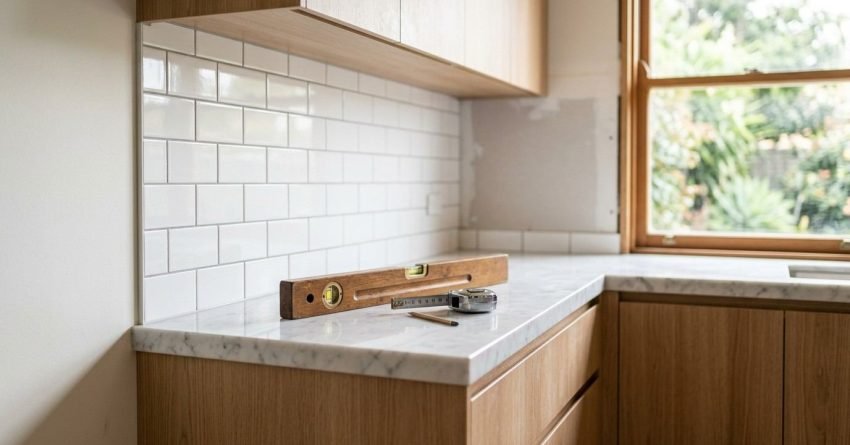
Renovating a small kitchen in Australia typically costs between $10,000 and $45,000, depending on the scope of work, materials selected, and whether structural or plumbing changes are involved. In Sydney, where labour rates and material costs sit above the national average, most homeowners budget between $15,000 and $35,000 for a quality small kitchen renovation.
Understanding where that money goes is the difference between a renovation that stays on track and one that blows out before the benchtop is even installed. Whether you are an owner-occupier refreshing a dated kitchen, a first-time renovator working through your first project, or a property investor maximising rental yield, getting the numbers right from the start matters.
In our experience working with Sydney homeowners, this guide breaks down every cost component of a small kitchen renovation in Australia, from cabinetry and benchtops to labour, trades, appliances, and the hidden expenses most budgets overlook, so you can plan with confidence and make decisions that hold up long after the last tile is laid.
What Is the Average Cost to Renovate a Small Kitchen in Australia?
The average cost to renovate a small kitchen in Australia ranges from $10,000 at the budget end to $60,000 or more for a premium full renovation. Most small kitchen renovations, defined as kitchens under 10 square metres, fall between $15,000 and $35,000 when completed by licensed trades with quality materials.
These figures cover a full renovation scope: new cabinetry, benchtops, splashback, appliances, flooring, painting, and trade work including electrical and plumbing. A cosmetic refresh, replacing doors, handles, and benchtops without touching the layout, can come in under $10,000, but it is not a full renovation.
The wide cost range reflects real differences in material quality, labour complexity, and project scope. A flat-pack kitchen with laminate benchtops and basic appliances sits at a very different price point than a custom-joinery kitchen with engineered stone and integrated appliances. Both are legitimate choices; the right one depends on your goals, your timeline, and what the property actually needs.
Small Kitchen Renovation Cost Breakdown by Tier
Understanding the three renovation tiers helps you set a realistic budget before you speak to a single contractor. Each tier reflects a genuine difference in material quality, finish level, and trade complexity, not just a price label.
| Renovation Tier | Typical Cost Range | What It Includes |
| Budget | $10,000 – $20,000 | Flat-pack cabinetry, laminate benchtops, basic appliances, cosmetic updates, minimal layout changes |
| Mid-Range | $20,000 – $35,000 | Semi-custom or modular cabinetry, stone benchtops, quality appliances, new flooring, full trade work |
| Premium | $35,000 – $60,000+ | Custom joinery, engineered or natural stone, integrated appliances, structural changes, high-end finishes |
A budget renovation is not a bad renovation. For an investment property or a kitchen that functions well but looks dated, a well-executed budget renovation delivers strong value. For a family home where the kitchen is the centre of daily life, a mid-range or premium scope is usually the right call.
We frequently see homeowners start with a budget-tier mindset and then upgrade individual items without adjusting the overall budget. That is how a $15,000 renovation becomes a $28,000 renovation with no clear plan behind it.
How Sydney Compares to Other Australian Cities
Sydney consistently sits at the higher end of renovation costs across Australia. Labour rates for licensed trades, including builders, electricians, plumbers, and tilers, are typically 10 to 20 percent higher in Sydney than in Melbourne, Brisbane, or Adelaide, reflecting higher living costs, stronger demand, and a competitive trades market.
Material costs are broadly similar across major cities, though Sydney suppliers and showrooms often carry premium stock as their standard range. This can push material budgets higher when you are not specific about what you need.
For a small kitchen renovation in Sydney, add a 10 to 15 percent buffer to national average figures when setting your initial budget. A renovation that costs $22,000 in Brisbane may realistically cost $24,000 to $26,000 in Sydney for the same scope and finish level.

What Factors Affect the Cost of a Small Kitchen Renovation?
No two kitchen renovations cost the same, even when the kitchens are the same size. The variables that drive cost are predictable once you know what to look for, and understanding them puts you in a much stronger position when reviewing quotes and making decisions.
Kitchen Size and Layout Complexity
A small kitchen under 6 square metres costs less to renovate than one approaching 10 square metres, even within the same tier. More floor area means more cabinetry, more benchtop linear metres, more flooring, and more trade time.
Layout complexity matters just as much as size. A galley kitchen with a straight run of cabinetry on one or two walls is the most cost-efficient layout to renovate. An L-shaped or U-shaped kitchen introduces corner cabinetry solutions, such as pull-out carousels, corner drawers, or blind corners, that add cost to both joinery and installation.
Changing the layout entirely, by moving the sink, relocating the cooktop, or reconfiguring the cabinetry footprint, adds high cost because it triggers plumbing, electrical, and potentially structural work. Working within an existing layout that already functions well is almost always the smarter financial decision.
Cabinetry and Joinery Costs
Cabinetry is typically the single largest cost item in a kitchen renovation, accounting for 30 to 40 percent of the total budget in most projects. For a small kitchen, cabinetry costs range from $3,000 to $5,000 for flat-pack options, up to $15,000 to $25,000 for fully custom joinery.
The difference between flat-pack and custom is not just aesthetics. Custom joinery is built to the exact dimensions of your space, which matters in small kitchens where every centimetre counts. Flat-pack cabinetry uses standard module sizes, which can leave awkward gaps or require filler panels in irregular spaces.
Semi-custom or modular cabinetry, offered by suppliers like Kaboodle, Polytec, and various local joinery workshops, sits between the two in both cost and quality. For most small kitchen renovations in Sydney, semi-custom cabinetry in the $6,000 to $12,000 range delivers a strong balance of quality, fit, and value.
Benchtop Material and Cost Variations
Benchtop selection has a significant impact on both the look and the cost of a kitchen renovation. Material choice drives not just the purchase price but also the installation complexity and long-term maintenance requirements.
Laminate benchtops are the most affordable option, typically costing $150 to $300 per linear metre supplied and installed. Stone and engineered stone benchtops, the most popular choice in Sydney renovations, range from $400 to $1,200 per linear metre depending on the material, thickness, and edge profile selected.
For a small kitchen with 4 to 6 linear metres of benchtop, the difference between laminate and engineered stone can be $2,000 to $5,000 on the benchtop line alone. That is a meaningful number on a tight budget, but engineered stone also adds genuine value to the property and holds up significantly better over time.
Appliances and Fixtures
Appliances are one of the most variable cost items in a kitchen renovation because the price range is enormous. A basic freestanding oven and cooktop package costs $800 to $1,500. A quality integrated oven, induction cooktop, and rangehood from brands like Bosch, Smeg, or Fisher and Paykel can cost $5,000 to $12,000 or more.
Our advice is to buy the best appliances you can afford within your budget, because appliances are the items you interact with every single day. Saving $2,000 on cabinetry to invest in better appliances is often the right trade-off for owner-occupiers.
For investment properties, mid-range appliances that are reliable and easy to maintain are usually the better call. Fixtures, including sink, tapware, and waste fittings, typically add $500 to $2,500 to the budget depending on quality and style.
Structural and Plumbing Changes
Structural and plumbing changes are where renovation budgets most commonly blow out. Moving a load-bearing wall, relocating a window, or shifting the sink to a new position all require licensed trade work and can add $2,000 to $10,000 or more to the project cost depending on complexity.
The golden rule is simple: don’t move what doesn’t need to move. Keeping the sink in its existing location, maintaining the current cooktop position, and working within the existing cabinetry footprint saves significant money and reduces the risk of unexpected structural discoveries during demolition.
When structural changes are genuinely necessary, for example, removing a wall to open the kitchen to a living area, we recommend budgeting for them explicitly and getting a structural engineer’s assessment before finalising your renovation quote.
Small Kitchen Renovation Cost Breakdown by Trade
A kitchen renovation involves multiple licensed trades, and understanding what each trade costs helps you read quotes accurately and identify where costs are reasonable versus where they may be inflated.
Labour Costs for Kitchen Renovations in Sydney
Builder or project manager labour, the person coordinating the renovation, managing demolition, installing cabinetry, and overseeing the project, typically costs $80 to $150 per hour in Sydney, or is priced as a fixed project rate. For a small kitchen renovation, builder labour costs generally range from $3,000 to $8,000 depending on scope and project duration.
A full small kitchen renovation in Sydney typically takes one to three weeks of active trade time. The overall project timeline from start to completion is often four to six weeks when accounting for material lead times, trade scheduling, and inspections.
Electrician and Plumber Costs
Electrical and plumbing work are non-negotiable licensed trade requirements in any kitchen renovation. In Sydney, licensed electricians charge $100 to $150 per hour, and plumbers charge $120 to $180 per hour, including call-out fees.
For a small kitchen renovation with no layout changes, electrical work, including relocating power points, installing new lighting, and connecting appliances, typically costs $1,500 to $3,500. Plumbing work for a like-for-like sink and dishwasher connection typically costs $800 to $2,000.
Moving the sink, adding a dishwasher connection where none existed, or upgrading the hot water system increases plumbing costs accordingly. Always get a fixed-price quote from your plumber before committing to layout changes; hourly rates on complex plumbing work can escalate quickly.
Tiling and Flooring Costs
Tiling costs in Sydney range from $60 to $120 per square metre for labour, plus the cost of tiles themselves. For a small kitchen splashback, typically 2 to 4 square metres, tiling labour costs $300 to $600, with tiles adding $30 to $150 per square metre depending on the material and format selected.
Floor tiling for a small kitchen of 6 to 10 square metres costs $800 to $2,500 all-in for labour and materials, depending on tile selection and subfloor preparation required. Vinyl plank flooring, a popular and practical choice for kitchens, costs $40 to $80 per square metre supplied and installed, making it a cost-effective alternative to ceramic or porcelain tile.
Painting and Finishing Costs
Professional painting of a small kitchen, including walls, ceiling, and any exposed surfaces, typically costs $800 to $2,000 in Sydney, depending on the condition of existing surfaces and the number of coats required. Painting costs increase proportionally if the kitchen opens to a living or dining area.
Finishing costs also include items like cornice, skirting, door hardware, and any patching or plastering required after trade work is completed. Budget $500 to $1,500 for finishing items that are easy to underestimate but essential to a polished result.
How Much Do Kitchen Cabinets Cost in a Small Kitchen Renovation?
Kitchen cabinet costs are the line item that most directly shapes the overall look, feel, and longevity of a renovation. Getting this decision right, balancing quality, cost, and fit for purpose, is one of the most important choices in the entire project.
For a small kitchen, total cabinetry costs including supply, delivery, and installation typically range from:
- Flat-pack (DIY or trade-installed): $3,000 to $8,000
- Semi-custom modular: $6,000 to $14,000
- Fully custom joinery: $12,000 to $25,000+
These ranges assume a complete set of upper and lower cabinets for a small kitchen. The final cost depends on the number of cabinet modules, the door style and finish selected, the internal fittings included, and whether a pantry or island is part of the scope.
Flat-Pack vs. Custom Cabinetry Cost Comparison
Flat-pack cabinetry, available from IKEA, Bunnings (Kaboodle), and similar suppliers, is the most affordable option and has improved significantly in quality over the past decade. The cabinets are manufactured to standard module sizes, flat-packed for delivery, and assembled on-site.
The cost advantage of flat-pack is real. A complete flat-pack kitchen for a small space can cost $3,000 to $6,000 in materials, with trade installation adding $1,500 to $3,000 on top. The trade-off is that standard module sizes do not always fit irregular spaces perfectly, and the internal hardware and drawer systems are typically lower quality than custom options.
Custom joinery is built to the exact dimensions of your kitchen by a local joinery workshop. Every cabinet is made to measure, internal fittings are specified to your requirements, and the finish quality is generally superior. The cost premium is significant, with custom joinery typically costing two to three times more than flat-pack, but for a kitchen that needs to work hard in a small space, the precision fit and quality hardware often justify the investment.
Semi-custom or modular cabinetry from suppliers like Polytec, Laminex, or local kitchen showrooms offers a middle ground: better quality than flat-pack, more flexibility than fully custom, and a price point that works for most mid-range budgets.
Cabinet Hardware, Handles, and Soft-Close Fittings
Cabinet hardware is a detail that significantly affects both the daily experience of using the kitchen and the overall cost of the cabinetry package. Soft-close hinges and drawer runners, which prevent doors and drawers from slamming, are now considered standard in quality renovations and add $500 to $1,500 to the cabinetry cost depending on the number of doors and drawers.
Handles and knobs range from $5 to $80 per piece depending on material and style. For a small kitchen with 15 to 25 cabinet doors and drawers, handle costs alone can range from $150 to $2,000. Handleless cabinetry, using push-to-open mechanisms or integrated finger pulls, eliminates this cost but adds to the joinery complexity.
Pull-out pantry systems, corner solutions, and internal drawer organisers are worth budgeting for separately. These fittings add $200 to $800 per unit but dramatically improve the functionality of a small kitchen where storage efficiency is critical.
Benchtop Costs for a Small Kitchen Renovation
The benchtop is the most visible and most used surface in any kitchen. It takes the daily punishment of food preparation, heat, moisture, and impact, and it sets the visual tone for the entire space.
Choosing the right material for your budget and your lifestyle is one of the most consequential decisions in a kitchen renovation. For a small kitchen with 4 to 6 linear metres of benchtop, total benchtop costs, supply and installation, typically range from $1,500 to $8,000 depending on material selection.
Laminate Benchtops
Laminate benchtops are the most affordable option and have improved considerably in quality and appearance. Modern laminate products from suppliers like Laminex and Formica offer realistic stone and timber looks at a fraction of the cost of natural materials.
Laminate benchtops cost $150 to $300 per linear metre supplied and installed, making them the go-to choice for budget renovations and investment properties. They are easy to clean, available in a wide range of colours and finishes, and can be replaced cost-effectively if damaged.
The limitations of laminate are real. It is not heat-resistant, it can chip at edges, and it does not add the same perceived value to a property as stone. For an owner-occupier kitchen that will be used heavily, laminate is a compromise worth understanding before committing.
Stone and Engineered Stone Benchtops
Engineered stone, from brands like Caesarstone, Silestone, and Quantum Quartz, is the dominant benchtop choice in Sydney kitchen renovations. It combines the look and feel of natural stone with greater consistency, lower maintenance, and better resistance to staining and scratching.
Engineered stone benchtops cost $500 to $900 per linear metre supplied and installed for standard thicknesses (20mm). Thicker profiles (40mm or waterfall edges) and premium brands push costs to $900 to $1,200 per linear metre or more.
For a small kitchen, an engineered stone benchtop typically adds $3,000 to $6,000 to the renovation budget compared to laminate, but it also adds genuine property value, durability, and a finish quality that elevates the entire kitchen. Natural stone, including marble, granite, and travertine, costs $800 to $1,500 per linear metre and above, and requires more maintenance than engineered alternatives.
Timber and Other Benchtop Materials
Timber benchtops offer warmth and character that stone and laminate cannot replicate. Hardwood timber benchtops, such as spotted gum, blackbutt, and similar Australian species, cost $300 to $600 per linear metre and require regular oiling to maintain their appearance and water resistance.
Timber works beautifully as a feature section, for example, a timber island or breakfast bar alongside a stone main benchtop, though it is not ideal around the sink area without careful sealing. This combination approach is increasingly popular in Sydney renovations and adds visual interest without dramatically increasing cost.
Stainless steel benchtops are a practical choice for high-use kitchens and cost $400 to $800 per linear metre. They are hygienic, heat-resistant, and extremely durable, though they scratch easily and have a commercial aesthetic that does not suit every home.

Appliance Costs for a Small Kitchen Renovation
Appliances represent one of the most flexible cost variables in a kitchen renovation. The range from entry-level to premium is enormous, and the right choice depends on how the kitchen will be used, who will use it, and what the property needs to achieve.
For a complete small kitchen appliance package, including an oven, cooktop, rangehood, dishwasher, and sink, budget $2,500 to $15,000 depending on brand, specification, and whether appliances are freestanding or integrated.
Oven, Cooktop, and Rangehood Costs
The oven, cooktop, and rangehood are the core cooking appliances and typically represent the largest portion of the appliance budget. Entry-level packages from brands like Chef, Westinghouse, or Euromaid cost $1,200 to $2,500 for all three. Mid-range packages from Bosch, Electrolux, or AEG cost $2,500 to $5,000, and premium packages from Smeg, Fisher and Paykel, Miele, or Gaggenau cost $5,000 to $15,000 and above.
Induction cooktops have become the preferred choice in new and renovated kitchens across Sydney, offering faster cooking, easier cleaning, and better energy efficiency than gas. This shift away from gas is also being driven by building regulations in some NSW councils that are progressively restricting new gas connections in residential properties.
Rangehood selection should be matched to the cooktop output. A 600mm rangehood is standard for a small kitchen, with ducted options preferred over recirculating models for genuine odour and steam extraction. Ducted rangehood installation adds $300 to $800 to the electrical and carpentry scope if new ductwork is required.
Dishwasher and Sink Costs
A quality dishwasher from Bosch, Miele, or Fisher and Paykel costs $900 to $2,500 for a standard 60cm model. Dishwasher installation, connecting to existing plumbing and electrical, typically costs $200 to $400 when done as part of a broader renovation.
Sink selection has a significant impact on both the look and the functionality of the kitchen. Undermount sinks, installed below the benchtop for a seamless look, are the most popular choice in renovated kitchens and cost $300 to $1,200 for the sink itself, plus installation.
Tapware costs range from $150 for entry-level to $800 or more for quality brands like Milli, Brodware, or Grohe. Mixer taps with pull-out spray functions are the most practical choice for a kitchen sink and are available across all price points.
Hidden Costs in a Small Kitchen Renovation
Hidden costs are the budget items that do not appear in a standard renovation quote but emerge during demolition, inspection, or the approval process. They are the primary reason renovation budgets blow out, and the primary reason experienced renovators always build a contingency into their budget.
A standard contingency allowance for a kitchen renovation is 10 to 15 percent of the total project cost. On a $25,000 renovation, that means holding $2,500 to $3,750 in reserve for unexpected costs. This is not pessimism; it is sound financial planning.
Asbestos Testing and Removal
Homes built before 1990 in Australia have a high likelihood of containing asbestos-containing materials in wall sheeting, floor coverings, ceiling tiles, and other building components. In Sydney, where a significant proportion of the housing stock dates from the 1950s through the 1980s, asbestos is a genuine and common renovation consideration.
Asbestos testing costs $200 to $500 for a professional inspection and laboratory analysis. If asbestos is identified, licensed removal is required before renovation work can proceed.
Budget $1,500 to $5,000 for removal in a small kitchen area. Attempting to renovate without testing in a pre-1990 home is not just financially risky; it is a serious health and legal risk.
Waterproofing and Structural Repairs
Demolition regularly reveals problems that were invisible before work began. Rotted subfloor framing under the sink, water damage behind the splashback, or deteriorated wall framing around windows are common discoveries in kitchens that have not been renovated for 20 or more years.
Structural repairs of this nature cost $500 to $3,000 depending on the extent of damage and the materials required. Subfloor replacement in a small kitchen area typically costs $800 to $2,000 including labour and materials.
Waterproofing around the sink area and any wet zones is a building code requirement in NSW and adds $300 to $800 to the project cost.
Council Approvals and Building Permits
Most cosmetic kitchen renovations, replacing cabinetry, benchtops, appliances, and finishes without structural changes, do not require council approval in NSW. They fall under exempt development provisions, meaning work can proceed without a formal DA (Development Application) or CDC (Complying Development Certificate).
Structural changes, such as removing walls, altering the building footprint, or changing the roofline, require either a CDC or a DA depending on the nature of the work. A CDC through a private certifier typically costs $1,500 to $3,000 and takes two to four weeks to process, while a DA through council costs $500 to $2,000 in application fees but can take significantly longer.
We always recommend confirming the approval pathway with your builder or a private certifier before committing to a timeline for any structural work.
Common Small Kitchen Renovation Mistakes to Avoid
Even well-planned renovations run into trouble when a few predictable mistakes creep in. Recognising these patterns early saves both money and stress once the project is underway.
Underestimating trade sequencing. Cabinetry, electrical, plumbing, and benchtop fabrication have to happen in a specific order, and skipping ahead on one trade before another finishes often causes rework and delays.
Choosing finishes before confirming the budget. Falling in love with a benchtop or appliance package before pricing the full scope leads to a mismatch between taste and budget that forces last-minute compromises elsewhere.
Ignoring trade availability and lead times. Custom cabinetry and stone benchtops both carry multi-week lead times, and ordering late is one of the most common causes of a stalled project.
Skipping the contingency altogether. Renovators who allocate every dollar to visible finishes with nothing held in reserve are the ones most likely to face a stressful, unplanned funding gap once demolition begins.
Verbal-only agreements with trades. Quotes and variations that are not documented in writing create disputes later. Every change to scope should be confirmed in writing before work proceeds.
Practical Ways to Reduce Small Kitchen Renovation Costs
A few deliberate choices can meaningfully lower your total spend without compromising the outcome.
- Keep the existing plumbing and electrical layout wherever possible to avoid triggering structural and trade cost increases.
- Choose semi-custom cabinetry instead of fully custom joinery for a strong balance of fit and value.
- Select mid-range tiles and hardware, both of which perform and look nearly identical to premium options at a fraction of the price.
- Combine a stone benchtop on high-use areas with a more affordable material on a feature section like a breakfast bar.
- Get at least three itemised quotes and compare them line by line rather than relying on a single total figure.
- Order long-lead-time materials, such as stone benchtops and custom cabinetry, as early as possible in the project timeline.
How to Budget for a Small Kitchen Renovation in Sydney
Budgeting well is not about spending less; it is about spending deliberately. A well-structured renovation budget gives you control over the project, reduces the risk of cost overruns, and ensures the money you spend delivers the outcome you actually want.
Setting a Realistic Renovation Budget
Start with a clear scope of work before you set a number. “I want to renovate my kitchen” is not a scope; it is a wish. A scope looks like this: new cabinetry, engineered stone benchtops, tiled splashback, new appliances, vinyl plank flooring, and fresh paint, within the existing layout.
Once you have a defined scope, use the cost ranges in this guide to build a bottom-up budget. Add each line item- cabinetry, benchtops, appliances, trades, flooring, and painting- then total them up and add your contingency of 10 to 15 percent. That total is your realistic budget.
When the total exceeds what you can spend, go back to the scope and make deliberate trade-offs. Downgrade the benchtop material, choose flat-pack over semi-custom cabinetry, or defer the dishwasher. Make conscious decisions about where to reduce cost rather than hoping the quotes come in lower than expected.
Where to Spend vs. Where to Save
Not all renovation dollars deliver equal value. Some items have a disproportionate impact on the look, feel, and longevity of the kitchen, and those are the items worth investing in.
Worth investing in:
- Cabinetry quality and internal fittings (you use them every day)
- Benchtop material (the most visible surface in the kitchen)
- Appliances, particularly the oven and cooktop
- Tapware and sink, both high-use items that affect daily experience
- Trade quality, since licensed, experienced trades protect your investment
Where saving is reasonable:
- Tile selection, since mid-range tiles look excellent and cost a fraction of premium options
- Handles and hardware, where affordable options look great with the right finish
- Lighting fixtures, prioritising function over decoration in a small kitchen
- Paint brand, since quality mid-range paints perform as well as premium brands
The most expensive mistake in a kitchen renovation is spending premium money on items that do not add value while cutting costs on items that do. A kitchen with custom joinery and laminate benchtops is a mismatch, while a kitchen with flat-pack cabinetry and quality stone benchtops is a smart trade-off.
Getting Accurate Kitchen Renovation Quotes
Getting accurate quotes requires providing accurate information. A contractor who quotes from a brief verbal description is guessing, and that guess will not protect you when costs escalate.
Before requesting quotes, prepare a written scope of work that includes the kitchen dimensions, the cabinetry style and supplier preference, the benchtop material, the appliances by model number if possible, the flooring type, and any specific trade requirements. Provide this document to every contractor you approach.
Get a minimum of three quotes for any renovation over $15,000, and compare them line by line rather than just the total. Ask every contractor to itemise their quote by trade and material category so you can make a genuine comparison.
Verify that every contractor holds a current NSW contractor licence and carries public liability and workers’ compensation insurance. In NSW, any residential building work over $20,000 requires a written contract and home building compensation (HBC) insurance, formerly known as home warranty insurance.
Is It Worth Renovating a Small Kitchen in Australia?
For most homeowners and property investors, renovating a small kitchen delivers a strong return, both in daily liveability and in property value. The kitchen is consistently identified as one of the highest-value renovation investments in Australian residential property, alongside bathrooms.
Return on Investment for Kitchen Renovations
A well-executed kitchen renovation in Sydney typically adds $1.50 to $2.00 in property value for every $1.00 spent, according to industry estimates from real estate and valuation professionals. This ratio is strongest for mid-range renovations in properties where the kitchen is clearly dated relative to the rest of the home and the local market.
The return diminishes at the premium end of the market. Spending $60,000 on a kitchen renovation in a property worth $800,000 is unlikely to deliver a dollar-for-dollar return, while spending $25,000 on a well-planned mid-range renovation in the same property is much more likely to.
For investment properties, the calculus is slightly different. A renovated kitchen commands higher rent and attracts better-quality tenants, reducing vacancy rates and maintenance costs over time. The rental premium for a renovated kitchen in Sydney typically ranges from $50 to $150 per week depending on the property type and location.
Renovating to Sell vs. Renovating to Live In
The right renovation scope depends heavily on your motivation. If you are renovating to sell, the goal is to maximise perceived value at the lowest possible cost, focusing on the items buyers notice, such as cabinetry condition, benchtop quality, and appliance appearance, rather than premium materials buyers may not value.
For a sale renovation, a mid-range scope with quality finishes and neutral selections is almost always the right approach. We advise against over-capitalising on a property where the market will not support the spend.
Renovating to live in changes the calculation. You will experience the kitchen every day for years or decades, so investing in what you will use and appreciate, based on your lifestyle rather than a resale checklist, makes the most sense.

How Long Does a Small Kitchen Renovation Take?
A small kitchen renovation in Sydney typically takes four to eight weeks from contract signing to practical completion. This timeline includes the pre-construction phase, finalising selections, ordering materials, and scheduling trades, as well as the active construction phase.
The active construction phase for a small kitchen renovation is usually one to three weeks of trade time. Demolition and preparation take one to two days, cabinetry installation takes two to four days, and trade rough-in (electrical and plumbing) takes one to two days. Benchtop templating and installation add three to five days for stone due to fabrication lead time, and tiling, flooring, painting, and finishing take a further three to five days.
The most common cause of timeline blowouts is material lead times. Engineered stone benchtops require templating after cabinetry installation and then fabrication, which typically takes seven to fourteen business days, while custom cabinetry has lead times of four to ten weeks from order to delivery.
Living without a kitchen for four to eight weeks is a genuine disruption. We recommend setting up a temporary kitchen space with a microwave, kettle, and bar fridge, and budgeting for additional food costs during the renovation period.
Conclusion
Renovating a small kitchen in Australia is one of the most impactful investments you can make in a residential property, but only when it is planned with accurate cost information, a clear scope, and a realistic budget. The cost range is wide, from $10,000 for a basic cosmetic refresh to $60,000 or more for a premium full renovation, and the difference between a successful project and a costly blowout almost always comes down to preparation.
Preparation is exactly where a good process protects you. Accurate scoping, itemised quotes, and a genuine contingency turn an unpredictable project into a manageable one.
We work with homeowners, first-time renovators, and property investors across Sydney to deliver kitchen renovations that stay on budget, on schedule, and built to last. If you are ready to move forward with a small kitchen renovation in Sydney, we would welcome the opportunity to provide a detailed, itemised quote based on your specific space and goals. Contact Sydney Home Renovation today to arrange a consultation and take the first step toward a kitchen that works as hard as you do.
Frequently Asked Questions
How much does it cost to renovate a small kitchen in Sydney?
A small kitchen renovation in Sydney typically costs between $15,000 and $45,000, depending on the scope of work, materials selected, and whether structural or plumbing changes are required. Budget renovations can come in under $20,000, while mid-range renovations generally cost $20,000 to $35,000.
Can I renovate a small kitchen for $10,000?
Yes, a cosmetic kitchen renovation replacing cabinet doors, benchtops, handles, and splashback without touching the layout can be completed for $8,000 to $12,000. A full renovation is unlikely to come in under $15,000 in Sydney with licensed contractors and quality materials.
What is the most expensive part of a kitchen renovation?
Cabinetry and joinery is typically the most expensive single line item, accounting for 30 to 40 percent of the total budget. For a small kitchen, cabinetry costs range from $3,000 for flat-pack options to $25,000 or more for fully custom joinery.
Do I need council approval to renovate my kitchen in NSW?
Most cosmetic kitchen renovations in NSW are classified as exempt development and do not require council approval. Structural changes such as removing walls require either a Complying Development Certificate or a Development Application.
How long does a small kitchen renovation take in Sydney?
A small kitchen renovation in Sydney typically takes four to eight weeks from contract signing to practical completion. Material lead times, particularly for engineered stone benchtops and custom cabinetry, are the most common cause of timeline extensions.
Is it worth renovating a kitchen before selling a house in Australia?
In most cases, yes. A well-executed mid-range kitchen renovation in Sydney typically adds $1.50 to $2.00 in property value for every $1.00 spent, making it one of the strongest renovation investments in residential property.
What hidden costs should I budget for in a kitchen renovation?
Common hidden costs include asbestos testing and removal, structural repairs discovered during demolition, waterproofing, and council approval fees for structural changes. A contingency allowance of 10 to 15 percent of the total project cost is standard practice.


