
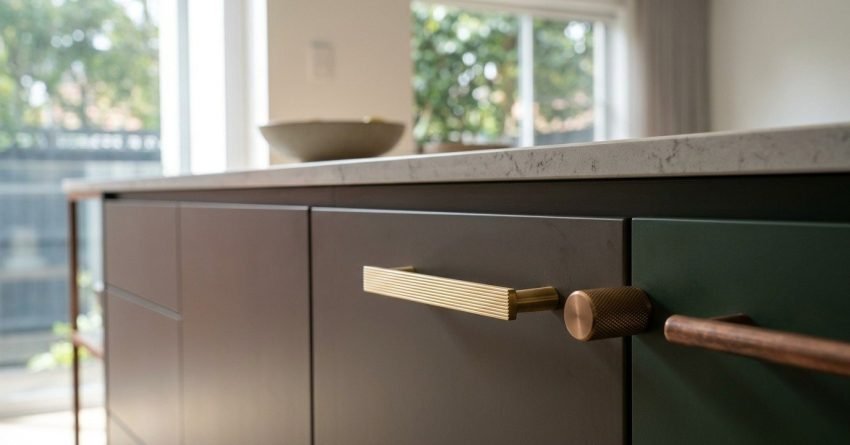
In 2026, we’re seeing cabinet pulls defined by clean geometry, tactile texture, and warm metallic finishes. It’s a clear move away from ornate detailing toward hardware that feels considered rather than decorative.
Cabinet hardware is one of the highest-impact, lowest-cost decisions in any renovation. The right pull ties a room together; the wrong one undermines an otherwise well-executed fitout.
We cover the styles, finishes, and practical considerations shaping cabinet hardware choices this year, including how pulls fit into a realistic renovation budget in Sydney.
Why Cabinet Hardware Trends Matter More Than Ever in 2026
Cabinet pulls used to be the last thing homeowners thought about. Now they’re often one of the first decisions made in a renovation brief, and for good reason.
Hardware is the jewellery of a kitchen or bathroom. It’s the detail that signals whether a renovation was designed with intention or assembled from a catalogue.
We’ve watched the hardware market mature significantly. Homeowners and renovators now have access to a wider range of styles, finishes, and price points than ever before.
That breadth of choice makes trend awareness genuinely useful, not as a reason to follow fashion blindly, but as a framework for decisions that hold up visually over time.
How Cabinet Pulls Affect the Overall Look of a Renovation
Cabinet pulls influence proportion, finish palette, and tactile experience simultaneously. A long flat bar pull on a shaker door reads as contemporary, while a small knob on the same door reads as traditional.
The hardware doesn’t just sit on the cabinet. It reframes the entire surface.
In practical terms, we recommend pull selection happen in parallel with cabinet door profile selection, not after. The two decisions are visually interdependent, and getting them out of sequence is one of the most common mistakes we see in DIY renovation planning.
The Shift From Purely Functional to Design-Forward Hardware
For most of the 2000s and early 2010s, cabinet hardware was selected primarily for function and finish matching. Brushed stainless was chosen for durability and neutrality. Knobs were chosen because they were cheap and easy to install.
That logic has shifted. In 2026, hardware is selected as a deliberate design element, one that contributes to the material story of a space.
Fluted pulls reference fluted glass and fluted tile. Arched pulls echo arched windows and arched niches. Hardware is now part of the design language, not a footnote to it.
The Most Popular Cabinet Pull Styles in 2026
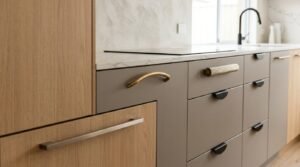
The pull styles gaining the most traction this year share a common thread: they’re geometric without being cold, and tactile without being fussy. Here’s a breakdown of the styles appearing most consistently across renovated kitchens and bathrooms in Australia.
Flat Bar and Thin Bar Pulls: The Minimalist Standard
Flat bar pulls remain the most widely specified pull style in contemporary Australian renovations. Their appeal is straightforward: clean, proportionally flexible, and compatible with a wide range of cabinet profiles and finishes.
We’re seeing the trend within flat bar pulls move toward thinner profiles, 8mm to 12mm bar diameter rather than the chunkier 16mm to 20mm bars that dominated the mid-2010s. The slimmer profile reads as more refined and pairs well with handleless lower cabinets and integrated appliances.
Length matters here. Longer pulls, 300mm to 500mm, are increasingly common on drawer fronts and tall pantry doors, creating a line that adds visual structure to large cabinet runs.
Arched and Curved Bar Pulls: Soft Lines for Modern Spaces
The arch pull is one of the defining hardware shapes of the current renovation cycle. It introduces a curved line into spaces otherwise dominated by right angles, and that contrast is exactly what makes it work.
Arched pulls are particularly effective on flat-front cabinetry, where the curve provides visual relief without disrupting the clean surface. We’re seeing them across kitchen cabinetry, bathroom vanities, and bedroom joinery in equal measure.
The key specification consideration with arch pulls is the height of the arch relative to the cabinet door size. A low, wide arch reads as subtle and contemporary, while a taller, narrower arch reads as more decorative and can reference Art Deco detailing depending on the finish chosen.
Fluted and Ribbed Pulls: Texture as a Design Statement
Fluted pulls are the hardware equivalent of fluted glass panels and fluted tile: a textural detail that adds depth and tactile interest without adding visual complexity. They’re one of the fastest-growing pull categories in the mid-to-premium renovation segment.
The ribbed or fluted surface catches light differently across the day, giving the hardware a quality flat bar pulls can’t replicate. In brushed brass or unlacquered brass, fluted pulls read as warm and artisanal. In matte black or brushed nickel, they read as architectural and precise.
We find fluted pulls work best when the surrounding material palette is relatively restrained. When cabinetry, benchtop, and splashback are already carrying significant texture, a flat bar pull is often the better choice.
Finger Pulls and Integrated Handles: The Handleless Look
The handleless kitchen and bathroom aesthetic has been building for several years, and it’s now firmly mainstream in the premium renovation segment. Finger pulls, small recessed or surface-mounted channels that allow a fingertip grip, are the hardware solution that makes this look functional.
There are two approaches to finger pulls. One is a fully integrated routed channel in the cabinet door itself, which requires the joinery to be designed for it from the outset. The other is a surface-mounted finger pull, a small, low-profile pull that sits flush or near-flush with the door face.
We recommend surface-mounted finger pulls for most renovation projects because they can be retrofitted to existing cabinetry. They’re available in all major finishes and in lengths from 64mm to 300mm.
Oversized and Statement Pulls: Bold Hardware for Feature Cabinetry
Not every cabinet in a renovation needs to recede. Feature cabinetry, a butler’s pantry door, a bathroom vanity with a strong material story, a laundry cabinet in a bold colour, can carry a statement pull without the space feeling overdone.
Statement pulls in 2026 are characterised by unusual proportions rather than ornate detailing: an extra-long bar pull on a single door, a thick cylindrical pull in an unexpected finish, a leather-wrapped pull on a timber cabinet. The statement comes from scale and material contrast, not decorative complexity.
Our rule of thumb: one statement pull per room, used on the piece of cabinetry already doing the most visual work.
The Finishes Defining Cabinet Hardware in 2026
Style and finish are equally important decisions. A flat bar pull in matte black reads completely differently to the same pull in brushed brass.
Brushed Nickel and Satin Nickel: The Reliable Neutral
Brushed nickel remains the most versatile hardware finish available. It reads as neither warm nor cool, making it compatible with a wide range of benchtop materials, tile palettes, and cabinet colours.
It doesn’t show fingerprints as readily as polished finishes, and it holds up well in humid environments like bathrooms.
In 2026, satin nickel is experiencing a quiet resurgence as homeowners move away from the starkness of matte black and the warmth of brass toward something more neutral and enduring. It’s the finish equivalent of a white wall: it doesn’t compete; it supports.
Matte Black Still Strong, Now More Selective
Matte black hardware had its peak moment between 2018 and 2022. It isn’t disappearing; it remains a strong, high-contrast choice, but it’s being used more selectively now.
Rather than specifying matte black across every tap, pull, and accessory in a bathroom, designers and renovators are using it as an accent finish against warmer or lighter palettes.
Matte black pulls work particularly well on white shaker cabinetry, sage green flat-front cabinetry, and natural timber joinery. The contrast is graphic and intentional. Matte black starts to look dated when it’s used as a default finish without a considered palette to support it.
Brushed Brass and Warm Gold Elevated Without Being Loud
Brushed brass is the finish that has shown the most sustained growth over the past three years, and it continues to be one of the most specified finishes in the mid-to-premium renovation segment. The key word is brushed, not polished, not antique, but a matte-satin warm gold that reads as contemporary rather than traditional.
Brushed brass pairs exceptionally well with white, cream, and warm grey cabinetry. It also works with deep navy and forest green, where the warmth of the brass provides contrast without the harshness of matte black.
On natural timber cabinetry, brushed brass can feel redundant; the warmth of the timber and the warmth of the brass compete rather than complement.
Unlacquered Brass: The Living Finish Trend
Unlacquered brass is the finish for renovators who want hardware that develops character over time. Unlike lacquered brass, which maintains a consistent appearance, unlacquered brass oxidises and patinas with use, darkening in areas of frequent contact and developing a warmth no factory finish can replicate.
This isn’t a finish for everyone. It requires accepting that the hardware will change, and that the change is the point.
We see unlacquered brass most often in renovation projects with a strong artisanal or natural material story: raked plaster walls, honed stone benchtops, handmade ceramic tiles. Some Australian suppliers are now also offering recycled brass options, which appeal to renovators prioritising lower-impact materials without sacrificing the living-finish appeal.
Chrome and Polished Finishes: A Quiet Comeback
Chrome was the dominant hardware finish for most of the 20th century, fell out of favour during the matte and brushed finish wave of the 2010s, and is now making a measured return. Polished chrome and polished nickel are appearing in renovations that reference mid-century modern aesthetics, or that deliberately lean into a high-gloss, high-contrast material palette.
Chrome pulls work best when the surrounding surfaces also carry some reflectivity: polished stone benchtops, gloss cabinetry, large-format polished tiles.
In a matte-heavy environment, a single polished chrome pull can look out of place rather than intentional.
Cabinet Pull Styles by Room: What Works Where in 2026
The same pull doesn’t work equally well in every room. Function, scale, and moisture exposure all influence the right hardware choice for each space.
Kitchen Cabinet Pulls Balancing Function and Style
Kitchen cabinetry takes more daily use than any other joinery in the home. Pulls need to be comfortable to grip, easy to clean, and durable enough to handle repeated contact with wet and greasy hands.
The most practical and stylish kitchen pull choices we recommend are flat bar pulls in lengths of 160mm to 320mm for upper cabinets and drawers, and longer bar pulls of 300mm to 500mm for lower drawer fronts and pantry doors. Arched pulls are gaining ground on upper cabinets where a softer line is wanted without sacrificing grip comfort.
We advise against pulls with deep recesses or complex profiles in kitchens. They collect grease and are difficult to clean thoroughly, so smooth, simple profiles remain the practical choice.
Bathroom Vanity Pulls: Small Hardware, Big Impact
Bathroom vanity pulls operate at a smaller scale than kitchen hardware, which means proportional precision matters more. A pull that’s slightly too large on a 600mm vanity door looks clumsy, and one that’s slightly too small looks like an afterthought.
Our standard guidance for bathroom vanity pulls is to select a length approximately one-third of the cabinet door width. On a 300mm door, that suggests a 96mm to 128mm pull; on a 450mm door, a 160mm pull is typically the right proportion.
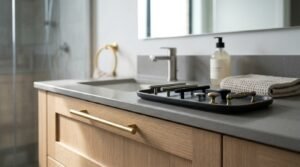
Bathroom vanity hardware is trending toward arched pulls and fluted pulls in brushed brass and brushed nickel, finishes that complement the warm, layered material palettes dominating bathroom renovation design.
Laundry and Utility Cabinet Pulls: Practical Choices That Still Look Good
Laundry cabinetry is often the last room considered in a renovation hardware specification, and it’s frequently under-budgeted. The result is hardware that looks mismatched with the rest of the home.
Our practical approach is to carry the same pull style used in the kitchen or bathroom into the laundry, potentially in a more affordable version of the same finish. This creates visual continuity across the home without requiring the same per-unit spend as the primary rooms.
Flat bar pulls in brushed nickel or matte black are the most practical laundry choices. They’re durable, easy to clean, and available at accessible price points from Australian hardware suppliers.
How to Match Cabinet Pulls to Your Renovation Style
Knowing what’s trending is useful. Knowing how to apply those trends to your specific renovation style is more useful still.
Matching Hardware to Contemporary and Minimalist Interiors
Contemporary and minimalist renovations are defined by restraint: flat-front cabinetry, neutral palettes, clean lines, and an absence of decorative detail. Hardware for these spaces should reinforce that restraint rather than introduce contrast.
The best pull choices for contemporary interiors are thin flat bar pulls, integrated finger pulls, or low-profile arch pulls. Finishes should be brushed nickel, matte black, or brushed brass, all of which read as considered without being decorative.
We advise avoiding knobs, ornate profiles, or polished finishes in these spaces.
Matching Hardware to Hamptons and Coastal Styles
Hamptons and coastal renovation styles are characterised by shaker cabinetry, white or soft grey palettes, natural textures, and a relaxed but polished aesthetic. Hardware for these spaces can carry slightly more visual weight than in a minimalist interior.
Bin pulls, cup pulls, and arched bar pulls in brushed nickel or brushed brass are the most authentic hardware choices for Hamptons-style renovations. Knobs on upper cabinets paired with bar pulls on lower drawers remain a classic Hamptons hardware combination popular in Sydney.
Matching Hardware to Industrial and Raw Material Aesthetics
Industrial renovation aesthetics- exposed concrete, raw timber, blackened steel, and textured surfaces- call for hardware that feels robust and unfinished. Matte black flat bar pulls, thick cylindrical pulls, and hardware with visible fasteners all work well in these spaces.
We recommend avoiding delicate or refined hardware profiles in industrial interiors. The hardware should feel like it belongs in the same material family as the surfaces around it: solid, direct, and without unnecessary ornamentation.
Mixing Metals When It Works and When It Doesn’t
Mixing metals is one of the most discussed hardware topics in renovation circles, and our guidance has evolved. Mixing metals works when there’s a clear hierarchy, one dominant finish and one accent finish, and when the metals share a tonal family.
Brushed brass and brushed nickel mix well because both are warm-to-neutral and matte. Matte black and brushed brass mix well because the contrast is intentional and graphic. Polished chrome and matte black mix poorly in most contexts because the reflectivity difference creates visual tension rather than intentional contrast.
Our practical rule: choose one finish for pulls and handles, and allow a second finish to appear in tapware or accessories. We recommend never using three or more finishes in the same room.

What to Consider Before Buying Cabinet Pulls for a Renovation
Style and finish decisions are only part of the hardware specification process. Before purchasing, there are practical considerations that determine whether the pulls you choose actually work in your renovation.
Centre-to-Centre Spacing and Sizing: Getting the Measurements Right
Cabinet pulls are sold by their centre-to-centre measurement, the distance between the two screw holes. This measurement must match the pre-drilled holes in your cabinet doors, or you’ll need to drill new holes, which risks damaging the door face.
Standard centre-to-centre measurements in Australia are 96mm, 128mm, 160mm, and 192mm. We recommend measuring the existing hole spacing on your cabinet doors, or confirming the specification with your cabinet maker, before ordering.
Ordering the wrong centre-to-centre measurement is one of the most common and easily avoided hardware mistakes we see. For single-hole pulls and knobs, centre-to-centre measurement isn’t relevant, but the screw diameter and thread pitch must still match the door thickness and the pull’s mounting hardware.
Material Quality and Durability: What to Look For
Cabinet pulls are available in a wide range of materials, from solid brass and stainless steel at the premium end to zinc alloy and plastic at the budget end. In a bathroom environment, material quality matters more than in a dry space because humidity accelerates corrosion in lower-quality alloys.
For bathroom vanity pulls, we specify solid brass or stainless steel construction with a PVD (Physical Vapour Deposition) coating if you want the finish to hold up over time. PVD coatings are significantly more durable than standard electroplated finishes and resist tarnishing, scratching, and moisture damage.
For kitchen and laundry pulls, solid brass or stainless steel remains the preferred base material. Zinc alloy pulls are acceptable in dry environments at lower price points but should be avoided in bathrooms.
Cabinet Pull Pricing by Type: What to Expect
Pricing varies considerably by material, finish, and brand. This table gives a general guide to what Sydney renovators typically pay per pull.
| Pull Type | Material | Typical Price Range (per unit) |
| Basic flat bar (zinc alloy) | Zinc alloy | $8–$20 |
| Flat bar (solid brass/stainless) | Solid brass or stainless steel | $25–$60 |
| Arched or fluted pull | Solid brass, PVD-coated | $35–$90 |
| Surface-mounted finger pull | Stainless steel or brass | $20–$70 |
| Designer/statement pull | Solid brass, leather, mixed material | $80–$180 |
These figures reflect standard Australian hardware suppliers and can vary depending on finish complexity and brand.
Budget Allocation for Cabinet Hardware in a Full Renovation
Cabinet hardware is one of the most cost-variable line items in a renovation budget. Across a full kitchen or bathroom renovation with 20 to 40 cabinet doors and drawers, pricing translates to a hardware budget of $160 to $7,200 for pulls alone.
We recommend setting a per-unit budget based on the overall renovation budget tier. In a mid-range bathroom renovation, a per-pull budget of $25 to $60 is realistic and accesses good quality brushed nickel, matte black, and brushed brass options from reputable Australian suppliers.
In a premium renovation, $80 to $150 per pull is the typical range for solid brass, PVD-coated, or designer hardware.
Installing Cabinet Pulls: DIY or Call a Professional?
Installing cabinet pulls is one of the more DIY-friendly hardware tasks in a renovation, provided the centre-to-centre measurements match existing pre-drilled holes. A cordless drill, a template, and a level are usually enough for a straightforward swap.
We recommend calling in a professional when new holes need to be drilled, when finger pulls require routed channels, or when working across a large number of doors where alignment consistency matters. A single misaligned pull is highly visible and difficult to disguise.
Cabinet makers and joiners can typically install hardware as part of a broader fit-out at minimal additional cost, which is often the most efficient option during a full kitchen or bathroom renovation.
Common Cabinet Pull Mistakes to Avoid
We see the same hardware mistakes repeated across renovation projects, and most are easy to avoid with a little forward planning.
Choosing pulls before finalising cabinet doors. Pull style and door profile are visually interdependent, so selecting them out of sequence often leads to a mismatch.
Ignoring centre-to-centre measurements. Ordering the wrong spacing means drilling new holes and risking damage to the door face.
Using too many finishes in one room. More than two finishes in a single space tends to look unplanned rather than intentional.
Under-budgeting laundry and utility hardware. This is the room most often left mismatched because it’s considered last.
Choosing decorative profiles for high-use kitchen cabinets. Deep recesses and ornate detailing collect grease and are hard to clean.
Where to Buy Quality Cabinet Pulls in Sydney
Sydney renovators generally source cabinet hardware through a mix of specialist hardware suppliers, cabinet makers, and larger home improvement retailers. Specialist suppliers typically offer the widest range of finishes, including PVD-coated and unlacquered brass options that aren’t always stocked by general retailers.
Working through your cabinet maker or renovation contractor for hardware sourcing often gives access to trade pricing and ensures pulls are ordered to match the exact centre-to-centre measurements of your cabinetry.
How Cabinet Hardware Fits Into Your Bathroom Renovation Budget in Sydney
Cabinet hardware is a small line item in the context of a full bathroom renovation, but it’s one that’s frequently underestimated. Understanding how hardware costs sit within a broader renovation budget helps avoid over-specifying pulls while under-budgeting for more structurally significant items.
Typical Hardware Allowances in Sydney Bathroom Renovations
In Sydney bathroom renovations, cabinet hardware, including vanity pulls, towel rails, toilet roll holders, and robe hooks, is typically budgeted as a combined accessories allowance. For a standard single bathroom renovation in the $15,000 to $25,000 range, a combined accessories allowance of $800 to $1,800 is typical, with vanity pulls representing $150 to $400 of that total.
For a premium bathroom renovation in the $30,000 to $50,000 range, the accessories allowance typically sits between $2,000 and $4,500, with more budget directed toward designer hardware, PVD-coated finishes, and coordinated accessory sets.
The key principle is coordination. Specifying pulls, tapware, and accessories from the same finish family, even if not from the same brand, creates a cohesive result without requiring a premium brand budget across every item.
Where to Splurge and Where to Save on Cabinet Pulls
The most value-efficient approach to cabinet hardware in a renovation is to concentrate spend on the pulls that receive the most visual attention and daily use, and to use more affordable options in secondary locations.
We suggest splurging on bathroom vanity pulls, kitchen drawer pulls on lower cabinets, and any feature cabinetry that’s a focal point of the room.
Save on upper kitchen cabinet pulls, laundry cabinetry pulls, and utility storage pulls. In these locations, a well-chosen mid-range pull performs identically to a premium option and won’t be noticed as a cost-saving measure.
Conclusion
Cabinet pulls in 2026 are defined by considered geometry, tactile finishes, and clear design intention, whether that’s the restraint of a thin flat bar pull or the warmth of a fluted brass arch pull. The right hardware choice depends on your renovation style, your cabinetry profile, and a realistic understanding of where hardware spend delivers the most value.
Getting the hardware specification right is one part of a well-planned renovation. The decisions that surround it- cabinetry selection, finish coordination, budget allocation, and installation sequencing- are equally important to a result that holds up over time and within budget.
At Sydney Home Renovation, we help homeowners and property investors make these decisions with confidence, from hardware specification and finish coordination to full bathroom renovation delivery, on budget and on schedule. Reach out to our team to start planning your renovation today.
Frequently Asked Questions
What cabinet pull style is most popular in 2026?
Flat bar pulls and arched bar pulls are the most widely specified styles in Australian renovations this year. Flat bar pulls suit contemporary and minimalist interiors, while arched pulls suit spaces wanting a softer line.
Are bar pulls still in style in 2026?
Yes, bar pulls remain one of the most enduring and versatile cabinet hardware styles. The trend within bar pulls is moving toward slimmer profiles and longer lengths, particularly on drawer fronts and pantry doors.
What finish is most popular for cabinet hardware in 2026?
Brushed brass and brushed nickel are the two most popular finishes this year. Brushed brass is the stronger growth finish, particularly in bathrooms, while brushed nickel remains the most versatile neutral option.
What size cabinet pull should I choose?
We recommend a pull length approximately one-third of the cabinet door width. For drawers, a pull spanning roughly half the drawer front width is a proportionally balanced choice.
Can I mix different cabinet pull styles in the same room?
Mixing pull styles in the same room isn’t generally recommended. Visual consistency across cabinetry creates a more resolved result, though intentional combinations like knobs on uppers and bars on lowers can work in Hamptons-style kitchens.
Are integrated finger pulls a good choice for bathroom vanities?
Integrated finger pulls are an excellent choice where a handleless aesthetic is the goal. Surface-mounted finger pulls are the more practical option for renovations since they can be applied without modifying existing cabinetry.
How much should I budget for cabinet pulls in a bathroom renovation?
For a standard single bathroom renovation in Sydney, a realistic budget for vanity pulls is $150 to $400. Mid-range pulls run $25 to $60 per unit, while premium solid brass or PVD-coated pulls typically range from $80 to $150.
Should I install cabinet pulls myself or hire a professional?
Straightforward swaps using existing hole spacing are DIY-friendly with basic tools. We recommend a professional for drilling new holes, routed finger pulls, or large-scale installations where alignment consistency matters.
Are there sustainable options for cabinet hardware?
Yes, some Australian suppliers now offer recycled brass pulls that suit renovators prioritising lower-impact materials. These typically carry the same living-finish qualities as standard unlacquered brass.


