
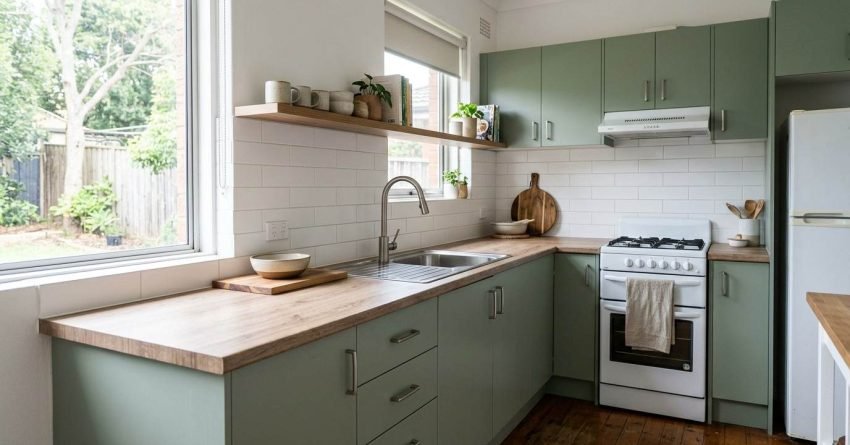
A $15,000 kitchen renovation in Sydney can deliver a genuinely transformed space. In our experience, new cabinetry, updated benchtops, a fresh splashback, and modernised fixtures are all realistic outcomes when the budget is planned carefully and allocated to the right priorities. It is a workable figure for a cosmetic-to-mid-range upgrade in an existing kitchen footprint, but we always set clear expectations with clients from the start.
Understanding exactly where that money goes is what separates a successful renovation from a costly overrun. Labour, materials, trades, and compliance costs all compete for the same dollars. Without a structured budget, even a modest kitchen project can spiral quickly.
In this guide, we break down every cost component of a $15,000 kitchen renovation in Sydney. We cover what it covers, what it does not, where hidden costs emerge, and how to extract maximum value from every dollar you spend.
Is $15,000 a Realistic Kitchen Renovation Budget in Sydney?
Yes, $15,000 is a workable kitchen renovation budget in Sydney, but it is not unlimited. At this price point, you are operating in the cosmetic-to-mid-range renovation tier. Meaningful, visible improvements are absolutely achievable, but full structural overhauls, premium custom joinery, and high-specification appliances sit outside this budget’s reach.
The key to making $15,000 work is understanding what the budget is genuinely suited for. We’re talking about refreshing an existing kitchen layout without moving walls, relocating plumbing, or reconfiguring the room’s footprint. When the structure stays intact and trades work is kept to a minimum, $15,000 can produce a kitchen that looks and functions significantly better than before.
For Sydney homeowners, first-time renovators, and property investors, this budget tier is one we see requested constantly. It is also one of the most misunderstood. Setting realistic expectations before a single quote is requested is the single most important step in the planning process.
What Does $15,000 Actually Cover in a Sydney Kitchen?
Within a $15,000 budget, a Sydney kitchen renovation can typically include new cabinet doors and drawer fronts, a replacement benchtop in laminate or entry-level stone, a new splashback in tiles or glass, updated tapware and sink, basic appliance upgrades such as a new cooktop or rangehood, and the associated labour to complete the installation.
It can also cover minor electrical work, such as adding a powerpoint or replacing a light fitting, and basic plumbing connections for a new sink. What it does not comfortably cover is a full cabinet carcass replacement across a large kitchen, structural changes, or premium stone benchtops across extended runs.
The scope that fits within $15,000 depends heavily on the kitchen’s existing size, condition, and layout. A compact galley kitchen in a Sydney apartment will yield far more visible transformation at this budget than a large open-plan kitchen in a family home.
How Does $15,000 Compare to Average Kitchen Renovation Costs in Sydney?
Kitchen renovation costs in Sydney span a wide range. According to Housing Industry Association renovation cost data, entry-level cosmetic refreshes typically start from around $10,000 to $15,000, mid-range renovations fall between $20,000 and $40,000, and full premium or custom kitchen builds can exceed $60,000 to $80,000 or more depending on size, materials, and complexity.
At $15,000, you are sitting at the upper end of the entry-level tier and the lower boundary of mid-range. This means you have more options than a bare-minimum refresh, but you are still working with real constraints around material quality, scope, and trade involvement.
For property investors renovating a rental property, or homeowners looking to modernise without a major capital outlay, we find $15,000 represents a practical and commonly used budget tier. When managed well, it delivers strong visual and functional results relative to spend.
Where Does Your $15,000 Kitchen Renovation Budget Go?
One of the most important things any renovator can do before starting a kitchen project is understand how the budget actually breaks down. A $15,000 figure sounds substantial until it is divided across labour, materials, trades, and compliance. At that point, the constraints become very clear, very quickly.
The following breakdown reflects typical cost allocations for a $15,000 kitchen renovation in Sydney. These are indicative ranges based on standard market rates and will vary depending on your specific kitchen size, condition, and scope of work.
| Cost Category | Estimated Allocation | % of Total Budget |
| Labour (installation, project management) | $4,500 – $6,000 | 30% – 40% |
| Cabinetry and joinery | $3,500 – $5,000 | 23% – 33% |
| Benchtop and splashback | $1,500 – $2,500 | 10% – 17% |
| Appliances and fixtures | $1,500 – $2,500 | 10% – 17% |
| Electrical and plumbing trades | $1,000 – $2,000 | 7% – 13% |
| Contingency (recommended) | $750 – $1,500 | 5% – 10% |
Labour Costs: The Biggest Slice of Your Budget
Labour consistently represents the largest single cost in any kitchen renovation, and Sydney’s trade rates reflect the city’s high cost of living. For a $15,000 kitchen renovation, expect labour to consume between $4,500 and $6,000 of your total budget, roughly 30 to 40 percent.
This covers the kitchen installer or cabinet maker, the project coordinator or builder managing the job, and any associated supervision. It does not include licensed trade labour for electrical or plumbing work, which is costed separately.
Sydney labour rates for kitchen installation typically run between $60 and $120 per hour, according to Master Builders Association trade rate benchmarks, depending on the trade and the complexity of the work. A standard kitchen installation, which involves removing old cabinetry, installing new doors and carcasses, fitting a benchtop, and connecting fixtures, will generally require two to four days of installation labour, plus coordination time.
Understanding that labour is non-negotiable and largely fixed helps you make smarter decisions about where to allocate the remaining budget. Cutting corners on labour to spend more on materials is one of the most common and costly mistakes we see renovators make.
Cabinetry and Joinery Allowances at This Price Point
Cabinetry is typically the second-largest cost in a kitchen renovation. Within a $15,000 budget, you have two primary options: replace cabinet doors and drawer fronts while retaining existing carcasses, or replace the full cabinet system with new flat-pack or semi-custom cabinetry.
Replacing doors and drawer fronts only, a popular approach at this budget tier, can cost between $1,500 and $3,000 for a standard-sized kitchen, depending on the number of doors, the material chosen, and the hardware selected. This approach delivers a dramatic visual transformation at a fraction of the cost of full cabinet replacement.
Full flat-pack cabinet replacement for a small to medium kitchen in Sydney typically costs between $3,500 and $5,000 for materials alone, before installation labour. This is achievable within a $15,000 budget for a compact kitchen but leaves limited room for premium benchtops or appliances.
Custom or semi-custom joinery, the kind specified by a kitchen designer and built to exact measurements, starts from around $8,000 to $12,000 for materials alone in Sydney. That places it well outside the $15,000 total budget range.
Benchtops, Splashbacks, and Surface Finishes
Benchtops and splashbacks are the surfaces that define the visual character of a kitchen, and they represent a significant portion of the materials budget. Within a $15,000 renovation, the material choices at this price point are laminate, reconstituted stone (engineered stone at entry-level pricing), and ceramic or porcelain tiles for splashbacks.
Laminate benchtops are the most budget-friendly option, typically costing between $300 and $800 for a standard kitchen run, including supply and installation. They have improved significantly in quality and appearance over recent years and represent strong value at this budget tier.
Entry-level engineered stone benchtops, such as 20mm Caesarstone or equivalent, start from around $800 to $1,500 for a standard kitchen, depending on the linear meterage and edge profile selected. Premium stone options such as marble, thick-format stone, or waterfall edges push costs considerably higher and are generally not achievable within a $15,000 total budget.
Splashbacks in standard ceramic or porcelain tiles typically cost between $400 and $900 supplied and installed for a standard kitchen. Glass splashbacks are a popular upgrade and can be achieved within budget at $600 to $1,200 depending on size and colour.
Appliances and Fixtures Within a $15,000 Budget
Appliances and fixtures, including cooktop, oven, rangehood, sink, and tapware, are often where renovators either overspend or underspend relative to the overall project. Within a $15,000 budget, we recommend a realistic appliance and fixture allowance of between $1,500 and $2,500.
At this allowance, you can comfortably include a mid-range freestanding or built-in cooktop ($400 to $700), a new rangehood ($300 to $600), an undermount or inset sink ($200 to $500), and quality tapware ($150 to $400). Ovens are typically the most expensive single appliance and, if replacement is required, can consume a significant portion of this allowance on their own.
For property investors, we suggest appliance selection at this budget tier should prioritise durability and tenant appeal over brand prestige. Mid-range brands such as Westinghouse, Bosch, or Smeg entry-level lines offer reliable performance at price points that fit within a $15,000 renovation budget.
Electrical, Plumbing, and Trade Work Costs
Licensed trade work, both electrical and plumbing, is a non-negotiable cost in any kitchen renovation. It is also one that is frequently underestimated by first-time renovators. In Sydney, licensed electricians charge between $90 and $150 per hour, and licensed plumbers charge between $100 and $160 per hour, according to Fair Trading NSW trade licensing guidance.
For a $15,000 kitchen renovation that does not involve relocating plumbing or electrical circuits, trade costs typically fall between $1,000 and $2,000. This covers disconnecting and reconnecting the sink and dishwasher plumbing, updating powerpoints, installing a new rangehood connection, and any required safety compliance work.
If the renovation involves moving the sink to a new location, adding a gas connection, or upgrading the electrical switchboard, trade costs increase substantially, often by $2,000 to $5,000 or more. This can push the total project cost well beyond $15,000. Keeping plumbing and electrical in their existing positions is one of the most effective ways to protect a $15,000 budget.
Common Mistakes That Blow a $15,000 Kitchen Budget
We see the same handful of mistakes derail otherwise well-planned $15,000 kitchen renovations time and time again. Knowing them in advance is one of the simplest ways to protect your budget.
The first is moving plumbing or gas points “just because” a new layout looks nicer on paper. Even a small relocation can add thousands in licensed trade costs that were never part of the original scope.
The second is choosing materials before confirming the full quote. We often see clients fall in love with a premium stone slab, then discover it consumes half the total budget on its own, leaving nothing for cabinetry or appliances.
The third is skipping the contingency altogether. A five to ten percent buffer feels optional until a wall is opened up and something unexpected is found behind it. The fourth is accepting a vague, lump-sum quote instead of an itemised one, which makes it almost impossible to track where money is actually going once work begins.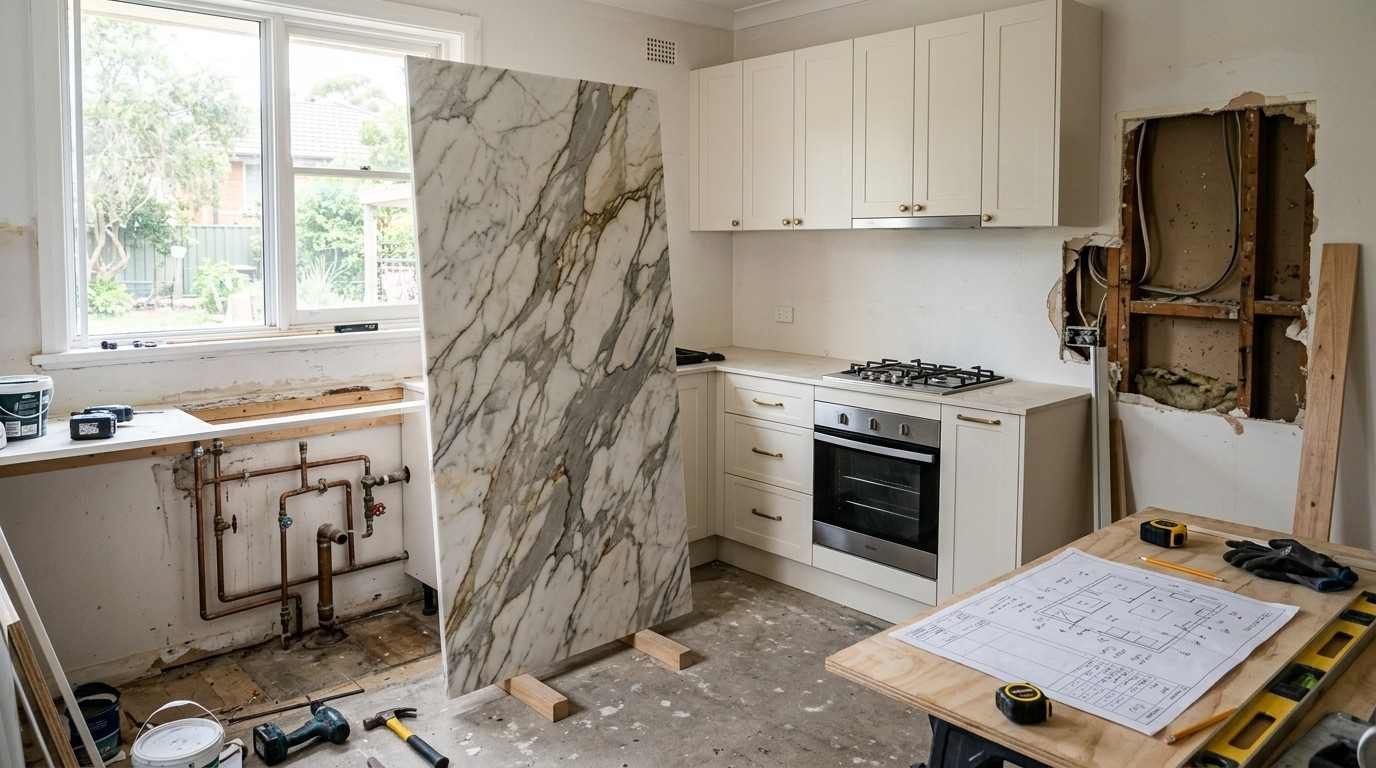
Can You DIY Any Part of a $15,000 Kitchen Renovation?
Some homeowners ask us whether DIY work can stretch a $15,000 budget further. The honest answer is yes, in limited areas, but it comes with real trade-offs.
Painting existing cabinet frames, installing new handles, or removing old fixtures before trades arrive are all tasks a reasonably capable homeowner can handle safely. These can save several hundred dollars in labour without touching licensed trade work.
What we do not recommend DIYing is anything involving electrical wiring, gas connections, or plumbing, all of which legally require a licensed tradesperson in NSW regardless of budget. Attempting this work yourself risks compliance issues, insurance complications, and costs that far exceed any initial saving if it needs to be redone by a licensed professional.
What Kitchen Upgrades Are Achievable for $15,000?
With a clear understanding of where the budget goes, the next question is what specific upgrades are genuinely achievable within $15,000. The answer depends on the kitchen’s existing condition, size, and layout, but for a standard Sydney kitchen in reasonable structural condition, the following upgrades are realistic and ones we deliver regularly at this price point.
Full Cosmetic Refresh: New Doors, Handles, and Surfaces
A full cosmetic refresh is the most cost-effective transformation available within a $15,000 budget. This approach retains the existing cabinet carcasses, the structural boxes behind the doors, and replaces only the visible elements: doors, drawer fronts, handles, benchtop, splashback, and tapware.
The result is a kitchen that looks entirely new without the cost of full cabinet replacement. For a standard Sydney kitchen with 15 to 25 cabinet doors and drawer fronts, a cosmetic refresh including new doors, handles, benchtop, splashback, sink, and tapware can be completed within $10,000 to $14,000, leaving room within a $15,000 budget for appliance upgrades or a contingency allowance.
This approach works best when the existing carcasses are structurally sound and the layout is functional. It is particularly popular with property investors seeking to improve rental appeal and resale value without a major capital commitment.
Cabinet Replacement Without Structural Changes
For kitchens where the existing carcasses are damaged, outdated, or poorly configured, a full flat-pack cabinet replacement is achievable within $15,000 for compact to medium-sized kitchens, provided the layout remains unchanged and plumbing and electrical connections stay in their current positions.
Flat-pack cabinetry from suppliers such as IKEA, Kaboodle, or Polytec offers a significant improvement in quality and appearance over older cabinet systems at price points that fit within this budget tier. A full flat-pack kitchen supply and installation for a small to medium kitchen in Sydney typically costs between $8,000 and $13,000 including labour, leaving $2,000 to $7,000 for benchtops, splashback, and fixtures.
The critical constraint at this scope is kitchen size. A large kitchen with extensive upper and lower cabinetry, an island bench, or a butler’s pantry will exceed $15,000 for cabinet replacement alone. We always recommend an honest assessment of the kitchen’s size and scope before committing to this approach.
New Benchtop Installation and Splashback Upgrade
Replacing the benchtop and splashback alone, without touching the cabinetry, is one of the highest-impact, lowest-cost upgrades available in a kitchen renovation. For many kitchens, the benchtop and splashback are the most visually dominant surfaces, and updating them can transform the feel of the space without a full renovation.
A new laminate or entry-level engineered stone benchtop combined with a new tiled or glass splashback can typically be supplied and installed in Sydney for between $2,500 and $5,000, depending on the linear meterage, material selection, and complexity of the installation. This leaves substantial budget available for cabinetry upgrades, appliances, or other improvements within a $15,000 total.
For homeowners who are happy with their existing cabinet layout and condition but want a fresher, more modern kitchen, a benchtop and splashback upgrade combined with new handles and tapware can deliver a compelling result at well under $15,000.
Appliance Upgrades and Fixture Replacements
Appliance and fixture upgrades, replacing an ageing cooktop, installing a new rangehood, updating the sink and tapware, are achievable as standalone upgrades or as part of a broader $15,000 renovation scope. New mid-range appliances and quality fixtures can meaningfully improve both the function and the appearance of a kitchen without requiring structural changes.
For property investors, appliance upgrades are often the fastest way to improve rental appeal and justify a rent increase. A new cooktop, rangehood, and sink combination can be supplied and installed in Sydney for between $1,500 and $3,000 depending on brand and specification. It is a targeted spend that delivers measurable return.
What Is Not Included in a $15,000 Kitchen Renovation?
Being clear about what $15,000 does not cover is just as important as understanding what it does. Misaligned expectations are the primary cause of budget overruns and renovation disappointment, and the $15,000 tier has well-defined limitations that every renovator should understand before committing to a scope.
Structural Changes and Layout Reconfigurations
Moving walls, relocating the kitchen to a different part of the home, or reconfiguring the room’s footprint are structural changes that sit well outside a $15,000 budget. Structural work in Sydney, including engineer’s reports, council approvals, demolition, and rebuilding, typically adds $10,000 to $30,000 or more to a project cost before any kitchen-specific work begins.
Similarly, relocating the sink, dishwasher, or gas cooktop to a new position within the kitchen requires licensed plumbing and gas fitting work that can add $2,000 to $6,000 to the project. Keeping all services in their existing positions is the single most effective way to protect a $15,000 budget from structural cost blowout.
High-End Materials and Custom Joinery
Premium materials, including thick-format stone benchtops, marble surfaces, custom-built joinery, imported tiles, and designer tapware, are not achievable within a $15,000 total budget for a full kitchen renovation. These materials are appropriate for higher-budget projects in the $30,000 to $60,000 range where the material allowance alone can justify the spend.
At $15,000, the material strategy should focus on mid-range products that deliver strong visual impact and durability at accessible price points. Entry-level engineered stone, quality laminate, standard-format porcelain tiles, and mid-range tapware brands all perform well and look excellent when installed by a skilled tradesperson.
Full Kitchen Extensions or Room Additions
Adding floor area to a kitchen, whether through a rear extension, a bump-out, or the removal of a load-bearing wall, is a construction project that begins at $30,000 to $50,000 in Sydney and increases significantly with size and complexity. This scope is entirely separate from a kitchen renovation budget and requires a builder’s licence, council approval, and structural engineering input.
If your primary goal is a larger kitchen, a $15,000 budget is better directed toward maximising the function and appearance of the existing space rather than attempting to extend it.
Hidden Costs That Can Blow a $15,000 Kitchen Budget
Hidden costs are the most common cause of budget overruns in kitchen renovations, and they are particularly dangerous at the $15,000 tier where there is limited financial buffer. Understanding the most common hidden costs before work begins allows you to plan for them, or at minimum, hold an adequate contingency.
Asbestos, Waterproofing, and Compliance Costs
Homes built before 1990 in Sydney have a meaningful probability of containing asbestos-containing materials in wall linings, floor coverings, or ceiling materials, according to Safe Work Australia asbestos awareness guidance. If asbestos is identified during demolition, licensed asbestos removal is legally required and can cost between $1,500 and $5,000 depending on the extent of the material and the removal method required.
Waterproofing requirements, while more commonly associated with bathroom renovations, can also apply to kitchen areas adjacent to wet zones or where flooring is being replaced. Compliance with the National Construction Code and relevant Australian Standards is non-negotiable and must be factored into the budget.
Unforeseen Structural or Electrical Issues
Opening up walls or removing old cabinetry can reveal problems that were not visible during the quoting stage: rotted wall framing, outdated wiring that does not meet current standards, inadequate ventilation, or subfloor damage. These issues must be rectified before new work can proceed and can add $1,000 to $5,000 or more to the project cost depending on severity.
We recommend a contingency allowance of five to ten percent of the total budget, or $750 to $1,500 on a $15,000 project, as the standard approach for managing unforeseen costs. Experienced contractors will flag potential risk areas during the quoting process, but some issues are genuinely impossible to identify without opening up the structure.
Council Approvals and Building Permits in Sydney
Most cosmetic kitchen renovations, replacing cabinets, benchtops, and appliances within the existing footprint, do not require council approval or a building permit in NSW. However, work that involves structural changes, new electrical circuits, gas fitting, or alterations to the building’s external envelope may trigger approval requirements.
Development Application (DA) or Complying Development Certificate (CDC) costs in Sydney can range from $500 to $3,000 or more depending on the nature of the work and the local council’s fee schedule. Your contractor should be able to advise on approval requirements during the quoting process. If they cannot, that is a red flag worth noting.
How to Maximise Value from a $15,000 Kitchen Renovation
Getting the most from a $15,000 kitchen renovation is not about spending less. It is about spending strategically. We find the renovators who achieve the best outcomes at this budget tier are those who prioritise ruthlessly, choose materials intelligently, and work with contractors who are transparent about costs from the outset.
Prioritise High-Impact, High-Visibility Upgrades
The highest-impact upgrades in a kitchen renovation are those that affect the surfaces you see and touch every day: cabinet doors, benchtops, splashbacks, and tapware. These are the elements that define the visual character of the space and the ones that buyers, renters, and visitors notice immediately.
Spending the majority of your $15,000 on these high-visibility elements, and retaining functional but less visible components like cabinet carcasses, flooring, or ceiling finishes, delivers the greatest visual return per dollar spent. Spending heavily on structural changes or behind-the-wall work that is invisible once complete is the fastest way to exhaust a $15,000 budget without a visible result.
Choose Mid-Range Materials That Perform Like Premium
The gap between entry-level and mid-range materials in kitchen renovations has narrowed significantly in recent years. Modern laminate benchtops replicate the look of stone convincingly. Porcelain tiles in large formats mimic marble at a fraction of the cost.
Choosing mid-range materials that perform and look like premium options is the most effective material strategy at the $15,000 tier. It allows you to achieve a high-quality visual result without the premium price tag, and it leaves more budget available for labour, trades, and contingency.
Work With a Contractor Who Offers Transparent Pricing
The single most important decision in any kitchen renovation is choosing the right contractor. At the $15,000 budget tier, the difference between a well-managed project and a cost overrun often comes down to the quality of the initial quote and the contractor’s willingness to be transparent about what is and is not included.
A detailed, itemised quote that separates labour, materials, trades, and contingency is the baseline expectation we set for our own projects. Contractors who provide vague lump-sum quotes without line-item breakdowns make it impossible to manage the budget effectively. Transparent pricing is not just a courtesy. It is a fundamental requirement for a well-managed renovation at any budget level.
A Simple Planning Checklist Before You Start
Before committing to a $15,000 kitchen renovation, we recommend working through a short checklist to confirm the budget is realistic for your specific kitchen.
Confirm your kitchen’s existing carcasses are structurally sound and worth retaining. Measure your cabinet doors and drawer fronts to estimate replacement costs accurately. Decide early whether plumbing and electrical points will stay in their current positions, since this single decision protects more of your budget than any other.
Get at least two itemised quotes so you can compare labour, materials, and trade costs line by line. Set aside a five to ten percent contingency before you finalise any material selections, and confirm with your contractor whether council approval applies to your specific scope of work.
$15,000 Kitchen Renovation vs. Higher Budget Options: What Changes?
Understanding how a $15,000 budget compares to higher-tier options helps renovators make informed decisions about whether to proceed at this budget level or invest more to achieve a different outcome.
$15,000 vs. $25,000 Kitchen Renovation: Key Differences
The jump from $15,000 to $25,000 opens up meaningful additional scope. At $25,000, a Sydney kitchen renovation can include full flat-pack or semi-custom cabinet replacement across a medium to large kitchen, a mid-range engineered stone benchtop with a more generous edge profile, higher-specification appliances, and more extensive trade work including minor plumbing or electrical relocations.
The primary differences are in material quality, kitchen size, and the degree of customisation available. A $25,000 budget allows for a more tailored result, one that is less constrained by the need to retain existing components and more able to address functional as well as cosmetic shortcomings.
| Feature | $15,000 Budget | $25,000 Budget |
| Cabinet scope | Door replacement or compact flat-pack | Full flat-pack or semi-custom replacement |
| Benchtop material | Laminate or entry-level stone | Mid-range engineered stone |
| Appliances | Mid-range entry-level | Mid-to-upper range |
| Trade work | Minimal, in-position only | Minor relocations possible |
| Kitchen size | Small to compact | Small to medium |
| Customisation | Limited | Moderate |
When Should You Consider Increasing Your Kitchen Budget?
Increasing the kitchen renovation budget beyond $15,000 makes sense when the existing kitchen has significant functional problems that a cosmetic refresh cannot address, such as inadequate storage, poor layout, damaged carcasses, or outdated electrical and plumbing infrastructure.
It also makes sense when the property’s value and the expected return on investment justify a higher spend. In Sydney’s property market, a well-executed mid-range kitchen renovation in a family home or investment property can deliver a return that exceeds the renovation cost, but only when the renovation quality matches the property’s price bracket and the target buyer or tenant profile.
If your kitchen is structurally sound and the primary goal is modernisation and improved appeal, $15,000 is a well-calibrated budget. If the kitchen has deeper functional or structural problems, investing more upfront is almost always more cost-effective than attempting to work around those problems within a constrained budget.
Does a $15,000 Kitchen Renovation Add Value to Your Sydney Property?
For homeowners and property investors, the return on investment question is central to any renovation decision. The kitchen is consistently identified as one of the highest-return renovation areas in residential property, but the return depends heavily on the quality of the renovation, the property’s price bracket, and the local market conditions.
Return on Investment for Kitchen Renovations in Sydney
Kitchen renovations are widely regarded by real estate professionals as one of the most effective ways to increase a property’s appeal and market value. In Sydney’s competitive property market, a modernised kitchen can meaningfully improve a property’s sale price or rental yield, particularly in the mid-market and investor-grade segments where buyers and tenants have clear expectations about kitchen quality.
A well-executed $15,000 kitchen renovation in a Sydney investment property or owner-occupied home can realistically deliver a return of $1.50 to $2.50 for every dollar spent in improved property value, according to REA Group renovation ROI research, depending on the property’s location, price bracket, and the quality of the renovation. This return is strongest when the renovation addresses genuine functional and aesthetic shortcomings rather than simply upgrading an already-adequate kitchen.
For rental properties, a modernised kitchen can support a rent increase of $30 to $80 per week in Sydney depending on the suburb and property type, translating to an annual rental income increase of $1,560 to $4,160 that begins recovering the renovation cost from the first year.
What Buyers and Renters Look for in a Renovated Kitchen
Sydney buyers and renters consistently prioritise kitchens that are clean, functional, and visually contemporary. The specific features that generate the strongest positive response include stone or stone-look benchtops, integrated or concealed appliances, adequate storage, quality tapware, and a cohesive colour palette.
At the $15,000 budget tier, all of these elements are achievable, not at the premium end of the specification range, but at a quality level that meets and exceeds the expectations of the mid-market buyer and tenant. A kitchen that looks well-considered, well-finished, and well-maintained will consistently outperform one that is dated or poorly presented, regardless of the price bracket.
For property investors in particular, the goal is not to build the most impressive kitchen in the suburb. It is to build a kitchen that is better than the competition at the same rental or sale price point. At $15,000, that goal is entirely achievable with the right planning, the right materials, and the right contractor.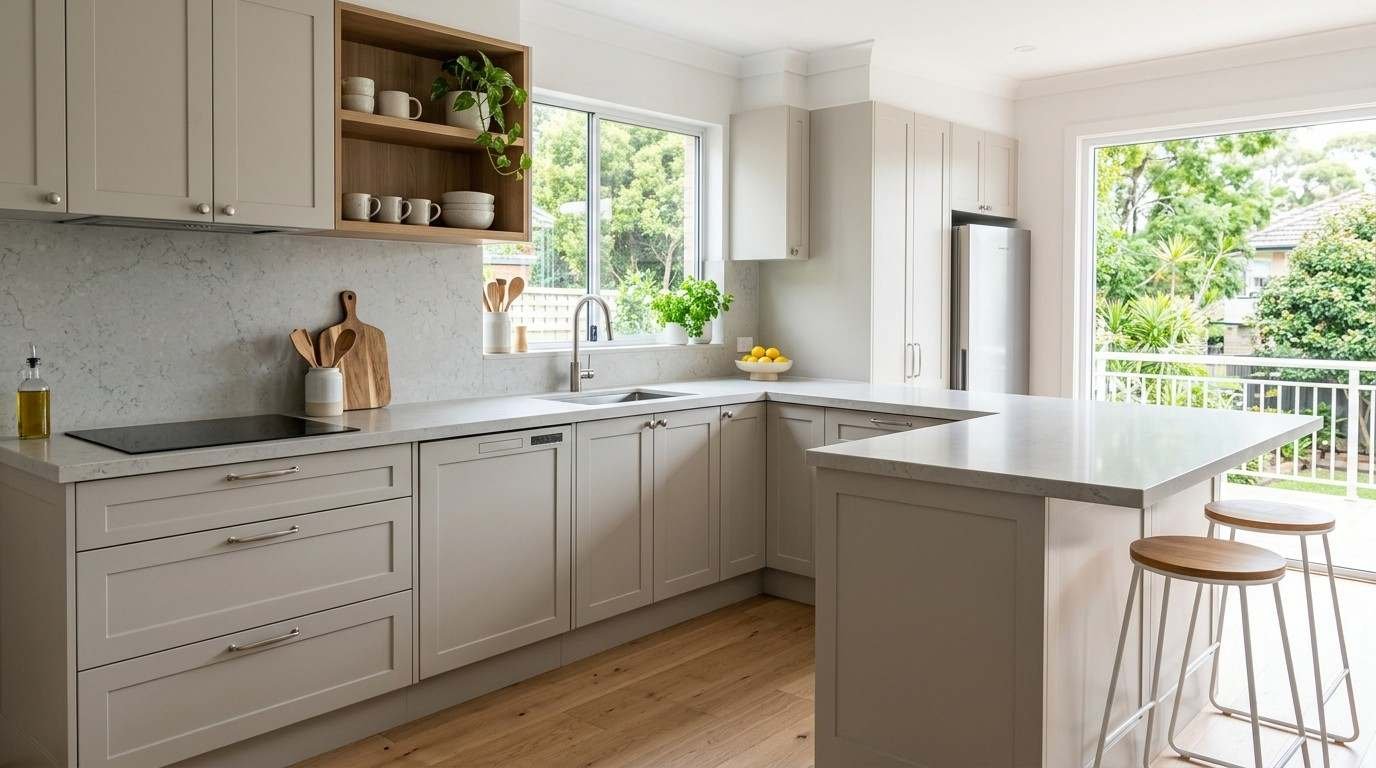
Conclusion
A $15,000 kitchen renovation in Sydney is a realistic, well-defined budget tier that can deliver a genuinely transformed kitchen. New cabinetry, updated surfaces, modernised fixtures, and improved functionality are all within reach when the scope is planned carefully and the budget is allocated strategically. The key is understanding what this budget covers, what it does not, and where the hidden costs are most likely to emerge.
We work with homeowners, first-time renovators, and property investors every day to turn $15,000 kitchen budgets into high-quality, high-value outcomes. Our approach combines transparent, itemised pricing with practical construction expertise and honest guidance on scope, materials, and priorities, so your renovation stays on budget, on schedule, and built to last.
If you are planning a kitchen renovation in Sydney and want a clear, detailed quote that tells you exactly what your $15,000 will achieve, contact Sydney Home Renovation today. We will walk you through every cost component, help you prioritise the upgrades that deliver the greatest return, and give you the confidence to move forward with a renovation plan that works.
Frequently Asked Questions
What can you realistically do with a $15,000 kitchen renovation?
With $15,000, we can realistically complete a full cosmetic refresh including new cabinet doors, a replacement benchtop, a new splashback, updated tapware and sink, and mid-range appliance upgrades in a compact to medium-sized Sydney kitchen. The budget works best when the existing cabinet carcasses are retained and the layout remains unchanged.
Is $15,000 enough for a kitchen renovation in Sydney?
Yes, $15,000 is a workable budget for a kitchen renovation in Sydney, but it is best suited to cosmetic and mid-range upgrades rather than full structural overhauls or premium custom kitchens. It covers labour, flat-pack or door-replacement cabinetry, an entry-level benchtop, splashback, fixtures, and basic trade work for a compact to medium kitchen.
How long does a $15,000 kitchen renovation take?
A $15,000 kitchen renovation in Sydney typically takes between one and three weeks from the start of demolition to practical completion. A cosmetic refresh replacing doors, benchtop, and splashback can often be completed in five to seven working days.
Can I get new cabinets with a $15,000 kitchen budget?
Yes, new flat-pack cabinets are achievable within a $15,000 budget for a compact kitchen in Sydney. Full flat-pack cabinet supply and installation for a small kitchen typically costs between $8,000 and $13,000 including labour, leaving $2,000 to $7,000 for benchtops, splashback, and fixtures.
What are the biggest hidden costs in a kitchen renovation?
The most common hidden costs we see in a Sydney kitchen renovation are asbestos removal in pre-1990 homes, unforeseen structural or electrical issues discovered during demolition, and compliance costs related to electrical or plumbing upgrades. Holding a contingency of five to ten percent of the total budget is our standard recommendation.
Should I renovate my kitchen before selling my Sydney property?
Renovating a kitchen before selling can be a sound investment, particularly if the existing kitchen is dated or significantly below the standard of comparable properties in the suburb. A well-executed $15,000 kitchen renovation can improve buyer appeal and support a higher sale price, but the return depends on the property’s price bracket.
How do I find a reliable kitchen renovation contractor in Sydney?
A reliable kitchen renovation contractor in Sydney should provide a detailed, itemised quote that separates labour, materials, and trade costs, hold the appropriate licences for building, electrical, and plumbing work, and provide references from recent kitchen renovation projects.


