
A kitchen can look outdated long before it stops functioning. We see worn cabinet finishes, dated colour palettes, poor lighting, and ageing benchtops as the most common culprits in Sydney homes. In this city’s competitive property market, these details quietly erode both liveability and resale value.
We believe understanding exactly what dates a kitchen is the first step toward making smart, targeted renovation decisions. Knowing which elements carry the most visual weight helps homeowners prioritise upgrades that deliver real impact.
This guide breaks down every major factor that makes a kitchen look old, from layout and lighting to hardware and flooring, and explains what we recommend Sydney homeowners do about it.
The Most Common Signs of an Outdated Kitchen
An outdated kitchen rarely announces itself with one glaring problem. More often, we find it is a combination of small, accumulated details: a worn finish here, a dated tile there, that collectively signal a space that has not kept pace with modern design standards.
Understanding these signs helps homeowners and renovators identify which elements are doing the most damage to a kitchen’s appearance. It also shows where targeted investment will deliver the greatest return.
Old Cabinet Styles and Worn Finishes
Cabinetry covers more surface area than any other element in a kitchen. When cabinet doors are dated in style or worn in finish, we find the entire room reads as old, regardless of what else has been updated.
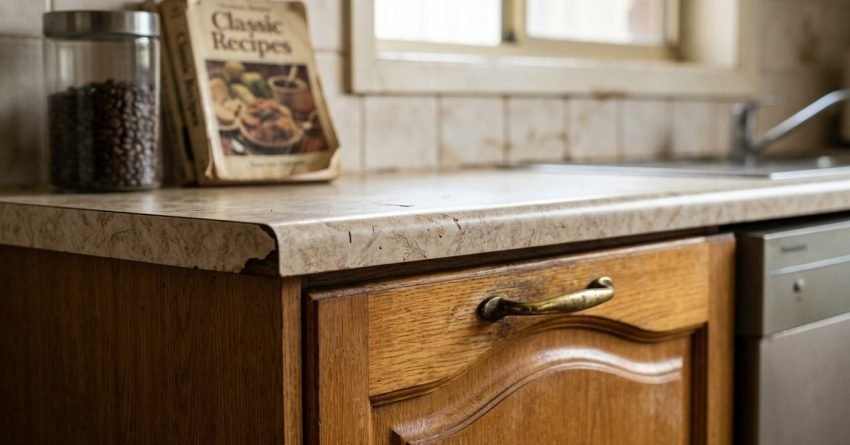
Raised-panel timber doors with heavy ornate detailing were popular through the 1980s and 1990s but now feel heavy and visually cluttered. Laminate doors in cream, almond, or honey oak tones carry a strong association with that same era. Thermofoil finishes that have begun to peel at the edges, or painted timber doors with visible chips and yellowing, compound the problem further.
Modern kitchens in Sydney favour flat-panel or shaker-style doors in matte or satin finishes, typically in white, warm grey, charcoal, or natural timber veneer. This shift is not just aesthetic. Flat-panel cabinetry reads as cleaner, more spacious, and easier to maintain, which aligns with how contemporary buyers evaluate a kitchen’s overall quality.
Worn hinges, misaligned doors, and soft-close mechanisms that no longer function properly are additional signals we look for. These details are noticed immediately, even by buyers who cannot articulate exactly why a kitchen feels tired.
Dated Benchtop Materials and Colours
Benchtops are a high-contact, high-visibility surface. We consider their material and colour choices among the strongest indicators of when a kitchen was last renovated.
Laminate benchtops in speckled beige, terracotta, or dark brown tones were standard through the 1980s and early 2000s. While laminate itself has evolved significantly as a material, older colour and pattern options are immediately recognisable as dated. Tile benchtops, once common in older Sydney homes, present similar challenges, with grout lines that accumulate staining and a surface profile that feels impractical by modern standards.
Polished granite in busy, heavily veined patterns was a premium choice through the 2000s but has since been overtaken by engineered stone in cleaner, more restrained designs. Thick, bullnose-edged benchtops in dark tones can also make a kitchen feel heavier and more closed-in than contemporary thin-profile alternatives.
Current preferences in Sydney lean toward engineered stone in white, light grey, or warm neutral tones, often with a waterfall edge or simple square profile. The visual effect is lighter, more open, and more aligned with the clean aesthetic that defines modern kitchen design.
Ageing Splashback Tiles and Grout
The splashback sits directly in the sightline when standing at the cooktop or sink. We treat it as one of the first surfaces a visitor registers, which makes dated tile choices in this zone highly influential on how old a kitchen appears.
Small ceramic mosaic tiles in terracotta, forest green, or navy blue were widely used through the 1990s. Larger format tiles in cream or off-white with decorative borders were common in early 2000s renovations. Both styles now read as distinctly period-specific.
Beyond the tile itself, grout that has darkened, stained, or cracked over time adds a layer of visual wear that no amount of cleaning fully resolves. Contemporary splashback choices in Sydney favour large-format porcelain tiles, subway tiles in matte finishes, or full-height engineered stone that matches the benchtop. These options minimise grout lines, simplify the visual field, and are far easier to maintain.
Quick Signs It’s Time to Renovate Your Kitchen
Before diving deeper, we recommend a quick self-check. If your kitchen shows several of the following, it is likely due for an update: worn or peeling cabinet finishes, a closed-off floor plan, fluorescent or single-source lighting, chrome tapware with a bar-profile handle, dated benchtop colours, and grout that no longer responds to cleaning.
If three or more of these apply, we would treat that kitchen as a strong renovation candidate rather than a maintenance job.
Kitchen Layouts That Feel Stuck in the Past
A kitchen’s layout shapes how the space functions and how it feels to move through it. Layouts that made sense for the way households lived decades ago often create friction in modern homes, and we see that friction show up immediately in how people use the space.
Closed-Off Floor Plans and Poor Flow
The closed kitchen, a separate room with walls on all sides and a single entry point, was the standard design for most of the twentieth century. It kept cooking smells and noise contained, which suited a time when kitchens were primarily functional work spaces rather than social hubs.
Today, the closed kitchen feels isolating. Sydney homeowners increasingly expect their kitchen to connect visually and physically to living and dining areas, allowing the person cooking to remain part of conversations happening elsewhere in the home. A kitchen walled off from the rest of the living space reads as outdated not just aesthetically but functionally.
We often recommend removing a non-structural wall to open a kitchen to an adjoining living or dining area. It is one of the most impactful structural changes a renovation can make, and it changes the perceived size of both spaces while improving natural light penetration.
This same principle applies strongly in Sydney’s many older apartments and terrace homes, where compact, boxed-in kitchens are especially common. Even small layout adjustments in these spaces can meaningfully shift how modern the kitchen feels without a full home extension in Sydney.
Insufficient Storage and Bench Space
Older kitchen designs frequently underestimated storage requirements. Shallow overhead cabinets, limited drawer configurations, and minimal bench run were standard in kitchens built before the 1990s, a period when households owned fewer appliances and cooking equipment.
A kitchen that lacks adequate storage forces worktops to become permanent storage surfaces, which creates visual clutter. Pantry space was often absent entirely in older designs, with food storage distributed across small, awkward cabinets that are difficult to access.
Modern kitchen design in Sydney prioritises deep drawers over base cabinets with shelves, full-height pantry towers, integrated appliance storage, and extended bench runs. When a kitchen visibly lacks these features, we see it as a clear signal of an older design philosophy.
Awkward Appliance Placement
In older kitchens, appliances were often positioned wherever they could be accommodated rather than where they made functional sense. Ovens mounted at floor level requiring the cook to bend down, undersized rangehoods poorly positioned relative to the cooktop, and refrigerators tucked into corners that interrupt workflow are all hallmarks of designs that predate modern ergonomic thinking.
Poor ventilation compounds these issues. An undersized or poorly ducted rangehood not only looks dated, but it fails to clear cooking odours and moisture effectively, which can contribute to grease build-up on cabinetry and ceilings over time.
Dishwashers added as afterthoughts, positioned at the end of a run rather than adjacent to the sink, create unnecessary movement during cleanup. Microwaves sitting on the benchtop because there is no integrated housing for them consume valuable workspace.
We treat appliance placement as a core design decision rather than an afterthought. Ovens at eye level, integrated rangehoods, and dedicated appliance cabinetry are now standard expectations in renovated kitchens.
Lighting That Makes a Kitchen Look Old
Lighting is one of the most underestimated factors in how a kitchen is perceived. A well-lit kitchen feels modern, clean, and inviting. A poorly lit one feels dated and unwelcoming, regardless of the quality of its other finishes.
Fluorescent Tubes and Single Overhead Fixtures
Fluorescent tube lighting was the default kitchen lighting solution for decades. It provided broad, even illumination at low cost, which made it practical for its time. Today, we consider it one of the clearest visual signals that a kitchen has not been updated.
The quality of light produced by fluorescent tubes is flat and harsh. It casts unflattering shadows, washes out colour, and creates a clinical atmosphere at odds with the warm, inviting aesthetic modern kitchen design aims to achieve. A single central pendant or surface-mounted fixture presents similar problems, creating uneven light distribution and leaving work surfaces in shadow.
We consistently recommend replacing fluorescent tubes with recessed LED downlights as one of the most cost-effective updates a Sydney homeowner can make. The change in atmosphere is immediate, and the energy savings over time are substantial.
Missing Task and Ambient Lighting Layers
Modern kitchen lighting design operates on multiple layers: ambient lighting for general illumination, task lighting for work surfaces, and accent lighting to highlight architectural features. Older kitchens typically have only one layer, a single overhead source, which leaves the space feeling flat and functionally limited.
Under-cabinet LED strip lighting is now a standard feature in renovated Sydney kitchens. It directs light precisely onto the benchtop where food preparation happens, eliminating shadows cast by overhead-only lighting. Pendant lights over an island or breakfast bar add a further layer of visual interest and warmth.
We see the absence of layered lighting immediately in older kitchens. It is not just an aesthetic issue; it affects how comfortable and practical the space is to use, which is why lighting upgrades consistently rank among the highest-impact, lowest-cost improvements we recommend.

Appliances and Hardware That Date a Kitchen Instantly
Individual appliances and hardware items may seem like minor details, but they carry significant visual weight. A single dated element in an otherwise updated kitchen can undermine the overall impression of the space.
Outdated Appliance Finishes and Styles
Appliance finishes follow design trends in the same way that cabinet colours and benchtop materials do. Bisque and almond-coloured appliances were standard through the 1980s and early 1990s. White appliances dominated through the late 1990s and 2000s, and both now read as dated in a modern kitchen.
Stainless steel became the premium finish of choice through the 2000s and remains widely used, but older stainless steel appliances with visible scratching, discolouration, or outdated control panel designs still signal age. Freestanding cookers with coil electric hotplates are particularly strong indicators of an unmodified older kitchen.
Contemporary appliance preferences in Sydney lean toward integrated or semi-integrated designs that sit flush with cabinetry, induction cooktops with flat glass surfaces, and pyrolytic ovens with clean digital interfaces. Matte black and brushed nickel finishes are increasingly popular alternatives to stainless steel.
Old Tapware, Handles, and Cabinet Hardware
Tapware and cabinet hardware are small in scale but highly visible. We find their design language communicates a great deal about when a kitchen was last updated.
Chrome tapware with separate hot and cold handles, or mixer taps with a heavy, ornate profile, are associated with older kitchen designs. Brass hardware that has not been maintained, or that features the yellow-gold tone of 1980s and 1990s fittings rather than the warmer, more refined brushed brass of contemporary design, reads as dated rather than classic.
Cabinet handles in polished chrome with a bar or bow profile were ubiquitous through the 2000s. While not inherently unattractive, they are now so strongly associated with that period that their presence immediately signals an older renovation.
We consider replacing tapware and cabinet hardware one of the most affordable ways to modernise a kitchen’s appearance. New handles in matte black, brushed nickel, or contemporary brushed brass, combined with a sleek mixer tap, can meaningfully shift the perceived age of a kitchen without any structural work.
Flooring Choices That Age a Kitchen
Kitchen flooring takes significant daily wear, and its condition and material choice both contribute to how old a kitchen appears. Flooring installed decades ago and never replaced carries the visual evidence of that age in ways that are difficult to conceal.
Vinyl Tiles, Laminate, and Worn Timber
Vinyl floor tiles in small formats, particularly those with a faux-stone or geometric pattern in beige, brown, or terracotta tones, were a common kitchen flooring choice through the 1980s and 1990s. They are now strongly associated with that era, and when worn or lifting at the edges, they add a layer of visual deterioration that compounds the dated impression.
Sheet vinyl in wood-grain or tile-effect patterns presents similar challenges. Modern luxury vinyl plank flooring has significantly advanced the material’s quality, but older sheet vinyl installations are immediately recognisable and difficult to rehabilitate without full replacement.
Laminate flooring in kitchens, particularly in lighter, washed-out timber tones popular in the early 2000s, has aged poorly. The material’s susceptibility to moisture damage means older laminate installations often show swelling, lifting, or surface wear.
Contemporary flooring choices for Sydney kitchens include large-format porcelain tiles, engineered timber, and modern LVP in warm, natural tones. We find these materials more durable, easier to maintain, and visually aligned with current design preferences.
Grout Lines, Staining, and Surface Wear
Even where the flooring material itself is not inherently dated, its condition can make a kitchen look old. Grout lines darkened with accumulated grime, tiles with surface scratching or chipping, and timber floors with worn finish patches all signal a space that has not been maintained.
Grout staining is particularly difficult to address without professional intervention. Consumer-grade grout cleaners rarely restore heavily stained grout to its original colour, and the contrast between clean tiles and dark grout lines draws the eye in a way that makes the floor look perpetually dirty.
We often tell Sydney homeowners that flooring replacement is a higher-priority investment than it initially appears. New flooring changes the visual foundation of the entire space and can make other existing elements, such as cabinetry or benchtops, look significantly more current by association.
Colour Schemes and Paint Choices That Show Their Age
Colour is one of the most immediate and emotionally resonant signals of a kitchen’s era. Certain colour combinations are so strongly associated with specific decades that they function almost as timestamps.
Dated Colour Palettes in Sydney Kitchens
The 1980s kitchen in Sydney was characterised by warm, earthy tones: terracotta, rust, avocado green, and harvest gold. These colours appeared on walls, tiles, appliances, and cabinetry simultaneously, creating a saturated, heavily layered palette that feels visually heavy by contemporary standards.
The 1990s brought a shift toward cooler, more neutral tones: cream, almond, and pale yellow, often combined with forest green or burgundy accents. Honey oak timber cabinetry paired with cream laminate benchtops and green splashback tiles is one of the most recognisable colour combinations of that decade in Australian kitchens.
The early 2000s introduced a preference for stainless steel, dark granite, and espresso-toned cabinetry. This palette reads as more contemporary than its predecessors but is now beginning to show its age, particularly alongside the heavy, ornate hardware of that period.
Current colour preferences in Sydney kitchens favour restrained, neutral palettes: white, warm grey, soft sage, and natural timber tones. These choices create a sense of lightness that aligns with the open-plan, light-filled aesthetic defining modern residential design in the city.
How Paint Condition Affects Perceived Age
Beyond colour choice, the physical condition of painted surfaces has a significant effect on how old a kitchen appears. Paint that has yellowed, chipped, or accumulated grease staining around high-use areas signals age and neglect in equal measure.
Kitchen walls are exposed to heat, moisture, and airborne grease daily. Without regular maintenance, even a relatively recent paint job can deteriorate to a point where it makes the space look significantly older than it is.
A fresh coat of paint in a contemporary colour, applied in a semi-gloss or satin finish appropriate for kitchen environments, is one of the lowest-cost interventions available to Sydney homeowners. It will not address structural or material issues, but it can meaningfully improve the overall impression of a space while more significant work is planned.
What Buyers and Renovators Notice First
Understanding what makes a kitchen look outdated is one thing. Understanding how that dated appearance translates into financial consequences for property value, rental yield, and renovation ROI is what helps homeowners and investors make decisions with confidence.
First Impressions and Property Value Impact
The kitchen is consistently cited by real estate agents and property valuers as one of the two or three spaces that most directly influence a buyer’s perception of a home’s overall value. According to CoreLogic’s renovation value research, kitchen and bathroom updates remain among the highest-return renovation categories in the Australian property market.
We often see buyers who walk into a kitchen with worn cabinetry, dated benchtops, and poor lighting mentally discount the entire home, even when other rooms are well-presented. The kitchen functions as a proxy for the property’s overall maintenance standard and investment history.
For Sydney property investors, a dated kitchen in a rental property can affect both achievable rent and the quality of tenants the property attracts. Tenants in Sydney’s competitive rental market have options, and a modern, functional kitchen is consistently ranked among the top priorities in rental property searches.
What a Kitchen Renovation Costs in Sydney
Kitchen renovation costs in Sydney vary significantly depending on the scope of work, the quality of materials selected, and whether structural changes are involved. We find that understanding the cost landscape helps homeowners direct investment for maximum return.
A cosmetic kitchen update, including new paint, replacement hardware, updated lighting, and a new splashback, can be completed for between $5,000 and $15,000 depending on the size of the kitchen. This level of investment addresses the most visible signs of ageing without requiring cabinetry replacement.
A mid-range kitchen renovation involving new cabinetry, benchtops, splashback, flooring, and appliances typically costs between $20,000 and $45,000 in Sydney. This scope of work delivers a comprehensive transformation and suits kitchens where the existing layout is sound, but the finishes have reached the end of their useful life.
A full kitchen renovation including structural changes, such as wall removal, new plumbing and electrical layouts, custom cabinetry, and premium finishes, can range from $45,000 to $80,000 or more in Sydney. This level of investment is typically justified where the layout is fundamentally limiting the kitchen’s functionality.
Energy Efficiency as a Modern Kitchen Standard
Beyond aesthetics, we increasingly see energy efficiency as a marker of a modern kitchen. Induction cooktops, which the Australian Government’s energy rating program recognises as significantly more efficient than traditional electric coil hotplates, are now a standard expectation in updated kitchens.
LED lighting throughout the space, combined with energy-efficient dishwashers and refrigerators, reduces running costs while reinforcing the perception of a well-considered, current design. We find that Sydney buyers and tenants increasingly factor these efficiencies into how “modern” a kitchen feels, not just how it looks.
How to Modernise an Outdated Kitchen Without a Full Rebuild
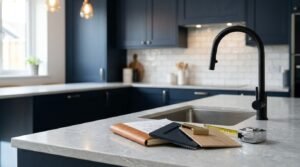
Not every outdated kitchen requires a complete renovation. In many cases, targeted, high-impact updates can meaningfully modernise a kitchen’s appearance and functionality at a fraction of the cost of a full rebuild.
High-Impact Updates on a Realistic Budget
Several kitchen updates consistently deliver strong visual impact relative to their cost. Cabinet door replacement, keeping existing carcasses and replacing only the doors and drawer fronts, is one of the most cost-effective ways to transform a kitchen’s appearance.
Benchtop replacement without cabinetry replacement is another high-value option. Engineered stone benchtops can be templated and installed over existing cabinetry in most cases, delivering a significant visual upgrade without the cost of a full cabinet replacement.
Splashback replacement, lighting upgrades, tapware replacement, and a fresh coat of paint round out the list of updates that deliver strong visual returns on modest investment. Approached strategically, we find these five interventions can transform the perceived age of a kitchen by a decade or more.
Homeowners weighing a kitchen refresh alongside other projects, such as a bathroom renovation or laundry update, often find that sequencing these smaller jobs together improves overall cost efficiency across the property.
When to Refresh Versus When to Renovate Fully
The decision between a cosmetic refresh and a full renovation depends on the condition of the existing cabinetry, the functionality of the current layout, and the financial objectives of the homeowner or investor.
We consider a refresh appropriate when the cabinet carcasses are structurally sound, the layout is functional, and the primary issues are cosmetic. In this scenario, targeted updates deliver strong returns without the cost and disruption of a full rebuild.
A full renovation is warranted when the layout is fundamentally limiting, particularly when walls need to be removed to open the space, when the cabinetry is structurally compromised, or when the kitchen is being updated as part of a broader property sale strategy. It is also the right choice when plumbing, electrical, and structural work all need addressing simultaneously.
Working With a Renovation Contractor in Sydney
Whether the scope is a targeted refresh or a full kitchen renovation, working with an experienced renovation contractor makes a measurable difference to the outcome. We help homeowners identify which investments will deliver the strongest returns and avoid common budget pitfalls.
Transparent cost planning from the outset, with detailed breakdowns of labour, materials, and contingency allowances, is the foundation of a renovation that stays on budget. It also gives homeowners a clear basis for comparing quotes.
Project coordination, trade scheduling, and quality oversight are equally important. A kitchen renovation involves multiple trades, cabinetmakers, tilers, electricians, plumbers, and painters, and managing their sequencing efficiently is critical to keeping the project on schedule.
Conclusion
An outdated kitchen is defined by the accumulation of specific, identifiable elements: worn cabinetry, dated benchtops, poor lighting, ageing flooring, and colour palettes that belong to a different decade. Each factor contributes to a space that feels tired, and together they can meaningfully affect both liveability and property value.
The good news for Sydney homeowners and investors is that not every outdated kitchen requires a full rebuild. Targeted, well-planned updates, directed at the elements that carry the most visual weight, can deliver a significant transformation at a realistic cost.
At Sydney Home Renovation, we help homeowners and property investors identify exactly what their kitchen needs, plan the work with transparent cost breakdowns, and deliver results that stay on budget and on schedule. If your kitchen is showing its age and you are ready to explore your options, we invite you to contact our team today for an honest, obligation-free consultation.
Frequently Asked Questions
What makes a kitchen look outdated?
A kitchen looks outdated when its cabinetry, benchtops, lighting, flooring, and colour palette reflect design trends from a previous decade. The most common culprits are raised-panel timber cabinet doors, laminate benchtops in dated colours, fluorescent tube lighting, and small-format ceramic tiles.
What kitchen features add the most value to a Sydney home?
Updated cabinetry, engineered stone benchtops, and an open-plan layout connecting the kitchen to living areas consistently deliver the strongest value uplift. Modern lighting, quality tapware, and integrated appliances also contribute significantly to buyer perception and achievable sale price.
How much does it cost to update an outdated kitchen in Sydney?
A cosmetic kitchen update typically costs between $5,000 and $15,000, covering paint, hardware, lighting, and splashback replacement. A mid-range renovation ranges from $20,000 to $45,000, while a full renovation with structural changes can cost $45,000 to $80,000 or more.
Can I modernise my kitchen without replacing the cabinets?
Yes. Cabinet door replacement, keeping the existing carcasses and replacing only the doors, drawer fronts, and hardware, is one of the most cost-effective ways to modernise a kitchen’s appearance. Combined with a new benchtop and lighting, it can deliver a comprehensive transformation at roughly half the cost.
What kitchen colours are considered outdated?
Terracotta, avocado green, harvest gold, and rust tones are strongly associated with 1980s kitchen design. Cream, almond, and honey oak combinations with forest green or burgundy accents are hallmarks of 1990s kitchens, while contemporary Sydney kitchens favour white, warm grey, and soft sage tones.
How do I know if my kitchen needs a full renovation or just an update?
A cosmetic update is appropriate when the cabinet carcasses are structurally sound, and the primary issues are visual. A full renovation is warranted when the layout is fundamentally limiting or structural changes are needed to open the space.
What is the most cost-effective way to modernise a kitchen?
The highest-impact, lowest-cost kitchen updates are cabinet door replacement, benchtop replacement, splashback replacement, lighting upgrades, and tapware and hardware replacement. Approached in combination, these interventions can transform a kitchen’s perceived age by a decade or more.


