
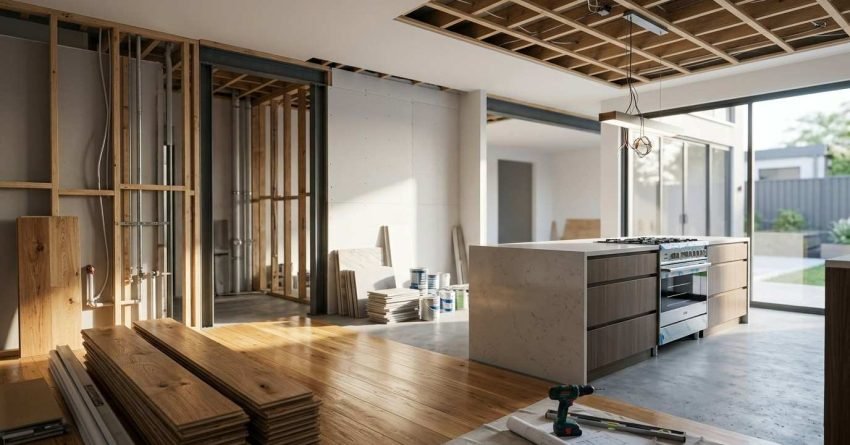
A full house renovation includes structural modifications, complete electrical and plumbing upgrades, kitchen and bathroom remodels, flooring replacement, painting, and fixture installation. Sydney projects run from $150,000 to $500,000 and beyond depending on scope and finish level. Knowing exactly what sits inside that number is what stops a budget blowout before it starts.
We have walked hundreds of homeowners through this. The ones who finish on budget are almost always the ones who understood the full scope before they signed anything.
Below we break down every element, from the first day of demolition to the final coat of paint, with real Sydney pricing and the sequence we actually work in. Australian households spent over $12.6 billion on residential alterations and additions in the most recent full year, according to Australian Bureau of Statistics building activity data, and a large share of that spend goes to whole-home projects like these.
Understanding Full House Renovation Scope
A full house renovation transforms an entire property rather than updating individual rooms. It addresses structural integrity, building compliance, functional layout, and finishes at the same time, under one coordinated program of works. Unlike a room-by-room approach, whole-house projects require every trade to be sequenced against every other trade.
A full house renovation typically includes:
Component | Typical Sydney Cost Band |
Demolition, strip-out, and waste removal | $11,000–$34,000 |
Structural repairs to foundations, walls, and roof | $30,000–$90,000 |
Complete electrical rewiring and switchboard upgrade | $11,500–$34,000 |
Plumbing, drainage, gas, and hot water replacement | $12,500–$33,000 |
Kitchen renovation (cabinetry, benchtops, appliances) | $25,000–$60,000 |
Bathroom renovations (waterproofing and tiling) | $15,000–$50,000 each |
Flooring throughout, plaster repair, and painting | $35,000–$80,000 |
Windows, doors, HVAC, and external works | $30,000–$90,000 |
The scope runs from foundation to roof and covers every internal space plus the external elements that affect how the home actually lives. We recommend this route for properties needing broad modernisation, homes with ageing electrical or plumbing systems, and any house where piecemeal updates cost more over ten years than doing it once properly.
Renovation vs Extension vs Knockdown Rebuild
Renovation keeps the existing structure and upgrades the systems, finishes, and layout inside it. An extension adds new floor area to the current footprint, and a home extension carries its own approval pathway and cost profile. A knockdown rebuild removes the dwelling entirely and starts again on the same land.
Full renovations generally land 30 to 50 percent below a comparable knockdown rebuild. You also keep character features and skip the longer approval pathway that new builds attract. Older properties with serious structural failure are the exception, and we say so when we see it.
When Full Renovation Makes Sense
Full house renovation suits properties where the bones are sound, but the systems and finishes have run out of life. Homes built before 1980 usually need complete rewiring, plumbing replacement, and asbestos assessment, which makes room-by-room work inefficient and repetitive.
Properties in established Sydney suburbs with heritage overlays or tight development controls often favour renovation over rebuilding. The existing footprint and height frequently exceed what current planning controls allow for a new dwelling, so the standing structure is an asset worth protecting.
Heritage conservation areas add a further layer. Councils in these zones control external materials, roof form, window profiles, and street-facing alterations, which pushes documentation cost up and narrows the range of compliant finishes.
Demolition, Site Preparation, and Waste Removal
Every full house renovation starts with removal, and this is the stage homeowners consistently underestimate. Demolition sets the schedule for everything downstream, and it is also where the expensive surprises surface.
Strip-Out and Structural Demolition
Internal strip-out removes cabinetry, fixtures, floor coverings, wall linings, and services back to the frame. We budget $8,000 to $25,000 for a full internal strip-out on an average Sydney home, driven by house size and access.
Selective structural demolition covers wall removal, floor cutting, and roof penetration. This work runs in parallel with propping and temporary support, so the engineer’s documentation needs to be complete before the first sledgehammer swings.
Asbestos and Hazardous Material Removal
Asbestos is the single most common hidden cost we encounter, and it sits in homes built or renovated before 1990. It appears in eaves, wall sheeting, wet-area linings, vinyl backing, and roof sheeting, which means demolition frequently uncovers it after the quote is signed.
Licensed removal costs $50 to $150 per square metre for non-friable material, with whole-house removal reaching $15,000 to $40,000. Friable asbestos requires a Class A licensed removalist and costs considerably more. Safe Work Australia sets the removal and clearance requirements, and clearance certificates are non-negotiable before we let any trade back on site.
Lead paint and old insulation add further remediation costs in pre-1970 properties.
Waste Disposal and Site Protection
Skip bins and tip fees are a real line item, not an afterthought. Full house renovations generate 8 to 20 cubic metres of mixed waste, costing $3,000 to $9,000 in disposal across the project.
Site protection covers hoarding, dust barriers, floor protection to retained areas, and temporary weatherproofing where the roof or windows come out. We price this in rather than absorbing it, because cutting it is how retained finishes get damaged.

Structural and Building Works
Structural work forms the foundation of the renovation, addressing the building’s skeleton before any cosmetic improvement begins. These elements carry the safety, compliance, and longevity of everything we install afterwards.
Foundation and Subfloor Repairs
Foundation assessment identifies settlement, cracking, and moisture issues that need remediation. Sydney’s reactive clay soils move seasonally, and that movement produces the stair-step cracking we see in brickwork across the older suburbs.
Subfloor work covers replacing damaged bearers and joists, improving ventilation, and levelling floors before new coverings go down. Budget $15,000 to $50,000 for significant foundation repair in Sydney, with restumping averaging $10,000 to $25,000 by house size.
Wall Modifications and Structural Changes
Removing walls for open-plan living requires engineering assessment and usually a steel beam. Load-bearing wall removal in Sydney typically costs $2,500 to $8,000, covering engineering, temporary propping, and beam installation.
New walls, doorways, and window openings involve framing, lintels, and integration with the existing structure. Any modification affecting load-bearing elements or the building footprint triggers a council approval pathway, so we resolve this at the design stage.
Roof Repairs and Replacement
Roof assessment determines whether targeted repair is genuine value or false economy. Sydney’s weather cycles are hard on roofing, with terracotta tiles reaching 50 to 100 years while metal roofing needs replacement at 25 to 50 years.
Full roof replacement costs $15,000 to $40,000 on an average Sydney home, covering removal, disposal, materials, and installation. Repairing sections, flashings, or valleys costs far less, and on a roof past 40 years, we tell clients plainly that the repair buys two years, not ten.
Electrical System Upgrades
Electrical work in a full renovation means complete rewiring, a new switchboard, and modern fixtures and safety systems. Older Sydney homes were never designed for today’s appliance and device loads, and the switchboard is usually the first thing that gives it away.
Complete Rewiring Requirements
Homes with original pre-1980 wiring need complete rewiring to meet the current Australian Standard for electrical installations (AS/NZS 3000). Rubber and cloth-insulated cable becomes brittle, and insurers increasingly decline cover on properties that still carry it.
Full house rewiring in Sydney costs $10,000 to $30,000, depending on property size, ceiling and subfloor access, and circuit count. That covers new cabling through walls and ceilings, new outlets and switches, and the connection into the upgraded board.
Switchboard and Safety Switch Installation
Modern switchboards carry higher loads and incorporate the safety switches now mandatory in Australian homes. Replacing an old ceramic fuse box with a circuit breaker board costs $1,500 to $4,000.
Safety switches cut power within milliseconds of detecting current leakage, which is the difference between a shock and a fatality. Every power and lighting circuit requires RCD protection in renovated properties, and interconnected smoke alarms are now standard practice on our jobs.
Lighting Design and Power Points
We plan lighting in layers: ambient, task, and accent. LED downlights, pendants, and integrated strip lighting deliver that layering while cutting running costs against the halogen fittings they replace.
Power point placement is where retrofit regret concentrates. Modern kitchens need 8 to 12 outlets, living areas need points every 2 to 3 metres, and home offices need dedicated circuits, so we mark every location on plan before the walls close up.
Plumbing and Gas Works
Plumbing upgrades cover water supply, drainage, gas lines, and hot water across the whole property. A full renovation is the one moment when every pipe is accessible at once, and we treat it that way.
Pipe Replacement and Upgrades
Galvanised steel and older copper pipes corrode internally, which is what causes the pressure drop and discoloured water in older Sydney homes. Full replacement in modern PEX or copper costs $8,000 to $20,000 by property size and access.
Drainage upgrades address blocked, cracked, and root-damaged sewer lines. We run a CCTV inspection before demolition starts, because spot relining at $3,000 and a full drainage replacement at $15,000 or more are very different conversations to have before a contract is signed.
Hot Water System Installation
Hot water selection drives ongoing energy costs more than almost any other appliance decision. The options are electric storage, gas storage, gas instantaneous, heat pump, and solar, and each carries a different upfront and running cost profile.
Heat pumps suit Sydney’s climate well, cutting hot water energy use substantially compared with electric storage at $3,000 to $5,000 installed. Gas instantaneous units deliver unlimited hot water at $1,500 to $3,000 installed with lower running costs than electric storage.
Gas Line Installation and Compliance
Gas work requires a licensed gasfitter and compliance certification, with no exceptions. New lines for cooktops, heating, or hot water cost $500 to $2,000 per appliance connection, and complete gas fitting across a full renovation runs $3,000 to $8,000.
Gas compliance certificates confirm safe installation and become necessary at sale and at claim time. All gas work meets AS/NZS 5601, and we recommend annual servicing on every appliance we connect.
Kitchen Renovation Components
The kitchen typically represents 10 to 15 percent of a full house renovation budget, reflecting how many trades converge in one room. A kitchen renovation inside a whole-house program brings plumbing, electrical, cabinetry, stone, and appliances into the same few square metres.
Cabinetry and Benchtops
Kitchen cabinetry runs from flat-pack at $5,000 to $10,000 through to custom joinery at $20,000 to $50,000 and above. Material choice across melamine, polyurethane, timber veneer, and solid timber drives both cost and how the doors look in year eight.
Benchtops move the budget hard. Laminate costs $200 to $500 per linear metre installed, engineered stone $600 to $1,200, and natural stone $800 to $2,000 or more. Thickness, edge profile, and cutout complexity all add to the final figure.
Appliance Allowances
Appliance packages range from $5,000 at the budget end to $30,000 and beyond for premium brands. The core list is cooktop, oven, rangehood, dishwasher, and refrigerator, with integrated microwaves and wine fridges now common additions.
Energy ratings affect running costs over the appliance’s life, so a higher purchase price frequently pays for itself. We also weigh warranty length and local service availability, because a premium appliance with no Sydney service agent is a liability.
Plumbing and Electrical Requirements
Kitchen plumbing covers sink installation, dishwasher connection, and refrigerator water lines for ice and filtration. Relocating a sink or adding an island sink requires drainage modification at $1,000 to $3,000.
Electrical requirements include dedicated circuits for ovens and cooktops, generous small-appliance outlets, and under-cabinet lighting. Kitchen electrical work inside a full renovation typically costs $2,000 to $5,000.

Bathroom Renovation Elements
Bathrooms inside a full house project cover waterproofing, plumbing, fixtures, and finishes. Each bathroom renovation typically costs $15,000 to $50,000 by size, fixture level, and layout complexity.
Waterproofing and Tiling
Waterproofing is the most critical element in the room and the least visible. Australian Standards require a compliant membrane in wet areas with certification issued before tiling begins, and we photograph every membrane before it disappears under tile.
I am direct about why. A failed membrane does not present as a leak; it presents as swollen skirting and a soft subfloor two years later, and rectification means demolishing a finished bathroom to fix a $1,500 defect.
Tiling cost swings widely on selection and layout. Budget tiles cost $30 to $60 per square metre, mid-range $60 to $150, and premium $150 to $400 or more, with Sydney tiling labour averaging $50 to $80 per square metre.
Fixtures, Fittings, and Ventilation
Bathroom fixtures cover toilets, basins, baths, and showers across every price tier. A complete fixture package costs $2,000 to $5,000 at standard quality, $5,000 to $15,000 mid-range, and $15,000 to $40,000 or more at premium level. Tapware and accessories add $500 to $3,000 per bathroom by brand and finish.
Bathroom ventilation prevents the moisture build-up that causes mould and structural damage. Exhaust fans cost $200 to $800 installed, and we specify ducted units over recirculating ones every time.
Heated towel rails and underfloor heating add comfort and help manage moisture. Electric underfloor heating costs $100 to $150 per square metre installed, with heated towel rails from $300 to $1,500 by size and style.
Flooring Throughout the Home
Flooring replacement creates continuity between spaces and removes the worn, dated surfaces that make a renovated home still feel old. Selection balances durability, maintenance, comfort, and budget zone by zone.
Timber, Tile, and Stone
Solid timber costs $120 to $250 per square metre installed and can be sanded and recoated several times across its life. Engineered timber at $80 to $180 per square metre gives a similar appearance with better dimensional stability over concrete slabs.
Species choice affects both look and wear. Spotted gum and blackbutt handle high-traffic zones well, while softer species like Victorian ash sit better in bedrooms, and we specify acoustic underlay on upper floors as standard.
Porcelain floor tiles cost $50 to $150 per square metre installed with excellent durability and almost no maintenance, while natural stone at $150 to $400 or more needs sealing and ongoing care. Large format and rectified tiles reduce grout lines and read as more contemporary, though handling and substrate preparation push installation cost up.
Carpet and Hybrid Flooring
Carpet still wins in bedrooms for warmth and acoustics at $60 to $150 per square metre installed. Wool outperforms synthetic on resilience and feel, which justifies the higher entry price for most clients.
Hybrid flooring pairs a vinyl wear layer with a rigid core for waterproof performance at $50 to $100 per square metre installed. It suits open-plan living that runs into a kitchen and forgives spills that timber does not.
Internal Wall Finishes
Wall finishes are where the renovation finally looks finished, and preparation regularly costs more than the coating itself. Full renovations include plaster repair, painting throughout, and any feature wall treatments.
Plastering and Repairs
Plaster repairs address cracking, holes, and uneven surfaces before paint goes anywhere near them. Skim coating whole walls costs $15 to $25 per square metre and produces the flat surface that premium paint finishes need.
Replacing damaged plasterboard, installing new cornices, and adding decorative mouldings all sit within plastering scope. Budget $3,000 to $10,000 for comprehensive plaster repair across a full house renovation.
Here is the part that surprises people. On a 1950s home with uneven walls, we frequently spend more on preparation than on the paint itself, because a premium finish over poor substrate still looks like a poor wall.
Painting, Wallcoverings, and Trim
Interior painting costs $20 to $40 per square metre in Sydney, covering preparation, priming, and two finish coats. A typical three-bedroom home needs $8,000 to $15,000 for complete internal painting.
Feature walls in wallpaper, timber panelling, or textured finish add interest at $50 to $200 per square metre. These work hardest in living areas, main bedrooms, and powder rooms where the eye lands.
Replacing dated architraves and skirting modernises a room faster than almost any other small change, with standard profiles at $8 to $15 per linear metre installed and decorative options at $15 to $30. Running one profile throughout creates cohesion, and MDF profiles hold paint well and resist the warping that timber shows in climate-controlled homes.
Windows and Doors
Window and door replacement lifts energy efficiency, security, and appearance in one move. These elements drive both street appeal and how comfortable the house feels in February and July.
Window Replacement Options
Aluminium windows cost $400 to $800 per square metre installed, with good durability and slim sightlines. Timber windows at $600 to $1,200 per square metre suit heritage properties and insulate better.
Double glazing adds $100 to $200 per square metre and delivers real comfort gains in Sydney’s climate. Low-E coatings improve thermal performance further, and the National Construction Code energy efficiency provisions now set minimum performance requirements that shape these selections.
Internal, External, and Security Doors
Internal door replacement costs $300 to $800 per door installed by style and hardware, and solid core doors insulate sound far better than hollow core. Cavity sliders and barn doors reclaim floor space in tight areas at $800 to $2,000 installed, including track and hardware.
Front door replacement delivers immediate impact, with quality doors at $1,500 to $5,000 installed. Pivot doors, double doors, and custom designs cost more and set the character of the entry.
Security screens on doors and windows add $300 to $800 per opening and let you leave the house open in summer. Stainless steel mesh outperforms aluminium on both strength and visibility.
Climate Control and Energy Efficiency
Climate control decides whether a renovated house is genuinely comfortable year-round. A full renovation is the cheapest moment to install ducted systems, because the ceilings and walls are already open.
Air Conditioning and Ventilation
Ducted reverse-cycle systems for average Sydney homes run $10,000 to $20,000 installed, covering indoor and outdoor units, ductwork, and zoning. Zoning gives independent control across areas, and four-zone systems add $1,000 to $2,000 to base pricing while paying that back in efficiency.
Split systems deliver cost-effective control for specific rooms at $1,500 to $4,000 installed by capacity, with multi-head systems running several indoor units off one outdoor compressor. Many of our clients combine ducted through living zones with splits in bedrooms.
Heat recovery ventilation costs $5,000 to $15,000 installed and exchanges stale air for filtered fresh air while retaining most of the heating or cooling energy. Subfloor ventilation tackles the damp that sits under older Sydney homes, with fan systems at $1,500 to $4,000 installed.
Insulation Upgrades
Open walls and ceilings make insulation the best value upgrade in the entire project. Ceiling batts cost $2,000 to $5,000 for an average home, wall insulation during the open-frame stage $3,000 to $8,000, and underfloor insulation $2,000 to $6,000.
We install it while the frame is exposed because the alternative is paying twice to open the same wall. Combined with double glazing and draught sealing, a properly insulated renovation cuts heating and cooling loads enough to let us specify a smaller HVAC system, which recovers part of the cost immediately.
External Works and Landscaping
External elements finish the renovation, covering street appeal, outdoor living, and how the property functions day to day. We run these alongside internal work wherever the site allows, which compresses the overall program.
Facade, Driveways, and Pathways
Facade improvement changes how the house reads from the street and covers rendering, cladding, and paint. Cement rendering costs $50 to $80 per square metre, with feature cladding in timber or composite at $100 to $250, and replacing fascias, gutters, and downpipes typically costs $3,000 to $8,000.
Driveway replacement addresses the cracked, stained concrete that undercuts an otherwise finished home. Plain concrete costs $80 to $150 per square metre, exposed aggregate $100 to $180, and paving $120 to $250.
We resolve drainage and stormwater connection at the design stage, because retrofitting into finished hardscape is expensive.
Outdoor Living Spaces
Decks and patios extend the living area outdoors and change how the whole home is used. Timber decking costs $300 to $600 per square metre installed, with composite at $400 to $800 and far lower maintenance.
Pergolas and covered outdoor areas run $5,000 to $30,000 by size, material, and roofing. They add usable space and protect outdoor furniture through Sydney’s summer storms.
How Homeowners Finance a Full House Renovation
Financing shapes scope as hard as any design decision, and it needs resolving before documentation is finalised. Most Sydney homeowners fund whole-house work through equity release, a construction loan, or a combination of savings and a personal facility.
Equity release refinances the existing mortgage and draws on accumulated value, which suits owners with substantial equity and a fixed-price contract in hand. Construction loans instead release funds in progressive drawdowns tied to completed stages, matching the payment schedule most builders work to.
Drawdown timing matters more than the headline rate. Lenders release each payment only after inspection, so we align our progress claims to the standard stage schedule of deposit, frame, lock-up, fixing, and completion to keep cash flow smooth.
Budget for interest during construction, which many owners overlook. On a 6-month program, you carry loan interest plus rental accommodation simultaneously, and that combined figure belongs in the budget from day one rather than surfacing in month three.
Insurance, Licensing, and Choosing Your Builder
Verifying your builder is the cheapest risk management available, and it takes an afternoon. In NSW, every residential job above the statutory threshold requires a licensed builder and Home Building Compensation cover, and we provide both certificates before any contract is signed.
Check the licence number against the NSW Fair Trading register, confirm it covers the class of work you need, and look for any disciplinary history. Ask for three completed whole-house projects of similar scope and speak to those owners directly about variations, communication, and how defects were handled.
Contract works insurance covers the building and materials during construction, and it sits with the builder on most fixed-price contracts. Confirm in writing who holds it and what the excess is, because an uninsured storm event mid-program is a genuine project-ending risk.
Your own home insurance also needs attention. Most policies restrict cover on unoccupied properties and on homes undergoing structural work, so notify your insurer before demolition rather than after.
Full House Renovation Timeline: Stage by Stage
Understanding the sequence matters as much as understanding the cost, because the two move together. Most full house renovations in Sydney run 4 to 8 months on site, with complex structural projects reaching 12 months.
Approval and Pre-Construction Phase
Design, documentation, and approval consume 8 to 20 weeks before any trade arrives. This covers architectural or draftsman documentation, engineering, and either a complying development certificate or a full development application.
We use this window to lock selections and finalise the contract. Every selection still open when construction starts becomes a variation later, and variations are where budgets fail.
Construction Phase Breakdown
On-site work follows a fixed order. Demolition and strip-out take 1 to 3 weeks, structural work 2 to 6 weeks, and electrical and plumbing rough-in 2 to 3 weeks once the frame is open.
Waterproofing, tiling, and cabinetry occupy the middle of the program at 4 to 8 weeks combined. Painting, flooring, and final fix close it out over 3 to 5 weeks, followed by certification and handover, with external works and landscaping running in parallel wherever the site allows.
Living Arrangements During the Build
Living on site through a full renovation is impractical and frequently unsafe, with services disconnected and wet areas out of action. Most clients budget $3,000 to $6,000 per month for rental accommodation across the program.
Staged renovation keeps part of the house habitable, but it extends the timeline by 20 to 40 percent and increases cost through repeated site setup and protection. We model both options at the quoting stage so the accommodation cost sits inside the budget from day one rather than arriving as a shock in month three.
Project Management and Compliance
Successful full house renovations depend on coordinating trades, approvals, and quality control against one schedule. Getting these right is what separates a project that lands on budget from one that drifts.
Council Approvals and Certifications
Renovation scope determines whether you need a complying development certificate or a full development application. DA costs run $2,000 to $10,000 including council fees and professional preparation, with approval typically taking 6 to 12 weeks. The NSW Planning Portal sets out which pathway applies to which work.
Building certifiers inspect at critical stages and issue the occupation certificate at completion. Certification costs $3,000 to $8,000 across a full renovation and covers multiple inspections through the program.
Trade Coordination
Full renovations require strict sequencing, and every trade depends on the one before it. The order we work in is fixed for good reason.
Demolition and strip-out come first, then structural work and framing, then electrical and plumbing rough-in while walls are open. Insulation follows, then plasterboard and setting, then waterproofing to wet areas.
Tiling comes next, then cabinetry and benchtop templating, then painting, then flooring. Final fix of electrical, plumbing, and hardware closes the program, followed by cleaning, certification, and handover.
Break that order, and the cost is real. Painting before flooring means damaged paint, and tiling before waterproofing certification means demolishing new tile.
Delays in one trade cascade through everything downstream, so we build 10 to 20 percent timeline contingency for weather, material lead times, and the unforeseen.
How to Compare Builder Quotes Accurately
Comparing quotes on total price alone is the most expensive mistake homeowners make. A $220,000 quote and a $265,000 quote frequently describe completely different projects.
Check whether each quote uses fixed inclusions or allowances. An allowance is a placeholder figure, so a $12,000 tiling allowance against a $28,000 specified selection makes one quote look cheaper while guaranteeing a variation later.
Confirm what each quote excludes, then check for provisional sums, demolition and waste, site protection, certification fees, and temporary accommodation. We present allowances and exclusions as separate line items precisely so this comparison is possible.
Fixed Price vs Cost Plus Contracts
Fixed price contracts set one figure for a defined scope, transferring cost risk to the builder. They suit renovations with complete documentation and few unknowns, and they are the right structure for the large majority of homeowners.
Cost plus contracts charge actual costs plus an agreed margin, typically 10 to 20 percent. They suit projects where the extent of structural or hazardous material work genuinely cannot be established until demolition, though they leave the homeowner carrying the cost risk.
Quality Control and Defect Management
Regular site inspection catches issues while they are still cheap to fix. We document progress photographically and keep written records of every variation and decision, which resolves disputes before they become arguments.
Defect liability periods run 6 to 12 months after completion, and the builder rectifies identified defects within it. Hold final payment until the defect list is genuinely closed out.
What a Full House Renovation Does Not Include
Knowing the exclusions protects your budget as much as knowing the inclusions. These items sit outside most standard renovation contracts, and homeowners discover them at the worst possible time.
Furniture, window furnishings, and loose appliances are almost always excluded. Blinds and curtains alone add $3,000 to $12,000 across a typical home, and nobody budgets for them.
Temporary accommodation, storage, and removalist costs sit outside the contract. So do landscaping and softscaping beyond the specified hardscape, plus swimming pool work, driveway gates, and solar installation unless explicitly scoped.
Provisional sums are the item to watch most closely. These are estimates for work that cannot be priced until it is exposed, most commonly structural repair, drainage replacement, and asbestos removal, and they adjust to actual cost when the work happens.
We list every exclusion and provisional sum in writing at the quoting stage. A quote without an exclusions list is not a complete quote.
Realistic Budget Planning
Accurate budgeting is what prevents the financial stress that stalls renovations halfway through. Understanding both the cost components and the contingency requirement lets you make decisions with confidence rather than hope.
Cost Breakdown by Category
Typical full house renovation costs are allocated roughly as follows.
Category | Share of Budget | Indicative Cost on a $300,000 Project |
Structural work | 15–20% | $45,000–$60,000 |
Electrical | 8–12% | $24,000–$36,000 |
Plumbing and gas | 8–12% | $24,000–$36,000 |
Kitchen | 15–20% | $45,000–$60,000 |
Bathrooms | 15–25% | $45,000–$75,000 |
Flooring | 8–12% | $24,000–$36,000 |
Painting and finishes | 8–12% | $24,000–$36,000 |
External works | 10–15% | $30,000–$45,000 |
Sydney full house renovations run $1,500 to $3,000 per square metre at standard quality and $3,000 to $5,000 or more for premium finishes. A 150 square metre home therefore lands between $225,000 and $750,000 depending on scope and specification.
Notice where the money goes early. Structural, electrical, and plumbing account for roughly 40 percent of the budget and produce almost nothing visible, which is exactly why projects get abandoned at the halfway mark by owners who expected to see progress matching their spend.
Contingency Requirements
Contingency of 15 to 20 percent covers the unforeseen conditions that renovation reliably produces. Older properties need the higher end, because more is hidden behind their linings.
The common contingency items are asbestos discovery, structural repair revealed at demolition, electrical and plumbing upgrades to meet current code, and material price movement. I tell every client to hold that contingency intact through the project, because spending it on upgraded finishes in month two leaves nothing for the real surprise in month five.
Return on Renovation Investment
Kitchens and bathrooms return the most reliably, typically recovering 60 to 80 percent of their cost in added value while transforming daily use. Structural and services work returns less on paper but protects the value of everything else and satisfies buyer due diligence at sale.
Overcapitalising is the risk to manage. We check the renovated value against the suburb ceiling before finalising scope, because spending $400,000 on a home in a street that tops out at $1.6 million destroys value rather than creating it.
Value Engineering Options
Value engineering finds savings without surrendering quality or function. The reliable moves are mid-range fixtures with premium appearance, timing purchases around supplier sales, and concentrating spend where hands and eyes actually land.
Phasing non-essential elements works well when budgets tighten. Landscaping, some external works, and decorative features defer comfortably without affecting how the home lives, and we structure the contract to make that possible.
Conclusion
A full house renovation covers demolition, structural work, complete electrical and plumbing upgrades, kitchen and bathroom remodels, flooring, painting, HVAC, and external improvements. Every one of those components carries its own cost, sequence, and compliance requirement. Understanding all of them is what lets you plan properly, compare quotes accurately, and decide with confidence.
At Sydney Home Renovation, we guide homeowners through every stage, from initial planning and accurate cost estimation through to construction and final handover. We put allowances, exclusions, and provisional sums in writing from the start, so you always know exactly what your number includes.
Ready to renovate with confidence? Contact Sydney Home Renovation for a detailed consultation, and we will build you a realistic scope and budget that keeps your project on schedule and inside its number.
Frequently Asked Questions
How long does a full house renovation take in Sydney?
Full house renovations take 4 to 8 months on site. Projects with significant structural work or a full development application extend to 12 months. Weather and material lead times affect the program.
Can I live in my house during a full renovation?
Living on site through a full renovation is impractical and often unsafe, since services get disconnected and wet areas come offline. Most clients arrange rental accommodation for the duration.
Do I need council approval for a full house renovation?
Approval depends on scope. Internal cosmetic work generally needs none, while structural changes, additions, and work on heritage properties require development consent or a complying development certificate.
What is the correct order of works in a full house renovation?
Demolition first, then structural work, electrical and plumbing rough-in, insulation, plasterboard, waterproofing, tiling, cabinetry, painting, flooring, and final fix. Breaking that sequence causes rework and added cost.
What’s the difference between a renovation and a restoration?
Renovation updates a property to current standards and preferences. Restoration returns it to original condition, preserving or recreating period detail. Full renovations often blend both approaches.
How do I choose between renovating and rebuilding?
Weigh structural condition, renovation cost against rebuild cost, planning restrictions, and your intended outcome. Sound structures suit renovation, while extensive structural failure favours rebuilding.
What hidden costs should I budget for in a full renovation?
Asbestos removal, structural repair found at demolition, code-compliance upgrades to electrical and plumbing, waste disposal, and temporary accommodation. Carry a 15 to 20 percent contingency for these.
What should be included in a full renovation quote?
A complete quote itemises inclusions, allowances, exclusions, and provisional sums separately. It also covers demolition, waste removal, site protection, and certification fees rather than omitting them.
Should I hire a builder or manage trades myself?
Builder management gives single-point accountability, trade coordination, and warranty cover. Owner management saves 15 to 20 percent but demands significant time, construction knowledge, and risk tolerance.


