
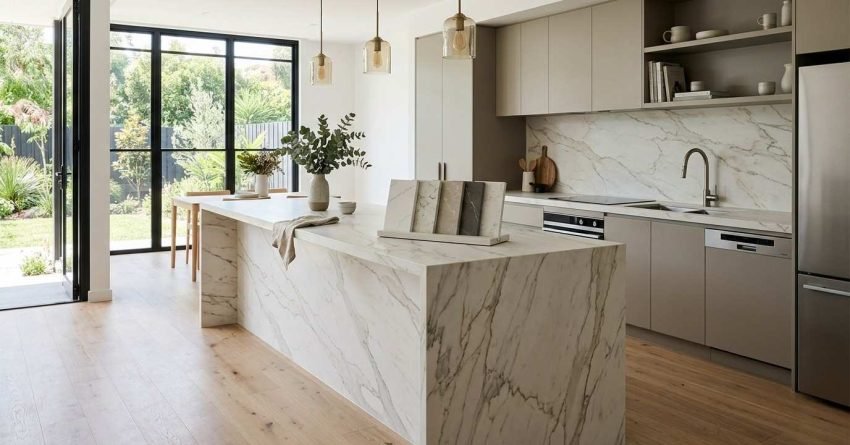
Engineered stone benchtops sit between $400 and $1,500 per linear metre installed in Sydney, depending on the brand, slab thickness, and complexity of your layout. That range is wide, and knowing where your project lands inside it makes the difference between a renovation that stays on budget and one that blows out before the tiler even starts.
Choosing the wrong material or brand for your space is one of the most common and costly mistakes I see renovators make. Getting this decision right early saves real money.
In this guide, I cover the top Australian brands, realistic Sydney pricing, honest material comparisons, and exactly what to look for before you commit to a slab.
What Is Engineered Stone and Why Do Homeowners Choose It?
Engineered stone is a manufactured surface made from roughly 90–95% crushed quartz bound together with polymer resins and pigments. It is not quarried from the ground in one piece it is engineered in a controlled factory environment to deliver consistent colour, hardness, and surface quality across every slab.
That consistency is the core reason homeowners choose it. Natural stone is beautiful, but it is unpredictable. Engineered stone gives you the look of stone with far more control over the outcome.
It is also non-porous, which matters enormously in bathrooms and kitchens where moisture, soap, and food contact the surface daily.
How Engineered Stone Differs from Natural Stone
Natural stone marble, granite, travertine is quarried directly from the earth. Every slab is unique, which sounds appealing until you realise that uniqueness also means inconsistency in colour, veining, and porosity.
Engineered stone is manufactured to a specification. The colour you see in the showroom is the colour you get on site. The surface density is uniform. There are no hidden fissures or soft spots that absorb staining liquids.
The trade-off is that engineered stone lacks the one-of-a-kind character of a genuine marble slab. For most renovators, that trade-off is worth it.
Key Benefits for Bathroom and Kitchen Renovations
The non-porous surface means bacteria, mould, and moisture cannot penetrate the material a genuine hygiene advantage in wet areas. Stain resistance is high, and routine cleaning requires nothing more than a damp cloth and mild detergent.
Scratch and impact resistance is strong across most grades, and the surface holds up well under the daily demands of a working kitchen or bathroom. Colour and finish options have expanded significantly over the past decade, covering everything from stark whites and concrete looks to deep charcoals and veined marble replicas.
For property investors, the durability-to-cost ratio is hard to beat.
Top Engineered Stone Benchtop Brands in Australia
Four brands dominate the Australian market. Each sits at a different price point and serves a different renovation profile. Understanding what separates them stops you from overpaying for features you do not need or underspending on a surface that will not last.
Caesarstone Premium Quality and Colour Range
Caesarstone is the benchmark premium brand in Australia. Originally manufactured in Israel, it is distributed nationally and carries one of the widest colour and finish ranges available over 40 active designs at any given time, including ultra-realistic marble looks and textured concrete finishes.
The quality is consistent and the warranty is strong, typically 25 years for residential use. You pay for that reliability. Caesarstone sits at the upper end of the price range, and it is the brand I recommend most often for owner-occupiers who want a surface that performs and looks exceptional for the long term.
It is not the right call for a rental property renovation where budget efficiency matters more than prestige.
Silestone Durability and Antibacterial Properties
Silestone, manufactured by Spanish company Cosentino, is the brand most focused on surface hygiene. Its HybriQ technology incorporates a bacteriostatic agent into the surface itself, which inhibits bacterial growth without relying on surface coatings that wear off over time.
The material also incorporates recycled glass and mirror content, which gives Cosentino a genuine sustainability story relevant for renovators who factor environmental credentials into their material decisions. Silestone sits in the mid-to-premium price bracket and competes directly with Caesarstone on quality while differentiating on the hygiene and sustainability angle.
For bathrooms in particular, the antibacterial surface is a meaningful advantage.
Quantum Quartz Australian-Made Value
Quantum Quartz is manufactured in Australia, which gives it a lead time and availability advantage over imported brands. Local fabricators are familiar with the material, and the supply chain is shorter both of which reduce the risk of delays on your renovation timeline.
It sits firmly in the mid-range price bracket and delivers solid performance across the standard renovation use cases: kitchen benchtops, bathroom vanities, and laundry surfaces. The colour range is more limited than Caesarstone or Silestone, but the core tones whites, greys, and stone looks are well represented.
For renovators who want reliable quality without the premium brand price tag, Quantum Quartz is a strong default choice.
Essastone Budget-Friendly and Widely Available
Essastone is the Laminex-owned engineered stone brand, stocked through Bunnings and widely available across Australia. It is the most accessible entry point into engineered stone, with pricing that makes it competitive against high-end laminate options.
The quality is functional rather than exceptional. For a rental property bathroom or a secondary kitchen renovation where budget is the primary constraint, Essastone does the job. For a forever home or a high-use kitchen, I would push the budget toward Quantum Quartz or above.
The availability through Bunnings also means lead times are shorter than specialty brands, which matters when a renovation is on a tight schedule.
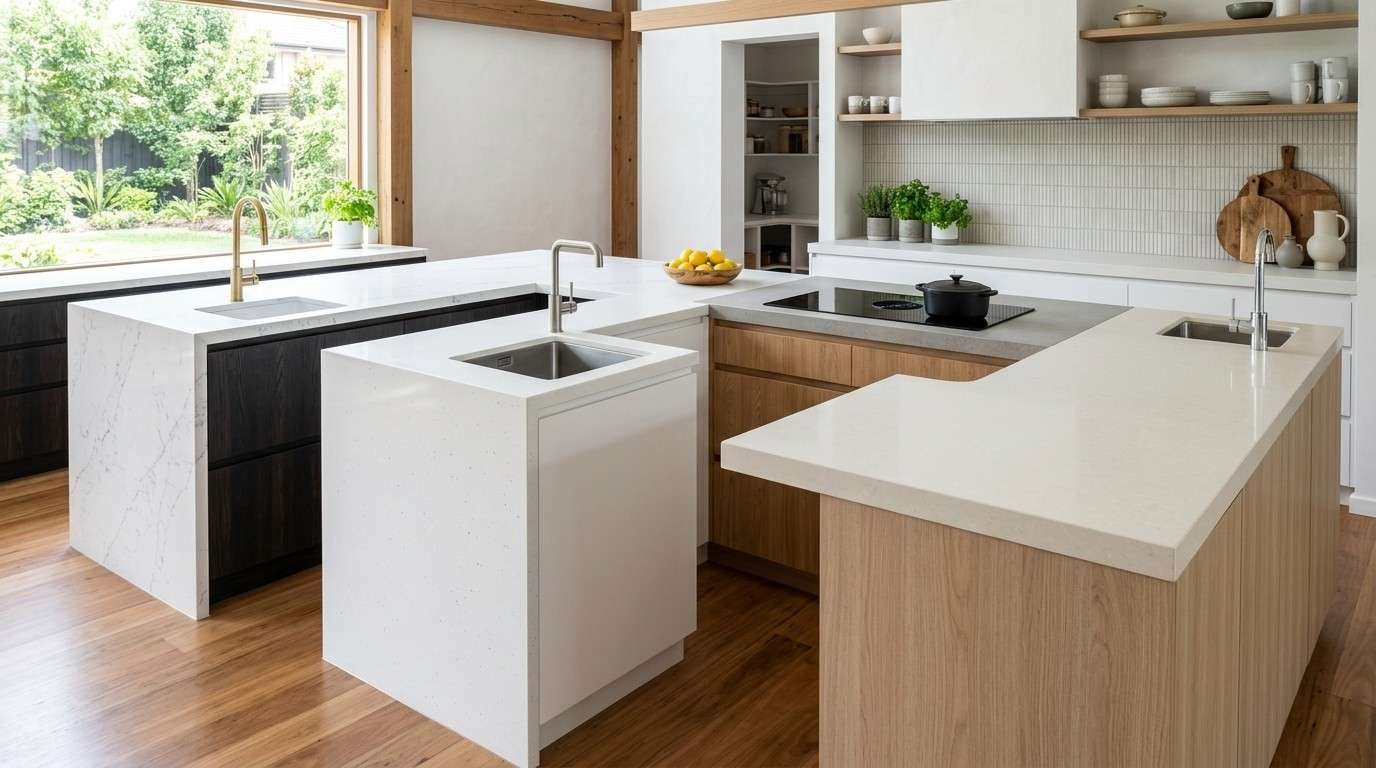
How Much Do Engineered Stone Benchtops Cost in Sydney?
Sydney pricing for engineered stone benchtops runs higher than the national average, driven by labour rates, demand, and the concentration of premium renovation projects in the market. The figures below reflect current 2025 Sydney market conditions across supply and installation.
Cost Per Linear Metre by Brand and Grade
Entry-level engineered stone Essastone and comparable grades runs between $400 and $600 per linear metre installed. This covers a standard 20mm slab with a basic square edge profile and a straightforward layout with no complex cutouts.
Mid-range brands like Quantum Quartz and mid-tier Silestone sit between $650 and $950 per linear metre installed. This bracket covers 20mm and 30mm slabs, a wider edge profile selection, and more complex colour options.
Premium brands Caesarstone top-tier and Silestone premium run from $950 to $1,500 per linear metre installed. At this level, you are paying for 30mm slabs, premium finishes, complex edge profiles, and the brand warranty that comes with it.
Supply-Only vs. Supply and Install Pricing
Supply-only pricing covers the slab material alone. It does not include templating, fabrication, delivery, or installation. Supply-only costs typically run 40–60% of the total installed price, depending on the brand and slab thickness.
The remaining cost covers the tradie work: a stonemason or fabricator templates your space, cuts the slab to size, machines the edge profiles, and installs the finished benchtop. In Sydney, fabrication and installation labour runs between $150 and $300 per linear metre on top of the material cost.
Buying supply-only and sourcing your own fabricator can save money, but it adds coordination risk. For most homeowners, a supply-and-install quote from a single contractor is the cleaner path.
Hidden Costs That Affect Your Final Budget
The per-linear-metre figure is the starting point, not the final number. Several add-ons push the total up, and most renovators do not account for them at the quoting stage.
Sink and tap cutouts typically add $80–$150 per cutout. Waterfall ends where the benchtop wraps vertically down the side of a cabinet add a full linear metre of material and fabrication cost per end. Upgraded edge profiles (bullnose, mitred, or ogee) add $50–$120 per linear metre over a standard square edge. Removal and disposal of an existing benchtop adds $150–$300 depending on the material and access.
Budget for these line items from the start. They are not optional extras they are standard parts of most renovation scopes.
Engineered Stone vs. Other Benchtop Materials
Engineered stone is not the only option, and it is not always the right one. The comparison below covers the three materials I see homeowners most commonly weighing against engineered stone in Sydney renovation projects.
Engineered Stone vs. Laminate
Laminate is the most affordable benchtop option, running $150–$350 per linear metre installed. Modern laminate has improved significantly textured finishes and stone-look prints are convincing at a glance but the material is not in the same durability class as engineered stone.
Laminate is susceptible to heat damage, moisture penetration at joins and edges, and surface scratching over time. For a rental property bathroom where budget is tight and the surface will be replaced in a decade anyway, laminate is a rational choice. For a kitchen or bathroom in an owner-occupied home, engineered stone’s durability advantage justifies the price difference over a 10–15 year horizon.
The cost gap narrows considerably when you factor in the longevity difference.
Engineered Stone vs. Porcelain
Porcelain benchtops are a newer entrant to the Australian market and are gaining ground fast. The material is UV-stable, making it the only benchtop option genuinely suited to outdoor kitchens and alfresco areas. It is also harder than engineered stone and highly resistant to heat and scratching.
The trade-offs are weight, cost, and workability. Porcelain slabs are heavier and more brittle during fabrication, which means fewer fabricators work with it confidently and the risk of cracking during installation is higher. Pricing sits at a similar level to premium engineered stone $900 to $1,400 per linear metre installed in Sydney.
For indoor applications, engineered stone remains the more practical choice. For outdoor or high-heat environments, porcelain is worth the premium.
Engineered Stone vs. Natural Stone (Marble and Granite)
Natural marble and granite carry a prestige that engineered stone cannot fully replicate. The veining is genuine, the depth of the surface is real, and the material has a warmth that manufactured products approach but do not match.
The practical reality is harder. Marble is porous and requires sealing on installation and periodically thereafter. It stains from acidic liquids coffee, lemon juice, red wine and scratches more easily than engineered stone. Granite is harder and more stain-resistant than marble but still requires sealing and carries the same consistency limitations of a quarried material.
Natural stone costs $800–$2,000+ per linear metre installed depending on the stone type and origin. For a high-end renovation where aesthetics are the priority and the owner is committed to the maintenance requirements, natural stone is a legitimate choice. For most renovation budgets and lifestyles, engineered stone delivers 90% of the visual result at a lower cost and with far less ongoing maintenance.
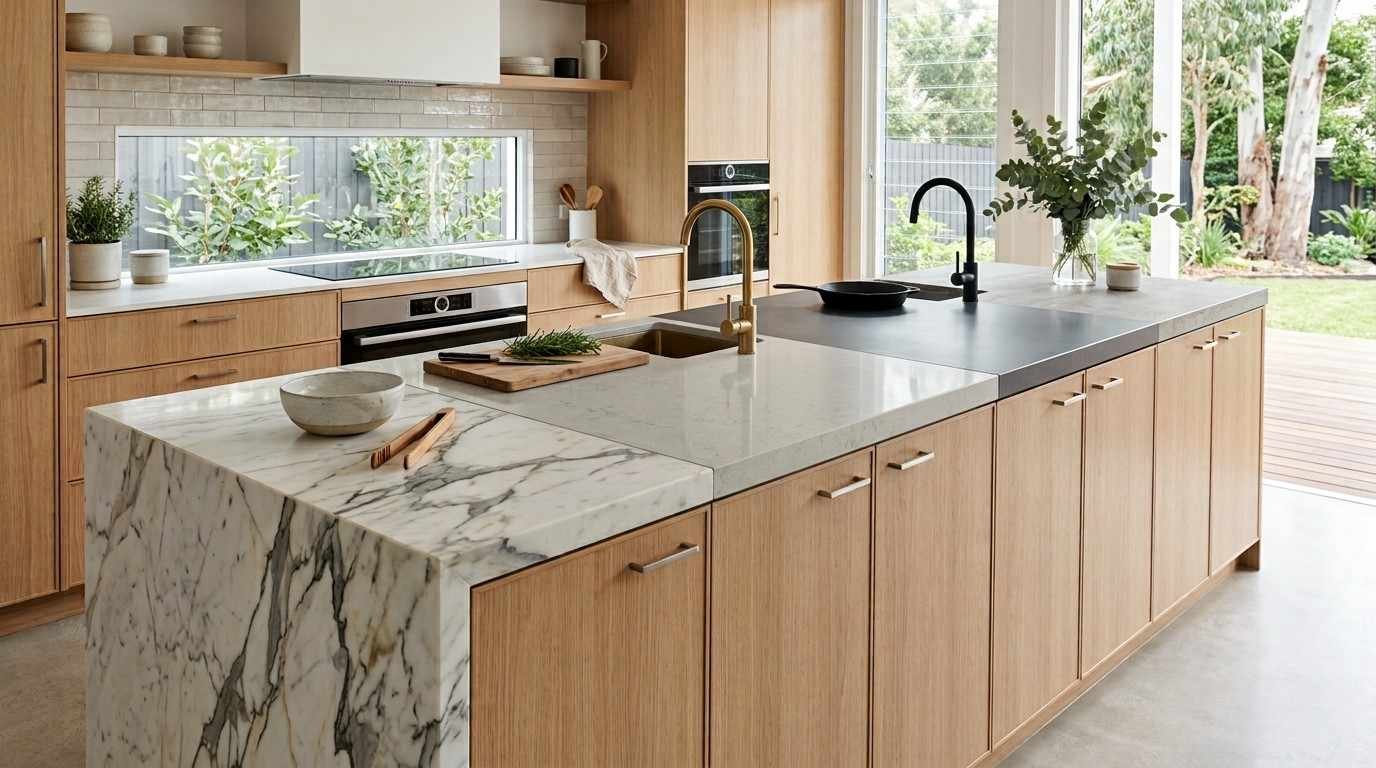
How to Choose the Right Engineered Stone for Your Renovation
The brand decision and the budget decision are connected, but they are not the same decision. Getting both right requires thinking about how the space will be used, who will use it, and what return you need from the renovation spend.
Matching Stone Grade to Your Budget and Lifestyle
For owner-occupied homes particularly kitchens and main bathrooms I recommend mid-range to premium grades. These spaces take daily punishment, and the surface quality difference between entry-level and mid-range is noticeable within two to three years of use.
For investment properties, entry-level to mid-range is the rational bracket. Tenants need a durable, hygienic surface not a premium finish. Essastone or entry-level Quantum Quartz delivers that without overcapitalising on a surface that will be replaced in a future renovation cycle.
The 30mm slab thickness is worth the upgrade in kitchens where the benchtop is a visual centrepiece. In bathrooms and laundries, 20mm performs identically and costs less.
What to Ask Your Supplier Before You Commit
Ask for the warranty terms in writing specifically what voids the warranty and whether it covers fabrication defects or material defects only. Ask about lead times from order to delivery, particularly for imported brands where supply chain delays are a real risk.
Request physical samples rather than relying on showroom displays under artificial lighting. The colour and finish of engineered stone reads differently under natural light, and the sample you take home is the most accurate preview of the installed result.
Ask your supplier to recommend a fabricator they work with regularly. The quality of the fabrication the precision of the cuts, the finish of the edge profiles, the accuracy of the templating affects the final result as much as the material itself.
Frequently Asked Questions
Is engineered stone banned in Australia?
Engineered stone containing crystalline silica above 1% was banned for benchtop fabrication in Australia from 1 July 2024, following Safe Work Australia’s determination that silica dust from cutting and grinding posed an unacceptable health risk to workers. Products manufactured to comply with the new standards using alternative binders and lower silica content remain legal and available. Always confirm with your supplier that the product you are purchasing meets current compliance requirements.
How long do engineered stone benchtops last?
A well-installed engineered stone benchtop in a residential setting lasts 15–25 years with standard care. The surface does not require sealing, and routine cleaning with a damp cloth and mild detergent is sufficient. Avoid prolonged exposure to strong chemicals, and use trivets under hot pots engineered stone handles brief heat contact but is not rated for sustained direct heat from cookware.
Can engineered stone be repaired if it chips or cracks?
Minor chips on edges can be repaired by an experienced stonemason using colour-matched epoxy filler. The repair is rarely invisible on close inspection but is functional and prevents further damage. Cracks through the body of the slab are more serious and typically require section replacement rather than repair. This is why installation quality matters a poorly supported slab is far more likely to crack under load.
What thickness should I choose 20mm or 30mm?
For most bathroom vanities and laundry benchtops, 20mm is sufficient and the cost saving is meaningful. For kitchen benchtops particularly islands and peninsulas where the edge profile is a visible design feature 30mm delivers a more substantial look and feel. The structural performance difference between the two thicknesses is minimal in standard residential applications.
Does engineered stone add value to a property?
Engineered stone benchtops are a recognised value-adding upgrade in Australian residential property. Real estate agents consistently identify kitchen and bathroom quality as primary drivers of buyer perception and sale price. The return on investment is strongest in owner-occupied renovations where the upgrade is visible at point of sale. For investment properties, the value case is more about tenant appeal and rental yield than capital gain.
How do I get an accurate quote for my renovation?
The most accurate quotes come from a supply-and-install contractor who templates your space in person before pricing. Avoid accepting quotes based on approximate measurements alone the difference between an estimated and a templated measurement can shift the final cost by 10–20%. Get at least two quotes, ensure both include fabrication, installation, cutouts, and edge profiles, and confirm the brand and grade of material being quoted.
What is the difference between quartz and engineered stone?
The terms are used interchangeably in the Australian market. Engineered stone benchtops are made primarily from crushed quartz so “quartz benchtop” and “engineered stone benchtop” refer to the same product category. The distinction only matters when comparing engineered stone to natural quartzite, which is a genuine quarried stone and a different product entirely.
Conclusion
Engineered stone benchtops deliver a durable, low-maintenance surface across a wide price range, with enough brand and grade options to suit both premium owner-occupied renovations and budget-conscious investment properties. The brand you choose, the slab thickness, and the complexity of your layout are the three variables that move the cost needle most.
Getting the material decision right at the planning stage prevents the expensive corrections that come from choosing on price alone. The hidden costs cutouts, edge profiles, waterfall ends are predictable when you know to ask for them upfront.
At Sydney Home Renovation, we help homeowners and investors navigate these decisions with transparent pricing and honest guidance from the first conversation. Reach out to our team to discuss your benchtop scope and get a detailed, templated quote for your renovation.


