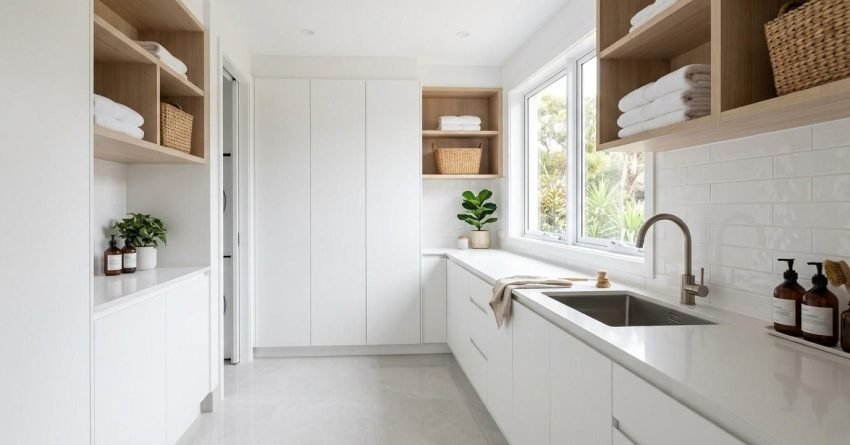
Laundry room storage ideas specifically cabinets and shelves are the single biggest factor in whether a laundry room works hard for your home or quietly frustrates you every single day. A well-planned storage system transforms a cramped, cluttered utility space into a room that handles washing, drying, sorting, and cleaning products with genuine efficiency. For Sydney homeowners, renovators, and property investors, getting this right from the start saves money, time, and a second renovation.
Poor laundry storage costs more than inconvenience it drives clutter, reduces property appeal, and forces expensive retrofits that a smarter initial plan would have avoided entirely.
This guide covers cabinet types, shelving systems, materials, small-space strategies, specific storage needs, styling, installation planning, and realistic budgeting for Sydney homes.
Why Laundry Room Storage Matters More Than Most Homeowners Realise
Most homeowners underestimate the laundry room. It gets the leftover budget, the leftover floor plan, and the leftover attention. That’s a mistake we see play out repeatedly on renovation projects across Sydney.
The laundry room is one of the highest-traffic utility spaces in any home. It handles washing, drying, ironing, cleaning product storage, linen management, and often doubles as a mudroom or pet-washing station. When storage is inadequate, every one of those functions creates friction.
The Hidden Cost of a Poorly Organised Laundry
A laundry room without proper cabinet and shelf storage doesn’t just look messy it actively costs you. Cleaning products stored on the floor create safety hazards, particularly in homes with children. Unsorted laundry piles on benches reduce usable workspace. Detergent bottles balanced on the edge of the machine get knocked over, spill, and damage flooring.
We’ve seen homeowners spend more on a second round of joinery installation than they would have spent getting it right the first time. The hidden cost of poor laundry storage is a renovation you didn’t plan for.
How Storage Shapes the Functionality of the Whole Room
The cabinet and shelf layout you choose determines the workflow of the entire room. Where you position wall-mounted cabinets affects how easily you can reach detergent mid-cycle. Whether you include a sorting station with integrated hamper storage determines whether clothes end up sorted or piled. The depth of your bench and the shelving above it dictates whether ironing is comfortable or awkward.
Storage isn’t decoration in a laundry room. It’s infrastructure.
Types of Laundry Room Cabinets: What Works and Where
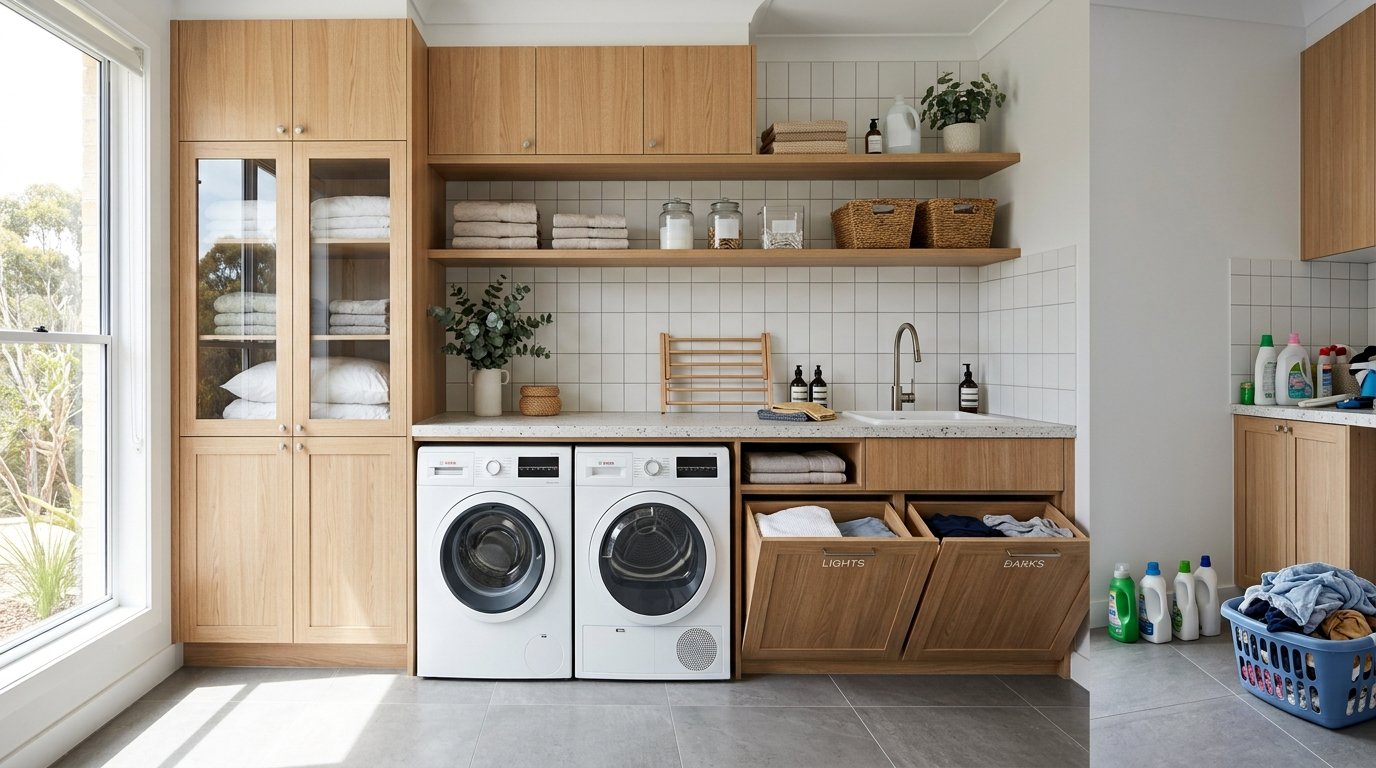
Cabinets are the backbone of any serious laundry storage system. The right cabinet type depends on your room’s dimensions, your appliance configuration, and how you actually use the space day to day. We work with four primary cabinet categories on most Sydney laundry renovations.
Wall-Mounted Cabinets
Wall-mounted cabinets are the most common laundry storage solution in Australian homes, and for good reason. They sit above the bench or appliances, keep the floor clear, and deliver enclosed storage without consuming any footprint. In a compact Sydney laundry which is often 2 to 3 square metres keeping the floor clear is non-negotiable.
Standard wall cabinet depths run between 300mm and 350mm, which is shallow enough to clear most front-loader doors when open. Height matters too: cabinets installed too low create head-clearance issues at the bench; too high and the top shelf becomes inaccessible without a step.
We typically recommend wall-mounted cabinets with soft-close hinges and full-overlay doors for a clean, modern finish that’s also practical in a humid environment.
Base Cabinets and Under-Bench Storage
Base cabinets sit at floor level and support the bench surface above them. In a laundry room, they’re most useful beside or between appliances particularly in a side-by-side washer and dryer configuration where there’s often a gap column that would otherwise be wasted.
Under-bench storage works well for bulkier items: laundry baskets, mop buckets, spare cleaning products, and utility items that don’t need to be at eye level. Pull-out drawers inside base cabinets are more functional than fixed shelves here they give you full access to the back of the cabinet without having to crouch and reach.
Tall Pantry-Style Cabinets and Broom Cupboards
Tall cabinets floor-to-ceiling or near-ceiling height are one of the most efficient storage formats available in a laundry room. A single 600mm-wide tall cabinet can hold a broom, mop, ironing board, vacuum cleaner, and multiple shelves of cleaning products simultaneously.
In Sydney homes where the laundry doubles as a utility room, a tall broom cupboard is often the single highest-value cabinet addition we recommend. It consolidates what would otherwise be scattered across multiple locations into one organised, enclosed space.
Recessed and Built-In Cabinet Options
Recessed cabinets are built into the wall cavity rather than projecting from it. They’re particularly useful in very narrow laundry rooms where every centimetre of clearance matters. A recessed cabinet above the bench can provide 100–150mm of depth without reducing the walkway.
Built-in joinery custom-designed and installed as part of the room’s structure gives the highest level of integration and finish. It’s the right choice when you want the laundry to look and function like a considered part of the home rather than an afterthought.
Shelving Solutions for Laundry Rooms: Open vs. Closed Storage
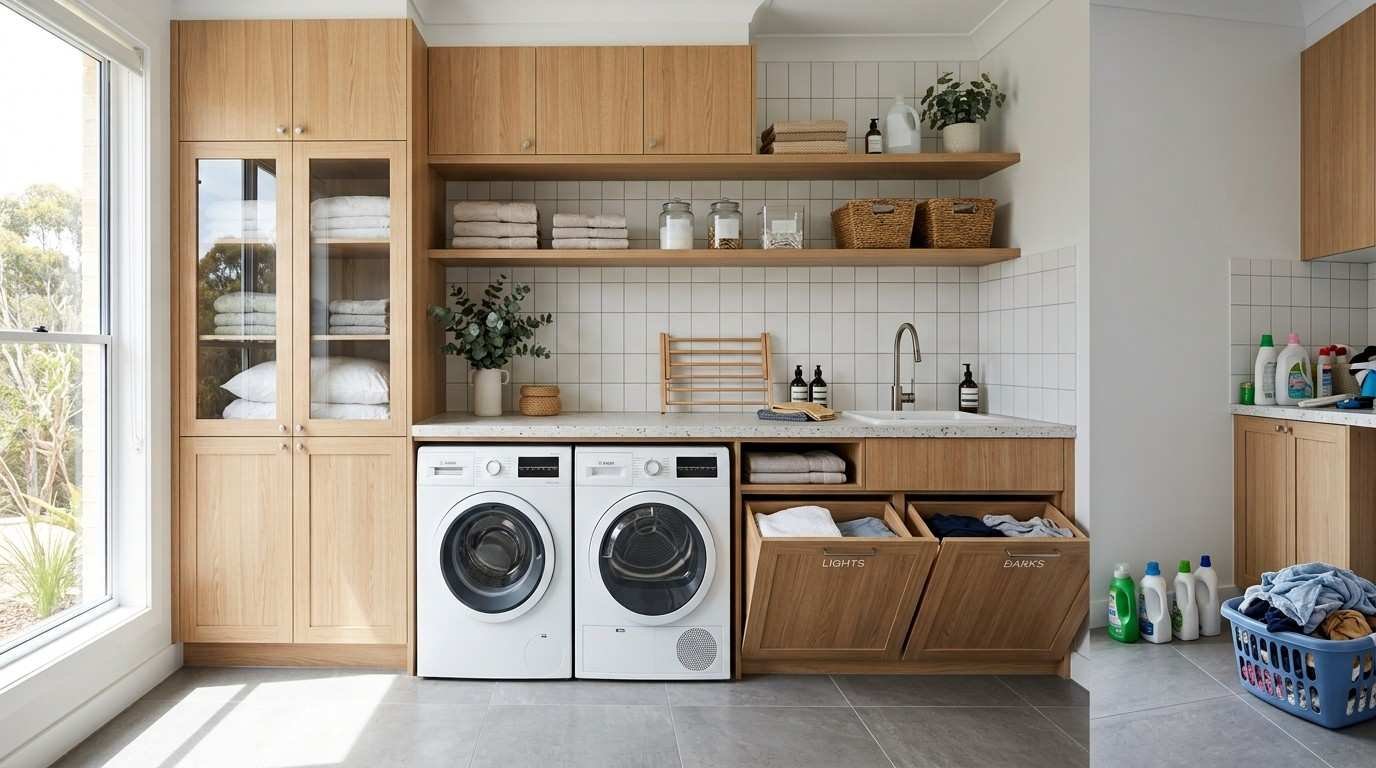
Shelving gives you faster access than cabinets and costs less to install. The trade-off is dust accumulation, visual clutter if items aren’t well-organised, and exposure to the humidity that laundry rooms generate. Understanding where each shelving type performs best is the key to getting the balance right.
Floating Shelves and Wall-Mounted Shelving Units
Floating shelves are the most popular open shelving choice in contemporary Sydney laundry renovations. They’re clean, minimal, and easy to install at custom heights. A single floating shelf above the bench positioned to clear the wall cabinet doors gives you an accessible landing zone for items you use every wash cycle.
The limitation is load capacity. Standard floating shelf brackets handle everyday laundry items comfortably, but they’re not the right choice for heavy detergent bulk-buy storage or stacked linen. For heavier loads, wall-mounted shelving units with visible brackets or a full rail system are more appropriate.
Wire Shelving and Ventilated Shelf Systems
Wire shelving is the practical workhorse of laundry storage. It’s moisture-resistant, allows air circulation (which matters in a room that generates steam), and is easy to clean. Wire systems are particularly well-suited to linen storage, where airflow helps prevent mustiness.
The visual aesthetic is utilitarian rather than refined, which makes wire shelving a better fit for enclosed laundry cupboards, garage laundries, or investment properties where function outweighs finish. For owner-occupied homes where the laundry is visible or styled, wire shelving is usually reserved for inside cabinets rather than open display.
Adjustable Shelving for Flexible Storage Needs
Adjustable shelving systems using a rail-and-bracket or pin-and-shelf mechanism let you reconfigure shelf heights as your storage needs change. This is particularly valuable in a laundry room that serves multiple functions or in a family home where storage requirements shift over time.
We recommend adjustable systems inside tall cabinets and base cabinets as a standard specification. The cost difference over fixed shelving is minimal, and the flexibility pays off consistently over the life of the renovation.
When Open Shelving Works and When It Doesn’t
Open shelving works well in laundry rooms when the items stored are visually consistent (matching baskets, folded linen, uniform containers) and when the room has good ventilation. It creates an accessible, airy feel and suits contemporary and Hamptons-style laundry designs that are popular across Sydney’s inner suburbs.
It doesn’t work well when the room stores a mix of cleaning chemicals, random utility items, and bulk supplies. Open shelving in that context creates visual noise that makes the room feel chaotic rather than organised. In those situations, closed cabinet storage is the right call even if it costs more upfront.
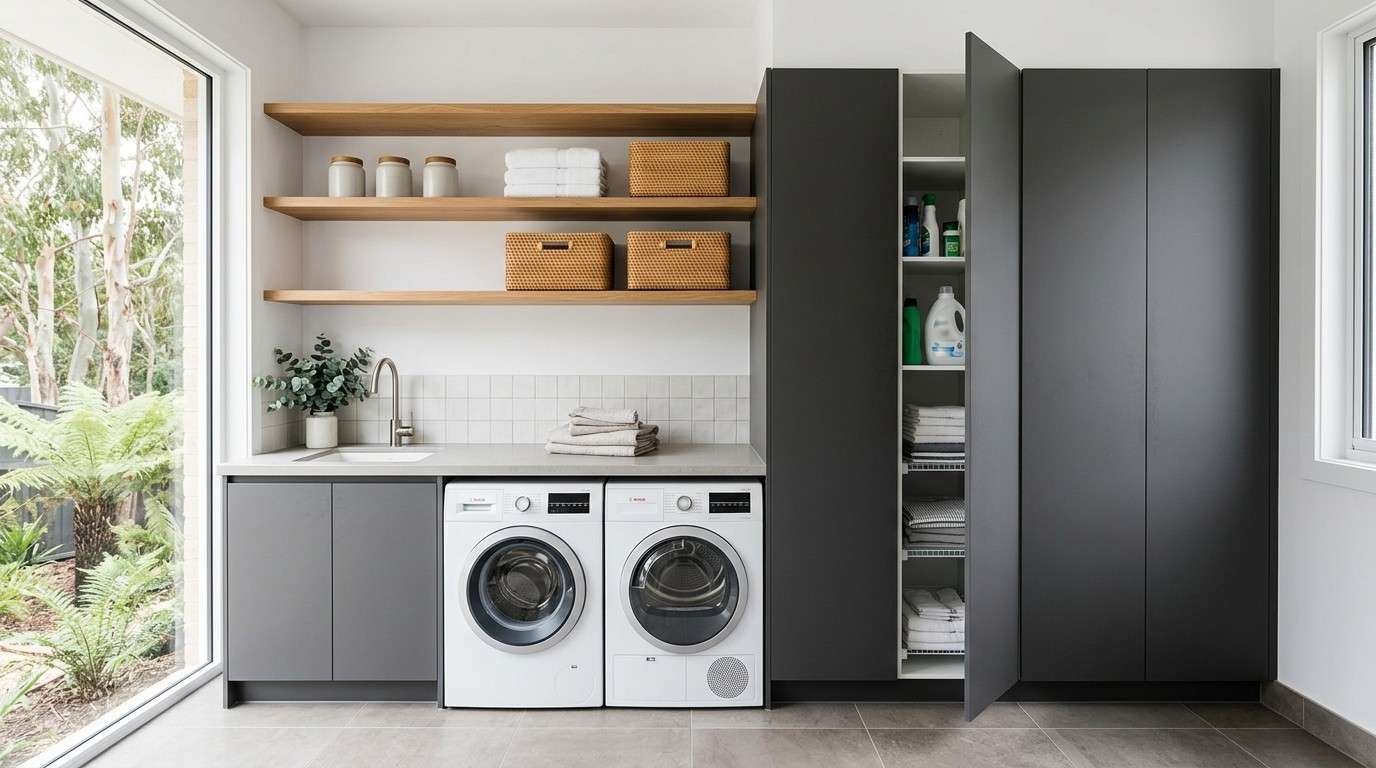
Choosing the Right Materials for Laundry Cabinets and Shelves
Material selection is where laundry storage projects succeed or fail over the long term. The laundry room is a humid, high-moisture environment. Materials that perform well in a kitchen or bedroom will deteriorate faster here if they’re not specified correctly.
Moisture-Resistant Board and Laminate Options
Moisture-resistant (MR) board sometimes called MDF MR or particleboard MR is the standard substrate for laundry cabinetry in Australian renovations. It’s dimensionally stable in humid conditions, takes laminate finishes well, and is significantly more resistant to swelling and delamination than standard MDF or particleboard.
Laminate finishes over MR board give you a wide range of colour and texture options while providing a sealed, easy-clean surface. Polyurethane (PU) doors are another popular option they offer a smooth, seamless finish and handle moisture well when properly sealed at the edges.
Solid Timber vs. Engineered Wood in Humid Environments
Solid timber looks beautiful in a laundry room, but it requires careful consideration. Timber moves with humidity it expands and contracts seasonally, which can cause doors to bind, gaps to open, and finishes to crack over time if the timber isn’t properly sealed and the room isn’t well-ventilated.
Engineered wood products including plywood and LVL are more dimensionally stable than solid timber and perform better in humid environments. Plywood in particular is a strong choice for laundry shelving and cabinet carcasses: it’s structurally robust, holds screws well, and handles moisture better than particleboard.
For Sydney homes, we generally specify MR board carcasses with PU or laminate doors as the standard, and reserve solid timber for feature elements where the aesthetic justifies the additional maintenance consideration.
Metal, PVC, and Wire: Durable Alternatives Worth Considering
For laundry shelving specifically, metal, PVC, and wire systems offer durability advantages that timber-based products can’t match in high-moisture conditions. Powder-coated steel shelving is strong, moisture-resistant, and long-lasting. PVC shelving is completely waterproof and easy to clean it’s a practical choice for laundry rooms that double as wet areas or outdoor laundries.
Wire systems, as covered in the shelving section, offer ventilation benefits alongside moisture resistance. The right material choice depends on the finish level you’re targeting and the specific conditions of your laundry room.
Maximising Small Laundry Room Storage: Layouts and Space-Saving Ideas
The majority of Sydney laundry rooms are compact often 2 to 4 square metres in apartments, townhouses, and older detached homes. In these spaces, every design decision either adds or subtracts usable storage. Getting the layout right is the difference between a laundry that works and one that frustrates.
Vertical Storage Strategies for Compact Laundries
In a small laundry room, the floor plan is fixed. The ceiling height is not. Vertical storage stacking cabinets from bench height to ceiling is the single most effective way to multiply storage capacity without expanding the room’s footprint.
A floor-to-ceiling cabinet run on a single wall can deliver more storage than a poorly planned room twice the size. We design vertical storage systems that keep the most frequently accessed items at eye level and bench height, with less-used items bulk supplies, seasonal items, spare linen stored in the upper cabinets.
Over-Washer and Over-Dryer Shelving and Cabinet Configurations
The space above front-loader appliances is one of the most underutilised areas in Australian laundry rooms. A shelf or cabinet positioned directly above the washer and dryer at a height that clears the lid or door when open creates immediate, accessible storage for detergent, fabric softener, and laundry accessories.
In a stacked washer-dryer configuration, the space beside the appliances becomes the priority. A tall cabinet column beside a stacked unit is one of the most space-efficient storage configurations available in a compact laundry.
Corner Storage Solutions and Awkward Space Fixes
Corners are consistently wasted in laundry rooms. A corner shelf unit, a diagonal cabinet, or a simple L-shaped shelf run can reclaim corner space that would otherwise be dead. In rooms with awkward angles common in older Sydney homes with irregular floor plans custom joinery is often the only way to make the space work properly.
We also see a lot of wasted space above doors and beside windows. A shallow cabinet above the door frame, or a narrow shelf run beside a window, can add meaningful storage without affecting the room’s usability or light.
Sliding Doors, Bi-Folds, and Space-Saving Cabinet Door Options
Standard hinged cabinet doors need clearance space to open. In a narrow laundry room, that clearance can be the difference between a comfortable working space and one where you’re constantly moving around open doors.
Sliding doors eliminate the swing clearance requirement entirely. Bi-fold doors halve it. Both are practical alternatives to standard hinged doors in compact laundry rooms, and both are available in the same laminate and PU finishes as standard cabinet doors. The hardware cost is slightly higher, but the functional gain in a tight space is significant.
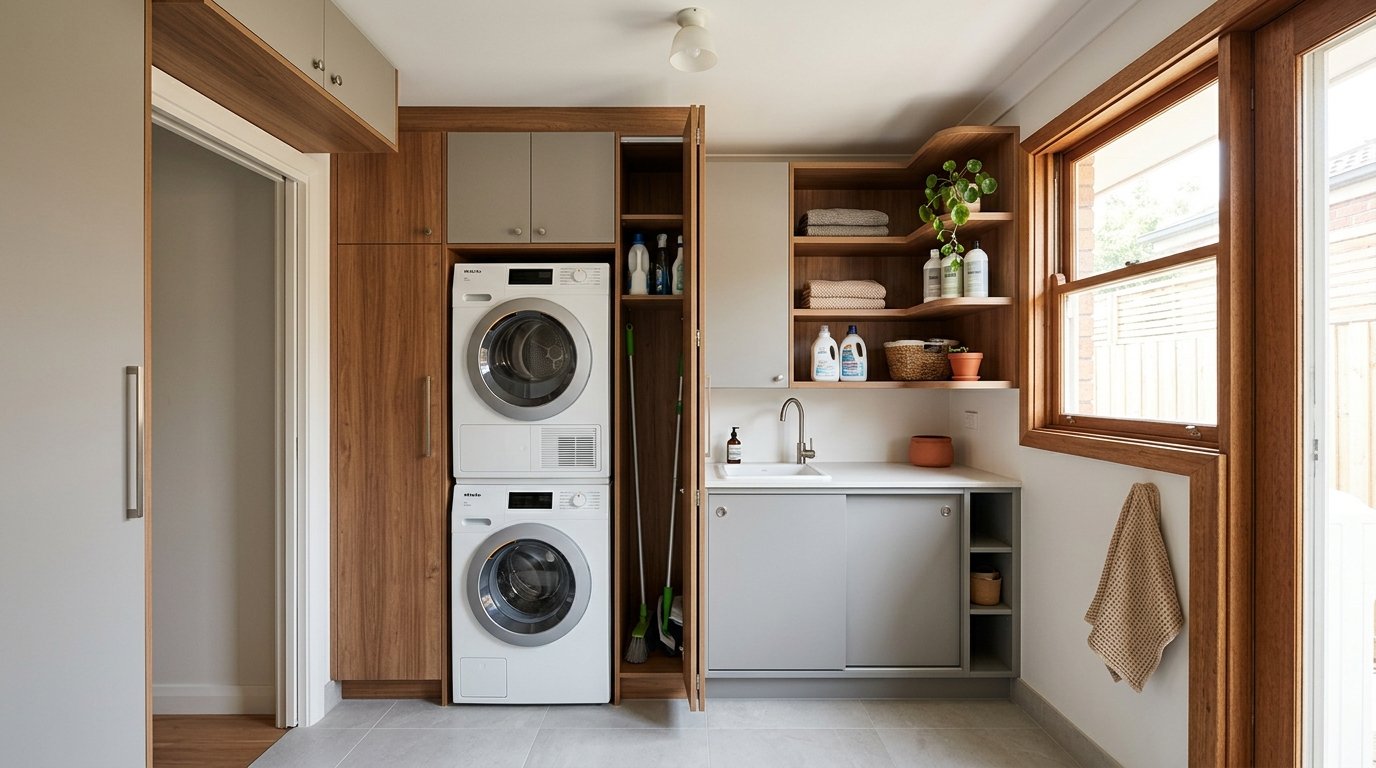
Laundry Room Storage for Specific Needs: Sorting, Cleaning, and More
A laundry room stores more than just detergent and clean clothes. Thinking through the specific storage needs of your household sorting, cleaning products, linen, and utility items before you finalise the cabinet and shelf layout prevents the frustrating gaps that appear after installation.
Laundry Sorting and Hamper Storage Integration
Sorting laundry before it goes into the machine saves time and protects fabrics. But sorting only happens consistently when the infrastructure makes it easy. Integrated hamper storage pull-out laundry baskets built into a base cabinet, or a dedicated sorting station with labelled compartments makes sorting a natural part of the laundry workflow rather than an extra step.
We typically specify two to three pull-out hamper baskets in a base cabinet beside the washer: one for lights, one for darks, and one for delicates or hand-wash items. It’s a simple addition that significantly improves how the room functions day to day.
Cleaning Product Storage: Safety, Access, and Organisation
Cleaning products present a specific storage challenge: they need to be accessible for adults, safely out of reach for children, and stored in a way that prevents spills and chemical interactions. A dedicated cleaning product cabinet ideally with a child-safety lock and a waterproof interior addresses all three requirements.
We recommend positioning cleaning product storage at a height that’s comfortable for adults to access without bending, but above the reach of young children. A tall cabinet with adjustable shelves works well here: the lower shelves hold frequently used products, and the upper shelves store bulk supplies and less-used items.
Linen, Towel, and Utility Storage in the Laundry Room
Many Sydney homes particularly apartments and townhouses don’t have a dedicated linen cupboard. The laundry room becomes the default linen storage location, which means the cabinet and shelf system needs to accommodate folded towels, bed linen, and spare bathroom supplies alongside the laundry function.
Dedicated linen shelving wide, adjustable, and positioned at a comfortable height keeps linen organised and accessible. Wire shelving is a good choice here for the airflow benefit. In homes where the laundry also stores utility items like toolboxes, spare parts, or cleaning equipment, a tall broom cupboard with adjustable shelving handles the overflow without cluttering the main storage system.
Styling Your Laundry Storage: Aesthetics Without Sacrificing Function
The laundry room used to be purely functional. That’s changed. Sydney homeowners increasingly treat the laundry as a designed space one that reflects the same aesthetic standards as the kitchen or bathroom. Good storage design is the foundation of a laundry room that looks as good as it works.
Colour, Finish, and Hardware Choices That Elevate the Space
Cabinet colour and finish set the tone for the entire room. White and off-white remain the most popular choices in Sydney laundry renovations they’re clean, bright, and make small spaces feel larger. Matte finishes are increasingly preferred over gloss for their contemporary look and their ability to hide fingerprints and water marks.
Hardware handles, knobs, and hinges is a small detail with a disproportionate visual impact. Brushed nickel, matte black, and brushed brass are the finishes we see most often in contemporary Sydney laundry designs. Matching hardware across cabinets and shelving brackets creates a cohesive, considered look that elevates the whole room.
Matching Laundry Storage to the Rest of Your Home’s Design
A laundry room that feels disconnected from the rest of the home is a missed opportunity. When the cabinet style, colour palette, and hardware finish echo the kitchen or bathroom, the laundry feels like a deliberate part of the home’s design rather than an afterthought.
This matters particularly for property investors and vendors preparing for sale. A well-styled laundry room with integrated cabinet and shelf storage consistently contributes to buyer perception of quality and overall property presentation. It’s one of the lower-cost, higher-impact improvements available in a pre-sale renovation.
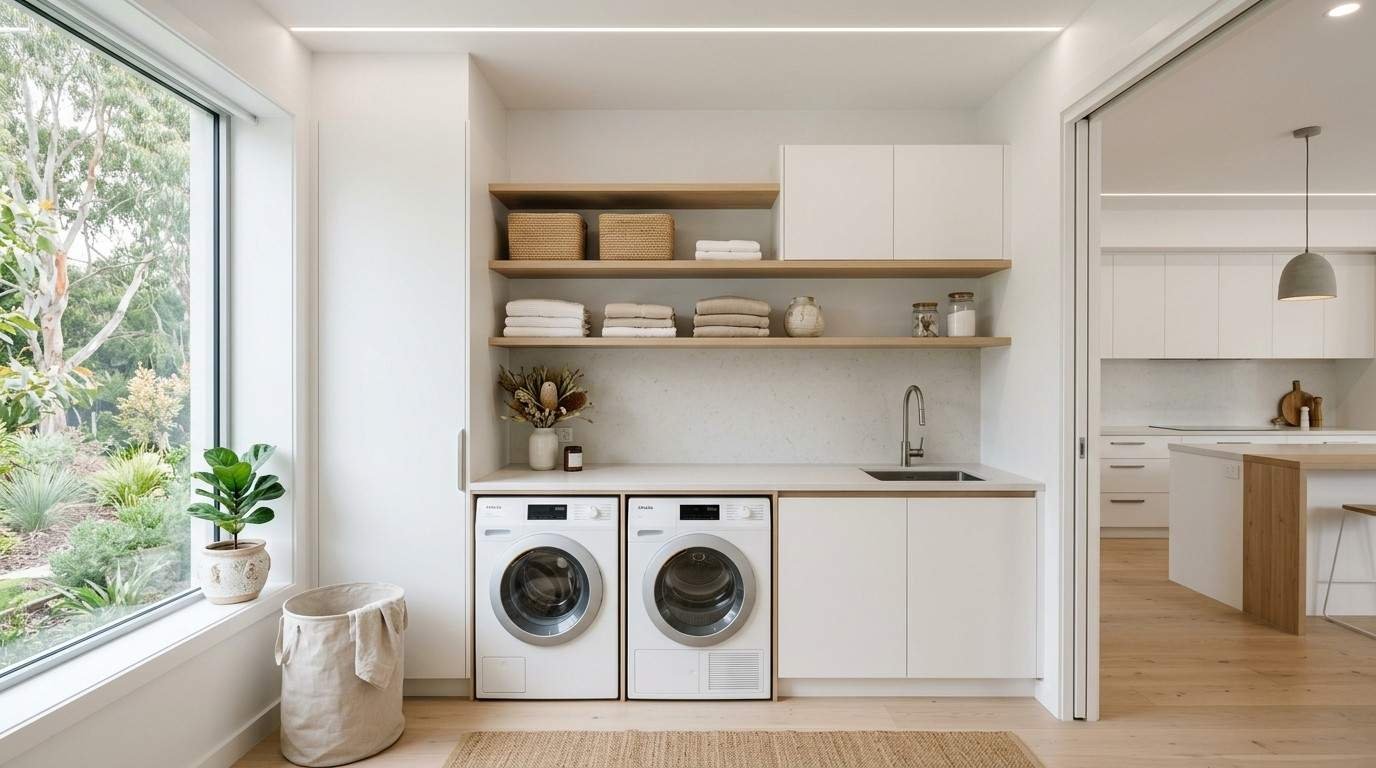
Planning and Installing Laundry Cabinets and Shelves: What to Know First
Good storage outcomes start with good planning. The most common laundry storage mistakes we see cabinets that don’t clear appliance doors, shelves at the wrong height, insufficient depth for the items being stored are all planning failures, not installation failures.
Measuring, Layout Planning, and Avoiding Common Mistakes
Accurate measurement is the foundation of a successful laundry storage installation. Before specifying any cabinet or shelf, you need the room’s full dimensions: floor-to-ceiling height, wall-to-wall width, appliance dimensions and door-swing clearances, plumbing and electrical outlet positions, and window and door locations.
The most common planning mistakes we encounter are: cabinets specified without accounting for appliance door clearance, shelves positioned too close to the ceiling to be usable, and bench heights set without considering the user’s height and the appliance height simultaneously. A measured drawing even a simple hand sketch with accurate dimensions prevents all of these.
DIY vs. Professional Installation: What the Job Actually Involves
Flat-pack laundry cabinets from retailers like IKEA, Bunnings, or Kaboodle are a legitimate DIY option for straightforward installations. They’re cost-effective, widely available, and come with installation instructions that a competent DIYer can follow. The limitation is customisation: flat-pack systems work well in standard configurations but struggle with non-standard room dimensions, awkward corners, and complex layouts.
Custom joinery designed and installed by a professional handles every room configuration and delivers a finish that flat-pack systems can’t match. The cost is higher, but the outcome is a storage system that fits the room precisely, uses every available centimetre, and is built to last. For most Sydney renovation projects where the laundry is a considered part of the home, custom or semi-custom joinery is the right investment.
Budgeting for Laundry Storage: Cost Ranges and What Drives Them
Laundry storage costs in Sydney vary significantly depending on the scope, materials, and whether you’re using flat-pack or custom joinery. As a general orientation:
Flat-pack cabinet installations typically range from $500 to $2,500 for materials, plus installation labour if you’re not doing it yourself. Semi-custom joinery where standard cabinet carcasses are combined with custom panels and finishes sits in the $2,500 to $6,000 range for a full laundry fit-out. Fully custom joinery for a complete laundry storage system in Sydney typically starts at $6,000 and scales with room size, material specification, and complexity.
The primary cost drivers are: cabinet material and finish quality, the number of cabinets and shelves, hardware specification, whether the installation requires any structural work (blocking, wall reinforcement), and the complexity of the layout. Understanding these drivers before you start planning helps you allocate budget where it delivers the most functional and aesthetic value.
Frequently Asked Questions
What type of cabinet is best for a small laundry room?
Wall-mounted cabinets are the best starting point for a small laundry room they keep the floor clear and maximise usable space. Pair them with a tall pantry-style cabinet for bulk and utility storage, and you cover most small-laundry storage needs efficiently.
Are open shelves practical in a laundry room?
Open shelves are practical when the items stored are visually consistent and the room has good ventilation. They work well for folded linen and matching storage baskets. For cleaning products and mixed utility items, closed cabinet storage is more practical and looks cleaner.
What materials are best for laundry room cabinets?
Moisture-resistant (MR) board with laminate or polyurethane (PU) doors is the standard specification for Australian laundry cabinetry. It handles humidity well, is easy to clean, and is available in a wide range of finishes. Avoid standard MDF or particleboard they swell and delaminate in humid conditions.
How much does it cost to add cabinets to a laundry room in Sydney?
Flat-pack cabinet installations in Sydney typically range from $500 to $2,500 for materials. Semi-custom joinery sits between $2,500 and $6,000 for a full fit-out. Fully custom laundry joinery generally starts at $6,000 and scales with room size and specification complexity.
Can I install laundry shelves myself or do I need a professional?
Floating shelves and simple wall-mounted shelving are well within DIY capability for most homeowners. Flat-pack cabinet installation is also manageable with basic tools and patience. Complex layouts, custom joinery, and any work involving plumbing or electrical adjustments require a professional.
How do I maximise storage in a laundry room with no wall space?
Focus on vertical storage floor-to-ceiling cabinet runs use height rather than footprint. Over-appliance shelving and cabinets reclaim the space above the washer and dryer. Corner shelving units recover dead corner space. In very constrained rooms, recessed cabinets built into the wall cavity add depth without reducing clearance.
What is the best way to organise a laundry room with limited storage?
Start by categorising what you store: laundry products, cleaning products, linen, and utility items. Assign each category a dedicated zone within your cabinet and shelf system. Use pull-out hamper baskets for sorting, uniform containers for products, and adjustable shelving so you can reconfigure as needs change.
Conclusion
Laundry room storage cabinets, shelves, materials, layouts, and planning is the infrastructure that determines whether this room works or frustrates. Every decision compounds.
The right storage system integrates sorting, cleaning products, linen, and utility needs into a cohesive, functional layout that serves your household for years. Deeper resources on each subtopic are available across our cluster guides.
We’re here to help you plan and build it properly. Contact Sydney Home Renovation to discuss your laundry storage project with a team that gets the details right.