
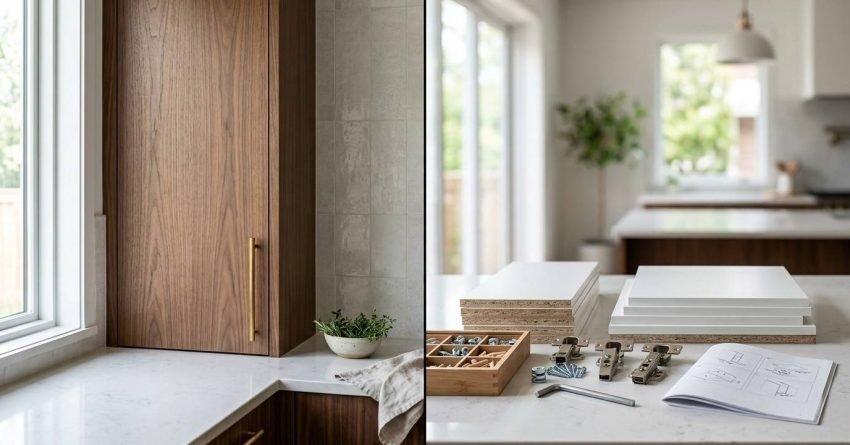
Flat pack cabinets cost roughly 40–60% less than custom cabinetry upfront, but that price gap tells only part of the story. The right choice depends on your budget, your property, and how long you plan to live with the result. I’ve seen both options succeed and both options fail, and the difference almost always comes down to matching the cabinet type to the renovation goal, not chasing the lowest price.
Choosing the wrong cabinet type is one of the most common ways Sydney renovators blow their budget or end up redoing work within a decade. Getting this decision right from the start saves money, time, and frustration.
This guide breaks down costs, quality, durability, and design flexibility for both options so you can make a clear, confident decision before spending a dollar.
What Are Flat Pack Cabinets?
Flat pack cabinets are pre-manufactured cabinet components sold in flat-packed boxes, designed for self-assembly or trade installation on site. The buyer selects from a fixed range of standard sizes, finishes, and configurations, then assembles the units using cam locks, dowels, and pre-drilled holes.
They are also called RTA cabinets, ready-to-assemble, and are widely available through major retailers and specialist flatpack suppliers across Australia.
How Flat Pack Cabinets Are Manufactured and Sold
Flat pack cabinets are produced in large volumes at manufacturing facilities, cut to standard dimensions, and flat-packed for efficient shipping and storage. The components arrive pre-drilled and pre-finished, which keeps production costs low and allows retailers to pass savings directly to the buyer.
In Australia, the dominant suppliers include IKEA, Kaboodle (Bunnings), and Freedom Kitchens. Each operates a showroom-and-order model where buyers select configurations online or in-store, then collect or receive delivery of flat-packed boxes.
Typical Materials, Finishes, and Size Limitations
Most flat pack cabinet carcasses are made from moisture-resistant particleboard or MDF, with a melamine or laminate finish on exposed surfaces. Door and drawer fronts come in a range of colours and textures, from matte white to timber-look laminates, but the selection is fixed to whatever the supplier stocks.
The critical limitation is sizing. Flat pack cabinets come in standard increments, typically 100mm or 150mm steps in width, which means non-standard spaces require filler panels, scribing strips, or creative workarounds. That constraint matters a lot in older Sydney homes where walls are rarely perfectly square.
What Are Custom Cabinets?
Custom cabinets are designed and built to the exact dimensions, materials, and specifications of a specific space by a cabinet maker or joinery workshop. Nothing is pre-made. Every component is cut, finished, and assembled to order based on a detailed design brief and site measurements.
The result is cabinetry that fits the space precisely, floor to ceiling, wall to wall, around every pipe and beam, with no fillers, no gaps, and no compromises on layout.
How Custom Cabinets Are Designed and Built
The process starts with a design consultation and detailed site measure. A cabinet maker or joinery business produces drawings, confirms material selections, and provides a fixed quote before any cutting begins. Lead times in Sydney typically run six to twelve weeks from deposit to installation, depending on complexity and the workshop’s schedule.
Every component is built in the workshop and delivered to site as finished units ready for installation. The cabinet maker handles installation directly, or coordinates with the renovation contractor to ensure a seamless fit.
Materials, Finishes, and Bespoke Sizing Options
Custom cabinetry opens up a significantly wider material palette. Carcasses are commonly built from structural plywood for superior strength and moisture resistance, with solid timber, 2-pac polyurethane, or high-pressure laminate used for doors and drawer fronts. Soft-close hardware, integrated lighting, and pull-out internal fittings are specified at the design stage rather than retrofitted.
Sizing is entirely bespoke. The cabinet maker works to the millimetre, accommodating sloped ceilings, exposed brick, non-standard ceiling heights, and any other site condition that would defeat a flat pack solution.
Flat Pack vs. Custom Cabinets, Cost Comparison
Cost is where the two options diverge most sharply, and where the most confusion exists. The headline price difference is real, but the total installed cost comparison is more nuanced than most buyers expect.
Flat Pack Cabinet Pricing in Sydney
For a standard Sydney kitchen, flat pack cabinets typically cost between $3,000 and $8,000 for supply only, depending on the number of units, the brand, and the finish selected. Add professional installation, which I always recommend over DIY for anything beyond a simple laundry, and the total installed cost lands between $6,000 and $14,000 for a mid-size kitchen.
Bathroom vanity flat pack units run considerably less, typically $400 to $1,500 per unit supplied, with installation adding $300 to $600 per unit depending on plumbing complexity.
Custom Cabinet Pricing in Sydney
Custom cabinetry in Sydney starts at around $12,000 to $15,000 installed for a mid-size kitchen and scales upward based on material selections, internal fittings, and complexity. High-specification kitchens with 2-pac doors, stone benchtops, and integrated appliances regularly reach $25,000 to $45,000 or more.
For bathrooms, a custom-built vanity unit runs $1,800 to $4,500 installed, depending on size, material, and the number of drawers and doors. The premium over flat pack is real, but so is the difference in what you get.
Quality and Durability, Which Lasts Longer?
Durability is the question I get asked most often when homeowners are weighing up these two options. The honest answer is that both can perform well, and both can fail early, depending on construction quality and how the cabinets are used.
Flat Pack Construction Quality and Lifespan
The weak points in flat pack cabinets are the joinery method and the substrate. Cam lock and dowel assembly creates a functional but mechanically weaker joint than a glued and screwed construction. Over time, particularly in high-humidity environments like kitchens and bathrooms, particleboard substrates can swell, delaminate, or lose structural integrity around fixings.
A well-assembled flat pack kitchen from a quality supplier, installed correctly and maintained properly, realistically lasts 10 to 15 years before showing meaningful wear. In a rental property or a budget renovation, that lifespan is often entirely acceptable.
Custom Cabinet Build Quality and Longevity
Custom cabinets built from structural plywood carcasses with quality hardware and proper finishing are a fundamentally different product. Plywood holds fixings far better than particleboard, resists moisture more effectively, and maintains structural integrity under heavy daily use. Dovetail or mortise-and-tenon joinery on drawer boxes adds further longevity.
A well-built custom kitchen in Sydney, maintained normally, lasts 25 to 40 years without structural failure. That lifespan changes the cost equation significantly when you calculate cost per year of use rather than upfront price alone.

Design Flexibility and Fit, Which Works Better for Your Space?
Design flexibility is where the gap between flat pack and custom cabinetry becomes most visible, and most consequential for the finished result.
Where Flat Pack Cabinets Fall Short on Fit
Standard sizing is the defining constraint of flat pack cabinetry. When a wall run measures 2,340mm and the nearest standard cabinet combination reaches 2,200mm, the remaining 140mm requires a filler panel, a visible, often awkward solution that experienced eyes notice immediately.
Corner solutions, overhead cabinets in rooms with non-standard ceiling heights, and runs that need to accommodate existing plumbing or structural elements all present challenges that flat pack systems handle imperfectly. The workarounds exist, but they add cost, compromise the visual result, and require a skilled installer to execute well.
Where Custom Cabinets Deliver a Precision Result
Custom cabinetry eliminates the filler panel problem entirely. Every unit is built to the exact dimension of the space it occupies. Floor-to-ceiling cabinetry sits flush against the ceiling with no gap. Corner units are designed around the actual corner angle, not a standard 90-degree assumption.
In Sydney’s older housing stock, federation homes, inter-war bungalows, 1960s brick veneer, walls are rarely plumb, floors are rarely level, and ceiling heights vary room to room. Custom cabinetry handles all of that at the design stage. Flat pack solutions handle it with compromises.
Which Cabinet Type Is Right for You?
The honest answer is that neither option is universally better. The right choice depends on what you’re renovating, why you’re renovating it, and what outcome you need from the investment.
When Flat Pack Is the Smarter Choice
Flat pack cabinets make strong financial sense for rental property renovations where durability expectations are moderate and budget efficiency is the priority. They also suit short-term ownership scenarios, renovating to sell within three to five years, where the visual result matters more than 30-year longevity.
Budget-conscious owner-occupiers renovating a secondary bathroom or a laundry also get strong value from quality flat pack products. The key is using a reputable supplier, specifying moisture-resistant board, and investing in professional installation rather than attempting DIY on anything structural.
When Custom Cabinets Are Worth the Investment
Custom cabinetry earns its premium in spaces where fit, finish, and longevity genuinely matter. A primary kitchen in a home you plan to live in for ten or more years is the clearest case. The cost-per-year calculation over a 30-year lifespan often makes custom the more economical choice when you account for the cost of replacing flat pack cabinetry once or twice in the same period.
High-end renovations targeting strong resale value also benefit from custom joinery. Buyers in Sydney’s premium suburbs notice the difference between a precision-fitted custom kitchen and a flat pack solution with filler panels, and they price accordingly.
Frequently Asked Questions
Are flat pack cabinets good quality?
Quality flat pack cabinets from reputable suppliers are genuinely functional and visually appealing. The construction method and substrate materials mean they won’t match the longevity of custom-built cabinetry, but for the right application and budget, they deliver solid value.
How much cheaper are flat pack cabinets than custom?
Flat pack cabinets typically cost 40 to 60% less than custom cabinetry on a like-for-like basis. For a mid-size Sydney kitchen, that gap often represents $8,000 to $20,000 in upfront cost, a meaningful difference that narrows when you factor in lifespan and replacement costs.
Can flat pack cabinets be installed professionally?
Yes. Professional installation of flat pack cabinets is common and strongly recommended for kitchens and bathrooms. A skilled installer handles scribing, levelling, and integration with plumbing and electrical services far more reliably than a DIY approach.
Do custom cabinets add value to a home?
Custom cabinetry adds measurable value in mid-to-high-end Sydney properties. A well-specified custom kitchen is a genuine selling point that buyers in competitive suburbs actively seek out and pay a premium for.
How long do flat pack cabinets last?
A well-installed flat pack kitchen from a quality supplier lasts 10 to 15 years under normal use. Moisture exposure, heavy daily use, and lower-quality substrates can shorten that lifespan. Custom cabinetry built from structural plywood typically lasts 25 to 40 years.
What is the lead time for custom cabinets in Sydney?
Most Sydney cabinet makers and joinery workshops quote lead times of six to twelve weeks from deposit to installation. Complex projects or busy periods can extend that to sixteen weeks. Flat pack cabinets are available immediately from stock.
Can I mix flat pack and custom cabinets in one renovation?
Yes, and it’s a strategy we use regularly on renovations where budget is a constraint. A common approach is specifying custom cabinetry for the primary kitchen, where fit and longevity matter most, and using quality flat pack for laundry, butler’s pantry, or secondary bathroom cabinetry where the visual and durability requirements are lower.
Conclusion
Flat pack and custom cabinets both have a legitimate place in Sydney renovations. The decision comes down to budget, property type, and how long the result needs to perform.
For rental properties, budget renovations, and short-term ownership, flat pack delivers strong value when specified and installed correctly. For primary kitchens, high-end renovations, and homes you plan to live in for a decade or more, custom cabinetry earns its premium through longevity, precision fit, and resale impact.
At Sydney Home Renovation, we help homeowners and investors make this call with clear, honest guidance, then deliver the result on budget and on schedule. Reach out to discuss your renovation and get a transparent quote.


