
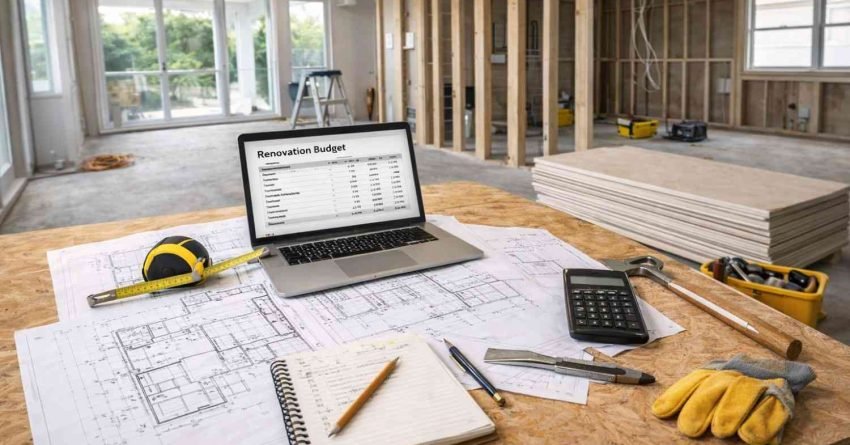
A whole home renovation in Sydney typically costs between $150,000 and $450,000 or more, depending on your property size, scope of work, and finish quality. Without a clear plan, those costs spiral fast.
Whether you are a first-time renovator tackling an older property, a homeowner upgrading for your family, or an investor preparing for the rental or resale market, understanding where your money goes is the most important step you take before demolition begins. This guide breaks down every major cost category from labour and materials to hidden expenses and council approvals so you walk away with the knowledge to set a realistic budget, sequence your renovation intelligently, and avoid the surprises that derail Sydney projects every week.
What Is Whole Home Renovation Planning?
Whole home renovation planning is the process of scoping, budgeting, designing, and scheduling a renovation that covers your entire property rather than a single room. It involves coordinating multiple trades, managing overlapping timelines, and making hundreds of material and design decisions within a unified budget framework.
This is not simply doing a kitchen and a bathroom at the same time. A whole home renovation treats your property as a single interconnected project. Electrical upgrades in the kitchen affect wiring in the hallway. Plumbing changes in the bathroom require access through bedroom walls. Flooring choices in living areas need to transition seamlessly into wet areas. Every decision has a downstream effect, and planning for those connections is what separates a successful renovation from a costly, fragmented mess.
How Whole Home Renovation Differs from Room-by-Room Upgrades
Renovating room by room feels safer. You contain the disruption, spread the cost over months or years, and only commit to one project at a time. But that approach carries hidden inefficiencies most homeowners do not account for until it is too late.
When you renovate your entire home as a single project, you benefit from economies of scale. Trades are already on site, scaffolding is already erected, and skips are already hired. You negotiate one contract instead of five and avoid the compounding cost of re-mobilising tradespeople for separate jobs, which in Sydney adds thousands of dollars per trade per visit.
Room-by-room renovations also create design inconsistency. Tiles chosen three years ago may be discontinued. Paint colours shift between batches. Flooring transitions become awkward. A whole home approach gives you a cohesive design language and a single point of accountability.

Why Sydney Homeowners Choose Full Home Renovations
Sydney’s property market creates unique conditions that make whole home renovations particularly common. Older housing stock dominates many desirable suburbs; homes in the Inner West, Northern Beaches, Eastern Suburbs, and Sutherland Shire often date from the 1920s through the 1970s. These properties frequently need simultaneous upgrades to plumbing, electrical wiring, insulation, and structural elements that make isolated room renovations impractical.
The cost of buying and selling in Sydney is also a powerful motivator. Stamp duty, agent commissions, and legal fees on a property transaction easily exceed $80,000 to $150,000. For many families, renovating their current home delivers better value than purchasing a new one, especially when the renovation is planned holistically to maximise both liveability and property value.
When to Renovate vs. Knock Down and Rebuild
A knockdown-rebuild makes sense when the existing structure has significant foundation problems, severe termite damage, or a layout so poor that renovation cannot fix it. In most other cases, renovation delivers better value. Demolition and rebuild in Sydney typically costs $350,000 to $600,000+ for a standard house before any finishes, making renovation the financially superior choice for the majority of Sydney homeowners working with structurally sound properties.
How to Set a Realistic Whole Home Renovation Budget
Setting a realistic budget is the foundation of every successful renovation. The most common mistake is starting with a wish list and trying to reverse-engineer a number. The correct approach is the opposite: start with what you can genuinely afford, then allocate that budget strategically across the areas that matter most.
Average Whole Home Renovation Costs in Sydney (2025)
Renovation costs in Sydney vary enormously based on property size, condition, location, and finish level. The following ranges reflect typical all-inclusive costs for a complete renovation of an existing residential property in 2025.
| Property Type | Budget Renovation | Mid-Range Renovation | High-End Renovation |
| 2-bedroom unit/apartment | $80,000 – $130,000 | $130,000 – $200,000 | $200,000 – $350,000+ |
| 3-bedroom house | $120,000 – $200,000 | $200,000 – $350,000 | $350,000 – $550,000+ |
| 4-bedroom house | $180,000 – $280,000 | $280,000 – $450,000 | $450,000 – $750,000+ |
| Large family home (5+ bed) | $250,000 – $400,000 | $400,000 – $600,000 | $600,000 – $1,000,000+ |
These figures include demolition, structural work, all trades, materials, fittings, project management, and basic landscaping. They do not include furniture, soft furnishings, or major structural additions such as second-storey extensions.
What Does Renovation Cost Per Square Metre in Sydney?
As a working benchmark, budget renovations in Sydney run at approximately $1,200 to $1,800 per m² of gross floor area. Mid-range renovations sit at $1,800 to $2,800 per m², and premium renovations reach $2,800 to $4,500+ per m². These figures are useful for early feasibility checks but are not a substitute for a detailed trade-by-trade quote, since wet areas cost significantly more per m² than dry areas.
Cost Breakdown by Room: Bathroom, Kitchen, Living Areas, Bedrooms
Wet areas bathrooms, kitchens, laundries are significantly more expensive per square metre than dry areas because they require waterproofing, specialised plumbing, tiling, and compliance with Australian Standards.
| Room | Typical Cost Range (Sydney 2025) | Key Cost Drivers |
| Bathroom (standard) | $25,000 – $50,000 | Waterproofing, tiling, plumbing, fittings |
| Bathroom (premium/master ensuite) | $45,000 – $80,000+ | Custom tiling, premium fixtures, heated floors |
| Kitchen | $30,000 – $70,000+ | Cabinetry, benchtops, appliances, plumbing, electrical |
| Laundry | $10,000 – $25,000 | Plumbing, cabinetry, tiling, ventilation |
| Living/dining areas | $15,000 – $40,000 | Flooring, painting, lighting, plastering |
| Bedrooms (each) | $8,000 – $20,000 | Flooring, built-in wardrobes, painting, electrical |
| Hallways and common areas | $5,000 – $15,000 | Flooring, painting, lighting |
| Outdoor/landscaping (basic) | $10,000 – $40,000 | Decking, paving, fencing, drainage |
When you add these individual room costs together, they align with the whole home ranges above. A whole home renovation is the sum of its parts, but the total is often slightly less than renovating each room independently because of shared trade mobilisation and bulk material purchasing.
How to Prioritise Spending Across Multiple Rooms
With a fixed budget and multiple rooms to renovate, prioritisation is critical. We invest most heavily in the rooms that deliver the greatest return on investment and the highest daily impact on quality of life.
Bathrooms and kitchens come first. These rooms carry the highest cost per square metre but also the highest impact on property value and daily liveability. A dated bathroom or kitchen drags down the perceived value of the entire home.
Structural and compliance work comes second. Electrical rewiring, plumbing upgrades, roof repairs, and asbestos removal are non-negotiable. Skipping these to fund a nicer benchtop is a false economy that costs more later.
Living areas and bedrooms come third. These rooms are less expensive to renovate and are often refreshed with new flooring, paint, and lighting without major structural work. Cosmetic and outdoor work is funded from whatever budget remains after the high-priority items are secured.
How to Finance a Whole Home Renovation in Sydney
Financing is the gap most renovation guides skip entirely, but it is one of the first decisions you need to make. We see three primary funding paths for Sydney homeowners.
Home equity/redraw: If you have built equity in your property, accessing it through a redraw facility or a home equity loan is typically the lowest-cost option. Interest rates are lower than personal loans, and the repayment structure is flexible. The risk is that your home secures the debt, so budget discipline is essential.
Construction loan: A construction loan releases funds in stages as work is completed and inspected, rather than as a lump sum. This structure protects you from paying for work before it is done and keeps the contractor accountable to milestones. Construction loans are standard for larger projects and are offered by most major Australian lenders.
Staged renovation with personal savings: For homeowners who cannot access equity or prefer not to borrow, staging the renovation across 12 to 24 months using personal savings is a viable path. The trade-off is higher total cost; you lose the economies of scale that come from a single whole-home project, but it eliminates debt entirely.
Whichever path you choose, confirm your financing before signing any contract. A contractor who starts work before your funding is confirmed creates a situation where you have no leverage if costs escalate.

Understanding Labour Costs for a Full Home Renovation
Labour is the single largest cost category in most whole home renovations, typically accounting for 35% to 45% of the total project budget. In Sydney, where trade rates are among the highest in Australia, understanding how labour is priced and managed is essential to controlling your overall spend.
Trades You Will Need: Plumbers, Electricians, Tilers, Carpenters
A whole home renovation requires coordination across a wide range of licensed and specialist trades. Most projects involve the following.
Licensed trades (legally required for regulated work):
- Plumber (rough-in, fit-off, gas, drainage)
- Electrician (rewiring, switchboard upgrade, lighting, power points)
- Waterproofer (bathrooms, laundry, any wet areas)
Specialist trades:
- Tiler (bathrooms, kitchen splashbacks, laundry)
- Carpenter (framing, doors, windows, built-in joinery)
- Plasterer (wall and ceiling repairs, cornices)
- Painter (interior and exterior)
- Cabinetmaker (kitchen, bathroom vanities, built-in wardrobes)
- Flooring installer (timber, vinyl, carpet)
- Demolition crew (strip-out of existing finishes)
Compliance and inspection:
- Building certifier or private certifier
- Structural engineer (if walls are being removed or modified)
On a typical whole home renovation in Sydney, you have 10 to 15 different trades cycling through the site over the course of the project. Each trade has its own scheduling requirements, lead times, and dependencies on other trades completing their work first.
How Labour Is Priced in Sydney Hourly vs. Fixed-Quote Models
Trades in Sydney price their work using two primary models, and understanding the difference protects you from budget blowouts.
Hourly rates are common for smaller jobs or work where the scope is uncertain. A licensed plumber in Sydney typically charges $90 to $130 per hour. Electricians sit in a similar range. Tilers, carpenters, and painters generally charge $60 to $100 per hour depending on experience and specialisation.
Fixed-quote pricing is standard for larger, well-defined scopes of work. Your contractor provides a lump sum price for the completed work based on plans and specifications. This model transfers the risk of time overruns to the trade, which is why fixed quotes are generally higher than the equivalent hourly rate but they give you budget certainty, which is far more valuable on a whole home renovation where small overruns across multiple trades compound rapidly.
Why Project Coordination Affects Your Labour Budget
The hidden labour cost most homeowners overlook is coordination. On a whole home renovation, trades arrive in a specific sequence: demolition finishes before the plumber begins rough-in, the plumber finishes before the waterproofer starts, and the waterproofer finishes before the tiler begins. If any trade is delayed, every subsequent trade is pushed back, and idle time costs money.
A skilled project manager keeps this sequence running efficiently. They manage deliveries, resolve clashes between trades, handle variations, and ensure inspections happen on time. This coordination role typically costs 10% to 15% of the total project value when provided by a builder or renovation contractor, and it is one of the most valuable line items in your budget.
Homeowners who attempt to self-manage a whole home renovation to save on project management fees almost always spend more in the long run. Missed inspections, scheduling gaps, rework caused by miscommunication, and trade disputes eat into savings quickly. Paying for coordination is not an optional extra; it is a budget protection mechanism.
Material Allowances and Fittings: What to Expect
After labour, materials and fittings represent the second largest cost category, typically accounting for 30% to 40% of your total renovation budget. The choices you make here have an outsized impact on both the final cost and the finished look of your home.
Standard vs. Premium Material Allowances
Most renovation contracts include allowances for materials and fittings a budgeted amount set aside for items not yet selected at the time of signing. If your contract includes a $5,000 allowance for bathroom tiles and you select tiles costing $4,500, you save $500. If you select tiles costing $7,000, you pay the $2,000 difference as a variation.
Here are typical allowance ranges for a Sydney renovation in 2025.
| Item | Budget Allowance | Mid-Range Allowance | Premium Allowance |
| Floor tiles (per m²) | $30 – $50 | $50 – $90 | $90 – $180+ |
| Wall tiles (per m²) | $25 – $45 | $45 – $80 | $80 – $150+ |
| Bathroom tapware (per set) | $200 – $400 | $400 – $800 | $800 – $2,000+ |
| Kitchen benchtop (per lin. m) | $300 – $500 (laminate) | $500 – $1,000 (engineered stone) | $1,000 – $2,000+ (natural stone) |
| Flooring timber/hybrid (per m²) | $40 – $60 | $60 – $100 | $100 – $200+ |
On a 3-bedroom house with two bathrooms, a kitchen, and 120 m² of flooring, the difference between budget and premium material selections easily exceeds $80,000 to $120,000. Material choices must be aligned with your overall budget from the outset, not decided ad hoc during construction.
Where to Save and Where to Invest in Materials
We invest in quality where it matters most and economise where it does not.
Invest in:
- Waterproofing (failure leads to catastrophic structural damage)
- Kitchen benchtops (high visibility, high use, defines the kitchen aesthetic)
- Bathroom floor and feature wall tiles (small area, high impact)
- Flooring in open-plan living areas (large visual area, sets the tone for the home)
- Insulation (invisible but dramatically improves comfort and energy costs)
Economise on:
- Tiles in secondary bathrooms used only by family
- Laundry cabinetry and benchtops
- Bedroom carpet (mid-range performs nearly as well as premium for most families)
- Internal paint (a quality mid-range paint performs excellently without the premium price of designer ranges)
The key is making these decisions before construction begins. Every change made on site costs more than the same decision made at the planning stage, because it triggers variations, delays, and potential rework.
Hidden Costs and Budget Pitfalls in Whole Home Renovations
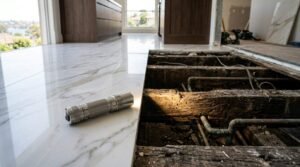
Hidden costs are the number one reason renovations exceed their budget. They are not truly hidden in most cases; they are foreseeable expenses that were either overlooked during planning or deliberately excluded from a low-ball quote to win the job.
Structural Surprises: Asbestos, Water Damage, and Compliance Issues
Older Sydney homes are particularly prone to structural surprises that only become visible once demolition begins.
Asbestos is present in a significant proportion of homes built before 1990. It appears in fibro sheeting, eaves, bathroom wall linings, vinyl flooring, and some textured ceilings. Asbestos removal by a licensed removalist costs $3,000 to $15,000 or more depending on extent and location. If your home was built before 1990, budget for an asbestos inspection before any work begins and include a provisional sum in your contract for removal.
Water damage and termite damage are common in bathrooms, kitchens, and subfloor areas. Rotted framing, damaged bearers and joists, and compromised wall studs are invisible until existing linings are stripped. Repairing structural timber adds $2,000 to $10,000 per affected area. Non-compliant previous work is another frequent discovery; bringing unlicensed or non-standard work up to code becomes your responsibility and your cost.
Council Approvals, Permits, and Compliance Costs in Sydney
Not every whole home renovation requires council approval, but many do.
Work that typically requires a DA or CDC:
- Structural alterations (removing load-bearing walls, changing rooflines)
- Changes to the building footprint or floor area
- Work affecting heritage-listed properties or conservation areas
- Plumbing and drainage work connecting to council infrastructure
Work that typically does not require approval:
- Like-for-like replacements (replacing a bathroom with the same layout)
- Internal cosmetic upgrades (painting, flooring, non-structural joinery)
- Minor electrical and plumbing upgrades within existing layouts
Council application fees in Sydney range from $500 to $5,000+ depending on scope and your local council. Private certification is generally faster but costs $2,000 to $6,000 for a whole home renovation. You also need to budget for required reports: structural engineering ($1,500 to $4,000), BASIX certificates for energy and water compliance ($200 to $500), and potentially heritage assessments or arborist reports depending on your site.
How to Build a Contingency Fund That Actually Protects You
Every renovation budget needs a contingency fund. For a whole home renovation of an older Sydney property (pre-1980), a contingency of 15% to 20% of the total contract value is appropriate. For newer properties in good structural condition, 10% to 15% is generally sufficient.
This contingency is not a slush fund for upgrades. It exists to cover genuine unforeseen costs: the asbestos you did not know about, the rotted subfloor, the plumbing that does not meet code. The critical discipline is protecting this fund early in the project. The temptation to upgrade materials in the first few weeks is strong because the budget feels large and the end feels far away. The most expensive surprises almost always emerge mid-project, and if your contingency is already spent on a nicer benchtop, you have no buffer when the real problems appear.
Planning the Renovation Timeline Stages and Sequencing
A well-planned timeline is as important as a well-planned budget. Delays cost money; every week your renovation runs over schedule adds holding costs, temporary accommodation expenses, and potential trade re-mobilisation fees.
The Typical Phases of a Whole Home Renovation
A whole home renovation in Sydney generally follows this sequence.
Phase 1: Planning and design (4 to 12 weeks) Engage your architect or designer, finalise plans, obtain quotes, select your contractor, and lodge any required council applications. This phase feels slow, but it is where the most important decisions are made.
Phase 2: Approvals and procurement (4 to 8 weeks) Wait for council or certifier approval. Order long-lead items such as custom joinery, imported tiles, and specialty fixtures. Finalise material selections and confirm allowances with your contractor.
Phase 3: Demolition and strip-out (1 to 3 weeks) Remove existing finishes, fittings, and any structures being modified. This is when hidden issues are most likely to be discovered.
Phase 4: Structural work and rough-in (3 to 6 weeks) Framing modifications, plumbing rough-in, electrical rough-in, and any structural steel or engineering work. Inspections occur at key hold points.
Phase 5: Waterproofing, insulation, and lining (2 to 4 weeks) Waterproof all wet areas, install insulation, and line walls and ceilings with plasterboard. Another round of inspections.
Phase 6: Fit-off and finishing (4 to 8 weeks) Tiling, painting, cabinetry installation, benchtop templating and installation, flooring, and fit-off of all plumbing and electrical fixtures. This is the longest phase and where the home starts to take shape.
Phase 7: Final fix and handover (1 to 2 weeks) Final paint touch-ups, cleaning, snagging, final inspections, and handover.
Total typical duration: 4 to 9 months from demolition to handover. Add the planning and approvals phases, and the full process from initial engagement to moving back in is typically 6 to 14 months.
How to Sequence Rooms to Minimise Disruption and Cost
The general principle is to work from the back of the house to the front, and from wet areas to dry areas. We start with bathrooms and the kitchen because these rooms require the most trades, the longest drying and curing times, and the most inspections. Getting wet areas completed early reduces the risk of water-related delays affecting the rest of the project.
Bedrooms and living areas are typically renovated in parallel with the later stages of wet area work. Flooring is one of the last items installed to avoid damage from ongoing trade activity. Painting is done in stages: a first coat after plastering, then final coats after all other trades have finished. External work and landscaping are completed last.
What Causes Renovation Delays and How to Avoid Them
The most common causes of renovation delays in Sydney are predictable and largely preventable.
Late material selections: If you have not chosen your tiles, tapware, and fittings before construction begins, trades wait on site with nothing to install. Make all selections during the planning phase.
Long lead times on imported products: Some tiles, fixtures, and specialty items have lead times of 8 to 16 weeks. Order early. Your contractor provides a procurement schedule that flags long-lead items.
Scope changes during construction: Every change after work begins requires a variation, which needs to be priced, approved, and potentially re-sequenced. Minimise changes by making thorough decisions during planning.
Discovery of unforeseen issues: Asbestos, structural damage, and non-compliant previous work all cause delays. A thorough pre-renovation inspection reduces but does not eliminate this risk.

Bathroom Renovation Budgeting: What to Know
Bathrooms are the most cost-intensive rooms per square metre in any home renovation. A complete bathroom renovation in Sydney in 2025 typically costs $25,000 to $50,000 for a standard bathroom, $45,000 to $80,000+ for a premium master ensuite, and $18,000 to $28,000 at the budget end for a small bathroom up to 4 m².
The single biggest variable is your tile and fitting selections. A bathroom tiled in $35/m² ceramic tiles with a $300 toilet suite looks and feels fundamentally different from one finished with $120/m² porcelain tiles and a $1,200 wall-hung toilet. Both are functional. The cost difference across a standard bathroom easily reaches $15,000 to $25,000.
Waterproofing is the one area where you never cut costs. Under Australian Standard AS 3740, all shower areas, bathroom floors, and areas around baths must be waterproofed by a licensed waterproofer. A waterproofing certificate is required before tiling commences. A failed membrane leads to structural damage, mould, and remediation costs that dwarf the original renovation budget.

How to Choose the Right Renovation Contractor in Sydney
Your choice of contractor has a greater impact on the outcome of your renovation than almost any other single decision. The right contractor delivers on budget, on time, and to the quality you expect.
What to Look for in a Whole Home Renovation Builder
Licensing In NSW, any building work valued over $5,000 must be carried out by a licensed contractor. Verify your contractor’s licence on the NSW Fair Trading website. They hold a General Building Contractor licence or an appropriate specialist licence for the work being performed.
Insurance: Your contractor carries Home Building Compensation Fund (HBCF) insurance for any residential work over $20,000. This protects you if the contractor dies, disappears, or becomes insolvent during or after the project. They also carry public liability insurance and workers’ compensation insurance.
Experience with whole home renovations: Renovating an entire home is fundamentally different from renovating a single bathroom or kitchen. Look for a contractor with a portfolio of completed whole home projects, ideally in your area and at a similar scale to your project.
Transparent pricing: A reputable contractor provides a detailed, it


