
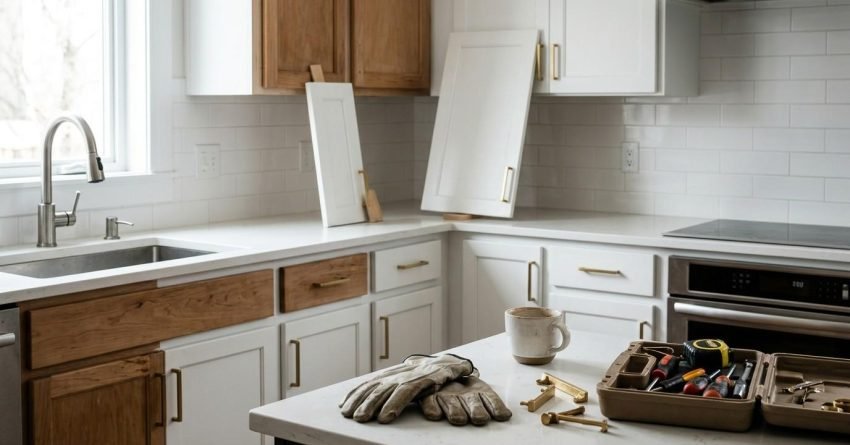
A partial kitchen renovation can refresh the look, function, and value of your kitchen for $5,000 to $25,000 without the disruption, timeline, or cost of a full structural rebuild. For Sydney homeowners working within a realistic budget, knowing which updates deliver the most impact is the difference between a smart investment and money spent in the wrong places.
Rising renovation costs and tighter household budgets make it more important than ever to prioritise updates that genuinely improve your kitchen without committing to a complete overhaul.
This guide covers the most effective partial kitchen updates, how to decide when a partial reno is enough, and how to budget your project with confidence in Sydney.
What Counts as a Partial Kitchen Renovation?
A partial kitchen renovation focuses on cosmetic and functional upgrades that improve the appearance and usability of your kitchen without altering the layout, moving plumbing, or replacing the structural framework. It typically involves replacing or resurfacing specific elements: cabinets, benchtops, splashbacks, tapware, appliances, flooring, or lighting while keeping the existing footprint intact.
This approach works well when the bones of your kitchen are sound: the layout functions, the cabinetry carcasses are structurally solid, and the plumbing and electrical are in good working order. The goal is targeted improvement, not wholesale replacement.
Every budget tier sits somewhere on the spectrum from a focused cosmetic refresh through to a full kitchen renovation. Understanding where a partial reno lands on that scale is the first step toward accurate planning.

Kitchen Updates You Can Do Without Touching the Layout
The most impactful partial renovation work happens at the surface level. Updating the visible elements of your kitchen without moving a single wall or pipe can produce a result that looks and feels like a completely new space.
Cabinet Doors, Handles, and Hinges
Cabinet doors are the dominant visual element in any kitchen. Replacing them with new profiles, or resurfacing existing doors with a fresh finish, delivers an immediate transformation at a fraction of the cost of full cabinet replacement. New handles and soft-close hinges add a functional upgrade that reinforces the visual improvement.
In Sydney, new cabinet doors typically range from $3,000 to $8,000 depending on material, profile, and the number of cabinets involved. Cabinet resurfacing with a two-pack paint finish or vinyl wrap can cost $2,000 to $5,000 for a standard kitchen, a meaningful saving when the existing carcasses are structurally sound.
The decision between replacing and resurfacing comes down to the condition of your existing frames and the finish quality you want. Replacement gives you more profile and material options; resurfacing delivers a strong result at lower cost when the bones are good.
Benchtops and Splashbacks
Replacing a benchtop is one of the highest-return updates in a partial kitchen renovation. Stone benchtops engineered quartz or natural stone are the most popular choice in Sydney, typically ranging from $400 to $1,200 per linear metre installed. Laminate benchtops offer a cost-effective alternative from $150 to $400 per linear metre and have improved significantly in quality and finish options.
Splashbacks work in tandem with benchtops to define the kitchen’s visual character. Tiled splashbacks, glass splashbacks, and stone offcuts all offer different price points and aesthetic outcomes. Replacing both the benchtop and splashback together is the most efficient approach; it minimises labour duplication and ensures a cohesive finish.
The right benchtop material depends on your budget, how heavily the kitchen is used, and the aesthetic you are working toward. Stone delivers the strongest visual impact and long-term durability; laminate closes the gap in quality at a lower entry point.
Tapware and Sink Replacement
Tapware and sink replacement sits at the more accessible end of the partial renovation budget. A new sink and mixer tap can be installed for $800 to $2,500 depending on the sink material, tap style, and whether any minor plumbing adjustments are required.
Undermount sinks require a solid benchtop surface and are typically installed during a benchtop replacement, making this the most efficient time to upgrade both together. Topmount sinks are more flexible and can be swapped independently. Any work involving changes to existing plumbing connections requires a licensed plumber under NSW regulations.
This update is particularly effective when combined with a new benchtop, as the sink is typically cut into the benchtop surface during installation.
Appliance Upgrades That Make an Immediate Difference
Appliances are one of the most practical areas to address in a partial renovation, particularly in kitchens where the existing appliances are dated, inefficient, or no longer performing reliably. Replacing a cooktop, oven, rangehood, or dishwasher does not require structural changes and can be completed with minimal disruption.
In Sydney, a mid-range freestanding oven and gas cooktop combination typically costs $1,500 to $4,000 for supply and installation. A quality rangehood replacement ranges from $800 to $2,500 installed. Dishwasher replacement sits between $900 and $2,200 for supply and installation, assuming the existing cavity and plumbing connections are compatible.
Kitchen appliance upgrades deliver the strongest return when you prioritise the items that affect daily cooking performance first: cooktop and oven before rangehood, rangehood before dishwasher, and avoid over-specifying on a partial renovation budget.

Flooring and Lighting: High-Impact, Lower-Cost Updates
Flooring Options for a Partial Reno
New flooring changes the entire feel of a kitchen and is one of the more accessible updates in a partial renovation. Hybrid flooring and luxury vinyl plank (LVP) are the most popular choices for Sydney kitchens undergoing partial updates; both are durable, water-resistant, and can be installed over existing subfloors in most cases, which reduces labour costs significantly.
Hybrid flooring typically costs $50 to $90 per square metre supplied and installed. Porcelain tile, while more expensive to install at $80 to $150 per square metre, offers superior durability and is a strong choice for high-traffic kitchens or investment properties.
The right kitchen flooring choice for a partial renovation balances upfront cost, installation disruption, and long-term durability. Hybrid and LVP suit most residential kitchens; porcelain tile is worth the premium in high-traffic or investment property contexts.
Lighting Upgrades That Change the Feel of a Kitchen
Lighting is consistently underestimated in partial renovation planning. Replacing a single overhead fitting with recessed LED downlights, adding under-cabinet task lighting, or installing a pendant above an island bench can dramatically shift the atmosphere and functionality of a kitchen.
Task lighting positioned directly above prep areas and the cooktop improves practical usability in ways that ambient overhead lighting alone cannot achieve. Under-cabinet LED strips are one of the most cost-effective additions available, requiring minimal installation time and no structural work.
Electrician costs for a lighting upgrade in Sydney typically range from $500 to $2,000 depending on the number of fittings, the complexity of the installation, and whether new circuits are required. Any new circuit installation must be completed by a licensed electrician under NSW electrical safety regulations.
How to Stage a Partial Kitchen Renovation Over Time
Staging updates across separate projects is a practical approach for homeowners working within a tighter budget. The key is sequencing updates in the order that delivers the most visible and functional improvement at each stage; so the kitchen improves meaningfully after every phase, not just at the end.
A logical staging sequence for most Sydney kitchens runs as follows. Start with benchtops and cabinet doors; these two elements have the greatest visual impact and are the first things buyers, tenants, and guests notice. Add appliances in the second stage if the existing ones are underperforming. Follow with flooring and lighting in the third stage, which completes the transformation without requiring any structural work.
Staging also gives you time to refine your material choices and gather accurate quotes between phases. The most common mistake in staged renovations is selecting materials in isolation; a benchtop chosen without the cabinet door finish in mind can create a mismatch that costs more to correct later. Plan the full scope upfront, even if you execute it in stages.

Which Updates Add the Most Property Value?
Not all partial renovation updates return equal value at sale or appraisal. New benchtops and cabinet doors consistently deliver the strongest return on investment; these two elements have the greatest visual impact and are among the first things buyers and tenants assess when evaluating a kitchen.
Appliance upgrades add functional value that buyers notice, particularly in the mid-to-upper price brackets where outdated appliances read as a deferred maintenance signal. Flooring and lighting improvements support the overall impression but rarely drive valuation independently.
The strongest partial renovation strategy for property value combines benchtops, cabinet doors, and at least one appliance upgrade targeting the elements that photograph well, read as modern, and signal a well-maintained property to buyers and agents.
When a Partial Renovation Is Enough and When It Isn’t
A partial renovation is the right choice when the kitchen layout works, the cabinetry structure is sound, and the primary issues are cosmetic or functional rather than structural. Updating to sell, refreshing a rental property, or modernising a kitchen that is functionally adequate but visually dated these are the scenarios where a partial renovation delivers strong, reliable value.
It is not the right choice when the layout is genuinely inefficient, the cabinetry carcasses are damaged or poorly constructed, the plumbing or electrical is non-compliant, or the kitchen footprint needs to change to meet your household’s needs. In these situations, a partial renovation addresses the surface while the underlying problems remain and the money spent does not resolve what is actually wrong.
The structural indicators that signal a full rebuild is necessary include carcasses that flex or sag under load, plumbing that does not meet current code, a layout that forces inefficient workflow, and a footprint that is too small for the household’s actual use. A licensed contractor can assess these conditions and give you an honest read on which path makes sense.
How to Budget a Partial Kitchen Renovation in Sydney
A realistic partial kitchen renovation budget in Sydney typically falls between $8,000 and $25,000 for a combination of cabinet updates, new benchtops, splashback, tapware, and appliances. Flooring and lighting add $2,000 to $6,000 depending on the scope. A focused single-element update such as benchtops only or cabinet doors only can be completed for $3,000 to $10,000.
The most common budget mistakes in partial renovations are underestimating labour costs, failing to account for waterproofing or compliance work uncovered during the project, and selecting materials without understanding the full installed cost. Getting itemised quotes from licensed contractors before committing to a scope is essential.
When requesting quotes, ask for a line-by-line breakdown that separates supply from labour for each element. This makes it straightforward to adjust scope, removing or deferring one element without renegotiating the entire quote. Three itemised quotes from licensed contractors give you a reliable market read and protect against pricing that does not reflect the actual scope of work.
Conclusion
A partial kitchen renovation gives Sydney homeowners a practical path to a better-functioning, better-looking kitchen without the cost or disruption of a full rebuild. The highest-impact updates cabinet doors, benchtops, splashbacks, appliances, and flooring can be combined strategically to achieve a result that looks and performs like a complete renovation.
Understanding where your budget is best spent, and where the limits of a partial approach lie, is what separates a renovation that adds real value from one that falls short of expectations.
We at Sydney Home Renovation specialise in partial and full kitchen renovations across Sydney. Contact our team for a transparent, itemised quote and honest advice on the right scope for your kitchen and budget.
Frequently Asked Questions
How much does a partial kitchen renovation cost in Sydney?
A partial kitchen renovation in Sydney typically costs between $8,000 and $25,000 depending on the scope. Focused single-element updates such as benchtops or cabinet doors alone can be completed for $3,000 to $10,000.
Can I update my kitchen cabinets without replacing them entirely?
Yes. Cabinet doors can be replaced or resurfaced with a new finish while keeping the existing carcasses, which significantly reduces cost. This works well when the cabinet frames are structurally sound, and the layout is functional.
Do I need council approval for a partial kitchen renovation in Sydney?
Most cosmetic and functional updates, including cabinet replacement, benchtops, appliances, and flooring, do not require council approval in NSW. Work involving changes to plumbing, electrical, or structural elements requires a licensed tradesperson and relevant permits.
How long does a partial kitchen renovation take?
A partial kitchen renovation typically takes one to three weeks depending on the scope of work, material lead times, and trade scheduling. Single-element updates such as benchtop replacement can often be completed in one to two days.
What is the best partial kitchen update for adding property value?
New benchtops and cabinet doors consistently deliver the strongest return on investment in a partial kitchen renovation. These two elements have the greatest visual impact and are among the first things buyers and tenants notice when assessing a kitchen.
Can I stage a partial kitchen renovation over time?
Yes. Staging updates across separate projects is a practical approach for homeowners working within a tighter budget. Prioritise benchtops, cabinet doors, and appliances first, then add flooring and lighting in a subsequent stage.
How do I know if my kitchen needs a full renovation instead?
If the layout is inefficient, the cabinetry carcasses are structurally compromised, or the plumbing and electrical are non-compliant, a partial renovation is unlikely to resolve the underlying issues. A licensed contractor can assess the condition of your kitchen and advise on the right approach.