
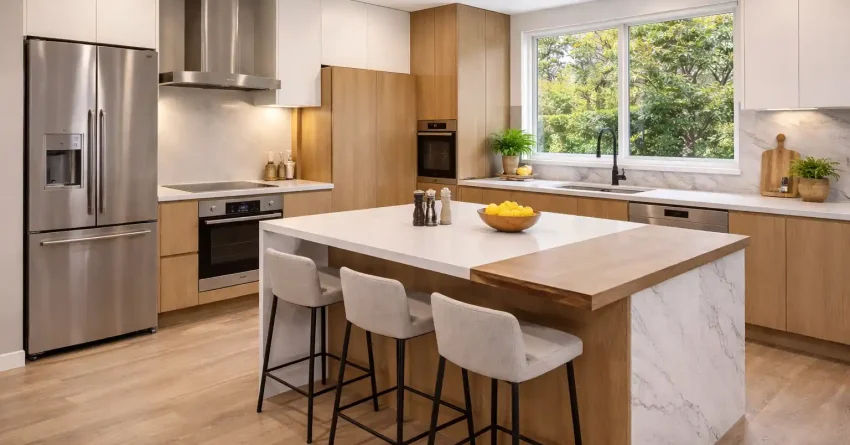
Your kitchen benchtop is the most used surface in your home, and the material you choose determines how it looks, performs, and holds its value for the next 15 to 30 years. With Sydney renovation costs climbing and material options expanding, picking the wrong benchtop can mean thousands in avoidable replacement or repair expenses.
This guide breaks down every major kitchen benchtop material available in Sydney, compares real costs per square metre, and gives you a clear framework for choosing the right surface for your budget, lifestyle, and kitchen renovation.
What Are Kitchen Benchtop Materials
Kitchen benchtop materials are the surface products used to fabricate and install the primary worktop in a kitchen. They range from natural stone like granite and marble to manufactured options like engineered stone, laminate, solid surface composites, timber, porcelain slabs, and stainless steel. Each material carries distinct characteristics in durability, heat resistance, stain resistance, maintenance requirements, and cost.
In a renovation context, your benchtop material is one of the highest-impact decisions you will make. It sits at the intersection of function and aesthetics. You prepare food on it, place hot cookware near it, spill liquids across it, and lean on it every single day.
Why Your Benchtop Choice Matters More Than You Think
A benchtop is not just a surface. It anchors the visual identity of your kitchen and dictates your cleaning routine, your tolerance for wear, and your long-term maintenance costs. Choose a porous material without understanding sealing requirements, and you are looking at staining within months.
The material also affects your renovation timeline. Natural stone requires templating and fabrication lead times. Engineered stone has specific installation requirements. Laminate can be cut and fitted faster but limits your edge profile options.
How Kitchen Benchtops Affect Property Value in Sydney
In Sydney’s competitive property market, kitchen presentation directly influences buyer perception and sale price. Kitchens and bathrooms remain the two rooms that drive the highest return on renovation investment. A dated laminate benchtop in a suburb like Balmain or Mosman can undercut an otherwise strong renovation.
Real estate agents across Sydney consistently report that stone benchtops, whether engineered or natural, signal quality to buyers and create a perception of a well-maintained, modern home. A benchtop upgrade from laminate to engineered stone can shift a property from “needs work” to “move-in ready” in buyer psychology, often recovering the cost at sale. For broader renovation scopes, allocating budget strategically across every room matters as much as the benchtop decision itself.
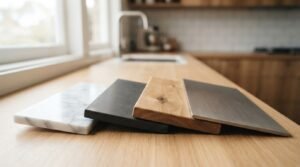
Most Popular Kitchen Benchtop Materials in Sydney
Sydney homeowners have access to a wide range of benchtop materials, each suited to different budgets, design preferences, and functional needs. Below is a detailed breakdown of the seven most commonly used materials in Sydney kitchen renovations.
Engineered Stone Benchtops
Engineered stone, also called reconstituted stone or quartz benchtops, is the most popular kitchen benchtop material in Australia. Brands like Caesarstone, Silestone, and Smartstone dominate the Sydney market. The material is manufactured from approximately 90 to 94 percent crushed natural quartz bound with polymer resins and pigments.
Key characteristics:
- Non-porous surface that resists staining without sealing
- Consistent colour and pattern across slabs
- Available in a wide range of colours, from solid whites to marble-look veining
- Scratch-resistant but not scratch-proof
- Not suitable for direct contact with extremely hot cookware (resin can discolour above 150°C)
- Typical thickness options: 20mm and 40mm
Engineered stone suits most Sydney kitchens. It balances durability, aesthetics, and maintenance better than almost any other option. The main limitation is heat sensitivity; always use trivets.
Engineered Stone Safety Regulations in Australia
Safe Work Australia banned the fabrication, supply, and installation of engineered stone products containing more than 1% crystalline silica, effective 1 July 2024. This regulation affects the most widely used benchtop material in the country and has reshaped the Sydney market.
In practice, most major brands including Caesarstone and Silestone have reformulated or introduced compliant product lines. When selecting engineered stone, confirm with your supplier that the specific product meets current Australian silica regulations. Non-compliant products cannot legally be fabricated or installed by licensed stonemasons in Australia.
Natural Stone Benchtops (Granite and Marble)
Natural stone benchtops are cut from quarried slabs. Granite and marble are the two most common types used in Sydney kitchens, though you will also find quartzite and soapstone in higher-end projects.
Quartzite is a naturally occurring metamorphic rock distinct from engineered quartz that offers hardness comparable to granite with marble-like veining. It is harder and more acid-resistant than marble, making it a strong alternative for homeowners who want natural stone aesthetics with better durability.
Granite is extremely hard, heat-resistant, and available in hundreds of natural colour variations. Each slab is unique. It requires periodic sealing (typically every 12 to 24 months) to maintain stain resistance.
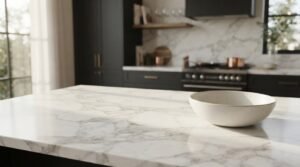
Marble is softer than granite and more porous. It etches when exposed to acidic substances like lemon juice, vinegar, or tomato sauce. Marble requires more frequent sealing and careful daily maintenance. Calacatta and Carrara marble remain highly sought after in Sydney for their distinctive veining.
Natural stone buyers need to understand the maintenance commitment before committing. Marble is beautiful but demanding. Granite is more forgiving for busy households.
Laminate Benchtops
Laminate benchtops are made from layers of kraft paper bonded with resin and topped with a decorative surface layer. They are the most affordable benchtop option and are widely available through suppliers like Laminex, Formica, and Polytec across Sydney.
Key characteristics:
- Lowest cost per square metre of any benchtop material
- Huge range of colours, patterns, and finishes including stone and timber looks
- Lightweight and fast to install
- Susceptible to heat damage, scratching, and chipping at edges
- Cannot be repaired easily once damaged
- Not waterproof at joins or edges if sealant fails
- Typical lifespan: 10 to 15 years with careful use
Laminate works well for rental properties, budget renovations, and secondary kitchens like granny flats. Modern laminate finishes have improved significantly, and for a tight budget, laminate lets you allocate funds to other areas of the renovation.
Solid Surface Benchtops
Solid surface benchtops are manufactured from acrylic or polyester resins blended with mineral fillers. Corian by DuPont is the most recognised brand, though Staron and Hi-Macs are also available in Sydney.
Key characteristics:
- Seamless joins (thermoformed to create invisible seams)
- Non-porous and hygienic
- Scratches and minor damage can be sanded and repaired on-site
- Available in a wide colour range
- Not heat resistant (direct heat causes damage)
- Softer than stone, so more prone to scratching under heavy use
- Mid-range pricing
Solid surface is a strong choice for kitchens where seamless aesthetics matter, particularly for integrated sinks and curved designs. The repairability is a genuine advantage over engineered stone, where chips require professional repair.
Timber Benchtops
Timber benchtops bring warmth and natural character to a kitchen. Popular species in Sydney include Tasmanian oak, spotted gum, blackbutt, and recycled hardwoods. Bamboo is also used as a sustainable alternative.
Key characteristics:
- Natural warmth and unique grain patterns
- Can be sanded and refinished multiple times over its lifespan
- Requires regular oiling (every 3 to 6 months depending on use)
- Susceptible to water damage, staining, and heat marks
- Expands and contracts with humidity changes
- Best suited as a feature section rather than full kitchen coverage
Timber works beautifully as an island benchtop or breakfast bar paired with stone on the main work surfaces. In Sydney’s humid coastal climate, timber benchtops need consistent care to prevent warping and moisture damage.
Porcelain Slab Benchtops
Porcelain slab benchtops are a newer option gaining traction in Sydney. Brands like Dekton by Cosentino and Neolith produce large-format sintered stone slabs that are extremely thin (as low as 6mm) yet remarkably strong.
Key characteristics:
- Highly resistant to heat, UV, scratching, and staining
- Ultra-thin profiles create a sleek, contemporary look
- Available in large formats that reduce visible joins
- Colour-consistent and fade-resistant (suitable for outdoor kitchen benchtops
- More brittle than engineered stone during fabrication and transport
- Requires specialist fabrication and installation
- Higher cost than engineered stone
Porcelain slabs are ideal for modern and minimalist kitchen designs. They also perform well in outdoor kitchen applications because they resist UV fading, a genuine advantage in Sydney’s climate. The main drawback is cost and the need for experienced fabricators.
Stainless Steel Benchtops
Stainless steel benchtops are standard in commercial kitchens and are increasingly used in residential projects that favour an industrial or professional aesthetic.
Key characteristics:
- Completely hygienic and non-porous
- Heat-resistant and waterproof
- Easy to clean
- Shows fingerprints, scratches, and water spots readily
- Can be noisy under impact
- Custom fabrication required for residential kitchens
- Cold to the touch
Stainless steel suits homeowners who prioritise hygiene and durability over warmth. It pairs well with timber or concrete elements to soften the industrial feel. In Sydney, stainless steel benchtops are most common in high-end contemporary kitchens and butler’s pantries.
Kitchen Benchtop Materials Comparison
Choosing between materials is easier when you see them side by side. The tables below compare the most important factors for Sydney homeowners.
Durability and Maintenance Comparison
| Material | Scratch Resistance | Heat Resistance | Stain Resistance | Sealing Required | Maintenance Level |
| Engineered Stone | High | Low-Medium | High | No | Low |
| Granite | High | High | Medium | Yes (annual) | Medium |
| Marble | Low-Medium | Medium | Low | Yes (frequent) | High |
| Laminate | Low | Low | Medium | No | Low |
| Solid Surface | Low-Medium | Low | High | No | Low-Medium |
| Timber | Low | Low | Low | Yes (oiling) | High |
| Porcelain Slab | Very High | Very High | Very High | No | Very Low |
| Stainless Steel | Low (visible) | Very High | Very High | No | Medium |
Porcelain slabs lead on raw durability metrics. Engineered stone offers the best balance of durability and low maintenance for most households. Timber and marble sit at the high-maintenance end.
Cost Comparison by Material Type
| Material | Cost Per m² (Supply Only) | Cost Per m² (Installed) | Budget Category |
| Laminate | $150–$400 | $300–$600 | Budget |
| Solid Surface | $400–$800 | $600–$1,200 | Mid-range |
| Engineered Stone | $400–$1,000 | $700–$1,500 | Mid-range to Premium |
| Granite | $500–$1,200 | $800–$1,800 | Mid-range to Premium |
| Timber | $400–$900 | $600–$1,400 | Mid-range |
| Marble | $600–$2,000+ | $1,000–$2,500+ | Premium |
| Porcelain Slab | $700–$1,500 | $1,200–$2,500 | Premium |
| Stainless Steel | $800–$2,000 | $1,200–$2,800 | Premium |
These figures reflect Sydney pricing as of 2025. Actual costs vary based on slab selection, edge profiles, cutouts for sinks and cooktops, and site access. Always get an itemised quote.
Benchtop Thickness Options Explained
Thickness affects both the visual weight of your benchtop and its structural performance. The three most common profiles in Sydney kitchens are 20mm, 40mm, and 12mm (porcelain only).
A 20mm slab is the standard for most engineered stone and granite installations. It is lighter, costs less in material, and suits most residential kitchen layouts. A 40mm profile often achieved by laminating two 20mm slabs creates a bold, substantial edge that reads as premium, particularly on islands. Porcelain slabs at 12mm or 6mm deliver a razor-thin contemporary edge that neither stone thickness can replicate, though they require specialist fabrication and careful handling.
Best Benchtop Materials for Different Kitchen Styles
Not every material suits every kitchen design. Here is a practical guide to matching materials with common Sydney kitchen styles:
- Modern/Contemporary: Engineered stone in white or grey tones, porcelain slabs with marble-look finishes, or stainless steel for an industrial edge.
- Hamptons Style: Engineered stone or marble in white with subtle veining. Shaker-style cabinetry pairs naturally with these surfaces.
- Coastal/Australian: Timber benchtops (spotted gum or blackbutt) on islands, paired with light-coloured engineered stone on work surfaces.
- Industrial: Stainless steel, concrete-look engineered stone, or dark granite with raw edge profiles.
- Traditional/Classic: Granite in natural tones or marble for a timeless look. These materials complement heritage and period-style Sydney homes.

How Much Do Kitchen Benchtops Cost in Sydney
Cost is the deciding factor for most Sydney renovators. Understanding where your money goes helps you make smarter material and design decisions.
Material Cost Breakdown Per Square Metre
The supply cost of your benchtop material is only part of the equation. A standard Sydney kitchen requires between 2.5 and 5 square metres of benchtop surface, depending on the layout. An L-shaped kitchen with an island can exceed 6 square metres.
For a mid-range engineered stone benchtop in a standard kitchen (approximately 3.5 square metres), expect to pay between $2,450 and $5,250 for the material and fabrication combined. Laminate for the same area costs between $1,050 and $2,100 installed.
The slab colour and pattern also affect price. A standard solid-colour engineered stone slab costs less than a premium marble-look variant from the same brand. Always check the pricing tier of your chosen colour before finalising your budget.
Installation and Labour Costs
Benchtop installation in Sydney involves templating, fabrication, delivery, and fitting. The templating process, where a fabricator takes precise measurements of your cabinetry before cutting the slab, is a critical step that prevents costly errors. Most stone fabricators charge a combined rate that includes all of these steps.
Typical installation cost components:
- Templating: $150–$300 (sometimes included in fabrication quote)
- Fabrication: Included in per-square-metre pricing
- Delivery: $100–$300 depending on Sydney location and site access
- Installation labour: $300–$800 depending on complexity
- Cutouts for sinks: $150–$350 each
- Cutouts for cooktops: $150–$350 each
- Edge profiles: Standard pencil round is usually included; waterfall edges, mitred edges, and bullnose profiles add $50–$200 per linear metre
For a complete engineered stone benchtop installation in a standard Sydney kitchen, total costs including all labour and fabrication typically range from $3,500 to $7,500. Premium materials and complex layouts push this higher.
Edge Profile Options and What They Cost
The edge profile is the finished shape applied to the exposed front edge of your benchtop. It affects both the visual style and the fabrication cost.
A pencil round or square edge is the most common and is included in most fabrication quotes. A waterfall edge where the stone continues vertically down the side of an island is the most dramatic option and adds $1,000 to $3,000 to the total cost depending on the island size. Mitred edges (two slabs joined at 45 degrees to create a thick-looking edge from a single slab) and bullnose profiles (fully rounded edge) sit in the mid-range at $50–$200 per linear metre above the base quote. Confirm all edge pricing in writing before signing off on your fabrication order.
Hidden Costs and Budget Considerations
Several costs catch Sydney renovators off guard during benchtop selection:
Removal and disposal. Replacing an old benchtop adds removal costs of $200 to $500 depending on material and size. Asbestos-containing materials in older Sydney homes require licensed removal, which costs significantly more.
Plumbing disconnection and reconnection. Sink and dishwasher connections need to be disconnected before removal and reconnected after installation. Budget $200 to $500 for a licensed plumber.
Structural support. Heavy stone benchtops, particularly on islands, may require additional cabinetry reinforcement. This is especially relevant for waterfall edges where the stone wraps down the side of the island.
Splashback coordination. Getting the sequencing wrong between benchtop installation and tiled splashbacks creates gaps or requires rework.
Lead times. Popular engineered stone colours and natural stone slabs can have 2 to 6 week lead times in Sydney. Delays here stall your entire kitchen renovation.
How to Choose the Right Kitchen Benchtop Material
With seven major material categories and dozens of brands, narrowing your choice requires a structured approach. Focus on three factors: your lifestyle, your kitchen layout, and your budget.
Matching Materials to Your Lifestyle
Your daily kitchen habits should drive your material choice more than aesthetics alone.
- Heavy cooking households: Granite or porcelain slabs handle heat and heavy use best. Engineered stone works well with trivets. Avoid marble and laminate near cooktops.
- Families with young children: Engineered stone and solid surface are forgiving. They resist stains, clean easily, and do not require sealing. Timber and marble demand more vigilance.
- Entertainers and open-plan living: Visual impact matters. Marble and porcelain slabs create statement surfaces. Engineered stone in premium finishes delivers a similar look with less maintenance.
- Rental properties: Laminate or mid-range engineered stone. Prioritise durability and low maintenance over premium aesthetics. Tenants will not oil timber benchtops.
- Low-maintenance preference: Homeowners who want zero ongoing maintenance after installation have two clear options: porcelain slabs and engineered stone.
Kitchen Layout and Benchtop Sizing
Your kitchen layout affects both material cost and material suitability.
Straight-line kitchens require the least benchtop material and have the simplest fabrication. Almost any material works here. L-shaped and U-shaped kitchens involve corner joins; engineered stone and solid surface handle these well, with solid surface capable of creating invisible seams.
Island benchtops are often the largest single piece. Large slabs of natural stone or porcelain reduce visible joins. Waterfall edges on islands add visual impact but increase material and fabrication costs by 30 to 50 percent. Galley kitchens in Sydney apartments benefit from thinner porcelain slabs (12mm) or laminate, which make a small kitchen feel less heavy than a thick 40mm stone edge.
Working With Your Renovation Budget
On a $15,000 to $25,000 total kitchen budget, spending $7,000 on a benchtop leaves too little for cabinetry, appliances, and finishes. A well-chosen mid-range engineered stone at $4,000 to $5,000 installed leaves more budget for quality finishes that collectively lift the kitchen.
For budget renovations under $15,000, laminate benchtops free up funds for better tapware, lighting, and storage solutions. For premium renovations above $30,000, natural stone, porcelain slabs, or top-tier engineered stone are appropriate at this budget level; the benchtop should be a centrepiece.
The key principle is proportional spending. Your benchtop should represent roughly 10 to 20 percent of your total kitchen renovation budget.
Kitchen Benchtop Maintenance and Care Tips
Every benchtop material has specific care requirements. Following the right routine extends the life of your surface and protects your investment.
Daily Cleaning and Stain Prevention
Engineered stone and solid surface: Wipe with warm water and a mild detergent. Avoid abrasive cleaners and scouring pads. Clean spills promptly, especially from turmeric, red wine, and coffee.
Granite and marble: Use a pH-neutral stone cleaner. Acidic cleaners, such as vinegar and, citrus-based products, damage marble and can dull granite over time. Blot spills immediately on marble; do not wipe, as this spreads the liquid into the pores.
Laminate: Clean with a soft cloth and mild detergent. Avoid excessive water at seams and edges. Do not use abrasive pads.
Timber: Wipe with a damp cloth and dry immediately. Avoid leaving standing water. Use cutting boards to prevent knife marks.
Porcelain slabs: Clean with any standard kitchen cleaner. Porcelain is highly resistant to chemicals and staining; this is one of the easiest surfaces to maintain.
Stainless steel: Use a microfibre cloth with warm soapy water. Wipe in the direction of the grain. Specialised stainless steel cleaners reduce fingerprint visibility.
Long-Term Sealing and Resurfacing
Granite needs resealing every 12 to 24 months. Test by placing a few drops of water on the surface; if the water absorbs within 5 minutes, it is time to reseal. Quality impregnating sealers are available from most hardware stores in Sydney.
Marble requires sealing every 6 to 12 months depending on use. Professional-grade sealers provide better protection than consumer products. Even with sealing, marble will develop a patina over time.
Timber benchtops need re-oiling every 3 to 6 months. Use a food-safe hardwax oil and sand lightly with fine-grit sandpaper before re-oiling. Timber can be fully sanded and refinished every 5 to 10 years to restore its original appearance.
Engineered stone, solid surface, laminate, porcelain, and stainless steel do not require sealing. Solid surface can be professionally sanded to remove deep scratches. Laminate cannot be repaired and must be replaced if significantly damaged.
Common Mistakes When Selecting Kitchen Benchtop Materials
After working on hundreds of Sydney kitchen renovations, these are the mistakes we see most often.
Choosing based on looks alone. A marble benchtop looks stunning in a showroom. In a busy family kitchen with three kids, it becomes a source of constant stress. Match the material to your actual lifestyle.
Ignoring edge profile costs. A waterfall edge or mitred edge can add $1,000 to $3,000 to your benchtop cost. Standard pencil-round or square edges are included in most quotes. Confirm edge pricing before committing to a design.
Not visiting a stone yard. Samples are small. The colour, veining, and pattern of a full slab can look completely different. Visit your fabricator’s yard in Sydney to select your actual slab, especially for natural stone and premium engineered stone.
Forgetting about overhang support. Breakfast bar overhangs exceeding 300mm typically need support brackets or a structural leg. This affects both cost and design.
Underestimating lead times. Ordering a benchtop two weeks before your kitchen installation date is a recipe for project delays. Allow 3 to 6 weeks for templating, fabrication, and delivery in Sydney.
Skipping the cutout discussion. Every sink cutout, cooktop cutout, and tap hole adds cost. Undermount sinks require more fabrication work than drop-in sinks. Discuss all cutouts with your fabricator during the quoting stage.
Not coordinating with other trades. Your benchtop installation needs to be sequenced after cabinetry and before final plumbing and electrical connections. Poor coordination between trades causes delays and rework.
Kitchen Benchtop Trends in Sydney for 2026
Sydney kitchen design continues to evolve. Here are the benchtop trends shaping renovations this year.
Marble-look engineered stone remains the dominant choice. Homeowners want the marble aesthetic without the maintenance burden, and manufacturers have refined veining technology to produce increasingly realistic patterns.
Ultra-thin porcelain slabs are growing in popularity, particularly for contemporary and architect-designed kitchens. The 6mm to 12mm profiles create a sharp, minimal edge that thick stone cannot replicate.
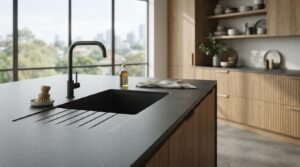
Integrated drainage grooves cut directly into stone benchtops near sinks are replacing traditional dish racks, both a functional and aesthetic trend.
Matte and honed finishes are overtaking high-gloss polished surfaces. Matte finishes hide fingerprints and minor scratches better, which appeals to busy households.
Sustainable and recycled materials are gaining real traction. Recycled glass benchtops made from post-consumer glass bound in resin or cement and reclaimed hardwood timber options appeal to environmentally conscious Sydney renovators who want a benchtop with a lower embodied carbon footprint.
Dark and bold colours are making a comeback after years of white dominance. Deep greens, charcoals, and black benchtops paired with lighter cabinetry create dramatic contrast in open-plan Sydney kitchens.
Conclusion
Kitchen benchtop materials vary widely in cost, durability, maintenance, and visual impact. Understanding the real differences between engineered stone, natural stone, laminate, timber, porcelain, and solid surface helps you make a confident, budget-smart decision for your Sydney kitchen renovation.
The right benchtop balances your daily cooking habits, your design preferences, and your renovation budget. Prioritise materials that match how you actually use your kitchen rather than chasing trends that do not suit your lifestyle.
At Sydney Home Renovation, we help Sydney homeowners navigate these decisions every day. We provide honest, itemised benchtop and kitchen renovation quotes backed by hands-on construction expertise and transparent pricing so you know exactly what you are getting before work begins. Contact us to get started.
Frequently Asked Questions
What is the most durable kitchen benchtop material?
Porcelain slab benchtops offer the highest overall durability, resisting heat, scratches, stains, and UV. Granite is the most durable natural stone option for heavy daily kitchen use.
How much should I budget for a kitchen benchtop in Sydney?
For a standard 3.5 square metre kitchen, budget $1,050 to $2,100 for laminate installed, or $3,500 to $7,500 for engineered stone installed. Premium stone costs more.
Are engineered stone benchtops better than natural stone?
Engineered stone requires less maintenance and resists staining without sealing. Natural stone offers unique patterns and superior heat resistance. The better choice depends on your maintenance tolerance.
Can I install a kitchen benchtop myself?
Laminate can be a DIY project for experienced renovators. Stone, porcelain, and solid surface require professional templating, fabrication, and installation; incorrect installation voids warranties and risks cracking slabs.
What kitchen benchtop material is best for resale value?
Engineered stone in neutral tones delivers the strongest return on investment for most Sydney properties. It signals quality to buyers without the maintenance concerns of marble or the budget perception of laminate.
How long do kitchen benchtops last?
Granite and porcelain slabs last 25 years or more. Engineered stone lasts 15 to 25 years. Solid surface lasts 15 to 20 years. Laminate lasts 10 to 15 years. Timber can exceed 20 years with regular oiling and refinishing.
What is the most affordable benchtop material in Australia?
Laminate is the most affordable option, starting from around $150 per square metre supply-only and $300 per square metre installed, available through Laminex and Formica across Sydney.


