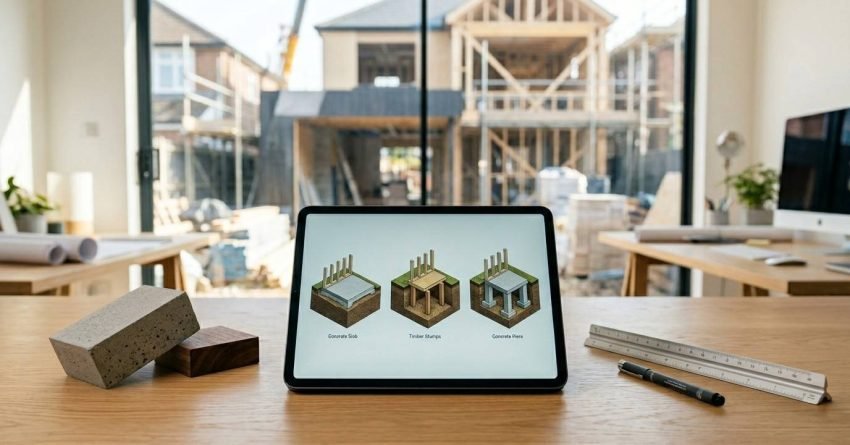
The foundation of your home extension determines everything that sits above it: its structural integrity, its longevity, and a significant portion of its total cost. In Sydney, three foundation systems are used for residential extensions: concrete slabs, stumps, and piers. Each suits different soil conditions, site topographies, and construction budgets. Choosing the wrong system, or accepting a quote that underspecifies the foundation, results in structural movement, costly remediation, and council compliance failures that delay or derail your project entirely.
Foundation decisions are made early, carry long-term consequences, and are frequently misunderstood by homeowners approaching their first extension project.
This guide covers what each foundation type is, how slab, stump, and pier systems compare across soil conditions, cost, and site requirements, what soil testing involves, how Sydney’s building regulations apply, and how to work with a builder who gets the specification right from the start.
What Is a Home Extension Foundation and Why Does It Matter?
A home extension foundation is the structural system that transfers the load of your new addition its walls, roof, floors, and contents safely into the ground beneath it. Without an adequately designed and constructed foundation, even the most carefully built extension will move, crack, and deteriorate over time.
The Role of Foundations in Home Extensions
Foundations serve three core functions in a home extension. They distribute the structural load of the new addition across a sufficient area of bearing ground. They resist differential settlement the uneven sinking that causes cracking in walls, sticking doors, and sloping floors. And they provide a stable, level platform from which the rest of the structure is built.
In a home extension context, the foundation must also integrate with the existing structure. A new addition that settles at a different rate from the original building creates movement joints, cracking at the connection point, and in severe cases, structural separation. Foundation design for extensions is not simply a matter of replicating what was done for the original home; it requires a site-specific assessment of soil conditions, load requirements, and the existing building’s foundation system.
How Foundation Choice Affects Cost, Timeline, and Structural Integrity
Foundation type is one of the most significant cost variables in a home extension. Slab foundations on flat, stable ground represent the most cost-efficient option. Stump systems add labour and material costs but are often the only practical solution on sloping blocks. Pier foundations, particularly drilled concrete piers, carry the highest construction cost but are non-negotiable on reactive clay soils or sites with poor bearing capacity.
Timeline is also affected. Slab pours require formwork, reinforcement, and a curing period before framing can begin. Stump installation is faster on accessible sites. Pier drilling requires specialist equipment and, on complex sites, extended engineering oversight.
We see this play out on nearly every project we manage; the foundation decision shapes the entire construction programme.
Slab Foundations for Home Extensions
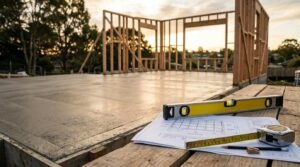
A concrete slab foundation is a continuous reinforced concrete platform poured directly onto prepared ground. It serves simultaneously as the structural foundation and the floor of the extension, eliminating the need for a separate subfloor system.
What Is a Concrete Slab Foundation?
A slab foundation consists of a reinforced concrete pad typically 100mm to 150mm thick in the field, with thickened edge beams at the perimeter and under load-bearing walls poured over a prepared sub-base of compacted fill or natural ground. Steel reinforcement mesh or bar is embedded throughout to resist tensile forces and control cracking. In Sydney, slab design must comply with AS 2870 (Residential Slabs and Footings), the standard that classifies sites by soil reactivity and prescribes minimum slab specifications for each classification.
Waffle Pod Slab vs. Conventional Slab
Two slab configurations are used in Sydney residential extensions. A conventional slab uses continuous reinforced concrete with a thickened edge and internal beams cast directly on the ground. A waffle pod slab uses a grid of polystyrene void formers to create a ribbed underside, reducing concrete volume while maintaining structural performance on reactive soils.
Waffle pod slabs are increasingly specified on Class M and Class H1 sites because the ribbed beam grid provides greater resistance to soil movement than a flat slab of equivalent thickness. They cost more to form, but less in concrete volume, and the net cost difference on reactive sites is often negligible. Your structural engineer will specify which configuration suits your site classification.
Drainage and Waterproofing Considerations for Slab Extensions
Drainage beneath and around a slab extension is a detail that is frequently underspecified. Water that pools against the slab edge or saturates the sub-base increases soil moisture variability, the primary driver of reactive clay movement. A well-designed slab extension includes perimeter drainage, a moisture barrier beneath the slab, and site grading that directs surface water away from the foundation.
In Sydney’s wetter western suburbs, we treat sub-slab drainage as a non-negotiable specification item, not an optional upgrade. Omitting it on a Class M or H1 site accelerates the soil movement the slab was engineered to resist.
When Is a Slab Foundation the Right Choice?
Slab foundations are best suited to flat or gently sloping sites with stable, low-reactivity soils. They are the default foundation type for single-storey extensions on Class A and Class S sites under AS 2870 classifications that indicate minimal or slight ground movement potential. Slabs are also preferred when the extension floor level needs to match an existing slab in the original home, and when the construction programme benefits from a fast, single-pour foundation system.
Slabs are not appropriate on steeply sloping sites, where the cost of cut-and-fill earthworks to create a level platform would exceed the cost of a stump or pier system. They are also unsuitable on highly reactive clay soils (Class H1, H2, or E under AS 2870) without significant engineering upgrades to the slab specification.
Slab Foundation Costs in Sydney
In Sydney, a standard reinforced concrete slab for a home extension typically costs between $80 and $150 per square metre for the slab itself, excluding site preparation, formwork, and any earthworks required to level the site. On reactive soil sites requiring an engineered slab design, costs rise to $200 per square metre or more. These figures vary with concrete grade, reinforcement specification, site access, and the complexity of the edge beam design.
Stump Foundations for Home Extensions
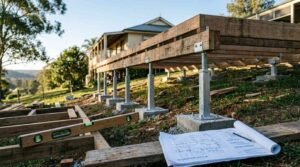
A stump foundation supports the floor structure of an extension on a series of vertical posts stumps that transfer load from the floor bearers down to individual footings in the ground. The result is a raised subfloor space beneath the extension, which is ventilated, accessible for services, and adjustable over time.
What Are Stumps and How Do They Work?
Each stump is a vertical column of timber, steel, or concrete set into a concrete footing cast in the ground. The stumps support horizontal floor bearers, which in turn carry floor joists and the finished floor above. The height of the stumps is varied across the site to create a level floor on a sloping block, making stump systems inherently adaptable to uneven terrain.
The footing at the base of each stump is sized by a structural engineer to distribute the load safely into the bearing stratum below. On sites with poor near-surface soils, footings need to be deepened to reach competent ground, a factor that increases cost but is non-negotiable for structural performance.
Timber vs. Steel vs. Concrete Stumps
Timber stumps were the standard in Sydney residential construction for most of the twentieth century and remain in place under many older homes. Hardwood stumps have a service life of 30–50 years depending on species, soil conditions, and moisture exposure. When an extension is added to an older home with existing timber stumps, the builder must assess whether the existing stumps carry the additional load or whether restumping is required.
Steel stumps, typically galvanised adjustable steel posts, are the modern standard for new stump installations. They are faster to install than concrete, adjustable after installation to correct minor settlement, and have a service life exceeding 50 years in most conditions. Concrete stumps offer the highest load capacity and durability but are more expensive to install and cannot be adjusted after pouring.
When Stumps Are the Preferred Foundation Type
Stumps are the preferred foundation system when the site slopes significantly, when the extension needs to match the subfloor height of an existing stumped home, when the soil profile is variable across the site, or when access beneath the floor for plumbing and electrical services is a priority. They are also the practical choice when the cost of earthworks to create a level slab platform would exceed the cost of a stump system.
On older Sydney homes built on timber stumps, we almost always recommend a stump extension rather than a slab; matching the existing subfloor system avoids differential settlement at the connection point between old and new.
Pier Foundations for Home Extensions
A pier foundation transfers structural loads from the extension down through weak or unstable near-surface soils to a deeper, competent bearing stratum. Piers are the engineered solution for sites where neither a slab nor stumps achieve the required bearing capacity at a practical depth.
What Is a Pier Foundation?
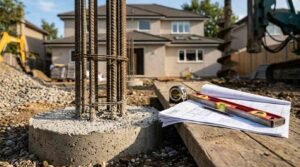
A pier is a deep, narrow structural element, typically a drilled concrete cylinder that extends from the underside of the floor structure or a ground-level pad footing down to rock, dense gravel, or other competent bearing material. The diameter and depth of each pier is determined by a structural engineer based on the load it must carry and the depth at which adequate bearing capacity is found.
In Sydney residential construction, piers are most commonly used in two configurations: drilled concrete piers (also called bored piers or caissons) that extend to rock or dense material, and pad footings isolated concrete pads at the base of each column or stump that spread load across a larger bearing area at a shallower depth.
Drilled Piers vs. Pad Footings: Key Differences
Drilled piers are used when competent bearing material is deep, typically more than 600mm below the surface, and when the near-surface soils are too weak, reactive, or variable to provide reliable support. They require specialist drilling equipment and are the most expensive foundation option per linear metre of construction.
Pad footings are used when competent bearing material is accessible at a shallower depth and when the structural loads are concentrated at discrete column or stump locations rather than distributed along a continuous wall. They are less expensive than drilled piers but require adequate bearing capacity at the footing depth, a condition confirmed by a geotechnical assessment.
When Pier Foundations Are Required in Sydney
Pier foundations are typically specified by a structural engineer when the site has highly reactive clay soils (Class H2 or E under AS 2870), when the site slopes steeply and the extension floor level is significantly above natural ground, when the near-surface soils have been disturbed by fill, tree root activity, or previous construction, or when the extension is two storeys and the loads exceed what a standard slab or stump system safely carries.
Comparing Slab, Stumps, and Piers: Which Foundation Type Suits Your Extension?
No single foundation type is universally superior. The right system for your extension depends on the intersection of your site’s soil conditions, topography, the structural loads involved, your budget, and the requirements of your local council and certifier.
Foundation Type Comparison at a Glance
| Factor | Concrete Slab | Stump System | Pier System |
| Best site type | Flat, stable (Class A/S) | Sloping, variable soils | Reactive clay, poor bearing |
| Soil classes suited | A, S, M (engineered) | S, M, H1 | H1, H2, E |
| Relative cost | Lowest on suitable sites | Moderate | Highest |
| Construction speed | Fast (single pour) | Moderate | Slowest (specialist equipment) |
| Subfloor access | None | Full access | Varies |
| Two-storey suitability | Yes (engineered) | Yes (engineered) | Yes (primary choice) |
Soil Type and Site Conditions
Soil classification under AS 2870 is the primary technical driver of foundation selection. Class A sites have stable, non-reactive soils such as rock, sand, or well-drained gravel and support standard slab designs without special engineering. Class S sites have slightly reactive clay soils and require a moderately engineered slab or standard stump system. Class M sites have moderately reactive clay and require an engineered slab or deeper stump footings. Class H1 and H2 sites have highly reactive clay common across large parts of western and south-western Sydney and typically require either a heavily engineered slab, a stump system with deep footings, or drilled piers. Class E sites are highly reactive and almost always require pier foundations.
Site topography interacts with soil classification. A Class M site that is flat is adequately served by an engineered slab. The same Class M site with a 1.5-metre fall across the extension footprint is better served by stumps, avoiding the cost of significant cut-and-fill earthworks.
Foundation Requirements for Two-Storey Extensions
Two-storey extensions place significantly higher loads on the foundation than single-storey additions. A standard slab or stump system designed for single-storey loads is not automatically adequate for a second storey; the structural engineer must recalculate bearing requirements and specify accordingly.
On Class A and Class S sites, an engineered slab with increased reinforcement and deeper edge beams typically handles two-storey loads. On Class M and above, pier systems are more commonly specified for two-storey work because they bypass the reactive near-surface soils entirely and bear on competent material at depth. We always confirm two-storey load requirements with the structural engineer before finalising any foundation specification.
Budget Considerations Across Foundation Types
As a general orientation, slab foundations are the most cost-efficient on suitable sites, stump systems carry a moderate premium, and pier foundations are the most expensive. However, these relationships invert when site conditions are unfavourable. A slab on a Class H2 site with significant earthworks required costs more than a stump system on the same site. A pier system on a site with rock at 800mm depth costs less than a stump system requiring deep footings through poor near-surface soils.
The most reliable way to compare foundation costs for your specific site is to obtain a geotechnical report first, then ask your builder and structural engineer to price each viable option. Accepting a foundation quote without a geotechnical report is one of the most common causes of cost blowouts in Sydney home extensions.
Council Approval and Engineering Requirements in Sydney
All three foundation types require council or certifier approval as part of the development application or complying development certificate process. In each case, the foundation design must be prepared or reviewed by a structural engineer, and the engineer’s certification must be submitted with the application. The level of engineering documentation required increases with site complexity; a standard slab on a Class A site requires less documentation than a drilled pier system on a Class H2 site.
Soil Testing and Site Assessment Before Choosing a Foundation
The single most important step before specifying a foundation type for your home extension is a geotechnical assessment of the site. Without it, foundation selection is guesswork, and guesswork in foundation engineering is expensive to correct.
Why Soil Classification Matters for Home Extensions
Australian Standard AS 2870 classifies residential sites into six reactivity categories: A, S, M, H1, H2, and E based on the degree to which the soil expands and contracts with changes in moisture content. Each classification prescribes minimum foundation requirements. Building a foundation that is underspecified for the site’s actual classification is a structural risk and a compliance failure.
In Sydney, highly reactive clay soils are widespread, particularly in the western suburbs, Hills District, and parts of the inner west. Homeowners and builders who assume a standard slab is appropriate without testing the soil are frequently surprised when a geotechnical report reveals a Class H1 or H2 classification that requires a significantly more robust foundation design.
Where Reactive Clay Soils Are Most Common in Sydney
Sydney’s reactive clay soils are concentrated in specific geographic bands. The western suburbs, including Parramatta, Blacktown, Penrith, and the Hills District, sit predominantly on Class M to H2 soils. The inner west, including Strathfield, Burwood, and Ashfield, has significant pockets of Class H1 clay. The northern suburbs and eastern beaches are more commonly Class A to S, underlain by sandstone and well-drained sandy soils.
This geography matters because a builder quoting a standard slab for a Blacktown extension without a geotechnical report is almost certainly underspecifying the foundation. We always obtain a soil classification before pricing any extension in the western or inner-western suburbs.
What a Geotechnical Report Covers
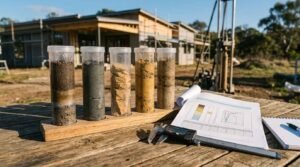
A geotechnical report for a residential extension site typically includes soil profile descriptions from test bores or pits, laboratory testing of soil samples for plasticity and reactivity, a site classification under AS 2870, and recommendations for foundation type and minimum specification. The report is prepared by a geotechnical engineer and typically costs between $800 and $2,500 in Sydney depending on the number of test locations and the complexity of the site.
The report is submitted to the structural engineer, who uses it to design the foundation system. It is also submitted to council or the certifier as part of the approval documentation. Obtaining a geotechnical report before finalising your extension design, not after, allows the foundation type and specification to be incorporated into the design from the outset, avoiding costly redesign later.
Foundation Costs for Home Extensions in Sydney
Foundation costs are one of the most variable line items in a home extension budget. The range between a straightforward slab on a flat, stable site and a drilled pier system on a reactive clay slope is substantial, and the difference is almost entirely driven by site conditions rather than builder margin.
Cost Summary by Foundation Type (Sydney, 2025–2026)
| Foundation Type | Typical Total Cost (40–60m²) | Cost per m² (slab) | Key Cost Driver |
| Standard concrete slab | $6,000–$15,000 | $80–$150/m² | Site preparation, earthworks |
| Engineered slab (reactive soil) | $18,000–$25,000+ | $200+/m² | Reinforcement, beam depth |
| Stump system | $12,000–$22,000 | N/A | Stump material, footing depth |
| Pier system (drilled) | $15,000–$35,000+ | N/A | Drilling depth, bearing stratum |
Typical Cost Ranges by Foundation Type
As a general guide for Sydney home extensions in 2025–2026, concrete slab foundations on standard sites typically range from $80 to $150 per square metre for the slab construction itself, with total foundation costs for a 40–60 square metre extension falling between $6,000 and $15,000 depending on site preparation requirements. Engineered slabs on reactive soil sites push this to $18,000–$25,000 or more for the same footprint.
Stump systems for a comparable extension typically range from $12,000 to $22,000, with the variation driven by stump material (steel vs. concrete), footing depth, site access, and whether restumping of the existing structure is required. Pier systems, particularly drilled concrete piers, typically start at $15,000 for a simple extension and reach $35,000 or more on complex sites with deep bearing requirements.
These figures are orientation-level estimates. Actual costs depend on the specific site, the structural engineer’s design, the builder’s methodology, and current material and labour pricing in Sydney.
What Drives Foundation Cost Variations
Five factors account for the majority of foundation cost variation in Sydney home extensions. Soil classification is the most significant; reactive clay soils require more robust foundation designs that cost more to build. Site topography determines whether earthworks are needed to create a level platform for a slab, or whether a stump or pier system works with the natural slope. Access affects the cost of delivering materials and operating equipment; tight inner-city sites with no vehicle access cost more to build on than open suburban blocks. Footing depth is driven by the depth to competent bearing material; deeper footings require more concrete, more labour, and in the case of piers, more drilling time. Engineering complexity reflects the number of load-bearing walls, the presence of two storeys, and any unusual structural conditions at the connection between the extension and the existing building.
Foundation work typically represents 10–20% of a home extension’s total construction budget.
Building Regulations and Engineering Requirements for Extension Foundations in Sydney
Home extension foundations in New South Wales are subject to a layered regulatory framework that combines national construction standards, Australian Standards, and local council requirements. Understanding this framework helps homeowners engage more effectively with their builder, structural engineer, and certifier.
NCC and AS 2870 Compliance
The National Construction Code (NCC) sets the performance requirements for all residential construction in Australia, including foundations. For residential slabs and footings, AS 2870 is the primary referenced standard; it prescribes minimum foundation specifications for each soil classification and provides the technical basis for structural engineer designs. Compliance with AS 2870 is not optional; it is a legal requirement for all new residential foundation work in NSW.
The NCC also requires that foundation work be carried out by or under the supervision of a licensed builder, and that the completed work be inspected and certified at mandatory hold points during construction. In NSW, these inspections are carried out by a private certifier or council building inspector, depending on the approval pathway used.
Structural Engineer Sign-Off Requirements
For most home extension foundations in Sydney, a structural engineer’s design and certification is required. The engineer prepares the foundation design based on the geotechnical report and the structural loads from the extension design, and certifies that the design complies with the NCC and AS 2870. This certification is submitted with the development application or complying development certificate application.
During construction, the structural engineer is required to inspect the foundation at key stages, typically after excavation and before concrete is poured to confirm that actual site conditions match the assumptions in the design. If conditions differ materially from the geotechnical report, the engineer requires a design variation, which affects both cost and programme.
What Happens at Foundation Inspection Hold Points
A hold point is a mandatory pause in construction where work cannot proceed until an inspection is completed and signed off. For home extension foundations in NSW, the standard hold points are: after excavation is complete and before any reinforcement is placed (to confirm soil conditions match the geotechnical report), after reinforcement is placed and before concrete is poured (to confirm steel placement matches the engineer’s design), and after the concrete pour and initial cure (to confirm no defects before framing begins).
Missing a hold point or pouring concrete before the engineer has inspected is a compliance failure that requires the concrete to be broken out and the work redone. We schedule hold point inspections as fixed milestones in every project programme, not as afterthoughts.

How to Choose the Right Foundation for Your Sydney Home Extension
Choosing a foundation type is not a decision homeowners make in isolation. It is a collaborative process involving a geotechnical engineer, a structural engineer, and a builder, each contributing a different layer of expertise. But homeowners who understand the decision framework are better positioned to ask the right questions, evaluate competing proposals, and avoid the most common mistakes.
Questions to Ask Your Builder Before Foundation Work Begins
Before accepting any foundation proposal, ask your builder to confirm that a geotechnical report has been obtained or is planned. Ask which soil classification the site has been assigned and how that classification has influenced the foundation specification. Ask whether the structural engineer has reviewed the geotechnical report and prepared a site-specific foundation design, or whether the builder is using a generic specification. Ask what the inspection hold points are and who will carry out the inspections. Ask what happens and what it costs if actual site conditions differ from the geotechnical report assumptions.
A builder who cannot answer these questions clearly, or who proposes to proceed without a geotechnical report, is a significant risk to your project.
Red Flags in Foundation Quotes and Contractor Proposals
The most common red flag in foundation quotes is a price that is significantly lower than comparable quotes without a clear explanation of why. Low foundation quotes frequently reflect underspecification of a standard slab proposed for a site that requires an engineered slab, or shallow footings proposed for a site that requires deeper bearing. The cost saving at quote stage becomes a cost blowout during construction when actual site conditions force a design variation.
Other red flags include quotes that do not reference a geotechnical report, foundation specifications that do not reference AS 2870 or a structural engineer’s design, and builders who are unable to explain the basis for their foundation specification in plain language.
Working With a Builder on Home Extension Foundations in Sydney
The quality of your home extension foundation depends as much on the builder’s understanding of foundation engineering as it does on the structural engineer’s design. A well-designed foundation is still poorly constructed if the builder delivers inadequate compaction, incorrect reinforcement placement, or concrete poured before the engineer’s inspection hold point is cleared.
Choosing a builder for your extension means choosing someone who understands not just how to build a foundation, but why each specification decision has been made and what the consequences of cutting corners are. It means choosing a builder who coordinates proactively with the geotechnical engineer, the structural engineer, and the certifier not one who treats engineering documentation as an administrative burden to be managed after the fact.
In Sydney, the most reliable indicators of a builder’s foundation competence are these five: they require a geotechnical report before pricing; they engage a structural engineer to review the report and prepare a site-specific design; they schedule and attend mandatory inspection hold points; they communicate clearly when site conditions differ from the design assumptions; and they provide a written record of every hold point inspection and sign-off.
We apply all five on every extension project we manage because the foundation is the one part of the build that cannot be fixed after the fact without tearing out everything above it.
Conclusion
Slab, stump, and pier foundations each serve a distinct structural purpose, and the right choice for your Sydney home extension depends on soil classification, site topography, structural loads, and budget, not on convention or the cheapest quote available.
This guide equips you to understand what each system does, when it is appropriate, what it costs, and what questions to ask before accepting any foundation proposal. That knowledge is the difference between a project that stays on budget and one that blows out at the footing stage.
When you are ready to move forward, we at Sydney Home Renovation bring the construction expertise, engineering coordination, and transparent cost planning your extension project needs to get the foundation right from day one.
Frequently Asked Questions
What is the most common foundation type used for home extensions in Sydney?
Concrete slab foundations are the most common system for single-storey extensions on flat or gently sloping sites. They suit Class A and Class S soils under AS 2870 and are cost-efficient to construct.
How do I know which foundation type is right for my site?
A geotechnical report classifies your site under AS 2870 and identifies which foundation types are structurally appropriate. We use that report to design the system that matches your site conditions and structural loads.
Do I need a structural engineer for a home extension foundation in Sydney?
Yes. In NSW, a structural engineer’s design and certification is required for home extension foundations as part of the DA or CDC process. The engineer certifies compliance with the NCC and AS 2870.
What is the difference between a slab and a pier foundation for a home extension?
A slab is a continuous reinforced concrete platform poured at ground level, suited to flat, stable sites. A pier foundation uses deep concrete columns to transfer loads through weak soils to a competent bearing stratum on reactive clay or poor-bearing sites.
How much does a home extension foundation cost in Sydney?
Foundation costs in Sydney range from $6,000 to $35,000 or more depending on foundation type, site conditions, and extension size. Slabs on standard sites are the most cost-efficient; drilled pier systems on reactive clay carry the highest cost.
Can I add a home extension to a house that already has stump foundations?
Yes, but the existing stumps must be assessed for their capacity to carry the additional load. In many cases, the extension is built on new stumps matching the existing subfloor height, and existing stumps are upgraded or replaced if deteriorated or undersized.
What happens if the soil conditions are different from what the geotechnical report predicted?
The structural engineer reviews the design and requires a variation if conditions differ materially. This affects both cost and programme and is one of the most common causes of budget overruns, which is why a thorough geotechnical investigation before construction begins is essential.