A double vanity transforms a shared bathroom but only when the space, the plumbing, and the daily routine actually call for it. Get the fit wrong, and you end up with a cramped room and a vanity that eats more space than it earns. Get it right, and it becomes one of the most used, most appreciated upgrades in the whole house.
I see this decision come up constantly on Sydney bathroom renovations. Homeowners want the look, but they’re not always sure the layout supports it.
This guide covers when a double vanity genuinely makes sense, when it doesn’t, what sizes and designs work in real Sydney bathrooms, and what the installation actually costs.
What Is a Double Vanity (and Why It’s Not Just About Space)
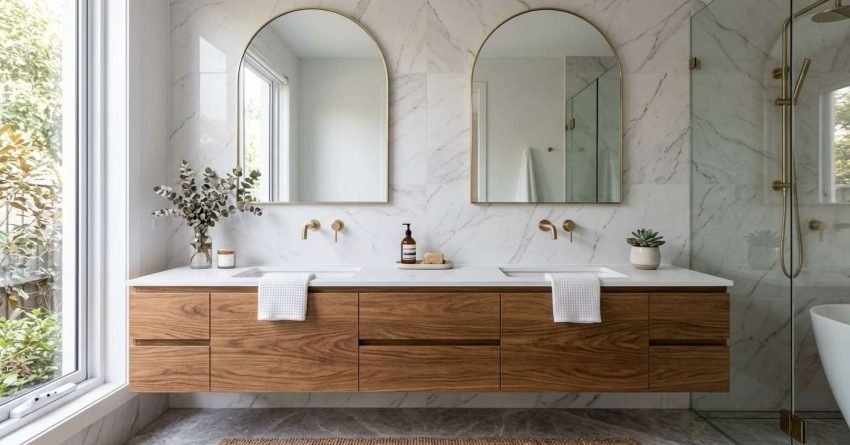
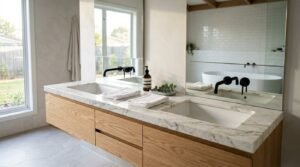
A double vanity is a bathroom vanity unit fitted with two basins and two sets of tapware, typically sharing a single benchtop and a unified cabinet below. It sits against one wall and gives two people independent sink access within the same bathroom footprint.
The appeal goes beyond aesthetics. It’s a functional solution to a real daily problem: two people, one bathroom, one sink, and a morning routine that turns into a bottleneck.
The Core Function: Two Sinks, One Shared Bathroom
The primary job of a double vanity is to eliminate the queue. Two people brush teeth, wash faces, and get ready simultaneously without negotiating mirror time or sink access.
That sounds simple. But in a household where two adults share a master bathroom, it changes the rhythm of the whole morning.
When a Single Vanity Simply Isn’t Enough
A single vanity works fine for one person or for a bathroom that sees light, infrequent use. The moment two adults share a bathroom daily, a single basin creates friction, especially in a master ensuite where both people are getting ready at the same time.
The double vanity solves that friction directly. It’s not a luxury upgrade for its own sake. It’s a functional response to a real usage pattern.
When a Double Vanity Actually Makes Sense
The right conditions make a double vanity one of the best investments in a bathroom renovation. The wrong conditions make it a space problem you’ll regret.
Shared Master Bathrooms and Morning Routines
The strongest case for a double vanity is a master bathroom shared by two adults with overlapping morning schedules. If both people are getting ready for work at the same time, a second sink pays for itself in daily convenience within the first week.
It also matters for couples where one person has a longer grooming routine. The second sink gives the other person access without interrupting the process.
Bathroom Size Requirements: The Minimum You Need
A double vanity needs room to breathe. The vanity itself typically runs 1200mm to 1800mm wide, and you need at least 900mm of clear floor space in front of it for comfortable use.
That means your bathroom wall needs to accommodate the vanity width plus any side clearances, and the room needs enough depth to keep the space functional rather than cramped. A bathroom under 2.4 metres wide will struggle to carry a double vanity without feeling tight.
Resale Value and Buyer Appeal in Sydney Homes
A well-designed double vanity in a master bathroom is a genuine selling point in the Sydney property market. Buyers notice it. It signals that the bathroom was designed for real daily use, not just for appearance.
For property investors and owner-occupiers planning to sell, a double vanity in the master ensuite consistently ranks as one of the higher-return bathroom upgrades, particularly in family homes and premium apartments where buyers expect it.
When a Double Vanity Is the Wrong Call
Knowing when NOT to install a double vanity saves you money, space, and a renovation you’ll want to undo.
Small Bathrooms Where Space Is Already Tight
Forcing a double vanity into a bathroom that can’t support the width creates a room that feels claustrophobic. The vanity dominates the space, the clearances shrink, and the bathroom becomes harder to use, not easier.
In a smaller bathroom, a well-designed single vanity with smart storage does more for the space than a double vanity that overwhelms it. Proportion matters more than the number of sinks.
Single-Occupant Bathrooms and Guest Ensuites
A guest bathroom or a single-occupant ensuite has no daily need for two sinks. Installing a double vanity there wastes both space and budget on a feature that adds no functional value for how the room is actually used.
Redirect that budget toward better materials, a larger shower, or improved storage. Those upgrades will serve the space better than a second basin that never gets used.
Double Vanity Sizes: What Fits and What Doesn’t
Getting the size right is the difference between a vanity that works and one that makes the bathroom feel wrong.
Standard Width Ranges and Clearance Rules
Double vanities in Australian bathrooms typically run from 1200mm to 1800mm wide. The 1200mm option fits two basins but keeps them close and workable, but not generous. The 1500mm to 1800mm range gives each person real elbow room and allows for better storage below.
Clearance rules matter just as much as the vanity width itself. You need a minimum of 900mm of clear floor space in front of the vanity, and at least 150mm between the edge of the vanity and any adjacent wall or fixture. These aren’t suggestions; they’re the measurements that determine whether the bathroom feels functional or frustrating.
Custom vs. Freestanding vs. Wall-Hung Options
Wall-hung double vanities are the most popular choice in contemporary Sydney bathrooms. They float off the floor, make the room feel larger, simplify cleaning underneath, and allow height adjustment during installation, which matters more than most people expect.
Freestanding vanities sit on legs or a full base and suit more traditional or transitional bathroom styles. They’re generally easier to install but harder to clean around.
Custom-built vanities give you full control over width, depth, storage configuration, and finish. They cost more, but in a bathroom with non-standard dimensions or a specific design brief, a custom unit is often the only way to get the result right.
Double Vanity Design Ideas for Sydney Bathrooms
Design is where a double vanity goes from functional to genuinely impressive. These are the combinations I see working consistently well in Sydney renovations.
Floating Double Vanities for a Modern Look
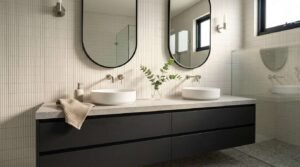
A wall-hung double vanity in a matte-finish white, charcoal, or a warm timber veneer is the most requested look in contemporary Sydney bathrooms right now. It reads as clean, considered, and current without trying too hard.
Pair it with a honed stone benchtop and the combination holds up for years without dating.
Timber and Stone Combinations
Warm timber cabinetry against a stone or stone-look benchtop is one of the most enduring combinations in bathroom design. It brings texture and warmth into a space that can otherwise feel cold and clinical.
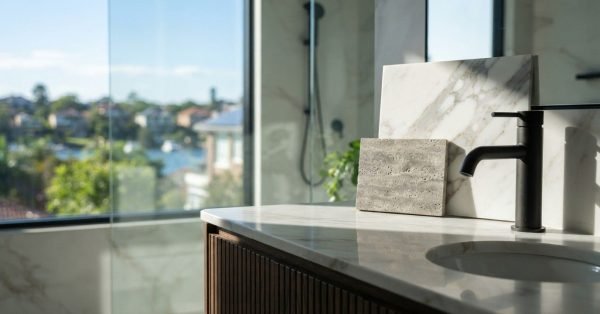
In Sydney bathrooms, this combination works particularly well with brushed brass or matte black tapware. The contrast between warm and cool tones gives the vanity visual depth without overcomplicating the design.
Mirror Configurations: Single Slab vs. Two Mirrors
The mirror decision shapes the whole feel of the vanity wall. A single large mirror running the full width of the double vanity creates a seamless, expansive look and makes the bathroom feel bigger.
Two individual mirrors, one centred over each basin, give each person their own defined space and allow for different heights if needed. Both approaches work. The choice comes down to the overall design direction and whether the bathroom has room for a full-width mirror without it feeling overwhelming.
Storage Solutions Built Into the Vanity Design
A double vanity with well-designed storage below is significantly more useful than one that looks good but leaves nowhere to put anything. Drawers outperform doors in bathroom vanities; they give you full access to the cabinet depth without crouching and reaching.
Divided drawers, pull-out organisers, and dedicated spaces for each person’s products make the vanity work harder every day. Build the storage into the design brief from the start, not as an afterthought.
Materials, Finishes, and Fittings That Work Together
The materials you choose determine how the vanity looks on day one and how it holds up over years of daily use.
Benchtop Materials: Stone, Laminate, and Solid Surface
Engineered stone is the most popular benchtop choice for double vanities in Sydney bathrooms. It’s durable, water-resistant, available in a wide range of colours and finishes, and holds up well in a high-use environment.
Laminate benchtops cost significantly less and have improved considerably in quality and appearance. They suit mid-range renovations where budget is a real constraint. Solid surface materials like Corian offer seamless integrated basin options and are worth considering when the design calls for a cleaner, more minimal look.
Basin Styles: Undermount, Above-Counter, and Integrated
Undermount basins sit below the benchtop surface, creating a clean line and making the benchtop easy to wipe down. They’re the most practical choice for a double vanity that sees daily use.
Above-counter basins sit on top of the benchtop and make a stronger visual statement. They work well in design-forward bathrooms but require more careful cleaning around the base. Integrated basins, where the basin and benchtop are formed from the same material, give the cleanest look of all and are increasingly popular in contemporary Sydney renovations.
Tapware Finishes That Tie the Design Together
Tapware finish is the detail that pulls the whole vanity together or makes it feel inconsistent. Matte black, brushed nickel, and brushed brass are the three finishes I see working most consistently in Sydney bathrooms right now.
The rule is simple: pick one finish and use it across every fitting in the bathroom tapware, shower fittings, towel rails, and accessories. Mixing finishes without a clear intention reads as unresolved. Committing to one finish reads as designed.
Double Vanity Installation: What the Process Looks Like
Installation is more involved than most homeowners expect, particularly when it comes to the plumbing.
Plumbing Considerations for Two Basins
A double vanity requires two waste connections and two sets of water supply lines, hot and cold for each basin. In a bathroom that previously had a single vanity, this means extending or reconfiguring the existing plumbing rough-in.
The complexity depends on how far the new basin positions sit from the existing waste stack and supply lines. In some bathrooms, the plumbing extension is straightforward. In others, particularly older Sydney homes with cast iron or galvanised pipes, it requires more significant work. A licensed plumber assesses this before the vanity goes in, not after.
What a Bathroom Renovation Contractor Handles
A full bathroom renovation contractor coordinates the entire double vanity installation: demolition of the existing vanity, plumbing reconfiguration, waterproofing where required, vanity installation, benchtop fitting, basin and tapware installation, and final connection.
We handle every trade involved so the project runs as a single coordinated process rather than a series of separate bookings. That coordination is what keeps the timeline tight and the result consistent.
How Much Does a Double Vanity Cost in Sydney?
Cost varies significantly depending on the vanity itself, the benchtop material, the basin style, and the complexity of the plumbing work required.
Supply-Only vs. Supply and Install Pricing
A supply-only double vanity in Sydney ranges from around $800 for a basic flat-pack unit to $4,000 or more for a premium custom or semi-custom option. That’s the vanity cabinet alone — before benchtop, basins, tapware, or installation.
Supply and install pricing covering the vanity, benchtop, basins, tapware, and all labour typically runs from $3,500 to $8,000 for a mid-range double vanity installation in a Sydney bathroom. Complex plumbing reconfiguration, premium materials, or custom cabinetry push that figure higher.
Where the Budget Goes: Labour, Fittings, and Benchtop
The benchtop is often the single largest cost variable. An engineered stone benchtop for a 1500mm double vanity adds $800 to $2,000 depending on the stone selected and the fabrication complexity.
Labour covering the plumber, the installer, and any tiling or waterproofing work typically accounts for 40 to 50 percent of the total project cost. Tapware for two basins from a quality brand adds another $400 to $1,200. Understanding where the budget goes helps you make smarter decisions about where to spend and where to save.
Conclusion
A double vanity earns its place in a shared master bathroom with the right dimensions and a clear daily need for two sinks. Without those conditions, it’s a cost and a space problem dressed up as an upgrade.
The design possibilities are genuinely strong: floating cabinetry, stone benchtops, integrated basins, and considered tapware finishes all combine to make a double vanity one of the most visually impactful elements in a bathroom renovation.
At Sydney Home Renovation, we plan and install double vanities as part of complete bathroom renovations, handling the plumbing, the cabinetry, the benchtop, and every fitting so the result is exactly what you planned. Get in touch, and we’ll help you work out whether a double vanity is the right call for your bathroom.
Frequently Asked Questions
What size bathroom do I need for a double vanity?
You need enough wall space to fit a vanity between 1200mm and 1800mm wide, plus at least 900mm of clear floor space in front of it. Most bathrooms under 2.4 metres wide will struggle to carry a double vanity comfortably.
Does a double vanity add value to a home?
Yes, in a master bathroom shared by two adults, a double vanity consistently ranks as a high-return upgrade. Sydney buyers notice it, and it signals a bathroom designed for real daily use rather than appearance alone.
Can I add a second sink to my existing vanity?
It depends on the vanity width and the existing plumbing rough-in. Some vanities can be modified, but most single vanity units aren’t designed to carry a second basin. A new double vanity unit is usually the more practical and better-looking solution.
What is the standard depth of a double vanity?
Standard double vanity depth in Australian bathrooms runs between 450mm and 550mm. Shallower vanities suit tighter spaces but offer less storage below. Deeper vanities give more cabinet space and a more substantial benchtop surface.
How long does it take to install a double vanity?
A straightforward double vanity installation where the plumbing rough-in is already in the right position takes one to two days. If plumbing reconfiguration is required, allow two to three days for the full installation process.
Are double vanities worth it for a single person?
Rarely. A single-occupant bathroom gets no functional benefit from two sinks. The budget is better spent on a well-designed single vanity with better storage, a quality benchtop, or upgraded tapware.
What’s the difference between a double vanity and a double basin vanity?
They’re the same thing. Both terms describe a vanity unit fitted with two basins and two sets of tapware. “Double vanity” is the more common term in Australia; “double basin vanity” is used interchangeably.