What Is the ROI on a Bathroom Renovation

Table of Contents
bathroom renovation before and after showing increased home value and return on investment

Bathroom renovations in Sydney typically deliver 60–80% ROI at resale, though returns vary significantly based on renovation scope, property type, and market conditions. For owner-occupiers, the value extends beyond resale improved functionality, reduced maintenance costs, and enhanced daily living create substantial long-term benefits that pure ROI calculations miss.

Understanding bathroom renovation ROI helps us make smarter financial decisions, prioritise value-adding upgrades, and avoid overcapitalisation. Whether we’re preparing to sell, improving rental yield, or simply upgrading our home, knowing realistic return expectations prevents costly mistakes and guides budget allocation.

This guide breaks down actual ROI figures for Sydney bathrooms, explains what influences returns, compares outcomes across renovation types, and reveals which upgrades deliver maximum value.

Brushed gold bathroom faucet on a white marble vanity with house keys and home design photos in a modern luxury bathroom renovation

Understanding Bathroom Renovation ROI in Sydney

What ROI Means for Bathroom Renovations

Return on investment (ROI) measures the financial return we receive relative to our renovation spend. The basic formula divides the property value increase by total renovation costs, expressed as a percentage. A $25,000 bathroom renovation that adds $20,000 to property value delivers 80% ROI  we recover 80 cents for every dollar spent.

Bathroom ROI calculations involve more complexity than simple arithmetic. Property valuation research shows bathroom improvements contribute to overall property appeal, influencing buyer perception and sale speed beyond direct dollar-for-dollar value addition. A well-executed renovation can reduce time on market by 15–20 days, creating indirect financial benefits through reduced holding costs and stronger negotiating positions.

Immediate ROI occurs at sale, while long-term ROI accumulates through reduced maintenance expenses, lower utility bills from efficient fixtures, and avoided emergency repairs. Owner-occupiers experience ongoing value through improved functionality and comfort  genuine financial and lifestyle returns that don’t appear in traditional ROI metrics.

Average ROI Figures for Sydney Bathrooms

CoreLogic data indicates Sydney bathroom renovations average 65–75% ROI at resale, with significant variation based on property price point and renovation quality. Mid-range renovations ($20,000–$35,000) typically achieve the highest percentage returns, while budget updates under $15,000 and luxury renovations exceeding $50,000 often deliver lower ROI percentages.

Sydney’s inner suburbs show stronger bathroom ROI than outer areas, reflecting buyer expectations and property price points. A bathroom renovation in Mosman or Woollahra returns 70–85%, while similar work in Western Sydney suburbs averages 55–65%. This disparity stems from buyer demographics, property values, and market competition rather than renovation quality differences.

Investment properties experience different ROI patterns. Renovated bathrooms can increase weekly rent by $30–$60 in Sydney, creating a 4–6% annual yield improvement on typical renovation costs. For a $25,000 renovation generating $50 additional weekly rent, the annual return reaches 10.4%  recovered within 10 years through rental income alone.

How ROI Differs from Cost Recovery

Cost recovery measures the absolute dollar amount recouped, while ROI expresses this as a percentage of investment. A $40,000 renovation recovering $32,000 achieves 80% ROI but represents an $8,000 loss in pure cost recovery terms. Most bathroom projects don’t generate profit  they minimise loss while adding value.

Break-even renovations (100% cost recovery) rarely occur in bathrooms unless addressing severe defects that actively reduce property value. Real estate agent surveys indicate dated or damaged bathrooms reduce property values by 5–8%, meaning renovation primarily prevents value loss rather than creating new value.

Homeowners planning to sell within 2–3 years benefit most from high-ROI cosmetic updates, while those staying 5–10+ years can justify lower-ROI structural improvements. ATO depreciation schedules allow bathroom renovation costs to be claimed over 40 years for building works and 5–15 years for fixtures, creating tax benefits that improve effective ROI beyond simple resale calculations.

Luxury modern bathroom with freestanding marble bathtub, glass walk-in shower, floating wood vanity, and marble flooring in a contemporary home renovation

Factors That Influence Bathroom Renovation ROI

Property Type and Location Impact

Property type fundamentally shapes bathroom renovation ROI expectations. Apartment bathrooms in Sydney typically achieve 55–70% ROI, lower than houses due to strata restrictions, smaller spaces, and buyer expectations for modern bathrooms as standard. Period homes and character properties can achieve 75–90% ROI when bathrooms are sympathetically updated to match architectural style while adding modern functionality.

Location within Sydney creates 15–25 percentage point ROI variations. A $35,000 bathroom renovation in Bondi returns $28,000–$31,500 (80–90% ROI), while identical work in Campbelltown returns $21,000–$24,500 (60–70% ROI)  not because the work quality differs, but because property price points and buyer expectations vary dramatically.

The table below maps typical bathroom renovation ROI by Sydney region:

Sydney RegionExample SuburbsTypical Bathroom ROI
Inner ring (0–10 km)Bondi, Mosman, Newtown, Surry Hills75–90%
Middle ring (10–20 km)Parramatta, Ryde, Hurstville, Manly65–75%
Outer ring (20+ km)Campbelltown, Penrith, Liverpool, Blacktown55–65%

Proximity to amenities, school zones, and transport infrastructure influences bathroom ROI indirectly. Properties in high-demand areas with limited supply see stronger returns on all renovations because buyers compete more aggressively and scrutinise property condition more carefully.

Scope of Renovation Work

Renovation scope directly correlates with ROI percentages, following a curve where mid-range work delivers optimal returns. Industry benchmarking data shows cosmetic updates ($8,000–$15,000) achieve 70–85% ROI, mid-range renovations ($20,000–$35,000) reach 65–75% ROI, and luxury renovations ($50,000+) drop to 50–65% ROI.

Structural changes like relocating plumbing, removing walls, or adding ensuites create lower immediate ROI (45–60%) but solve functional problems that severely impact property value if unaddressed. A poorly configured bathroom in a 4-bedroom house with only one bathroom can reduce property value by 10–15%, making structural renovation financially justified despite lower percentage returns.

Partial renovations  updating fixtures while retaining existing layout and tiles  deliver 75–90% ROI when executed well. Buyer perception studies indicate cohesive, fully renovated bathrooms add more value than superior partial updates, suggesting complete mid-range renovations outperform partial luxury upgrades in most scenarios.

Quality of Materials and Finishes

Material quality creates a J-shaped ROI curve  very low quality reduces returns, mid-range maximises returns, and ultra-premium reduces returns again. A bathroom using builder-grade materials ($150–$250/m² for tiles) achieves 60–70% ROI, while mid-range materials ($300–$500/m²) reach 70–80% ROI, and luxury materials ($800+/m²) drop to 55–65% ROI.

Porcelain tiles and quality tapware lasting 15–20 years without replacement create better total ROI than cheaper alternatives requiring replacement every 5–7 years. For owner-occupiers and long-term investors, material longevity directly impacts effective ROI through reduced lifecycle costs.

Bathroom fixtures from recognised brands like Caroma, Reece, or Methven add perceived value, but ultra-premium European brands deliver diminishing returns unless the overall property price point justifies luxury expectations. A $3,000 designer tapware set in a $900,000 property won’t recover costs, while the same fixture in a $3 million property meets buyer expectations and contributes to overall value perception.

Current Bathroom Condition

Starting condition dramatically affects achievable ROI. Renovating a severely dated or damaged bathroom (original 1970s–1980s fixtures, water damage, mould) can achieve 80–100% ROI because the existing condition actively reduces property value. The renovation prevents value loss rather than purely adding value.

Functional bathrooms with cosmetic age present the most challenging ROI scenarios. Buyers discount these properties by 3–5% for dated aesthetics, but renovation costs often exceed the value recovery. A $25,000 cosmetic update on a $1.1 million property addresses a $33,000–$55,000 perceived value reduction, delivering 132–220% effective ROI when accounting for prevented loss.

Recently renovated bathrooms (less than 5 years old) offer minimal ROI from further updates unless addressing specific defects or style mismatches. Over-renovating by replacing functional, modern bathrooms yields 30–50% ROI because buyers don’t value the change proportionally to costs.

Modern bathroom renovation featuring a marble vanity, black wall-mounted faucet, round mirror, herringbone tile wall, and frameless glass shower

Typical ROI by Renovation Type

Cosmetic Updates and Refreshes

Cosmetic refreshes deliver the highest ROI percentages at 75–90% while requiring $8,000–$15,000 investment. These updates address buyer perception without structural complexity, making them ideal for pre-sale renovations or rental property improvements.

High-impact cosmetic updates include:

  • Tapware replacement ($800–$1,500): Modern mixers and showerheads create immediate visual improvement
  • Vanity refresh or replacement ($1,200–$3,500): New vanity transforms bathroom appearance disproportionately to cost
  • Mirror and lighting upgrades ($600–$1,800): Improved lighting and larger mirrors enhance functionality and perceived space
  • Re-grouting and caulking ($400–$800): Fresh grout lines make tiles appear new
  • Paint and ventilation ($500–$1,200): Ceiling paint and upgraded exhaust fans address common deterioration points

Real estate staging data shows cosmetically refreshed bathrooms photograph significantly better than dated originals, increasing online inquiry rates by 25–40% and shortening sale timelines. The indirect ROI from faster sales often exceeds the direct value addition from the cosmetic work itself.

Cosmetic updates work best when underlying structure, layout, and major fixtures remain functional. Building inspections reveal underlying issues regardless of surface presentation, making cosmetic-only approaches risky when fundamental problems exist.

Mid-Range Bathroom Renovations

Mid-range renovations ($20,000–$35,000) represent the ROI sweet spot, achieving 65–75% returns while delivering comprehensive updates that meet modern buyer expectations. These renovations typically include complete retiling, new fixtures, updated plumbing, improved lighting, and quality finishes without luxury materials or structural changes.

Typical mid-range renovation scope:

  • Full retiling (floor and walls): $6,000–$10,000
  • New toilet, vanity, and basin: $2,500–$4,500
  • Shower screen and fixtures: $2,000–$3,500
  • Tapware and accessories: $1,500–$2,500
  • Lighting and ventilation: $1,200–$2,000
  • Labour and project management: $8,000–$14,000

Market analysis shows mid-range bathrooms align with buyer expectations across $800,000–$1.5 million Sydney properties  the largest market segment. A $28,000 mid-range renovation adds approximately $18,000–$21,000 to property value while eliminating a dated bathroom that reduces value by $25,000–$35,000.

High-End Luxury Bathroom Upgrades

Luxury renovations exceeding $50,000 deliver lower ROI percentages (50–65%) but create absolute value additions that matter in premium property markets. High-end bathrooms featuring designer tiles, premium fixtures, custom joinery, heated floors, and spa-like amenities appeal to specific buyer segments willing to pay premiums for exceptional quality.

Luxury renovation elements:

  • Premium imported tiles: $800–$1,500/m²
  • Designer tapware and fixtures: $4,000–$8,000
  • Custom vanity and joinery: $6,000–$12,000
  • Underfloor heating: $2,500–$4,500
  • High-end shower systems: $3,500–$7,000
  • Specialty lighting and automation: $2,000–$4,000

Buyers of $2.5 million+ properties expect exceptional bathrooms as standard, making luxury renovations necessary to compete rather than optional value-adds. In this context, the 50–65% ROI represents competitive positioning rather than poor investment.

Adding an Ensuite: ROI Considerations

Adding an ensuite to a master bedroom is one of the highest-impact structural renovations in Sydney, typically costing $25,000–$45,000 and delivering 55–75% direct ROI at resale. The financial case is strongest in 3–4 bedroom homes where the absence of an ensuite creates a clear market disadvantage.

Properties without an ensuite in Sydney’s $900,000–$1.5 million price bracket can be discounted by $40,000–$80,000 relative to comparable properties that have one. A $35,000 ensuite addition that prevents a $50,000 value discount delivers 143% effective ROI when prevented loss is included in the calculation.

The ROI on ensuite additions improves significantly in inner-ring suburbs where buyer expectations are highest. We see the strongest returns in properties where the existing bathroom count (one) creates a genuine functional gap relative to competing listings.

Luxury bathroom renovation with freestanding soaking tub, double vanity, walk-in glass shower, and bathroom remodeling plans on a modern countertop

ROI for Owner-Occupiers vs Property Investors

Value-in-Use for Homeowners

Owner-occupiers experience bathroom ROI differently than investors because we capture ongoing use value throughout ownership, not just resale value. Quality of life improvements  better functionality, improved aesthetics, enhanced comfort  create daily benefits that accumulate over years.

Non-financial owner-occupier benefits include:

  • Improved daily functionality: Better storage, lighting, and layout reduce frustration
  • Enhanced comfort: Modern fixtures, better temperature control, improved ventilation
  • Reduced maintenance burden: New fixtures and finishes require less upkeep
  • Energy and water efficiency: Modern fixtures reduce ongoing utility costs
  • Health and safety: Improved ventilation, slip-resistant surfaces, better lighting

Homeowner satisfaction research shows bathroom renovations rank among the highest satisfaction improvements, with 87% of homeowners reporting they would renovate again despite modest financial ROI. Using an improved bathroom 700+ times annually creates cumulative benefit that pure financial metrics don’t capture.

A $30,000 bathroom renovation used for 10 years before selling costs $3,000 annually for the improved experience, plus recovers $19,500–$22,500 (65–75% ROI) at sale. The total net cost of $7,500–$10,500 over 10 years represents reasonable expense for daily quality-of-life improvement.

Rental Yield Impact for Investors

Investment property bathroom renovations create ROI through increased rental income and improved tenant quality, not just property value appreciation. Renovated bathrooms command $30–$60 weekly rent premiums in Sydney, generating $1,560–$3,120 annual income increase that compounds over time.

Rental yield ROI calculation example:

  • Renovation cost: $25,000
  • Weekly rent increase: $45 ($2,340 annually)
  • Annual yield improvement: 9.36%
  • Payback period: 10.7 years
  • Plus resale value addition: $16,250–$18,750 (65–75% ROI)

Bathroom renovations in high-demand rental areas near universities, hospitals, and transport hubs achieve faster payback through rental premiums. A $28,000 renovation in Newtown or Redfern generates a $60 weekly rent increase, recovering costs in 9 years through rental income alone.

Tenant retention improves with quality bathrooms, reducing vacancy periods and turnover costs. Property management data indicates tenants in properties with renovated bathrooms stay 18–24 months longer on average, saving $2,000–$3,500 in vacancy costs, advertising, and lease-up expenses per tenancy cycle.

Resale Value Considerations

Market cycle timing significantly affects bathroom renovation ROI. Renovations completed during rising markets achieve 10–15 percentage points higher ROI than identical work in flat or declining markets. A $30,000 renovation in a rising market returns $24,000–$27,000 (80–90% ROI), while the same work in a declining market returns $18,000–$21,000 (60–70% ROI).

Real estate agent recommendations suggest completing bathroom renovations 3–6 months before listing to allow work to settle, address any defects, and present as established rather than rushed. Renovations completed immediately before sale risk appearing as problem-concealment to sophisticated buyers.

Buyer demographics in your area influence which bathroom features add most resale value. Demographic analysis reveals whether your suburb attracts families (who value bathtubs and storage), young professionals (who prefer modern showers and style), or downsizers (who need accessibility features). Aligning renovation choices with dominant buyer demographics maximises resale ROI.

Maximising Your Bathroom Renovation ROI

High-Impact, Cost-Effective Upgrades

Strategic upgrade selection maximises ROI by focusing spending on elements buyers notice and value most. Buyer attention studies show buyers focus on vanity and basin (32% of viewing time), shower and tiles (28%), overall cleanliness and condition (24%), and lighting (16%).

Highest ROI individual upgrades:

  • Vanity replacement (ROI: 85–110%): New vanity with modern basin transforms bathroom appearance for $1,500–$4,000
  • Shower screen upgrade (ROI: 80–95%): Frameless glass screens add perceived luxury for $1,200–$2,500
  • Tapware replacement (ROI: 75–90%): Quality mixers and showerheads create immediate visual impact for $800–$1,800
  • Lighting improvement (ROI: 70–85%): LED downlights and vanity lighting enhance functionality for $600–$1,500
  • Tile refresh or replacement (ROI: 65–80%): Clean, modern tiles define bathroom quality for $4,000–$8,000

A $12,000 investment in new vanity, tapware, shower screen, and lighting achieves 75–85% ROI while creating dramatic visual improvement that photographs well and meets buyer expectations.

Features That Add the Most Value

Universal appeal features  those valued by nearly all buyers  deliver the strongest ROI by maximising the potential buyer pool. Buyer preference surveys show walk-in showers (preferred by 78% of buyers), quality tapware (74%), good lighting (71%), adequate storage (68%), and modern tiles (66%) rank as most desired features across demographics.

Walk-in showers with frameless glass screens achieve 75–90% ROI in most Sydney properties, particularly 2+ bedroom homes. Only 23% of homeowners use bathtubs weekly, while 94% shower daily  removing unused bathtubs to create spacious walk-in showers aligns with actual usage patterns and buyer preferences.

A well-designed vanity with drawer organisation, integrated power points, and adequate depth (450–600mm) achieves 80–95% ROI because it solves universal bathroom storage challenges. Freestanding storage units or over-toilet shelving return 35–50% ROI because buyers view them as temporary solutions rather than permanent improvements.

Accessible Design Features and Resale Value

Accessible design features are increasingly valued by Sydney buyers, particularly in suburbs with higher proportions of downsizers and older owner-occupiers. Features like wider doorways (820mm+), step-free shower entries, grab rails, and comfort-height toilets add 5–8% to property value in the right demographic context.

The ROI on accessible features varies significantly by suburb and buyer profile. In areas like Mosman, Lane Cove, and the Northern Beaches where downsizer demand is strong, a bathroom with accessible design elements achieves 70–80% ROI on those specific features. In suburbs dominated by young families or first-home buyers, the same features return 45–60% ROI.

We recommend assessing your suburb’s buyer demographics before investing in accessible design. The Australian Bureau of Statistics suburb-level age data provides a reliable guide to whether accessible features will resonate with your likely buyer pool.

DIY vs. Professional Renovation: ROI Reality

DIY bathroom renovations appear to offer higher ROI by reducing labour costs, but the reality is more complex. Labour typically represents 35–45% of total bathroom renovation costs in Sydney, so a $28,000 professional renovation might cost $15,000–$18,000 as a DIY project  but only if all work is executed to a professional standard.

The critical issue is compliance. Building Code of Australia requirements for waterproofing to AS 3740, electrical safety switches, and RCD protection require licensed tradespeople. Non-compliant DIY work creates disclosure obligations at sale, reduces buyer confidence, and can require expensive rectification. A $15,000 DIY renovation with $8,000 in compliance rectification costs achieves worse effective ROI than a $28,000 professional renovation.

We consistently see the strongest ROI from professionally managed renovations where licensed plumbers, tilers, and electricians handle their respective scopes. The project management overhead is real, but the compliance certainty and workmanship quality it delivers protects the investment at sale.

Common Mistakes That Reduce ROI

Over-customisation for personal taste rather than broad appeal reduces ROI by limiting the buyer pool. Neutral, contemporary designs achieve 15–25 percentage points higher ROI than distinctive personal statements because they allow buyers to envision their own style overlay.

Mismatched quality levels between bathroom elements create perception problems that reduce ROI. A luxury rainfall shower ($3,500) paired with builder-grade tiles ($180/m²) appears incongruous and suggests poor planning. Buyers discount mismatched bathrooms by 8–12% compared to cohesive designs at consistent quality levels.

Ignoring structural issues while pursuing cosmetic improvements creates discovered problems during building inspections. A $15,000 cosmetic renovation over $8,000 of hidden structural problems delivers negative ROI when buyers discover issues and negotiate $12,000–$15,000 price reductions or walk away entirely.

Bathroom renovation cost assessment with exposed plumbing, moisture meter, construction plans, and budgeting calculator during a home remodeling project

Hidden Costs That Affect ROI Calculations

Structural and Compliance Work

Structural discoveries during renovation frequently add 15–30% to planned budgets. Building inspection data shows 38% of bathroom renovations in pre-1990 properties uncover structural issues requiring remediation  rotted floor joists, inadequate waterproofing, asbestos materials, or non-compliant plumbing.

Building Code of Australia requirements for bathroom renovations include waterproofing to AS 3740, ventilation standards, electrical safety switches, and accessible design elements in some contexts. These compliance costs ($2,500–$5,000 typically) represent necessary expenses that buyers expect as standard rather than value-adding features.

Asbestos removal in pre-1990 properties creates significant hidden costs. Licensed removal is required when asbestos-containing materials are disturbed, adding $2,000–$6,000 to renovation budgets without adding value.

Unexpected Plumbing or Electrical Issues

Moving toilet waste pipes requires a minimum 1:60 fall (16mm per metre), often impossible in concrete slab construction without macerator pumps ($1,500–$3,000) or floor raising ($3,000–$6,000). These costs add $4,500–$9,000 to budgets while creating functional compromises that don’t add value.

Electrical upgrades to meet current standards add hidden costs. Upgrading from old ceramic fuses to modern switchboards with safety switches costs $1,200–$2,500 and becomes necessary when electrical work is undertaken. Sydney Water supply data shows 12% of properties experience low water pressure (below 250 kPa) that makes modern showers and tapware perform poorly, requiring pressure pumps ($1,500–$3,500) or supply line upgrades ($2,000–$4,000).

Project Management and Holding Costs

Self-managed bathroom renovations require 40–60 hours of coordination, decision-making, and problem-solving. For professionals earning $50–$100/hour, this represents $2,000–$6,000 opportunity cost that reduces effective ROI even when not paid directly.

Full bathroom renovations requiring 2–4 weeks completion create $1,500–$4,000 additional costs for alternative accommodation, eating out, and lifestyle disruption. For investment properties, a 4-week renovation on a property renting for $650/week creates $2,600 lost income plus $800–$1,200 in re-letting costs  reducing a $25,000 renovation’s effective ROI from 70% to 56%.

Financing costs when borrowing for renovations reduce net ROI. Personal loan rates for renovations average 7–12% annually, meaning a $30,000 renovation financed over 5 years costs $5,250–$9,900 in interest  reducing effective ROI from 70% to 52–60% after interest expenses.

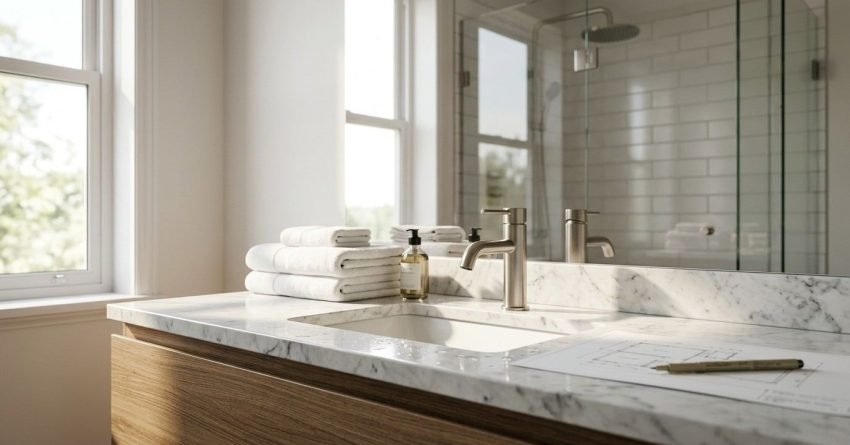
Modern bathroom vanity countertop with integrated white sink, brass compass, open planner featuring bathroom floor plan sketch, architect's pen, and tile samples in natural daylight

Measuring and Tracking Your Bathroom ROI

Calculating Your Actual ROI

Accurate cost tracking requires comprehensive documentation of all expenses, not just contractor invoices. Complete renovation cost accounting includes materials, labour, permits and fees, design and planning, project management, temporary accommodation, financing costs, and opportunity costs. A renovation appearing to cost $25,000 in contractor invoices often totals $32,000–$35,000 when all expenses are properly accounted.

ROI calculation formula:

ROI = (Property Value Increase – Total Renovation Costs) / Total Renovation Costs × 100

Example:

Property value increase: $22,000

Total renovation costs: $30,000

ROI = ($22,000 – $30,000) / $30,000 × 100 = -26.7%

Alternative (cost recovery):

Cost Recovery = $22,000 / $30,000 × 100 = 73.3%

Comparative market analysis by licensed real estate agents provides realistic value estimates. Professional valuations ($300–$600) provide legally defensible figures necessary for refinancing or investment analysis.

Short-Term vs Long-Term Returns

Immediate ROI at resale represents only one component of total renovation returns. A $28,000 renovation with 68% immediate ROI ($19,000 resale value) delivers 95% total ROI when $7,500 in avoided maintenance over 5 years is included.

ATO depreciation schedules allow bathroom capital works to be claimed over 40 years (2.5% annually) and fixtures and fittings over 5–15 years. A $30,000 renovation generates $1,250–$1,800 annual tax deductions, creating $375–$810 annual tax savings (at 30–45% marginal rates) that improve effective ROI by 8–12 percentage points over 10 years.

New bathroom fixtures and finishes require minimal maintenance for 8–12 years, while old bathrooms average $800–$1,500 annual maintenance. Avoiding $8,000–$18,000 maintenance over 10 years improves total ROI by 27–60 percentage points compared to immediate resale ROI alone.

Non-Financial Benefits to Consider

Quality of life improvements create genuine value for owner-occupiers that financial ROI doesn’t measure. Using an improved bathroom 700+ times annually for 10 years creates 7,000+ positive experiences that pure financial analysis ignores.

Building health research shows adequate bathroom ventilation reduces mould-related respiratory issues by 60–75%, while slip-resistant tiles and grab rails prevent 40–55% of bathroom falls in older occupants. WELS-rated 4-star showerheads and dual-flush toilets reduce bathroom water use by 30–40%, saving $180–$280 annually for typical households.

A bathroom that functions smoothly  adequate storage, good lighting, comfortable temperature, reliable fixtures  eliminates hundreds of minor frustrations annually, creating quality-of-life value that financial ROI calculations completely miss.

Conclusion

Bathroom renovation ROI in Sydney typically ranges from 60–80% at resale, with mid-range renovations delivering optimal returns while cosmetic updates and luxury upgrades occupy opposite ends of the ROI spectrum. Understanding these realistic expectations prevents overcapitalisation and guides smart investment in features that buyers actually value  modern fixtures, quality finishes, functional layouts, and cohesive design that photographs well and meets contemporary standards.

The true value of bathroom renovations extends beyond immediate resale returns to encompass rental income improvements, avoided maintenance costs, tax benefits for investors, and substantial quality-of-life enhancements for owner-occupiers. A comprehensive ROI analysis accounts for these multiple value streams rather than focusing solely on property value addition, revealing that well-planned bathroom renovations often deliver stronger total returns than traditional ROI percentages suggest.

At Sydney Home Renovation, we combine transparent cost planning with skilled execution to deliver bathroom renovations that maximise both financial returns and long-term value. Our detailed budgeting approach, quality workmanship, and honest pricing guidance help you make informed decisions that balance renovation costs with realistic value expectations  ensuring your bathroom renovation achieves optimal ROI while creating a space you’ll enjoy for years to come. Contact us today for a comprehensive bathroom renovation consultation and transparent cost assessment.

Frequently Asked Questions

What is a good ROI for a bathroom renovation in Sydney?

A good bathroom renovation ROI in Sydney ranges from 65–75% for mid-range renovations, meaning we recover $16,250–$18,750 on a $25,000 investment at resale. Total ROI including rental income, avoided maintenance, and use value often exceeds 100% over 5–10 years of ownership.

Do bathroom renovations add more value than kitchen renovations?

Kitchen renovations typically deliver slightly higher ROI (70–85%) than bathrooms (65–75%) in Sydney, but bathrooms cost less to renovate, making them more accessible value-adding projects. Both renovations work synergistically when completed together.

How long does it take to recoup bathroom renovation costs?

Immediate cost recovery occurs at property sale, typically recouping 65–75% of renovation costs. Owner-occupiers typically achieve full effective cost recovery within 6–10 years when resale value, avoided maintenance ($800–$1,500 annually), and use value are all considered.

Which bathroom upgrades offer the best ROI?

Vanity replacement (85–110% ROI), shower screen upgrades (80–95% ROI), and quality tapware (75–90% ROI) deliver the highest individual returns. Combining 3–4 of these elements creates dramatic improvement while maximising ROI on limited budgets.

Does a luxury bathroom renovation guarantee higher ROI?

No  luxury renovations typically deliver lower ROI percentages (50–65%) than mid-range work (65–75%) because buyers don’t value ultra-premium features proportionally to their costs. The optimal approach matches bathroom quality to the overall property price point and target buyer expectations.

How does bathroom ROI differ for investment properties?

Investment properties experience ROI through rental income increases ($30–$60 weekly in Sydney) plus resale value addition. A $25,000 renovation generating $45 weekly rent increase returns 9.4% annually through rental income, recovering costs in 10.6 years, plus 65–75% immediate ROI at resale.

Should I renovate my bathroom before selling?

Renovate before selling if the bathroom is severely dated (pre-1990s), damaged, or non-functional  these conditions reduce property values by 5–10%. For functional but dated bathrooms, cosmetic updates ($8,000–$15,000) deliver 75–90% ROI and improve sale speed.

What bathroom features do Sydney buyers value most?

Sydney buyers prioritise walk-in showers (78% preference), quality tapware (74%), good lighting (71%), adequate storage (68%), and modern tiles (66%). Frameless glass shower screens, contemporary vanities with storage, neutral colour schemes, and quality ventilation consistently add value across all property types and price points.

Can I achieve positive ROI on a budget bathroom renovation?

Yes  cosmetic updates ($8,000–$15,000) achieve 75–90% ROI, the highest percentage returns of any renovation type. A $4,200–$8,600 investment in new vanity, tapware, lighting, fresh paint, and re-grouting creates dramatic visual improvement while maintaining strong ROI.

How do I calculate ROI on my bathroom renovation?

Calculate ROI using: (Property Value Increase – Total Renovation Costs) / Total Renovation Costs × 100. Obtain a pre-renovation valuation, track all costs including materials, labour, permits, financing, and accommodation, then obtain a post-renovation valuation. Professional valuations ($300–$600) provide accurate figures for planning purposes.

Facebook
X
LinkedIn
Pinterest

Related Posts

Spirit level, kitchen renovation blueprint, cabinet door sample, countertop sample, and hardware arranged on a kitchen island.

How to Find a Licensed Kitchen Renovator in NSW

Finding a licensed kitchen renovator in NSW starts with one step: checking that your contractor holds

Comparison of solid wood, painted shaker, and flat-pack cabinet doors with assembly hardware displayed on a kitchen countertop.

Custom Kitchen Cabinets vs Flat-Pack vs Semi-Custom

The cabinet type you choose is the single biggest cost decision in any kitchen renovation, and

Flat-pack kitchen cabinet panels, tools, and hardware laid out for assembly in a partially renovated kitchen.

How to Install Flat Pack Kitchen Cabinets

Flat pack kitchen cabinets are genuinely DIY-friendly, and with the right sequence, the right tools, and