
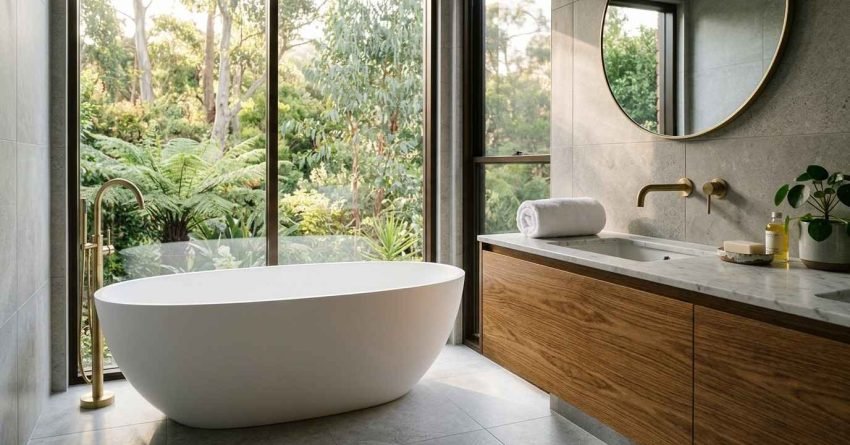
A standard bathroom renovation in Australia costs between $15,000 and $30,000 for a mid-range finish. Budget renovations start around $10,000, and high-end transformations reach $50,000 or more. These figures cover demolition, waterproofing, plumbing, electrical, tiling, fixtures, and finishing.
Your final cost depends on three things above all else: bathroom size, material choices, and whether you move the existing layout. We quote bathrooms across Sydney every week, and those three variables account for almost all the difference between a $16,000 job and a $38,000 one.
Below, we break the numbers down by trade, budget tier, and Sydney suburb, then walk through the hidden costs that catch homeowners out.
Average Bathroom Renovation Costs in Australia
Bathroom renovation costs vary significantly based on scope of work, material quality, and location. The national average sits between $20,000 and $25,000 for a complete renovation of a standard bathroom of roughly 5 to 8 square metres.
Averages only tell part of the story. Your actual cost depends on whether you are doing a cosmetic refresh or a full gut-and-rebuild. Here is what we see across the three common budget tiers.
Budget Bathroom Renovation ($10,000–$15,000)
A budget renovation focuses on cosmetic updates while retaining the existing layout and plumbing positions. This approach works well for bathrooms with sound structural bones that simply need refreshing.
What we typically include:
- Basic demolition and waste removal
- Replacement fixtures (toilet, vanity, tapware) in builder-grade products
- Standard ceramic tiles for walls and floors
- Essential plumbing connections with no relocation
- Basic electrical work
- Waterproofing to Australian Standards
- Standard paint and finishing
What sits outside this tier:
- Layout changes or plumbing relocation
- Premium fixtures or custom joinery
- Heated flooring or towel rails
- Frameless shower screens
- Feature lighting
Budget renovations suit investment properties, rental preparation, and homeowners who need functional improvement without premium finishes.
Mid-Range Bathroom Renovation ($15,000–$30,000)
The mid-range tier is the most popular choice among the homeowners we work with. This budget buys quality fixtures, better tile selections, and some customisation while keeping costs under control.
What we typically include:
- Complete demolition and disposal
- Quality fixtures from reputable brands such as Caroma, Methven and ADP
- Porcelain or quality ceramic tiles
- Semi-frameless or frameless shower screen
- Updated lighting with dimmer options
- Heated towel rail
- Quality tapware and accessories
- Professional waterproofing with certification
- Minor layout adjustments
A mid-range renovation delivers a bathroom that looks and feels premium without a luxury price tag. Most of our clients find this tier gives the best balance between spend and long-term satisfaction.
High-End Bathroom Renovation ($30,000–$50,000+)
High-end renovations involve premium materials, custom design elements, and often significant structural changes. This tier suits homeowners building a luxury retreat or working with complex site requirements.
What we typically include:
- Complete structural modifications
- Premium fixtures such as Villeroy & Boch, Duravit, and Rogerseller
- Natural stone or large-format porcelain tiles
- Custom vanity with stone benchtop
- Freestanding bath
- Frameless glass shower with ceiling-mounted rail
- Underfloor heating
- Premium tapware in brushed nickel, matte black or brass
- Smart features including heated mirrors and digital shower controls
- Designer lighting scheme
- Full project management
High-end renovations regularly exceed $50,000 once structural changes, plumbing relocation, imported fixtures, or natural stone enter the scope.
Bathroom Renovation Cost Breakdown by Trade
Understanding how costs distribute across trades shows you exactly where your budget goes and where savings are genuinely available. Here is the detailed breakdown we use for a mid-range bathroom.
Demolition and Waste Removal
Cost range: $800–$2,500
Demolition strips the existing bathroom back to the structural frame. This covers removal of tiles, fixtures, vanities, waterproofing membrane, and sometimes wall linings.
| Item | Cost Range |
| Strip-out labour | $500–$1,500 |
| Skip bin hire | $300–$600 |
| Asbestos testing (where required) | $150–$400 |
Demolition costs climb for bathrooms with floor-to-ceiling tiles, multiple layers of flooring, or difficult access. Older homes need asbestos testing before we start work.
Plumbing Costs
Cost range: $2,500–$6,000
Plumbing represents 15 to 20 percent of a typical renovation budget. Costs move sharply depending on whether you keep existing plumbing positions or relocate fixtures.
| Service | Cost Range |
| Rough-in (existing positions) | $1,500–$2,500 |
| Rough-in (new positions) | $3,000–$5,000 |
| Fixture installation | $800–$1,500 |
| Hot water connection | $200–$400 |
| Drainage modifications | $500–$2,000 |
Key cost driver: moving a toilet, shower, or basin from its current position requires new drainage runs and water supply lines. That single change adds $2,000 to $4,000 to your plumbing costs.
Electrical Work
Cost range: $1,000–$3,000
Electrical work covers lighting, exhaust fans, power points, and heated elements such as towel rails or underfloor heating.
| Service | Cost Range |
| New lighting circuit | $400–$800 |
| Exhaust fan installation | $200–$400 |
| Power point installation | $150–$250 each |
| Heated towel rail connection | $200–$350 |
| Underfloor heating (electric) | $800–$1,500 |
| Switchboard upgrade (where required) | $500–$1,200 |
All bathroom electrical work complies with Australian Standards and is completed by a licensed electrician. Bathrooms carry specific zone requirements for installations near water sources.
Waterproofing
Cost range: $1,000–$2,000
Waterproofing is non-negotiable and legally required in wet areas. It protects your home’s structure and must be completed by a licensed waterproofer working to AS 3740, the Australian Standard for waterproofing domestic wet areas.
| Service | Cost Range |
| Membrane application (shower + floor) | $800–$1,500 |
| Full bathroom waterproofing | $1,200–$2,000 |
| Waterproofing certificate | Included |
| Hob construction (where required) | $200–$400 |
Waterproofing is inspected and certified before tiling begins, and that certificate is the document you produce if you ever sell or claim.
Cutting corners here leads to remediation work that runs $15,000 to $30,000 once water reaches the structure.
Tiling (Walls and Floors)
Cost range: $3,000–$8,000
Tiling is the highest single cost in most bathroom renovations, combining material spend with labour-intensive installation.
| Component | Cost Range |
| Floor tiles (supply) | $30–$150/m² |
| Wall tiles (supply) | $30–$150/m² |
| Feature tiles | $80–$300/m² |
| Tiling labour | $60–$120/m² |
| Tile adhesive and grout | $300–$600 |
| Waterproofing under tiles | Included above |
Cost factors we watch:
- Large-format tiles at 600x600mm and above need more substrate preparation but produce fewer grout lines
- Natural stone requires sealing and specialist installation
- Intricate patterns and feature walls add labour hours
- Floor-to-ceiling tiling costs more than half-height walls
A standard 6m² bathroom with floor-to-ceiling tiles needs roughly 25 to 30m² of tile once walls and floor are counted.
Fixtures and Fittings
Cost range: $2,500–$10,000+
Fixtures cover your toilet, vanity, basin, shower, bath, tapware and accessories. This category carries the widest price variation of any trade.
| Fixture | Budget | Mid-Range | Premium |
| Toilet suite | $250–$500 | $500–$1,200 | $1,200–$3,000 |
| Vanity with basin | $400–$800 | $800–$2,000 | $2,000–$6,000 |
| Shower screen | $400–$800 | $800–$1,500 | $1,500–$3,500 |
| Tapware set | $200–$500 | $500–$1,200 | $1,200–$3,000 |
| Showerhead/rail | $100–$300 | $300–$700 | $700–$1,500 |
| Mirror/cabinet | $150–$400 | $400–$1,000 | $1,000–$2,500 |
| Accessories | $100–$300 | $300–$600 | $600–$1,500 |
Mid-range Australian brands such as Caroma, Clark and Methven give you strong quality and warranty support without premium pricing.
Painting and Finishing
Cost range: $500–$1,500
Finishing covers painting of ceilings and non-tiled walls, accessory installation, silicone sealing, and the final clean.
| Service | Cost Range |
| Ceiling and wall painting | $300–$800 |
| Silicon sealing | $150–$300 |
| Accessory installation | $150–$300 |
| Final clean | $100–$200 |
Bathroom Renovation Timeline and Cost Stages
Cost and time are linked, because most bathroom overruns are schedule overruns first. A standard renovation runs 2 to 4 weeks, and each stage locks in spend as it completes.
| Stage | Duration | Trades On Site |
| Demolition and strip-out | 1–2 days | Demolition, waste removal |
| Rough-in plumbing and electrical | 2–3 days | Plumber, electrician |
| Wall and floor preparation | 1–2 days | Carpenter, plasterer |
| Waterproofing and cure time | 2–3 days | Waterproofer |
| Tiling | 3–5 days | Tiler |
| Fit-off and fixtures | 2–3 days | Plumber, electrician |
| Screens, painting, final clean | 2–3 days | Glazier, painter |
Waterproofing cure time is the stage homeowners most often try to compress. We never do, because tiling over an uncured membrane is the fastest route to a failed bathroom.
The expensive delays are almost always the same two: fixtures ordered late, and selections changed mid-build. Both hold trades off-site, and idle trade days cost you money without producing any work.
Bathroom Renovation Costs in Sydney
Sydney consistently ranks as Australia’s most expensive city for bathroom renovations. Higher labour costs, increased material transport expenses, and strong demand for qualified trades all drive premium pricing.
Sydney vs Other Australian Cities
| City | Average Mid-Range Renovation |
| Sydney | $22,000–$35,000 |
| Melbourne | $20,000–$32,000 |
| Brisbane | $18,000–$28,000 |
| Perth | $18,000–$28,000 |
| Adelaide | $16,000–$26,000 |
| Hobart | $15,000–$25,000 |
Sydney homeowners pay roughly 15 to 25 percent above the national average for equivalent work.
Inner City vs Suburban Pricing
Location within Sydney also shifts your number.
Inner City and Eastern Suburbs (Surry Hills, Paddington, Bondi):
- Premium pricing, typically 10 to 20 percent above standard rates
- Parking restrictions increase costs
- Heritage considerations apply in many streets
- Smaller bathrooms paired with higher finish expectations
Northern Beaches and North Shore:
- Standard to premium pricing
- Good trade availability
- Larger bathrooms are common
Western Sydney and South-West:
- Competitive pricing
- Strong trade availability
- Larger properties with better site access
Inner West:
- Standard to premium pricing
- Terrace houses with genuine access challenges
- Heritage overlays across several suburbs
Why Sydney Renovations Cost More
Several factors drive Sydney’s higher pricing:
- Labour rates: Sydney trades command higher hourly rates driven by cost of living and demand
- Travel time: traffic congestion means trades build travel into their quotes
- Parking and access: permit costs and difficult access add to project expense
- Material delivery: inner-city deliveries require special arrangements
- Competition for trades: high demand leaves less negotiating room
- Compliance costs: council requirements and certification fees
Factors That Affect Your Bathroom Renovation Cost
Understanding the cost drivers lets you decide where to invest and where to economise.
Bathroom Size and Layout
Size drives both material quantities and labour hours.
| Bathroom Type | Typical Size | Renovation Range |
| Powder room | 1.5–2.5 m² | $8,000–$15,000 |
| Small ensuite | 3–4 m² | $12,000–$22,000 |
| Standard bathroom | 5–8 m² | $15,000–$30,000 |
| Large bathroom | 9–12m² | $25,000–$45,000 |
| Master ensuite | 12m²+ | $35,000–$60,000+ |
Small bathrooms never cost proportionally less, and that surprises people. A 2m² powder room still needs a plumber, an electrician, a waterproofer and a tiler, so the fixed trade call-out component lands on a much smaller floor area.
Here is how cost per square metre moves across tiers in Sydney:
| Tier | Cost per m² |
| Budget | $1,800–$2,500 |
| Mid-range | $2,500–$4,500 |
| High-end | $4,500–$7,000+ |
Scope of Work (Cosmetic vs Full Renovation)
The extent of work changes your number dramatically.
Cosmetic refresh ($5,000–$12,000):
- New tapware and accessories
- Repaint walls and ceiling
- Replace vanity and mirror
- Keep existing tiles and layout
Partial renovation ($12,000–$20,000):
- Replace fixtures
- New floor tiles, keeping wall tiles
- Update lighting
- Minor plumbing updates
Full renovation ($20,000–$35,000):
- Complete strip-out
- New waterproofing
- All new tiles, fixtures, and fittings
- Electrical and plumbing updates
Structural renovation ($35,000+):
- Layout changes
- Wall removal or addition
- Plumbing relocation
- Possible extension
Material and Fixture Quality
Material choice creates the single biggest variation in renovation cost.
| Category | Budget Impact |
| Tiles | $1,500–$8,000 difference |
| Vanity | $400–$5,000 difference |
| Tapware | $300–$2,500 difference |
| Toilet | $200–$2,500 difference |
| Shower screen | $400–$3,000 difference |
Choosing mid-range materials throughout instead of premium selections shifts your total budget by $10,000 to $15,000.
Structural Changes and Layout Modifications
Moving fixtures from their current positions triggers immediate cost increases.
| Change | Additional Cost |
| Move toilet | $1,500–$3,500 |
| Move shower | $2,000–$4,000 |
| Relocate vanity | $1,000–$2,500 |
| Remove wall | $2,000–$5,000 |
| Add window | $2,500–$6,000 |
| Change door position | $1,500–$3,500 |
Keeping fixtures in their current positions eliminates expensive plumbing relocation entirely.
Access and Site Conditions
Difficult access adds both time and cost.
- Multi-storey homes: upper-floor bathrooms add $500 to $1,500 in material handling and waste removal
- Narrow hallways: restricted material movement adds labour hours across every trade
- No parking: trades charge for permits or extended travel, typically $200 to $600 across a project
- Occupied homes: working around residents adds protection, setup, and pack-down time daily
- Strata properties: building access restrictions, approval requirements, and restricted work hours extend timelines
Hidden Costs in Bathroom Renovations
Hidden costs catch many homeowners off guard. Building them into your budget from the start prevents unwelcome surprises.
Asbestos Testing and Removal
Homes built before 1990 contain asbestos in wall linings, floor tiles, or adhesives more often than owners expect.
| Service | Cost |
| Asbestos testing | $150–$400 |
| Asbestos removal (small area) | $1,500–$4,000 |
| Asbestos removal (extensive) | $4,000–$10,000 |
Asbestos is identified and safely removed by licensed professionals before any renovation work begins.
Unexpected Plumbing or Electrical Issues
Opening walls reveals problems invisible during initial inspection.
| Issue | Typical Cost |
| Corroded pipes | $500–$2,500 |
| Damaged drainage | $1,000–$4,000 |
| Outdated wiring | $800–$2,500 |
| Water damage repair | $1,500–$5,000 |
| Termite damage | $2,000–$8,000 |
Older homes carry a higher risk of discovery once demolition begins.
Council Approvals and Certifications
Most bathroom renovations proceed without council approval, though some situations require it.
| Requirement | When Needed | Cost |
| Development application | Structural changes, extensions | $500–$2,500 |
| Complying development certificate | Some layout changes | $1,000–$2,000 |
| Waterproofing certificate | All wet area work | Usually included |
| Plumbing certificate | All plumbing work | Usually included |
| Electrical certificate | All electrical work | Usually included |
Homes in heritage conservation areas require additional approvals, and we factor that into the program before we quote.
Temporary Bathroom Arrangements
Single-bathroom homes need alternative arrangements during the build.
| Option | Cost |
| Portable toilet hire (2 weeks) | $200–$400 |
| Gym membership (shower access) | $50–$150 |
| Staying elsewhere | Variable |
Most bathroom renovations run 2 to 4 weeks, so factor the inconvenience into your planning.
How to Budget for Your Bathroom Renovation
Smart budgeting prevents cost blowouts and gets you the bathroom you want within your means.
Setting a Realistic Budget
Start with what you can afford, then work backward:
- Assess your finances: establish what you spend comfortably
- Research realistic costs: use the figures above as your baseline
- Get preliminary quotes: speak with 2 to 3 renovators for ballpark figures
- Prioritise must-haves: separate non-negotiables from nice-to-haves
- Build in contingency: add a 10 to 15 percent buffer
If your budget is $15,000, plan a $13,000 renovation and hold the difference.
Understanding Quotes and Allowances
Renovation quotes include allowances for fixtures and tiles, and understanding them prevents budget surprises.
Provisional sum: an estimated amount for items not yet selected. Selections above that amount become your cost.
Prime cost (PC) item: a specific allowance for a particular item, common for tiles, vanities and tapware.
Worked example:
- Quote includes a $1,500 PC allowance for the vanity
- You select a $2,200 vanity
- You pay the $700 difference
Always ask three questions: what allowances are included, what happens when you exceed them, and what sits outside the quote entirely.
Payment Schedules and Progress Payments
In NSW, residential building contracts cap the deposit at 10 percent of the contract price for work valued above $20,000. Anyone asking for 40 percent up front is a warning sign, not a discount opportunity.
We structure payments against completed stages rather than dates:
| Stage | Typical Payment |
| Deposit | 5–10% |
| Demolition and rough-in complete | 20–25% |
| Waterproofing certified | 20–25% |
| Tiling complete | 20–25% |
| Practical completion | 15–20% |
Tie every payment to a stage you can physically inspect. Variations get documented and priced in writing before the work happens, never verbally on site.
Building in a Contingency Fund
We recommend a 10 to 15 percent contingency on every project.
| Budget | Recommended Contingency |
| $15,000 | $1,500–$2,250 |
| $25,000 | $2,500–$3,750 |
| $35,000 | $3,500–$5,250 |
Contingency covers unexpected repairs discovered during demolition, material price increases, minor scope changes, and additional work required for compliance.
Prioritising Your Renovation Spend
Not all bathroom elements deliver equal value.
High priority, invest here:
- Waterproofing, never compromise
- Quality plumbing fixtures
- Good ventilation
- Adequate lighting
- Durable floor tiles
Medium priority:
- Vanity and storage
- Shower screen quality
- Tapware finish
- Wall tiles
Lower priority, save here:
- Decorative accessories
- Premium grout colours
- Luxury extras
Ways to Save Money on Your Bathroom Renovation
Strategic decisions reduce cost without sacrificing quality or function.
Keep Existing Layout Where Possible
The single biggest saving available is keeping fixtures in their current positions.
| Approach | Potential Savings |
| Keep toilet position | $1,500–$3,500 |
| Keep shower position | $2,000–$4,000 |
| Keep vanity position | $1,000–$2,500 |
| Total potential savings | $4,500–$10,000 |
If your current layout works functionally, put the savings into better fixtures and finishes instead.
Lock Your Selections Before Work Starts
Here is the cost curve nobody quotes for: the same decision costs different amounts depending on when you make it.
Change your tile choice during the selection stage, and it costs nothing. Change it after we have ordered, and you pay a restocking fee plus a delivery delay. Change it after the tiler has started, and you pay for demolition, new materials, new labour, and every idle trade day in between.
We ask clients to lock selections before demolition for exactly this reason. It is the cheapest budget control tool available, and it costs nothing but decision discipline.
Choose Mid-Range Fixtures with Style
Premium brands do not always mean better quality. Australian mid-range brands deliver genuine value:
- Toilets: Caroma, Clark
- Tapware: Methven, Phoenix
- Vanities: ADP, Timberline
- Tiles: National Tiles, Beaumont Tiles ranges
These brands offer modern design, solid warranties, and readily available spare parts.
Time Your Renovation Strategically
Timing affects both cost and trade availability.
Best times to renovate:
- Autumn, March to May, when trades ease off after the summer rush
- Late winter, August, ahead of the spring renovation season
- Avoid December and January for holiday premiums and limited availability
Ask about off-peak discounts, package deals on fixtures, and end-of-line tile specials.
Get Multiple Detailed Quotes
Comparing quotes shows you fair pricing and reveals genuine value.
Quote comparison steps:
- Get 3 to 5 quotes from licensed renovators
- Confirm every quote covers identical scope
- Compare allowances and inclusions line by line
- Check what sits outside each quote
- Verify the builder licence number on the NSW Fair Trading public register
- Confirm current home building compensation cover for work above $20,000
- Ask for references from projects completed in the last 12 months
Red flags we tell people to walk away from:
- Quotes sitting well below the others, because something is missing from the scope
- Vague inclusions or missing detail
- Pressure to decide quickly
- No written contract offered
- Cash-only arrangements or deposits above 10 percent
DIY vs Professional: Where You Can Actually Save
DIY looks like the obvious saving, and for two trades it is illegal rather than merely unwise.
In NSW, plumbing, electrical work and waterproofing all require licensed tradespeople. Waterproofing is the one homeowners most often attempt themselves, and it is the one that voids insurance, fails certification, and produces the $15,000 to $30,000 remediation bills we discussed earlier.
| Task | DIY? | Realistic Saving |
| Demolition and strip-out | Yes, with care | $500–$1,200 |
| Waste removal runs | Yes | $200–$400 |
| Painting non-tiled surfaces | Yes | $300–$700 |
| Accessory installation | Yes | $150–$300 |
| Tiling | Technically yes | $1,500–$3,000, at high risk |
| Waterproofing | No, licensed only | Nil |
| Plumbing | No, licensed only | Nil |
| Electrical | No, licensed only | Nil |
Demolition is the genuine DIY win, because it is labour rather than skill. Tiling is where enthusiastic DIY most often costs more than it saves, since a poor tile bed shows permanently and re-tiling means removing the waterproofing underneath it.
Is a Bathroom Renovation Worth the Investment?
Understanding return on investment justifies renovation spending and guides your budget decisions.
Return on Investment for Resale
Bathroom renovations rank among the highest-return home improvements in Australia.
| Renovation Level | Typical Cost | Value Added | ROI |
| Budget refresh | $10,000–$15,000 | $15,000–$25,000 | 50–100% |
| Mid-range renovation | $20,000–$30,000 | $30,000–$50,000 | 50–80% |
| High-end renovation | $40,000–$60,000 | $50,000–$80,000 | 25–50% |
Key insights from the projects we deliver:
- Mid-range renovations return the strongest ROI
- Over-capitalisation risk rises sharply with luxury renovations
- Dated bathrooms reduce property value by $20,000 to $50,000
- Buyers now expect modern, functional bathrooms as a baseline
The best-returning improvements are consistently the least glamorous: replacing dated fixtures, modern tiling, good lighting, and quality waterproofing that prevents future problems.
Value for Owner-Occupiers
For homeowners staying long-term, value extends well beyond financial return.
Quality of life:
- Daily enjoyment of a well-designed space
- Improved function and storage
- Better energy and water efficiency
- Reduced maintenance from quality materials
- Increased home comfort
Long-term savings:
- Water-efficient fixtures reduce your bills every quarter
- Quality materials last longer between replacements
- Proper waterproofing prevents costly structural damage
- Modern ventilation prevents mould and the health issues that follow it
For owner-occupiers, a well-planned renovation delivers years of daily satisfaction. That value never appears on a balance sheet, and it is the reason most of our clients renovate in the first place.
Conclusion
Bathroom renovation costs in Australia run from $10,000 for budget updates to $50,000 or more for high-end transformations. Most homeowners invest $15,000 to $30,000 for a quality mid-range result. Understanding where that money goes across plumbing, electrical, waterproofing, tiling, and fixtures lets you make informed decisions and avoid costly surprises.
Sydney homeowners budget 15 to 25 percent above national averages, with inner-city locations commanding premium rates. The smartest approach combines realistic budgeting, a 10 to 15 percent contingency, and clear decisions about where to invest and where to save. Keeping your existing layout, choosing quality mid-range fixtures, and locking your selections early delivers the best value of any strategy we know.
At Sydney Home Renovation, we provide transparent, detailed quotes that show exactly where your money goes, with no hidden costs or surprise variations. Our team delivers quality bathroom renovations on time and on budget, backed by clear communication at every stage. Contact us today for a free consultation and a detailed quote for your bathroom renovation.
Frequently Asked Questions
How long does a bathroom renovation take?
A standard bathroom renovation takes 2 to 4 weeks from demolition to completion. Bathroom size, scope, fixture availability, and structural changes all affect the timeline. Complex layout changes extend the program to 5 or 6 weeks.
Can I renovate a bathroom for under $10,000?
Yes, with limitations. A sub-$10,000 renovation covers cosmetic updates only: new tapware, vanity replacement, painting, and accessories while keeping existing tiles and layout. Full renovations with new waterproofing and tiling start around $12,000 to $15,000.
What is the most expensive part of a bathroom renovation?
Tiling represents the highest single cost, combining material expense with labour-intensive installation. For a floor-to-ceiling tiled bathroom, tiling consumes 25 to 35 percent of your total budget. Plumbing ranks second, particularly when relocating fixtures.
What order do the trades work in during a bathroom renovation?
Demolition comes first, followed by plumbing and electrical rough-in, wall preparation, waterproofing, tiling, then fixture fit-off, screens and painting. Waterproofing must cure fully before tiling begins, and that sequence never changes.
Do I need council approval for a bathroom renovation?
Most standard bathroom renovations need no council approval. Approval applies to structural changes such as removing walls, extensions, and work on heritage-listed properties. Your renovator advises on the compliance requirements for your specific project.
Which parts of a bathroom renovation can I legally do myself?
Demolition, waste removal, painting, and accessory installation are all genuine DIY tasks. Plumbing, electrical work, and waterproofing require licensed tradespeople in NSW, and unlicensed work voids insurance and fails certification.
Should I renovate my bathroom before selling?
Generally yes, if your bathroom is dated or in poor condition. Outdated bathrooms reduce property value by $20,000 to $50,000 and deter buyers. A mid-range renovation returns 50 to 80 percent of its cost in added value.
How much does labour cost for a bathroom renovation?
Labour represents 40 to 50 percent of total renovation costs. For a mid-range Sydney bathroom, expect labour of $8,000 to $15,000 covering demolition, plumbing, electrical, waterproofing, tiling and installation. Rates vary by trade and complexity.
What do I do if I only have one bathroom?
Plan for 2 to 4 weeks without it. Most clients combine a portable toilet hire at $200 to $400 with gym shower access, or arrange to stay with family during the tiling and fit-off weeks.
What should I look for in a bathroom renovation quote?
A comprehensive quote itemises all costs, specifies allowances for fixtures and tiles, details inclusions and exclusions, provides a timeline, and sets payment terms. Verify licensing, insurance, and recent project references before signing.


