
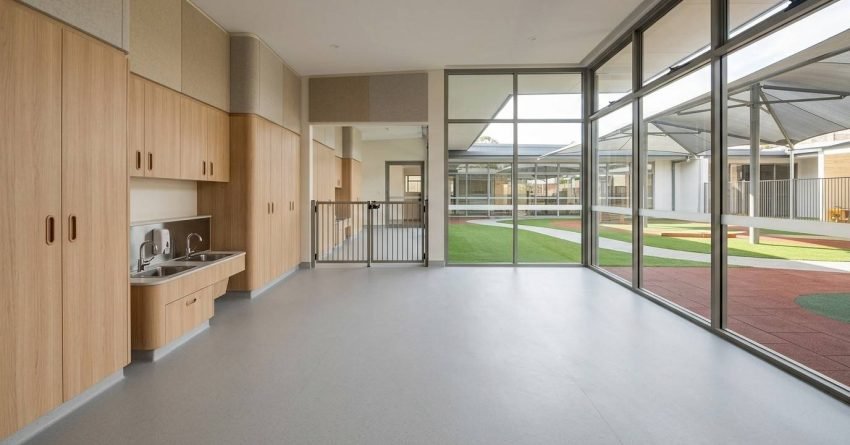
Renovating a childcare centre in Sydney involves a distinct set of requirements that go well beyond a standard commercial fit-out. From National Quality Framework compliance and council approval to indoor space ratios, outdoor play area standards, and specialist mechanical systems, every decision must satisfy regulatory thresholds before a centre can operate.
Failing to understand these requirements before construction begins leads to costly rework, delayed approvals, and potential licensing issues that put your entire project at risk.
This guide covers every major requirement category for a childcare centre renovation in Sydney, giving operators and project managers a clear, practical framework to plan with confidence.
Why Childcare Centre Renovations Have Unique Requirements
Childcare centres are regulated environments. Unlike a standard office or retail fit-out, a childcare renovation must satisfy obligations across multiple regulatory frameworks simultaneously, including the Education and Care National Law, the National Quality Framework (NQF), the Building Code of Australia (BCA), and local council planning controls.
This layered compliance environment means that decisions made early in the design phase, including room layouts, material selections, and fixture specifications, have direct consequences for licensing approval and operational sign-off. A renovation that meets BCA requirements but fails NQF spatial standards will not receive an operating approval regardless of construction quality.
Regulatory and Compliance Obligations in NSW
In New South Wales, childcare centre renovations must comply with the Education and Care National Regulations, administered through the NSW Department of Education. These regulations set minimum standards for indoor and outdoor space per child, toilet and handwashing facilities, sleep and rest areas, and kitchen or food preparation zones.
The Australian Children’s Education and Care Quality Authority (ACECQA) provides the national framework, but NSW-specific requirements and local council overlays apply on top of this baseline. Operators must also ensure that any renovation maintains or improves the centre’s rating against the NQF Quality Areas, particularly Quality Area 3 (Physical Environment).
Meeting these regulatory obligations is a multi-agency process that spans the NSW Department of Education, ACECQA, local council, and a certifying authority. Each agency applies its own assessment criteria to the physical premises before an operating approval is issued.
Structural and Safety Requirements for Childcare Spaces
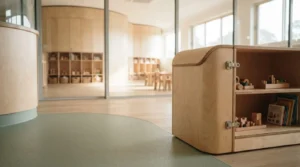
The structural requirements for a childcare renovation are driven by child safety, supervision sightlines, and the physical demands of high-frequency use by young children. Walls, floors, joinery, and fixtures must all be specified to withstand intensive daily use while eliminating hazards such as sharp edges, pinch points, and unstable surfaces.
Structural modifications, including wall removals, new openings, or changes to load-bearing elements, require engineering certification and building approval. Any work that alters the fire rating of a wall or changes egress paths must be assessed by a certifying authority before construction proceeds.
Indoor Space Ratios and Room Configuration
The Education and Care National Regulations specify a minimum of 3.25 square metres of unencumbered indoor space per child. This calculation excludes storage areas, bathrooms, corridors, and any space not directly usable by children during care hours.
Room configuration must support clear sightlines for educators, age-appropriate zoning (infant, toddler, and preschool rooms have different requirements), and safe transition paths between activity areas and outdoor spaces. Any renovation that changes room boundaries or introduces new partitions must be assessed against these spatial thresholds before approval.
Outdoor Play Area Standards
The National Regulations require a minimum of 7 square metres of unencumbered outdoor space per child. In Sydney, where many childcare centres occupy constrained urban sites, meeting this requirement often involves creative design solutions including rooftop play areas, multi-level outdoor decks, or staged outdoor access arrangements.
Outdoor surfaces must meet impact attenuation standards under AS 4422 for areas beneath and around play equipment. Shade provision must meet the Cancer Council’s SunSmart guidelines for early childhood settings.
Fencing is a critical safety and compliance element in outdoor areas. Perimeter fencing must prevent unsupervised child egress and, where the outdoor area adjoins a pool or water feature, must comply with pool barrier regulations under the Swimming Pools Act 1992 (NSW). Gate hardware must be child-resistant and self-closing, and the full fencing specification must be reviewed by the certifying authority as part of the approval process.
Building Code and Council Approval Requirements in Sydney
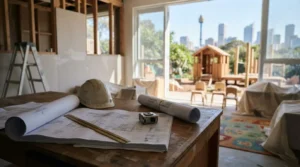
A childcare centre renovation in Sydney almost always requires formal building approval, and in many cases a Development Application (DA) to council. The approval pathway depends on the nature of the work, the existing use classification of the building, and whether the renovation constitutes a change of use under the Environmental Planning and Assessment Act 1979.
Works that are purely internal and do not change the building’s use classification may qualify for a Complying Development Certificate (CDC), assessed by a private certifier. Any change to the building’s footprint, facade, or use classification, including converting a residential or commercial building to a childcare use, requires a DA.
Development Applications and Certifier Sign-Off
A DA for a childcare centre renovation in Sydney typically requires a Statement of Environmental Effects, architectural drawings, a BASIX certificate (where applicable), a traffic and parking assessment, and a childcare-specific planning report addressing the relevant State Environmental Planning Policy (SEPP).
The NSW Childcare and Economic Opportunity Fund SEPP, which came into effect in 2017 and has been updated since, sets out specific planning controls for childcare facilities across NSW. Understanding which SEPP provisions apply to your site, and how they interact with local council LEP and DCP controls, is essential before lodging any approval.
Fit-Out Requirements: Fixtures, Fittings, and Finishes
Childcare fit-out requirements are more prescriptive than most commercial renovation categories. Fixtures, fittings, and finishes must satisfy safety standards, hygiene requirements, and age-appropriate design principles simultaneously.
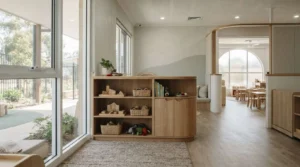
Joinery must be built to child height with rounded edges and no exposed fixings. Floor finishes must be slip-resistant, easy to clean, and free from toxic materials. Wall finishes in wet areas, including bathrooms, nappy change rooms, and kitchen zones, must be fully waterproofed and tiled or lined with impervious materials to a height that prevents moisture ingress.
Age-Appropriate Design and Durable Materials
Infant rooms require specific nappy change facilities with individual change mats, handwashing basins at adult height, and secure storage for each child’s personal items. Toddler and preschool rooms require child-height basins, low-level storage, and furniture specified to the relevant age group’s anthropometric dimensions.
Material durability is a significant cost driver in childcare renovations. Surfaces that perform adequately in a standard commercial environment often fail within 12 to 18 months under childcare conditions. Specifying commercial-grade materials from the outset, even where they carry a higher upfront cost, consistently delivers better lifecycle value than replacing budget finishes after a year of use.
Sleep and Rest Room Requirements
Sleep and rest rooms are a distinct fit-out category with their own compliance requirements. Each rest area must provide adequate space per sleeping child, with cot or mat placement allowing clear sightlines for supervising educators at all times.
Ventilation in sleep rooms must maintain comfortable temperatures without creating draughts, and lighting must be controllable to support rest periods during daylight hours. Surfaces and furnishings must be easy to clean and sanitise between uses, with no soft furnishings that cannot be laundered or wiped down to the required hygiene standard.
Mechanical, Electrical, and Hydraulic Requirements
Mechanical, electrical, and hydraulic (MEH) systems in a childcare centre must meet both the BCA’s minimum performance requirements and the specific operational needs of a licensed early childhood setting. These systems are often the most technically complex and cost-significant component of a childcare renovation.
Ventilation, Lighting, and Plumbing Standards
Natural ventilation is strongly preferred in childcare environments and is referenced in the NQF Quality Area 3 assessment criteria. Where mechanical ventilation is required, systems must be designed to maintain adequate air changes per hour without creating draughts or noise levels that disrupt children’s sleep or learning.
Lighting must meet minimum lux levels for each activity zone. Reading and craft areas require higher illumination than sleep rooms, and all lighting must be specified to eliminate glare at child eye level. Emergency lighting and exit signage must comply with AS 2293.
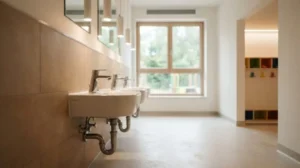
Plumbing requirements include child-height basins in bathroom and nappy change areas, thermostatic mixing valves on all hot water outlets accessible to children (to prevent scalding), and separate handwashing facilities for food preparation zones. Hydraulic design must account for the high frequency of use that characterises a childcare environment, with fixture counts and pipe sizing specified accordingly.
Acoustic and Noise Control Requirements
Acoustic performance is a compliance and operational requirement that is frequently underestimated in childcare renovations. The NQF Quality Area 3 assessment criteria reference the physical environment’s capacity to support children’s learning and wellbeing, and excessive noise transfer between rooms directly affects this assessment.
Wall and ceiling assemblies between activity rooms, sleep rooms, and outdoor areas must be specified to achieve adequate sound reduction. We recommend engaging an acoustic consultant during the design phase, particularly where sleep rooms adjoin high-activity spaces or where the centre occupies a mixed-use building with noise sources above or below.
Budgeting for a Childcare Centre Renovation in Sydney
Childcare centre renovation costs in Sydney vary significantly based on the scope of compliance works required, the condition of the existing building, and the level of fit-out specification. A basic compliance-driven renovation of an existing licensed centre typically starts from $150,000 to $250,000 for a small to medium-sized facility. A full fit-out of a new childcare tenancy, including all MEH, joinery, flooring, and outdoor works, commonly ranges from $400,000 to $800,000 or more depending on size and specification.
Getting a realistic picture of what a compliant childcare renovation costs in Sydney requires understanding how labour, materials, and approval fees interact across every stage of the project.
Cost Variables and Common Budget Pitfalls
The most common budget pitfalls in childcare renovations stem from underestimating the cost of compliance works, approval fees, and the time required to obtain regulatory sign-off. Operators who budget only for construction costs, without accounting for DA fees, certifier costs, engineering reports, and the potential for council-required design amendments, routinely experience cost overruns of 20 to 35 percent.
Asbestos removal, structural upgrades to meet current BCA standards, and hydraulic upgrades to meet child-specific plumbing requirements are the three most frequently underestimated cost items in Sydney childcare renovations. A thorough pre-construction due diligence process, including a building condition report, an asbestos assessment, and a compliance gap analysis against current NQF and BCA standards, is the most effective way to surface these costs before construction begins. We treat this due diligence phase as a non-negotiable first step on every childcare project we manage.

Working With a Renovation Contractor on Childcare Projects
Childcare centre renovations require a contractor with specific experience in regulated environments. The combination of compliance obligations, multi-agency approval processes, and the operational sensitivity of working in or adjacent to a licensed centre demands a level of project management for childcare renovations that goes beyond standard commercial construction.
A qualified contractor will coordinate directly with certifiers, council planners, and licensing authorities, manage the sequencing of compliance works to minimise disruption to centre operations, and provide transparent cost reporting throughout the project.
Project staging is a critical part of this coordination. Many Sydney childcare centres remain operational during renovation works, which means construction must be sequenced to isolate active areas from the building zone at all times. We plan staging in detail before any work begins, with clear handover milestones agreed with the centre director so that licensing continuity is never at risk.
Conclusion
Childcare centre renovation requirements in Sydney span regulatory compliance, structural safety, council approval, fit-out specification, and MEH systems, each with its own standards and approval pathways that must be satisfied before a centre can operate.
Understanding these requirements before construction begins is the single most effective way to avoid cost overruns, approval delays, and licensing complications that derail otherwise well-planned projects.
Sydney Home Renovation specialises in compliant childcare centre renovations across Sydney. Contact our team today to discuss your project requirements and receive a transparent, obligation-free assessment of your renovation scope.
Frequently Asked Questions
Do I need council approval to renovate a childcare centre in Sydney?
In most cases, yes. Any renovation that changes the building’s use classification, alters its footprint, or involves significant structural work will require either a Development Application or a Complying Development Certificate. Internal works that do not change the use classification may qualify for a CDC assessed by a private certifier.
What is the minimum indoor space requirement per child in a childcare centre?
The Education and Care National Regulations require a minimum of 3.25 square metres of unencumbered indoor space per child. This calculation excludes bathrooms, storage areas, corridors, and any space not directly usable by children during care hours.
What is the minimum outdoor space requirement per child?
The National Regulations specify a minimum of 7 square metres of unencumbered outdoor space per child. In constrained Sydney sites, this requirement is sometimes met through rooftop play areas or multi-level outdoor decks, subject to council and certifier approval.
How long does a childcare centre renovation take in Sydney?
A compliance-driven renovation of an existing licensed centre typically takes 8 to 16 weeks for construction, depending on scope. When a Development Application is required, the approval process adds 3 to 6 months to the overall project timeline before construction can begin.
What materials are required for childcare bathroom and wet areas?
Wet areas in childcare centres, including bathrooms, nappy change rooms, and kitchen zones, must be fully waterproofed and lined with impervious, easy-to-clean materials. Tiling is the most common specification. All surfaces must be non-toxic, slip-resistant, and capable of withstanding commercial-grade cleaning products.
What are the hot water requirements for childcare centres?
All hot water outlets accessible to children must be fitted with thermostatic mixing valves (TMVs) set to a maximum of 45 degrees Celsius to prevent scalding. This requirement applies to child-height basins in bathrooms, nappy change areas, and any other fixtures accessible to children during care hours.
How much does a childcare centre renovation cost in Sydney?
A compliance-driven renovation of an existing small to medium-sized childcare centre in Sydney typically starts from $150,000 to $250,000. A full fit-out of a new childcare tenancy commonly ranges from $400,000 to $800,000 or more, depending on the size of the facility, the level of specification, and the extent of MEH and structural works required.


