
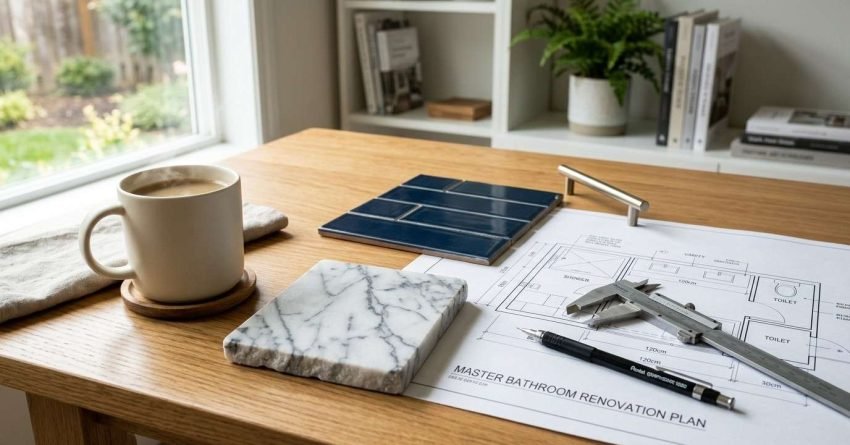
A well-planned bathroom renovation in Sydney follows seven structured stages: scope, budget, design, contractor selection, approvals, construction, and handover. Getting each one right is what separates a $20,000 win from a $40,000 blowout.
Bathrooms are the most cost-intensive room per square metre in any home, so every decision compounds across labour, materials, and long-term resale value for Sydney owners. According to Houzz Australia’s 2024 Renovation Trends Study, the bathroom remains the most renovated room in Australian homes, with median spend rising year on year.
This guide walks through each planning step in order, with realistic cost ranges, contractor checks, compliance points, and practical tips to keep your project on budget and on schedule across all seven stages.
Step 1: Define Your Bathroom Renovation Goals and Scope
Every successful renovation starts with a clear scope. Before you call a single trade, decide whether you are doing a cosmetic refresh, a full strip-out, or a structural reconfiguration, because each path carries a very different cost and timeline.
Clarify Purpose, Users, and Lifestyle Needs
A family bathroom needs durability, storage, and easy-clean surfaces. An ensuite prioritises comfort, lighting, and resale appeal. An investment property bathroom should focus on neutral finishes, low maintenance, and tenant longevity. Match the spec to the actual user, not to Pinterest.
Ensuite, Main Bathroom, or Powder Room: Planning Differences
The bathroom type you are renovating changes almost every decision you make. A main bathroom serving a family of four needs a bath or oversized shower, double vanity storage, and hard-wearing floor tiles rated R10 or higher for wet-area slip resistance. An ensuite for a master bedroom prioritises a frameless shower, quality tapware, and lighting that flatters rather than flattens. A powder room is the smallest scope of all: vanity, toilet, and a feature tile or mirror that punches above its size. Locking in the bathroom type before you design anything prevents you from specifying a family bathroom when you actually need an ensuite, which is a costly mistake to reverse mid-build.
Identify Must-Haves vs Nice-to-Haves
List every inclusion you want, then split the list into three tiers: structural (plumbing relocations, wall removal), functional (vanity size, shower screen, heated towel rail), and aesthetic (tile choice, tapware finish). When the budget tightens later, you cut from the bottom up, never from the top.
A bathroom renovation scope checklist helps you capture every inclusion before the first quote goes out.
Step 2: Set a Realistic Budget and Cost Plan
Budget is where most Sydney renovations succeed or fail. Set the number before you fall in love with finishes, not after.
Typical Bathroom Renovation Cost Ranges in Sydney
As a working benchmark for Sydney in 2025–2026:
- Budget refresh: $15,000–$22,000 (same layout, new fixtures, retiled)
- Mid-range renovation: $25,000–$38,000 (full strip-out, quality fittings, minor layout changes)
- Premium renovation: $40,000–$70,000+ (custom joinery, premium stone, structural changes, underfloor heating)
A standard 5–7 m² Sydney bathroom most commonly lands between $25,000 and $35,000 for a full mid-range strip-out and rebuild. These figures align with Master Builders Australia’s residential cost benchmarks for the Sydney metro market.
Labour, Materials, Fittings, and Hidden Costs
Labour absorbs around 40–50% of the total, materials and fittings 35–45%, and the remaining 10–15% covers waterproofing, plumbing rough-in, electrical, and waste removal.
Hidden costs are where budgets collapse. Rotten subfloors discovered after demolition add $1,500–$4,000 for replacement and re-levelling. Old lead-jointed waste pipes require full replacement under current plumbing code, adding $800–$2,500 depending on run length. Asbestos in pre-1987 wall sheeting triggers licensed removal and disposal, typically $1,200–$3,500 for a standard bathroom. Out-of-square walls demand extra tiling labour because every tile must be individually adjusted, adding $500–$1,500 to the tiling bill. A bathroom renovation cost calculator lets you stress-test each of these allowances before your first quote arrives.
Build a Contingency Buffer
Always add a 10–15% contingency on top of your quoted price. On a $30,000 project, that is $3,000–$4,500 set aside specifically for unknowns discovered after demolition. This is not optional. It is the single most effective protection against cost overruns.

Step 3: Design the Layout and Choose Materials
Design is where budget meets function. Decisions made here lock in roughly 80% of your final cost.
Plan the Bathroom Layout for Function and Flow
Moving plumbing is expensive. Every relocated waste outlet or wall-mounted tap adds $800–$2,500 to the project. If your existing layout works, keep it. If it does not, plan changes once, not three times mid-build.
Consider clearances (450 mm minimum either side of a toilet pan), door swing direction, and natural light before finalising. A layout that ignores door swing or natural light creates a bathroom that functions poorly regardless of how much you spend on finishes.
Select Tiles, Fixtures, Tapware, and Finishes
Group your selections in tiers to control spend:
- Tiles: Floor $45–$120/m², wall $35–$95/m², feature wall $90–$180/m²
- Vanity: Off-the-shelf $600–$1,500; custom joinery $1,800–$4,500
- Tapware suite: Budget $400–$800; mid-range $900–$1,800; premium $2,000+
- Shower screen: Semi-frameless $700–$1,200; frameless $1,400–$2,400
Tile format matters as much as tile price. Large-format tiles (600×600 mm or bigger) reduce grout lines and read as more premium, but they require a flatter substrate and more skilled laying, which adds labour cost. Mosaic tiles on a shower floor provide better slip resistance but take significantly longer to lay. Rectified tiles (precision-cut edges) allow tighter grout joints for a cleaner look, while non-rectified tiles need wider joints that show more grout over time. Choose all finishes before construction starts. Mid-project selection changes are the second biggest cause of cost blowouts after structural surprises.
Ventilation and Exhaust Fan Requirements
Ventilation is a compliance requirement in NSW, not an optional upgrade. Under the National Construction Code, every bathroom must have either a window opening to outside air or a mechanical exhaust fan ducted to the exterior. An exhaust fan must achieve a minimum air change rate of 25 litres per second for a standard bathroom. Undersized or incorrectly ducted fans cause moisture buildup, which accelerates grout failure, promotes mould growth, and can void your waterproofing warranty. Budget $300–$700 for a quality exhaust fan with timer and humidity sensor, installed and ducted correctly by a licensed electrician.

Step 4: Hire the Right Bathroom Renovation Contractor
Your contractor choice has more impact on outcome than any tile or tap. Choose carefully.
Licences, Insurance, and Verified Trades
In NSW, any residential work over $5,000 requires a contractor licensed by NSW Fair Trading, plus a written contract and Home Building Compensation cover for work over $20,000. Waterproofers must hold a separate waterproofing licence. Always verify both licence numbers directly on the NSW Fair Trading public register before signing anything.
Quotes, Inclusions, and Contract Clarity
Collect three written quotes on identical scope. Compare line by line, not by bottom-line price. A quote $4,000 cheaper that excludes waterproofing, tile laying, or waste removal is not cheaper it is incomplete.
Your contract should list every inclusion, every PC (prime cost) and PS (provisional sum) item, a payment schedule tied to milestones, and a clear variation procedure. A milestone payment schedule typically runs: deposit on signing (10%), frame and rough-in complete (25%), waterproofing signed off (25%), tiling complete (25%), and final fit-off and handover (15%). Never pay the final instalment before the defects inspection is complete.
Many homeowners renovating a bathroom also refresh an adjoining laundry renovation at the same time to share trades, waterproofing costs, and site access.
Step 5: Handle Approvals, Permits, and Compliance
Most bathroom renovations in Sydney do not need development approval, but several compliance gates still apply.
Council Approvals and Waterproofing Standards
Like-for-like refurbishments are generally exempt development. Layout changes that move plumbing externally, alter windows, or affect structural walls require a Complying Development Certificate. All waterproofing work must comply with AS 3740-2021, with mandatory waterproofing of the shower floor, walls to a defined height, and the entire bathroom floor in upper-storey installations.
The waterproofing membrane stage is the most critical inspection point in the entire build. Once tiles go down, the membrane is invisible and inaccessible. A failed membrane means full tile removal, re-waterproofing, and re-tiling a rectification cost that routinely exceeds $8,000–$15,000.
Strata and Building Code Considerations
If you live in a strata apartment, almost every bathroom renovation needs owners corporation approval because waterproofing and plumbing are common property. The approval process runs in four steps. First, prepare a written application that includes your full scope of works, trade licences, public liability insurance certificates, and a waterproofing specification. Second, submit the application to the strata manager and allow the standard response period, typically 21–28 days. Third, obtain written approval before any work begins verbal approval from a committee member is not sufficient and will not protect you in a dispute. Fourth, notify the strata manager when waterproofing is complete so an inspection can be arranged before tiling proceeds. Skipping any of these steps is the single most common cause of strata disputes and forced rectification at the owner’s expense.
Step 6: Manage the Construction and Build Phase
This is where planning pays off. The build phase typically runs 3–5 weeks for a standard Sydney bathroom.
Demolition, Rough-In, and Trade Coordination
A typical sequence runs: strip-out (1–2 days), plumbing and electrical rough-in (2–3 days), wall and floor preparation (1–2 days), waterproofing (3 days including cure time), tiling (4–7 days), fit-off of fixtures and tapware (2–3 days), and final clean and silicone (1 day).
Trades must be sequenced by the contractor. Never expect individual tradespeople to coordinate themselves without a single point of accountability, gaps appear between trades and the project stalls.
Bathroom Renovation Timeline: Week-by-Week Breakdown
| Week | Stage | Key Activities |
| Week 1 | Demolition and rough-in | Strip-out, structural checks, plumbing and electrical rough-in |
| Week 2 | Substrate and waterproofing | Wall and floor prep, membrane application, cure time |
| Week 3 | Tiling | Floor tiles, wall tiles, feature wall, grouting |
| Week 4 | Fit-off | Vanity, toilet, shower screen, tapware, accessories |
| Week 5 | Finishing | Silicone, final clean, defects inspection, handover |
Delays most commonly occur at the waterproofing cure stage (weather-dependent) and at fit-off when fixtures arrive damaged or incorrect. Order all fixtures and fittings at least 3–4 weeks before the build starts to avoid supply delays stalling the project.
Quality Checkpoints and Variation Control
Inspect at four critical points: after demolition (to confirm structural condition), after rough-in (to check pipe locations), after waterproofing (before tiles cover it permanently), and after tiling (to confirm falls and finish quality).
Any variation request must be priced in writing and signed before work proceeds. Verbal variations are the most common source of end-of-project disputes, and without a written record, the homeowner has no enforceable position.
Step 7: Final Inspection, Handover, and Aftercare
The last 5% of the project protects the first 95%.
Defects Inspection and Sign-Off
Walk through with your contractor before final payment. Check silicone lines, grout consistency, tile lippage, shower fall direction, door alignment, drawer runners, tap operation, and water pressure. Compile a written defects list. Withhold the final payment (typically 5–10%) until every defect is rectified to your satisfaction.
Warranty, Maintenance, and Long-Term Value
NSW statutory warranty covers structural defects for 6 years and non-structural defects for 2 years under the Home Building Act 1989. Waterproofing should carry a minimum 7-year manufacturer warranty. Re-silicone wet seals every 2–3 years, deep-clean grout annually, and address any leak immediately water damage compounds fast in concealed cavities.
How a Bathroom Renovation Affects Resale Value in Sydney
A well-executed bathroom renovation is one of the highest-returning improvements a Sydney homeowner can make before sale. According to CoreLogic’s Renovation Value Report, bathroom renovations in Australian capital cities return between 60% and 80% of their cost in added property value, with premium finishes in high-demand suburbs performing at the upper end of that range.
The return depends heavily on matching the renovation spec to the suburb and buyer profile. A $35,000 mid-range bathroom in a $1.2M Sydney home is likely to add $40,000–$55,000 in perceived value at sale, particularly when the renovation is recent, well-photographed, and clearly documented. A budget refresh in the same home adds less because buyers at that price point expect quality finishes and will discount accordingly.
Three factors drive bathroom ROI in Sydney specifically. First, condition relative to comparable sales a renovated bathroom in a street of unrenovated homes commands a premium. Second, fixture quality tapware and vanity finishes are the first things buyers notice and the easiest to value. Third, waterproofing documentation buyers and their building inspectors increasingly ask for waterproofing certificates, and having them ready removes a negotiation point.
For investment properties, the calculus is different. A $20,000 budget refresh that lifts weekly rent by $50–$80 delivers a strong yield improvement and reduces vacancy. The goal is not premium finishes but durable, neutral, low-maintenance surfaces that photograph well and hold up to tenants.
Conclusion
Planning a bathroom renovation from start to finish comes down to disciplined scope, honest budgeting, verified trades, compliant construction, and a tight handover process across every stage.
Get the first three steps right scope, budget, and design and the remaining stages become execution rather than crisis management. The decisions you make before a single tile is lifted determine whether the project finishes on time, on budget, and at the quality level you planned.
We help Sydney homeowners and investors plan, price, and deliver bathroom renovations with full transparency across every stage. Talk to Sydney Home Renovation today and renovate with complete confidence.
Frequently Asked Questions
How long does a bathroom renovation take in Sydney from start to finish?
Most Sydney bathroom renovations take 6–10 weeks end to end, with 2–4 weeks for planning, design, and approvals, then 3–5 weeks of on-site construction including waterproofing cure times.
What is a realistic budget for a bathroom renovation in Sydney?
A standard mid-range bathroom renovation in Sydney typically costs $25,000 to $38,000 for a full strip-out and rebuild. Budget refreshes start near $15,000, while premium custom bathrooms exceed $40,000.
Do I need council approval for a bathroom renovation in NSW?
Like-for-like bathroom renovations are usually exempt development in NSW. Approval is generally required only when you alter structural walls, change external plumbing, or modify windows. Strata properties always need owners corporation consent.
What is the most common cause of bathroom renovation cost blowouts?
The two biggest causes are hidden defects discovered after demolition, such as rotten subfloors or old plumbing, and mid-project selection changes. A 10–15% contingency and locking in finishes early prevent most blowouts.
Should I move the plumbing in my bathroom renovation?
Only if the existing layout genuinely does not function. Each relocated waste or water point adds $800–$2,500. If you can achieve your goals within the current plumbing footprint, you save significant cost and project time.
How do I know if a bathroom renovator is reputable?
Verify their NSW Fair Trading licence number directly on the public register, confirm Home Building Compensation cover, request three recent client references, and ensure the contract clearly itemises all inclusions, prime cost items, and a milestone payment schedule.
Does a bathroom renovation add value to a Sydney home?
Yes. A well-executed bathroom renovation typically returns 60–80% of its cost in added property value in Sydney. Mid-range renovations in high-demand suburbs often return more than their cost when the home is sold within 3–5 years of completion.


