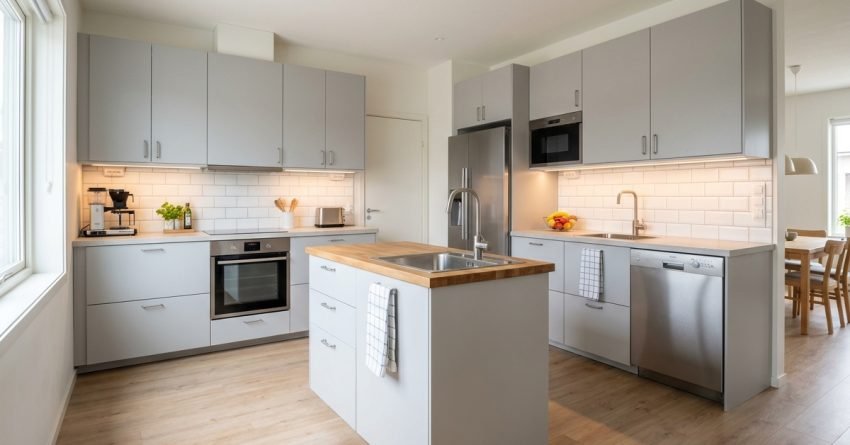
A full IKEA kitchen in Sydney typically costs between $10,000 and $45,000 fully installed, covering cabinets, benchtops, labour, and trades. The flat-pack price from IKEA alone ranges from roughly $3,000 to $15,000 depending on kitchen size, cabinet range, and benchtop selection.
What we see most homeowners underestimate is the gap between the IKEA sticker price and the real total cost once installation, plumbing, electrical, tiling, and appliances are factored in. That gap can double an initial budget when a homeowner goes in unprepared.
We break down every cost layer below, from cabinet ranges and benchtop options to Sydney installation rates, hidden expenses, and realistic total installed price ranges, so you can budget accurately before spending a dollar.
What Does a Full IKEA Kitchen Actually Include?
Before we can help a client budget accurately, we make sure they understand exactly what IKEA sells and what it does not. The IKEA kitchen system is a flat-pack, modular product. Buyers are purchasing components, not a complete, installed kitchen.
A “full IKEA kitchen” refers to the complete set of cabinet carcasses, doors, drawer fronts, interior fittings, and a benchtop. It does not include installation labour, trades work, appliances, or site preparation.
Understanding this distinction is the single most important step in building an accurate renovation budget.
Cabinet Carcasses, Doors, and Hardware
The IKEA kitchen system is built around the SEKTION cabinet carcass, a standardised box that forms the structural base of every configuration. Carcasses come in base, wall, and tall formats, with widths ranging from 12 to 36 inches.
Doors and drawer fronts are sold separately and are the primary driver of visual style and cost variation. Hardware, including hinges, drawer runners, and soft-close mechanisms, is included with most door and drawer purchases.
Cabinet carcass pricing starts at roughly $60–$120 per unit for smaller base cabinets and rises to $200–$400 for tall pantry or corner units. A full kitchen of 15–20 carcasses typically costs $2,000–$6,000 in carcasses alone before doors are added.
Benchtops, Handles, and Interior Fittings
IKEA sells benchtops in laminate, wood, and stone-effect finishes through its BADELUNDA, EKBACKEN, and KARLBY ranges. These are priced per linear metre and represent a significant portion of the total IKEA spend.
Interior fittings such as pull-out organisers, drawer inserts, and shelf inserts are optional but add functionality and cost. Handles range from a few dollars per unit to $20–$40 each for premium options across a full kitchen.
We recommend budgeting $500–$2,500 for handles and interior fittings depending on kitchen size and the level of organisation required.
What Is Not Included in IKEA Kitchen Pricing
This is where most renovation budgets go wrong. IKEA’s quoted kitchen price does not include:
- Installation labour (flat-pack assembly and cabinet hanging)
- Plumbing rough-in or reconnection
- Electrical work including powerpoint relocation and rangehood wiring
- Gas connection where applicable
- Demolition and disposal of the existing kitchen
- Wall preparation, patching, and painting
- Tiling for splashback and floor
- Appliances including oven, cooktop, dishwasher, and rangehood
- Sink and tapware
- Stone or custom benchtop fabrication and installation
Each of these line items carries its own cost in Sydney. Together they typically represent 50–70% of the total project budget, which is why we plan for them upfront on every job.
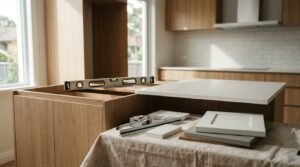
IKEA Kitchen Cost Breakdown by Kitchen Size
Kitchen size is the primary variable in any IKEA kitchen budget. More cabinets mean more carcasses, more doors, more benchtop length, and more installation time.
Small Kitchen (Under 10 Cabinets)
A small kitchen, typical of a studio apartment, granny flat, or compact galley layout, generally requires fewer than 10 cabinet units. This includes base cabinets, wall cabinets, and potentially one tall unit.
IKEA product cost for a small kitchen typically falls between $3,000 and $6,500, assuming a basic laminate benchtop. Upgrading to stone adds $1,500–$4,000 to this figure.
Medium Kitchen (10–20 Cabinets)
A medium kitchen is the most common configuration we see in Sydney homes and apartments, using 10 to 20 cabinet units across an L-shape, U-shape, or galley layout with an island or peninsula.
Product cost typically ranges from $6,000 to $12,000, reflecting the gap between entry-level doors like AXSTAD and mid-range options like BODBYN or VOXTORP. Benchtop selection adds $1,500–$5,000 depending on material and length.
Large Kitchen (20+ Cabinets)
A large kitchen is common in family homes, open-plan living spaces, and properties with butler’s pantries. It requires 20 or more cabinet units and often includes an island bench with additional storage.
Product cost ranges from $10,000 to $18,000 or more. A large kitchen with premium doors, stone benchtops, and full interior fittings can reach $20,000–$25,000 in product cost alone, before any trade is engaged.
IKEA Kitchen Cabinet Ranges and Price Differences
IKEA offers multiple door and drawer front ranges at different price points. The carcass system stays the same across all ranges. What changes is the door style, finish, and material.
SEKTION vs AXSTAD vs BODBYN
AXSTAD is IKEA’s most affordable range, featuring a flat-panel, matt finish in white, dark grey, and olive green. It’s the go-to choice for budget-conscious renovators and investment properties, with doors starting at $30–$80 depending on size.
BODBYN offers a traditional shaker-style profile with a painted finish. It’s one of IKEA’s most popular Australian ranges and sits in the mid-price bracket, with doors ranging from $60–$130.
VOXTORP sits at a similar price point to BODBYN with a more contemporary flat-panel look. Premium ranges like KUNGSBACKA, made from recycled materials with a matte anthracite finish, command $90–$180 per door.
Across a full kitchen of 20 doors, the gap between the cheapest and most expensive IKEA range can amount to $1,500–$4,000 in door costs alone.
Door Styles, Finishes, and Total Cost
Finish selection affects long-term durability as much as price. High-gloss finishes show fingerprints more readily, while matte finishes hold up better in high-traffic kitchens. Timber-effect foil doors offer warmth without the upkeep of real timber.
The finish also affects resale perception. In our experience across Sydney’s property market, mid-range shaker doors in white or grey consistently perform well for owner-occupiers and investors alike. A polarising colour can limit buyer appeal for anyone renovating to sell.
Benchtop Costs for an IKEA Kitchen in Sydney
The benchtop is one of the highest-impact decisions in any kitchen renovation, both visually and financially. IKEA sells its own range, but many of our Sydney clients pair IKEA cabinets with a custom stone benchtop from a local stonemason.
Laminate vs Stone vs Timber Pricing
IKEA’s laminate benchtops, sold under the EKBACKEN range, are the most affordable option at approximately $100–$250 per linear metre. For a standard 4–5 metre kitchen, expect to pay $500–$1,500.
Engineered stone is the most popular choice in Sydney renovations, fabricated and installed by a third-party stonemason. Pricing typically runs $400–$900 per linear metre installed, depending on thickness and edge profile, with a full benchtop commonly costing $3,000–$7,000 installed.
IKEA’s timber benchtops, the KARLBY range in oak, walnut, and pine, run $200–$450 per linear metre. They need oiling and ongoing maintenance but bring a warmth laminate and stone can’t match.
Which Benchtop Adds the Most Value
For Sydney homeowners renovating to maximise resale value, engineered stone consistently delivers the strongest return, since buyers associate stone with quality. For investment properties, a quality laminate benchtop is practical and cost-effective, freeing up budget for appliances or other visible upgrades.
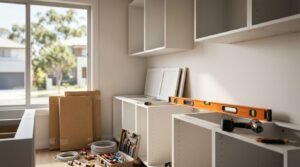
Installation Costs for an IKEA Kitchen in Sydney
IKEA product cost is only one part of the equation. Installation and trades represent a substantial portion of the total Sydney kitchen renovation budget, and this is where costs vary most between projects.
What a Kitchen Installer Charges in Sydney
Many of our clients engage an independent installer or renovation contractor directly rather than using IKEA’s own third-party service. Installation typically ranges from $1,500 to $4,500 for flat-pack assembly and cabinet installation, depending on size and complexity.
Some homeowners attempt the flat-pack assembly themselves to save on this cost, but we generally recommend professional installation for anything beyond a very small kitchen. Poorly fitted carcasses and misaligned doors are common DIY issues that end up costing more to fix than the original installation would have.
This covers assembly, hanging wall cabinets, fitting doors and drawer fronts, and adjusting hinges and runners. It does not cover benchtop installation, which the benchtop supplier or a separate carpenter typically handles. For a medium kitchen, we budget approximately $2,500–$3,500 for professional installation.
Trades Beyond the IKEA Installer
A Sydney kitchen renovation requires several licensed trades beyond the flat-pack installer, and we treat these as non-negotiable line items on every quote.
A licensed plumber is required for disconnecting and reconnecting the sink, dishwasher, and any relocated water lines. Sydney plumbing rates typically run $120–$180 per hour, with a kitchen scope commonly costing $800–$2,500.
A licensed electrician handles powerpoint relocation, rangehood wiring, and new circuits, typically costing $600–$2,000. A gas fitter, required for cooktop installation or relocation, typically costs $400–$1,200. A tiler handles splashback and floor work at $60–$120 per square metre, with a standard splashback costing $800–$2,500.
Why Labour Costs Vary Between Sydney Suburbs
Labour rates across Sydney are not uniform. Inner-city suburbs, including the Inner West, Eastern Suburbs, and Lower North Shore, typically attract higher trade rates due to parking difficulties and travel time. Outer suburban and Western Sydney projects generally attract lower rates.
Project complexity drives variation too. A renovation requiring moved walls, relocated plumbing stacks, or upgraded switchboards costs significantly more than a straight cabinet swap. We always recommend at least three quotes from licensed Sydney tradespeople before committing to a budget.
Hidden Costs Most Homeowners Miss
The most common cause of budget blowouts isn’t the cabinets or benchtop. It’s the costs that were never included in the original estimate, and they’re predictable with proper upfront planning.
Demolition and Disposal
Removing an existing kitchen is a cost many homeowners forget to budget for. In Sydney, demolition and rubbish removal typically cost $500–$1,500, depending on size, access, and whether asbestos testing is required.
Older Sydney homes, particularly those built before 1990, may contain asbestos in wall sheeting or floor adhesives behind the existing kitchen. Testing costs approximately $150–$300, and licensed removal adds $1,000–$3,000 or more. This is a non-negotiable safety and legal requirement on our projects.
Plumbing, Electrical, and Gas Rough-In
A new layout that differs from the existing one, even slightly, escalates rough-in costs quickly. Moving a sink by 500mm requires new waste and water lines, and relocating a cooktop to an island requires new gas or electrical rough-in.
We build in a contingency of $1,500–$3,000 for rough-in adjustments on nearly every project, since walls and floors often reveal surprises once the old kitchen comes out.
Wall Repairs, Tiling, and Flooring Adjustments
Removing old cabinets almost always leaves wall damage: patched plaster, old tile adhesive, and paint lines that no longer match. Rectifying these surfaces before new cabinets go in adds $500–$2,000 depending on the extent of the damage.
Floor coverings need attention too. Where existing tiles or timber flooring extend under the old cabinets, the new footprint may not align, leaving exposed or mismatched flooring that needs patching.
Appliances, Sink, and Tapware
IKEA sells sinks and tapware, but most of our Sydney clients purchase appliances separately. A realistic appliance budget for a mid-range renovation looks like this:
- Oven: $800–$3,000
- Cooktop: $400–$2,500
- Rangehood: $300–$1,500
- Dishwasher: $600–$2,000
- Sink and tapware: $400–$1,500
Total appliance and fixture budget: $2,500–$10,500 depending on brand selection.
Total Installed Cost of a Full IKEA Kitchen in Sydney
Combining product costs, installation labour, trades, and hidden costs, the following ranges represent realistic total installed costs for a Sydney IKEA kitchen renovation in 2025.
Budget IKEA Kitchen
A budget kitchen uses entry-level ranges like AXSTAD, a laminate benchtop, basic handles, and minimal fittings, with the layout following the existing footprint to minimise trades costs.
Total installed cost: $10,000–$18,000
This suits investment properties, rental renovations, and homeowners prioritising function over premium finishes.
Mid-Range IKEA Kitchen
A mid-range kitchen uses a shaker-style range like BODBYN or VOXTORP, an engineered stone benchtop, quality handles, and a full set of interior fittings, with mid-to-upper market appliances.
Total installed cost: $20,000–$32,000
This is the price range we see most often for Sydney owner-occupiers renovating their primary residence.
Premium IKEA Kitchen
A premium kitchen uses top-tier ranges like KUNGSBACKA, a thick-profile stone or timber benchtop, premium handles, full fittings, and high-spec appliances, often including an island bench or structural changes.
Total installed cost: $35,000–$50,000+
At this level, the IKEA cabinet system serves as a cost-efficient structural base while premium finishes and trades work drive the total. The result is indistinguishable from a fully custom kitchen in most cases.
Is an IKEA Kitchen Worth It Compared to a Custom Kitchen?
IKEA kitchens occupy a specific position in the Sydney market. They offer genuine value at the product level, but the total installed cost narrows the gap with custom alternatives more than most homeowners expect.
IKEA vs Flat-Pack Competitors in Sydney
IKEA isn’t the only flat-pack option in Sydney. Kaboodle, available through Bunnings, is the most direct budget competitor, with pricing broadly similar to IKEA’s entry-level range. Kinsman and Freedom Kitchens offer more customisation and local support at a premium of 20–40% over IKEA for equivalent configurations.
IKEA’s advantage lies in its global supply chain and the depth of its accessory range. The trade-off is the self-service model, which demands more planning effort and puts ordering errors on the homeowner to resolve.
When to Choose IKEA and When to Upgrade
IKEA is the right choice when the kitchen footprint is standard, the layout is straightforward, and budget is the primary constraint. We see it perform exceptionally well in apartments, investment properties, and functional family kitchens.
A custom kitchen earns its premium when the space has non-standard dimensions, when specific storage solutions can’t be achieved with flat-pack, or when the kitchen is a primary selling feature of a high-value property.

How to Budget for an IKEA Kitchen Renovation in Sydney
Accurate budgeting before visiting IKEA or engaging any contractor is the single most effective way to avoid cost overruns. This is the approach we use with our own clients across Sydney.
Setting a Realistic Budget
We recommend allocating spend across four categories using this framework for a mid-range Sydney renovation:
- IKEA products (cabinets, benchtop, fittings): 30–40% of total budget
- Installation labour: 10–15% of total budget
- Trades (plumbing, electrical, tiling): 20–30% of total budget
- Appliances, sink, tapware: 15–20% of total budget
- Contingency: 10–15% of total budget
This framework prevents the common mistake of spending most of the budget on IKEA products and discovering too late that funds are short for trades and appliances.
Using the IKEA Kitchen Planner
IKEA’s free online kitchen planner lets homeowners design a layout, select configurations, choose doors and benchtops, and generate an itemised product list with pricing. We recommend generating a budget, mid-range, and premium scenario before committing to a design.
Contingency Allowances
Every kitchen renovation should carry a contingency of at least 10–15% of the total budget. For homes built before 1980, we increase this to 20%, since unexpected discoveries behind walls and under floors are common in Sydney’s ageing housing stock.
A contingency isn’t a budget to spend. It’s a financial buffer that protects the project from scope creep and unforeseen site conditions, and we build it into every estimate as standard practice.
Conclusion
A full IKEA kitchen in Sydney costs between $10,000 and $50,000 installed, with the final figure shaped by kitchen size, cabinet range, benchtop selection, trades complexity, and appliance specification. The IKEA product cost is only one part of the total.
Budgeting accurately from the start, across all four cost categories and with a proper contingency, is what separates renovations that finish on budget from those that blow out. The IKEA system delivers genuine value when it’s planned correctly and supported by experienced trades.
At Sydney Home Renovation, we help homeowners and property investors plan and deliver IKEA kitchen renovations with full cost transparency, coordinated trades, and no budget surprises. Contact our team for an honest, detailed quote on your kitchen renovation.
Frequently Asked Questions
How much does a full IKEA kitchen cost in Australia?
A full IKEA kitchen in Australia costs between $3,000 and $20,000 for flat-pack products alone, depending on size, door range, and benchtop. With installation, trades, and appliances included, the total installed cost in Sydney typically runs $10,000 to $50,000.
Does IKEA install kitchens in Sydney?
IKEA offers installation through third-party contractors arranged via the IKEA website or in-store. We often see homeowners choose an independent renovation contractor directly for greater flexibility and better coordination of the full trades scope.
How long does it take to install an IKEA kitchen?
Physical installation typically takes two to five days for a medium kitchen, not including trades work. With plumbing, electrical, tiling, and other trades factored in, a complete renovation generally takes two to four weeks from demolition to completion.
Can I use an IKEA kitchen with a stone benchtop?
Yes, IKEA cabinets are fully compatible with custom engineered stone benchtops fabricated by a local stonemason. This is one of the most popular combinations we install in Sydney, with stonemasons templating directly from the installed cabinets.
What trades do I need to install an IKEA kitchen in Sydney?
A complete installation requires a licensed plumber for sink and dishwasher connections, an electrician for power points and wiring, a gas fitter if installing a gas cooktop, and a tiler for the splashback. A flat-pack installer handles the cabinet assembly.
Is it cheaper to buy an IKEA kitchen or a custom kitchen?
IKEA kitchens are generally 30–50% cheaper at the product level than a fully custom kitchen. The total installed cost gap narrows once trades, installation, and appliances are included, though IKEA still delivers strong value for standard layouts.
What is the cheapest full IKEA kitchen I can buy?
The cheapest configuration uses the AXSTAD door range, a laminate EKBACKEN benchtop, basic handles, and a minimal cabinet count. For a small kitchen of eight to ten cabinets, product cost can be as low as $3,000–$5,000, with installed totals starting around $10,000–$14,000.