White, greige, and navy cabinetry consistently increase home value in Sydney’s resale market, while trend-driven or highly saturated colors tend to work against it. We’ve found that color is one of the most underestimated tools for lifting buyer appeal, because it shapes a buyer’s first impression before they even consider layout or storage.
For homeowners preparing to sell, renovators planning a kitchen upgrade, and investors maximising return, color selection is a strategic decision. It isn’t just an aesthetic one.
This guide covers the best kitchen colors that increase home value, which colors to avoid, how to coordinate a complete color scheme, and when a repaint versus a full renovation delivers the strongest return.
Why Kitchen Color Choices Directly Affect Property Value
Color is not decoration in a kitchen. It’s a value signal. Buyers form an impression within seconds of entering a room, and that impression is shaped almost entirely by color, light, and finish before they assess layout or appliances.
A poorly chosen kitchen color can make a well-built, functional kitchen feel dated or cheap. A well-chosen color can make a modest kitchen feel premium and move-in ready.
That difference translates directly into stronger buyer competition and higher offers.
How Buyers and Valuers Perceive Kitchen Aesthetics
We consistently see buyers and valuers assess kitchens through the lens of condition, presentation, and market appeal, and color plays a central role in all three. A kitchen painted in a neutral, contemporary palette reads as well-maintained and current. A kitchen in an outdated or polarising color reads as a renovation project, which buyers price accordingly.
Valuers weigh comparable sales and market expectations when forming an opinion of value. According to Domain’s property research, kitchens and bathrooms remain the two rooms buyers cite most often as influencing their purchase decision. Color is typically the first thing a buyer notices in a listing photo, which makes it a critical factor in generating inspection traffic before a sale even begins.
The Link Between Kitchen Presentation and Sale Price in Sydney
Sydney’s property market is presentation-driven, and buyers in most suburbs expect kitchens to be close to move-in ready, particularly in the mid-to-upper price brackets. A kitchen that looks fresh and cohesive, achieved largely through color, reduces the perceived renovation burden for buyers.
That perception supports a higher willingness to pay. Within the kitchen itself, cabinet color is the dominant visual element, which makes getting that color right one of the most cost-effective ways to increase perceived value without a full structural renovation.
The Best Kitchen Colors That Increase Home Value
Not all kitchen colors perform equally in the resale market. The colors that consistently add value share three traits: they’re neutral enough to appeal to a broad buyer pool, contemporary enough to feel current, and versatile enough to work across different home styles and light conditions.
White and Off-White Kitchens: The Timeless High-Value Choice
White remains the single most popular kitchen cabinet color in the Australian resale market. White kitchens photograph exceptionally well, reflect natural light, and create a sense of cleanliness and space that appeals to the widest possible buyer demographic.
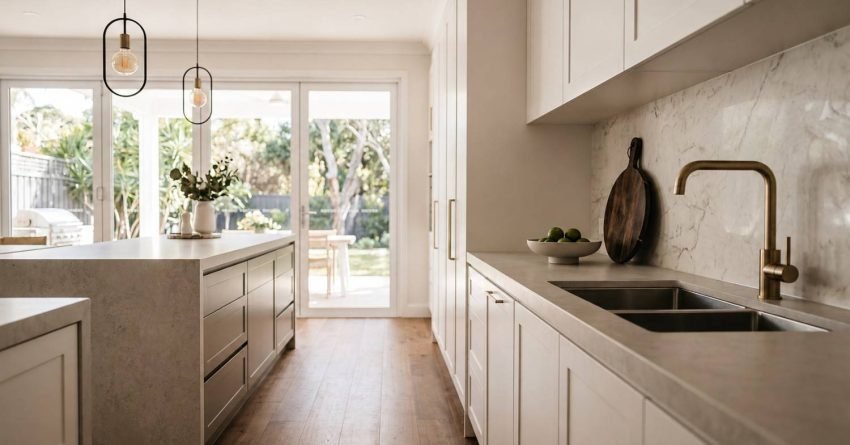
Off-white tones, including warm whites, linen, and soft cream, have grown in popularity as alternatives to stark, cool whites. These warmer variations feel less clinical and pair naturally with timber benchtops, stone surfaces, and brass or matte black hardware.
For Sydney homes, we consider white and off-white cabinetry a safe, high-performing choice across most property types, from inner-city apartments to suburban family homes. It’s the color least likely to alienate buyers and most likely to support a strong first impression.
Greige and Warm Neutrals: The Modern Buyer’s Preference
Greige, a blend of grey and beige, has become one of the most sought-after kitchen cabinet colors in the Australian market over the past several years. It sits in the ideal middle ground between the cool feel of grey and the warmth of traditional beige.
Warm neutrals in this family, including taupe, stone, and warm sand tones, work particularly well in Sydney homes with north-facing kitchens and good natural light. They pair seamlessly with engineered stone benchtops, subway tile splashbacks, and both timber and concrete-look flooring.
We find greige cabinetry consistently performs well in buyer feedback as a color that feels current without being trend-dependent, which supports long-term resale value.
Navy and Deep Blue Cabinetry: Bold Choices That Pay Off
Navy blue has established itself as a premium kitchen cabinet color in the Australian market, particularly in higher-end renovations. When paired with white or stone benchtops, quality hardware, and appropriate lighting, navy cabinetry signals sophistication and intentional design.
The key with navy and deep blue tones is execution. These colors work best in kitchens with adequate natural light, since dark cabinetry in a poorly lit space can feel heavy.
In Sydney’s inner suburbs and coastal markets, we’ve seen navy cabinetry become a recognisable marker of a quality renovation, supporting both buyer appeal and valuation outcomes.
Sage Green and Muted Earth Tones: The Emerging Value-Add Color
Sage green has moved from a niche choice to a mainstream kitchen color over the past few years, driven by a broader shift toward biophilic design. Muted, dusty greens, including sage, eucalyptus, and olive, bring warmth without the risk of feeling overly bold.
These colors work particularly well in homes with natural timber elements and indoor-outdoor connections, both common in Sydney’s lifestyle-oriented property market. Sage green paired with a white or light stone benchtop and brushed brass hardware creates a kitchen that feels current and considered.
Sage carries slightly more design risk than white or greige. In the right property context, though, it’s increasingly well-received by Sydney buyers and can be a strong differentiator in a competitive listing.
Charcoal and Soft Black Contemporary Appeal for Premium Buyers
Charcoal and soft black cabinetry sits at the premium end of the kitchen color spectrum. These colors are bold and unambiguously contemporary, qualities that appeal strongly to a specific buyer profile but carry more risk in the broader market.
In the right property, a modern architectural home or a prestige renovation, charcoal or soft black cabinetry can be a significant value driver. It pairs naturally with premium materials like marble, engineered stone, and brushed metal.
The risk with dark cabinetry is narrowing buyer appeal. In properties with a broad target buyer pool, family homes, entry-level apartments, and investment properties, charcoal and black kitchens can polarise opinion and reduce competitive offers.
Kitchen Colors That Can Hurt Your Home’s Value
Just as the right color can increase buyer appeal, the wrong color can actively work against you. Understanding which colors reduce perceived value is as important as knowing which ones add it.
Overly Trendy Colors That Date Quickly
Colors strongly associated with a specific design era tend to date a kitchen quickly. Terracotta, mustard yellow, and certain shades of burnt orange were popular in earlier decades and now read as dated in most Sydney markets.
The same risk applies to colors currently at peak trend saturation. Choosing colors with longevity, neutrals, classics, and timeless tones protects resale value over a longer horizon.
High-Contrast or Polarising Color Combinations to Avoid
Highly personalised color choices, including bright primary colors and heavily saturated tones, tend to reduce buyer appeal by making it harder for buyers to visualise themselves in the space. A bold, personal color requires buyers to mentally renovate before they can connect with the property.
High-contrast combinations that lack design coherence also reduce perceived quality. Buyers interpret visual incoherence as a sign of poor workmanship or a rushed renovation.

How to Choose the Right Kitchen Color for Maximum Resale Value
Choosing a kitchen color for resale is a different exercise from choosing one for personal enjoyment. The goal is to select a color that maximises buyer appeal, photographs well, and works cohesively with the rest of the kitchen’s materials.
Match Kitchen Color to Your Home’s Style and Architecture
The most effective kitchen colors feel consistent with the home’s broader architectural character. A contemporary kitchen in a Federation-era home can work beautifully, but the palette needs to bridge old and new without visual conflict.
In heritage and period homes, we recommend warmer neutrals and muted tones over stark cool greys or industrial blacks. In modern architectural homes, cooler neutrals, charcoal, and deep tones feel entirely at home.
Consider Natural Light and Kitchen Size When Choosing Color
Natural light is one of the most important variables in kitchen color selection. A color that looks warm in a north-facing kitchen can feel dark and oppressive in a south-facing kitchen with limited sun exposure.
Lighter colors are generally safer choices in kitchens with limited natural light, since they reflect available light and create a sense of openness. Darker colors can work in well-lit kitchens but need careful lighting design.
Kitchen size matters too. In smaller kitchens, common in Sydney apartments and terrace homes, lighter colors help maintain a sense of space.
Coordinate Cabinet Color With Benchtop, Splashback, and Hardware
A kitchen color doesn’t exist in isolation. Cabinet color must work cohesively with benchtop material, splashback, flooring, and hardware finishes.
We recommend anchoring the palette around one dominant neutral, typically the cabinet color, and building the remaining elements around it. Hardware in matte black, brushed brass, or brushed nickel adds a finishing layer that elevates the presentation.
Kitchen Color Combinations That Buyers Love in Sydney
Beyond individual cabinet colors, the combination of colors and finishes across the kitchen creates a cohesive, high-value presentation. Certain combinations have proven particularly effective in Sydney’s property market.
Two-Tone Cabinet Color Schemes That Add Visual Depth
Two-tone kitchens, where upper and lower cabinets are finished in different but complementary colors, have become a popular strategy for adding visual interest. The most successful combinations pair a lighter upper cabinet color with a slightly deeper lower cabinet color.
Common high-performing combinations include white uppers with greige or navy lowers, and sage green lowers with white or linen uppers. These combinations photograph with strong visual impact, which matters in Sydney’s online-first property market.
Neutral Cabinets With Contrast Island: A High-Impact Strategy
In kitchens with a central island, using a contrasting color on the island while keeping perimeter cabinets neutral is one of the most effective ways to create a premium, designed feel. A white or greige perimeter with a navy, charcoal, or sage green island creates a focal point buyers respond to strongly.
This strategy works particularly well in open-plan living areas where the island is visible from multiple vantage points.
Does Repainting Kitchen Cabinets Add Value to Your Home?
Repainting kitchen cabinets is one of the most cost-effective ways to update a kitchen’s color and improve buyer appeal without the expense of a full renovation. The key question is whether the investment delivers a meaningful return for your property and target market.
What Does a Kitchen Cabinet Repaint Cost in Sydney?
In Sydney, a professional kitchen cabinet repaint typically costs meaningfully less than full cabinet replacement or a complete kitchen renovation, with pricing generally scaling with the number of doors, drawers, and the finish selected. We recommend a sprayed finish over a brushed finish where budget allows, since sprayed lacquer delivers a smoother, more durable result that photographs better for resale purposes.
DIY repainting can reduce upfront cost, but we generally advise against it for resale-focused projects. Buyers and their inspectors notice uneven coverage, poor edge finishing, and inconsistent sheen far more readily than most homeowners expect, and a professional finish tends to earn back its cost through stronger buyer confidence at inspection.
Cost of Repainting vs. Full Cabinet Replacement in Sydney
A repaint updates the color and finish of existing cabinet doors and frames, which can dramatically change the kitchen’s appearance if the underlying cabinet structure is in good condition. Full cabinet replacement involves removing existing cabinetry and installing new boxes, doors, and hardware, a substantially larger investment.
That larger investment is justified when the existing cabinetry is structurally compromised or poorly laid out. For properties where the layout is sound but the color is dated, a professional repaint in a contemporary neutral can deliver a strong return relative to its cost.
When a Cabinet Repaint Is Worth the Investment
A cabinet repaint delivers the strongest return when the existing structure is in good condition, and the primary issue is color rather than design or functionality. In these circumstances, a repaint can transform the kitchen’s presentation at a fraction of the cost of a full renovation.
A repaint is less likely to deliver strong returns when the cabinetry is visibly damaged, or the layout is inefficient. In these cases, a repaint may improve presentation marginally but won’t address the issues buyers identify during inspection.
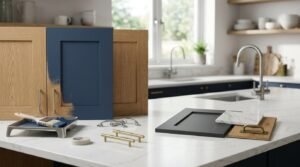
Kitchen Renovation Colors vs. Cabinet Repaints: What Adds More Value?
The choice between a full kitchen renovation and a cabinet repaint ultimately comes down to return on investment relative to the property’s value, condition, and target market. Both strategies can add value, but they suit different circumstances.
Full Kitchen Renovation Color Strategy for Maximum ROI
A full renovation allows for a complete color strategy, new cabinetry paired with coordinated benchtops, splashback, flooring, and hardware, that creates a cohesive, high-impact result. This level of investment suits properties where the existing kitchen is structurally outdated, or the renovation is intended to support a significant uplift in sale price.
We recommend planning color strategy from the outset as part of the overall design brief, with the cabinet color anchoring every other material decision.
Budget-Friendly Color Updates That Still Impress Buyers
Not every property requires a full kitchen renovation to achieve a meaningful improvement in buyer appeal. Several targeted, budget-conscious updates can deliver strong results.
Repainting cabinet doors in a contemporary neutral, replacing dated hardware, updating a tired splashback, and repainting walls in a complementary tone are relatively low-cost interventions. When coordinated thoughtfully, these updates can make a kitchen feel substantially more current to buyers.
How Sydney Home Renovation Helps You Choose Value-Adding Kitchen Colors
Choosing the right kitchen color for resale isn’t simply a matter of picking a popular shade from a paint chart. It requires understanding your property’s architecture, natural light, existing materials, and target buyer profile.
We approach kitchen color selection as part of a broader renovation strategy. We assess your kitchen’s existing condition, layout, and materials, and recommend color choices calibrated to maximise buyer appeal in your specific market.
Our end-to-end service covers everything from initial color consultation through to full renovation delivery, ensuring the color strategy is executed consistently across cabinetry, benchtops, splashback, hardware, and finishes.
Why Transparent Pricing and Color Strategy Go Hand in Hand
One of the most common mistakes homeowners make when renovating for resale is investing in the wrong areas, spending heavily on elements buyers don’t value while underinvesting in high-impact changes like color and finish. Transparent pricing guidance is essential to making decisions that deliver genuine return.
We provide clear, detailed cost breakdowns for every scope of work, from a targeted cabinet repaint to a full kitchen renovation, so you can invest where it matters most for buyer appeal and market value.
Conclusion
Kitchen color is one of the most powerful and cost-effective tools for increasing home value in Sydney’s competitive property market. From timeless white and greige to contemporary navy and sage green, the right cabinet color builds buyer appeal and supports stronger valuations.
Whether you’re planning a full kitchen renovation or a targeted cabinet repaint, the color decisions you make now will directly influence how buyers perceive and price your property. Getting those decisions right takes more than a paint chart. It takes a clear understanding of your market, your buyer, and your budget.
At Sydney Home Renovation, we help homeowners and property investors make confident, well-informed kitchen renovation decisions, from color strategy and material selection to full project delivery. Contact us today to discuss how the right kitchen color choices can increase your home’s value.
Frequently Asked Questions
What is the most popular kitchen cabinet color for resale value?
White and off-white remain the most popular colors for resale value in Australia. They appeal to the broadest buyer demographic and photograph well in listing imagery.
Do white kitchens increase home value?
Yes, white kitchens consistently support strong buyer appeal. White cabinetry reflects natural light and makes kitchens feel larger, cleaner, and more move-in ready.
What kitchen colors should I avoid if I want to sell my home?
Avoid highly personalised, polarising, or heavily trend-dependent colors. These narrow buyer appeal and can signal that a renovation is needed.
Is it worth repainting kitchen cabinets before selling?
Repainting is worth it when the existing cabinet structure is in good condition, and the color is simply outdated. A professional repaint improves appeal at a fraction of replacement cost.
What color kitchen sells the fastest in Sydney?
Neutral kitchens, particularly white, off-white, and greige, tend to sell fastest because they appeal to the widest buyer pool and photograph well online.
Do two-tone kitchen cabinets add value to a home?
Two-tone cabinets can add value when the combination is cohesive. Lighter uppers with a deeper lower tone create visual depth that buyers respond to positively.
How much value does a kitchen renovation add to a Sydney home?
Value added depends on the property’s price point and quality of execution. A well-planned renovation with a strong color strategy can meaningfully lift buyer appeal and sale price.