Building a granny flat in Sydney is one of the most practical ways to add value to your property and generate rental income, but the rules governing secondary dwellings in NSW are detailed, location-specific, and easy to get wrong. Understanding the approval pathways, size limits, setback requirements, and council-specific controls before you build is not optional. It is the difference between a compliant, income-generating asset and a costly legal problem.
NSW planning law has made granny flat approvals more accessible than most homeowners realise. The State Environmental Planning Policy (Affordable Rental Housing) 2009 created a streamlined pathway that bypasses traditional council DA processes for eligible properties. But eligibility depends on your lot size, zoning, and local environmental plan.
This guide covers everything Sydney homeowners, investors, and first-time renovators need to know: what qualifies as a granny flat under NSW law, who can build one, which approval pathway applies, what design rules govern the build, and what it all costs.
What Is a Granny Flat Under NSW Planning Law?
A granny flat is a self-contained secondary dwelling built on the same lot as an existing principal dwelling. Under NSW planning legislation, it must include its own kitchen, bathroom, and living area. It is not a boarding house, a dual occupancy, or a studio addition; it is a legally defined dwelling type with its own planning controls, approval requirements, and occupancy rules.
The legal framework governing granny flats in NSW sits primarily within the State Environmental Planning Policy (Affordable Rental Housing) 2009, commonly referred to as the ARHSEPP. This policy was introduced specifically to increase housing supply across NSW by making it easier for eligible homeowners to build secondary dwellings without navigating the full development application process.
How NSW Defines a Secondary Dwelling
Under the ARHSEPP, a secondary dwelling is a self-contained dwelling established in conjunction with another dwelling (the principal dwelling) on the same lot of land. It must be on the same lot, not a separate title. It must be self-contained, with its own cooking, bathing, and sleeping facilities, and it must be ancillary to the principal dwelling, not the dominant structure on the site.
This definition determines which planning controls apply, which approval pathway is available, and whether your proposed structure qualifies for the streamlined complying development pathway or requires a full development application. Getting this classification right at the start of your project saves significant time and money.
Granny Flat vs. Secondary Dwelling vs. Dual Occupancy
These three terms are often used interchangeably, but they carry distinct legal meanings in NSW that affect your approval pathway, your ability to rent, and your long-term property options.
A granny flat and a secondary dwelling are effectively the same thing under NSW law. Both refer to a self-contained dwelling on the same lot as a principal dwelling, governed by the ARHSEPP.
A dual occupancy is a fundamentally different planning category. It involves two dwellings on the same lot treated as separate, co-equal dwellings rather than a principal and secondary arrangement. Dual occupancies are subject to different planning controls, often require a DA regardless of lot size, and in some zones can be subdivided into separate titles, a Torrens title subdivision which a granny flat cannot.
The practical difference: a granny flat is always subordinate to the main house and cannot be sold separately. A dual occupancy can, in some circumstances, be strata or Torrens titled and sold as an independent property. If your goal is to eventually sell the secondary dwelling as a standalone asset, a dual occupancy is the relevant planning pathway, not a granny flat.
Granny Flat Design Types: Detached, Attached, and Conversions
Before working through the approval rules, it helps to understand the three main physical forms a granny flat takes in Sydney. The design type affects your site planning, construction cost, and in some cases your approval pathway.
Detached Granny Flat
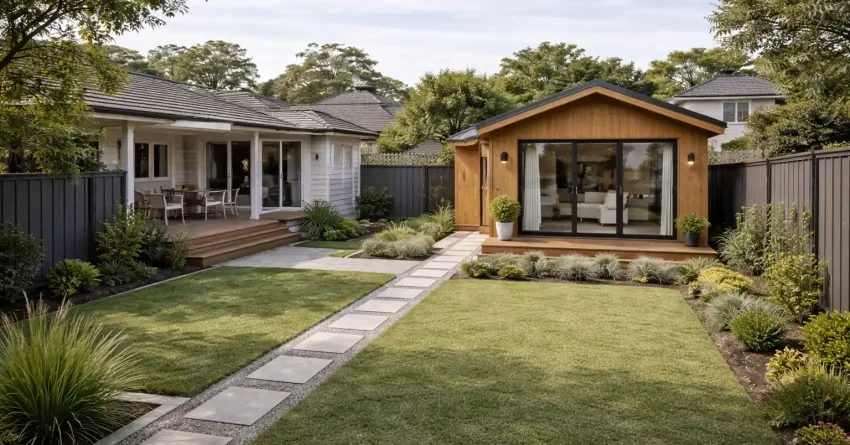
A detached granny flat is a freestanding structure built in the rear yard, completely separate from the main house. This is the most common form in Sydney, and the one the ARHSEPP framework is primarily designed around. Detached builds offer the most privacy for both occupants and are generally the most straightforward to approve under the CDC pathway, provided the lot meets the size and setback requirements.
Construction costs for detached builds are typically higher than conversions because the structure is built from the ground up. Site access, slope, and soil conditions all affect the final cost.
Attached or Internal Granny Flat
An attached granny flat shares a wall with the principal dwelling or is created by converting part of the existing house, a lower ground floor, a garage attached to the main structure, or a large room with a separate entrance. These designs are common on smaller lots where a detached structure cannot meet setback requirements.
Internal conversions generally cost less than new builds because the structure already exists. However, they require careful attention to acoustic separation, fire rating between dwellings, and the NCC’s habitability standards for the converted space.
Garage Conversion
Converting a freestanding or attached garage into a self-contained dwelling is a cost-effective entry point for many Sydney homeowners. The existing slab, roof, and walls reduce construction costs significantly. The key compliance requirements are achieving the minimum ceiling height of 2.4 metres for habitable rooms, meeting NCC waterproofing and ventilation standards, and ensuring the converted space qualifies as a secondary dwelling under the ARHSEPP rather than a simple habitable room addition.
Garage conversions that do not meet the ARHSEPP secondary dwelling definition may require a different approval pathway or may not qualify for the CDC route at all.
Who Can Build a Granny Flat in Sydney?
Not every Sydney property qualifies for a granny flat under the streamlined ARHSEPP pathway. Eligibility is determined by a combination of lot size, zoning, existing dwelling status, and local environmental plan controls. Understanding these criteria before engaging a builder or designer prevents wasted time and abortive design costs.
Minimum Lot Size Requirements in NSW
The ARHSEPP sets a minimum lot size of 450 square metres for properties in the Sydney metropolitan area to be eligible for a granny flat under the complying development pathway. This is a hard threshold. Properties below 450m² are not eligible for the CDC pathway and must pursue a development application if they want to build a secondary dwelling, subject to their council’s LEP permitting it at all.
For properties between 450m² and 900m², the maximum floor area of the granny flat is calculated as a proportion of the lot size. For lots 900m² and above, the maximum floor area cap of 60 square metres applies regardless of how large the lot is.
The 450m² minimum refers to the total lot area, not the area of the rear yard or the area available for construction. The lot area is the total registered land area as shown on your title documents.
Owner-Occupier Rules and Eligibility Criteria
One of the most commonly misunderstood aspects of NSW granny flat rules is the owner-occupier requirement. Under the ARHSEPP, at least one of the dwellings on the lot must be occupied by the owner of the property. This means you cannot build a granny flat on an investment property where neither dwelling is owner-occupied and use the ARHSEPP pathway.
This rule does not prevent investors from building granny flats. It simply means the owner must reside in one of the dwellings. If you live in the main house and rent the granny flat, you comply. If you live in the granny flat and rent the main house, you also comply.
Properties in zones R1 (General Residential), R2 (Low Density Residential), R3 (Medium Density Residential), R4 (High Density Residential), and R5 (Large Lot Residential) are generally eligible under the ARHSEPP, subject to meeting the lot size and other development standards. Properties in rural, industrial, or business zones are typically not eligible.
Granny Flat Approval Pathways in NSW
There are two primary approval pathways for building a granny flat in Sydney: the Complying Development Certificate (CDC) and the Development Application (DA). The pathway available to you depends on your lot size, zoning, site constraints, and the design of your proposed granny flat. Choosing the right pathway from the start is critical to managing your timeline and budget.
Complying Development Certificate (CDC) Explained
The CDC pathway is the faster, simpler approval route for eligible properties. Your granny flat is assessed against a set of predetermined development standards, the ARHSEPP standards, rather than being subject to the full merit-based assessment process of a DA. If your proposal meets all the standards, approval is essentially guaranteed, and it is issued by a private certifier rather than the council.
The CDC pathway typically takes between 10 and 20 business days from lodgement to approval. To be eligible, your property must meet the minimum lot size of 450m², be in an eligible zone, not be subject to certain overlays (such as heritage conservation areas, acid sulfate soils, or certain flood categories), and the proposed granny flat must comply with all ARHSEPP development standards including floor area, setbacks, height, and private open space requirements.
Development Application (DA) Process in Sydney
If your property does not meet the CDC eligibility criteria, or if you want to build a granny flat that does not comply with the ARHSEPP standards, for example, a larger floor area or reduced setbacks, you must lodge a Development Application with your local council.
The DA process involves a merit-based assessment of your proposal against the council’s Local Environmental Plan (LEP) and Development Control Plan (DCP). The council has discretion to approve or refuse your application, and conditions can be imposed that require design changes. The DA process is longer, more expensive, and less certain than the CDC pathway.
DA timeframes in Sydney vary significantly by council. Some councils process straightforward residential DAs within 40 to 60 days. Others, particularly those with high application volumes or complex assessment requirements, take four to six months or longer. Engaging a town planner or planning consultant to prepare and manage your DA submission is strongly recommended for complex sites.
CDC vs. DA: Which Approval Path Is Right for You?
The decision between CDC and DA comes down to three factors: eligibility, design flexibility, and timeline.
If your property meets the ARHSEPP criteria and your proposed granny flat complies with all development standards, the CDC pathway is almost always the better choice. It is faster, cheaper, and more certain. The private certifier assesses compliance against objective standards, removing the subjectivity of council assessment.
If your property has constraints that prevent CDC eligibility heritage overlay, flood affectation, lot size below 450m², or non-compliant design the DA pathway is your only option. In some cases, a DA is also strategically preferable if you want to negotiate design variations or if your council’s LEP allows for a larger or differently configured secondary dwelling than the ARHSEPP standards permit.
| Factor | CDC | DA |
| Typical timeframe | 10–20 business days | 3–6+ months |
| Assessed by | Private certifier | Local council |
| Approval certainty | High (if compliant) | Discretionary |
| Design flexibility | Limited to ARHSEPP standards | Greater flexibility |
| Typical approval cost | $1,500–$3,500 | $3,000–$10,000+ |
| Eligible properties | 450m²+, no overlays | All eligible zones |
Typical Granny Flat Project Timeline
Understanding the full sequence from feasibility to handover helps you plan your budget and manage expectations. A typical CDC-pathway granny flat project in Sydney runs as follows.
Weeks 1–2: obtain a Section 10.7 Planning Certificate, confirm eligibility, and engage a designer. Weeks 3–8: complete architectural drawings and engineering. Weeks 9–11: lodge CDC with a private certifier and receive approval. Weeks 12–13: obtain the Construction Certificate and appoint a builder. Weeks 14–36: construction, with inspections at key stages. Week 37 onwards: final inspection, occupation certificate issued, and handover.
DA-pathway projects add three to six months to the approval stage. Complex sites with heritage, flood, or bushfire overlays extend the timeline further.
NSW Granny Flat Size and Design Rules
The physical design of your granny flat is governed by a detailed set of development standards under the ARHSEPP. These standards define the maximum floor area, minimum setbacks from boundaries, maximum height, and private open space requirements. Every element of your design must comply with these standards to be eligible for the CDC pathway.
Maximum Floor Area Limits for Granny Flats
The maximum floor area for a granny flat in NSW is 60 square metres. This is a hard cap that applies regardless of how large your lot is. The 60m² limit includes all internal floor space but excludes covered outdoor areas such as verandahs and pergolas that are open on at least two sides.
For lots between 450m² and 900m², the maximum floor area is the lesser of 60m² or one square metre of granny flat floor area per 15 square metres of lot area. For a 600m² lot, this formula yields a maximum of 40m². For a 750m² lot, it yields 50m². For lots 900m² and above, the full 60m² cap applies.
Many homeowners assume they can build a 60m² granny flat on any lot above 450m², but the proportional formula means smaller lots within the eligible range are subject to a reduced maximum floor area.
Setback Requirements and Boundary Rules
Setback requirements define how close your granny flat can be built to the boundaries of your property. Under the ARHSEPP, the following minimum setbacks apply for complying development.
Rear boundary setback: at least 3 metres from the rear boundary for single-storey structures; 5 metres for two-storey structures. Side boundary setback: minimum 900mm for single-storey; 1.5 metres for two-storey. Front setback: the granny flat must be located behind the principal dwelling and cannot be built in the front yard.
These are minimums. Your council’s DCP may impose greater setbacks, particularly for properties in heritage conservation areas or where the DCP has specific rear lane or boundary interface controls.
Height Limits and Storey Restrictions
Under the ARHSEPP, a granny flat approved as complying development must not exceed 8.5 metres in height, measured from natural ground level to the highest point of the roof. In practice, most granny flats are single-storey structures with a maximum height of around 4 to 5 metres, well within this limit.
Two-storey granny flats are permissible under the ARHSEPP but are subject to the increased setback requirements noted above and must still comply with the 60m² maximum floor area limit. The 60m² limit applies to the total combined floor area of both storeys. Some councils impose additional height controls through their LEPs or DCPs that are more restrictive than the ARHSEPP standard.
Private Open Space and Landscaping Requirements
The ARHSEPP requires that the principal dwelling retains at least 24 square metres of private open space with a minimum dimension of 3 metres in any direction after the granny flat is built.
At least 20% of the lot area must also be maintained as a landscaped area of permeable, vegetated ground. Hard paving, driveways, and building footprints all count against this 20% minimum. For smaller lots near the 450m² threshold, meeting the landscaping requirement alongside the building footprint is a common design constraint that needs to be resolved early in the design process.
Council-Specific Granny Flat Regulations Across Sydney
While the ARHSEPP provides a state-level framework for granny flat approvals, local councils across Sydney have their own planning instruments that can add layers of complexity, restriction, or in some cases, additional flexibility. Understanding how your council’s controls interact with the state framework is essential before you commit to a design.
How Local Environmental Plans (LEPs) Affect Your Build
Every council in NSW has a Local Environmental Plan (LEP) that sets the zoning, land use permissibility, and development standards for properties within its boundaries. The LEP works alongside the ARHSEPP, and in some cases, council LEP controls are more restrictive than the state policy.
Some councils have minimum lot size requirements in their LEPs that are higher than the ARHSEPP’s 450m² threshold. If your council’s LEP requires a minimum lot size of 600m² for secondary dwellings, then properties between 450m² and 600m² in that council area cannot use the CDC pathway, even though they are otherwise eligible under the ARHSEPP.
Councils also use Development Control Plans (DCPs) to set detailed design guidelines for secondary dwellings. DCPs can specify requirements around materials, roof pitch, window placement, privacy screening, and landscaping that go beyond the ARHSEPP standards. While DCPs are not legally binding in the same way as LEPs, they carry significant weight in DA assessments and can influence CDC compliance assessments.
Sydney Councils With Stricter or More Flexible Rules
Granny flat rules vary meaningfully across Sydney’s 33 local government areas. Some councils have embraced the ARHSEPP framework and apply it with minimal additional restrictions. Others have used their LEPs and DCPs to impose controls that effectively make granny flat approvals more difficult or expensive in their areas.
Councils in Sydney’s inner ring, including the City of Sydney, Inner West, and Woollahra, tend to have more complex planning environments due to the prevalence of heritage conservation areas, higher density zoning, and smaller lot sizes. Many properties in these areas fall within heritage conservation areas that exclude them from the CDC pathway entirely, requiring a DA regardless of lot size.
Councils in Sydney’s outer west and southwest, including Penrith, Camden, and Liverpool, generally have larger lot sizes and fewer heritage constraints, making CDC approvals more straightforward. However, these areas also have more properties affected by bushfire-prone land and flood planning areas, which introduce their own constraints.
How to Get a Section 10.7 Planning Certificate
Before engaging a designer or builder, obtain a Section 10.7 Planning Certificate (formerly known as a Section 149 certificate) from your council. This document sets out all the planning controls, overlays, and restrictions that apply to your specific property.
The certificate is the definitive starting point for understanding what is and is not possible on your site. It identifies heritage overlays, flood planning areas, bushfire-prone land mapping, acid sulfate soil classifications, and any special LEP provisions that apply. Most councils issue Section 10.7 certificates within 5 to 10 business days of application, and the fee is typically under $200.
Granny Flat Building Codes and Construction Standards
Beyond planning approval, a granny flat must comply with the National Construction Code (NCC) and relevant Australian Standards. These building codes govern the structural integrity, fire safety, energy efficiency, and habitability of the dwelling. Compliance with the NCC is assessed by your private certifier or council building surveyor as part of the construction certificate and occupation certificate process.
National Construction Code (NCC) Requirements
The NCC sets minimum standards for the design and construction of all buildings in Australia, including secondary dwellings. For granny flats, the most relevant NCC requirements relate to structural adequacy, fire resistance, energy efficiency, waterproofing, ventilation, and sanitary facilities.
From May 2023, the NCC 2022 introduced updated energy efficiency requirements for residential buildings, including secondary dwellings. New granny flats must achieve a minimum 7-star NatHERS energy rating, up from 6 stars under the previous code. This has implications for insulation specifications, glazing performance, and mechanical ventilation design.
The NCC also sets minimum ceiling heights of 2.4 metres for habitable rooms, minimum room sizes, and requirements for natural light and ventilation in all habitable spaces. These requirements apply regardless of whether your granny flat is approved via CDC or DA.
Occupation Certificate and Final Sign-Off
An occupation certificate (OC) is the final approval required before anyone can legally occupy your granny flat. It is issued by your private certifier or council building surveyor after a final inspection confirms the completed building complies with the approved plans and the NCC.
You cannot legally rent or occupy the granny flat until the OC is issued. The final inspection typically occurs within a few days of practical completion, provided all mandatory inspections during construction were completed and documented. Skipping any mandatory inspection during the build can delay or prevent the issue of the OC.
Bushfire, Flood, and Contamination Overlays
Many properties across Sydney are affected by planning overlays that impose additional construction requirements or, in some cases, prohibit development entirely. The three most common overlays affecting granny flat approvals in Sydney are bushfire-prone land, flood planning areas, and acid sulfate soils.
Bushfire-prone land: properties mapped as bushfire-prone land under the NSW Rural Fire Service mapping are subject to additional construction requirements under Planning for Bush Fire Protection 2019. Granny flats on bushfire-prone land must be constructed to an Asset Protection Zone (APZ) standard, which typically requires non-combustible cladding, ember-proof vents, and specific window and door specifications.
Flood planning areas: properties within a flood planning area are subject to flood-related development controls set by the council. These controls may specify minimum floor levels, restrict the use of certain materials below the flood planning level, or, in high-hazard flood areas, prohibit residential development entirely. Flood affectation can also exclude a property from the CDC pathway, requiring a DA.
Acid sulfate soils: properties near waterways, wetlands, or low-lying coastal areas may be mapped as containing acid sulfate soils. Disturbing acid sulfate soils during excavation releases sulfuric acid, causing environmental damage. Development on acid sulfate soil-affected land requires an Acid Sulfate Soils Management Plan and specific construction methods.
Accessibility and Livability Standards
From September 2023, the NCC 2022 introduced mandatory livability standards for new Class 1a dwellings, which include granny flats. These standards, based on the Livable Housing Design Guidelines, require new dwellings to include a step-free entry, wider doorways (820mm clear opening), and a bathroom on the entry level that can be adapted for accessibility.
These requirements add a modest cost to construction but significantly improve the long-term usability of the dwelling for occupants with mobility limitations or those ageing in place. For investors, livable design features also broaden the rental market for the dwelling.
Costs and Fees Associated With Granny Flat Approvals
Understanding the full cost of building a granny flat in Sydney requires looking beyond the construction contract. Approval fees, infrastructure contributions, design costs, and utility connection costs all add to the total project cost. Budgeting accurately for these items from the start prevents unpleasant surprises during the project.
Development Application and CDC Fees in Sydney
The cost of obtaining planning approval for a granny flat varies depending on the approval pathway and the council area.
For a CDC, the primary cost is the private certifier’s fee. You also need to pay for a Construction Certificate (CC) from the same certifier. Total CDC and CC costs for a standard granny flat generally fall in the range of $3,000 to $6,000, though this varies by certifier and project complexity.
For a DA, council application fees are calculated based on the estimated cost of works under the NSW Environmental Planning and Assessment Regulation. Add to this the cost of preparing the DA documentation, architectural drawings, statement of environmental effects, shadow diagrams, and other required reports, which varies significantly depending on the complexity of the site and the consultants engaged.
Section 7.11 Contributions and Infrastructure Levies
Section 7.11 contributions (formerly Section 94 contributions) are charges levied by councils to fund local infrastructure required to support new development. These contributions are calculated based on the council’s contributions plan and the type of development being approved.
Not all councils levy Section 7.11 contributions on granny flats. Some councils have exempted secondary dwellings from contributions in recognition of their role in increasing housing supply. Others levy contributions at a reduced rate compared to new dwelling houses. The contribution amount varies significantly by council; check your council’s contributions plan before finalising your budget.
Section 7.11 contributions are payable before the construction certificate is issued and must be factored into your upfront project costs.
Typical Build Costs for a Granny Flat in Sydney
Construction costs for a granny flat in Sydney vary based on size, design complexity, site conditions, and finish level. As a general guide, the following ranges apply for 2024–2025.
| Granny Flat Type | Size | Typical Cost Range (Sydney) |
| Prefabricated/modular | 40–60m² | $120,000–$180,000 |
| Custom-built (standard) | 40–60m² | $150,000–$220,000 |
| Custom-built (premium) | 50–60m² | $220,000–$320,000+ |
| Garage conversion | Variable | $80,000–$140,000 |
These figures include construction costs but exclude land, design fees, approval costs, landscaping, and utility connection costs. Site-specific factors such as slope, soil conditions, existing drainage infrastructure, and the need for retaining walls can add $10,000 to $50,000 or more to the base construction cost.
Utility connections water, sewer, electricity, and gas, if applicable for a new granny flat typically cost between $5,000 and $20,000 depending on the distance from existing and the complexity of the connection. Sydney Water charges a developer charge for new connections, which is separate from the plumber’s installation cost.
Total all-in project costs for a standard 60m² granny flat in Sydney, including design, approval, construction, landscaping, and utility connections, typically range from $180,000 to $280,000. Premium builds with high-end finishes, complex sites, or heritage requirements can exceed $350,000.
How to Finance a Granny Flat in Sydney
Most Sydney homeowners fund a granny flat build through one of three routes: equity release from the existing property, a construction loan, or a personal loan for smaller conversion projects.
Equity release, drawing on the available equity in your home through a redraw facility or line of credit, is the most common approach for established homeowners. Construction loans are structured to release funds in stages as the build progresses, which suits new detached builds. For garage conversions or smaller attached projects, some homeowners use personal loans or savings, though interest rates on personal loans are typically higher than secured lending.
Speak with your lender or mortgage broker before committing to a build budget. The rental income a granny flat generates can be factored into your borrowing capacity assessment, which improves your financing position.
Renting Out Your Granny Flat in NSW
One of the primary motivations for building a granny flat in Sydney is the rental income it generates. Sydney’s rental market is among the tightest in Australia, and a well-located granny flat produces meaningful returns. Renting out a secondary dwelling comes with specific legal obligations under NSW tenancy law and has implications for your tax position.
Rental Rules and Tenancy Laws for Secondary Dwellings
Renting a granny flat in NSW is governed by the Residential Tenancies Act 2010. Any tenancy arrangement must comply with the same legal framework as any other residential rental in NSW, including requirements around tenancy agreements, bond lodgement, rent increases, repairs and maintenance, and the termination of tenancies.
As a landlord, you are required to provide a written tenancy agreement and lodge the bond with NSW Fair Trading (maximum four weeks’ rent). You must also maintain the property in a reasonable state of repair and comply with minimum standards for rental properties introduced under the Residential Tenancies Amendment (Minimum Standards) Act 2018. These minimum standards cover weatherproofing, plumbing, electrical safety, and the provision of a functional bathroom and kitchen.
Granny flat rental yields in Sydney vary by location. In western and southwestern Sydney, a 60m² granny flat typically achieves $400 to $550 per week in rent. In inner and eastern suburbs, rents for comparable secondary dwellings range from $550 to $800 per week or higher.
Impact on Land Tax, CGT, and Investment Returns
Renting out a granny flat has tax implications that homeowners and investors need to understand before proceeding. The two most significant are land tax and capital gains tax (CGT).
Land tax: in NSW, your principal place of residence is exempt from land tax. However, if you rent out a granny flat on your principal place of residence, Revenue NSW apportions the land value and applies land tax to the portion of the property used for income-producing purposes. The apportionment is typically based on the floor area ratio of the granny flat to the total dwelling area. Seek advice from a tax professional before renting.
Capital gains tax: renting out a granny flat on your principal place of residence affects your CGT main residence exemption. The ATO’s position is that if part of your home is used to produce income, the main residence exemption is only available for the portion of the property not used for income-producing purposes. The proportion subject to CGT is calculated based on the floor area of the granny flat relative to the total dwelling area and the period during which it was rented.
Depreciation and Tax Deductions for Granny Flat Investors
Investors who rent out a granny flat are entitled to claim depreciation on the building and its fixtures and fittings as a tax deduction. A quantity surveyor prepares a tax depreciation schedule that identifies all depreciable assets and their effective lives under the ATO’s tax depreciation rules.
For a new granny flat, the building itself is depreciable at 2.5% per year under Division 43 (capital works deductions), and fixtures and fittings, appliances, carpets, and blinds are depreciable under Division 40 (plant and equipment). A depreciation schedule typically costs $500 to $800 and generates tax deductions that far exceed that cost in the first year alone. This is one of the most overlooked financial benefits of building a new granny flat as an investment.
Granny Flat Rules for Strata and Heritage Properties
Two property types in Sydney present particular challenges for granny flat approvals: strata title properties and properties within heritage conservation areas. Both involve additional layers of regulation that significantly affect feasibility.
Can You Build a Granny Flat on a Strata Title Lot?
Building a granny flat on a strata title lot is extremely difficult and, in most cases, not feasible under the standard ARHSEPP pathway. The ARHSEPP applies to Torrens title (freehold) lots. Strata title lots are part of a strata scheme, and any development on a strata lot requires the approval of the owners corporation (body corporate) in addition to any planning approval.
Under the Strata Schemes Management Act 2015, making structural changes to a strata lot requires a special resolution of the owners corporation, 75% of lot owners voting in favour. Even with owners corporation approval, the physical constraints of most strata lots make it practically impossible to meet the ARHSEPP development standards for a secondary dwelling.
There are limited circumstances where a granny flat-style addition might be possible on a strata lot, such as converting an existing garage or storage area into a habitable space. These projects require careful legal and planning advice and are not straightforward.
Heritage Overlay Restrictions and Approval Challenges
Properties within heritage conservation areas (HCAs) or listed as individual heritage items face significant additional constraints when it comes to granny flat approvals. Heritage conservation areas are designated by councils through their LEPs to protect the character and significance of historically important streetscapes and neighbourhoods.
Properties within HCAs are excluded from the CDC pathway for granny flats. Any secondary dwelling on a heritage-affected property must be approved via a DA, regardless of lot size or compliance with ARHSEPP standards. The DA must be accompanied by a Statement of Heritage Impact prepared by a heritage consultant, assessing the impact of the proposed development on the heritage significance of the property and its context.
Councils assess heritage DAs against their heritage conservation area guidelines, which typically require that new structures be sympathetic to the existing character of the area in terms of scale, materials, setbacks, and design. The approval process for heritage properties is longer, more expensive, and less certain than for non-heritage properties.
Individual heritage item properties specifically listed in the council’s LEP face even greater scrutiny. Any development on or adjacent to a listed heritage item requires a heritage impact assessment and is subject to the council’s heritage advisor’s review. In some cases, the heritage significance of the property makes a granny flat impractical or impossible without unacceptable impact on the heritage values.
Common Mistakes Homeowners Make With Granny Flat Approvals
The granny flat approval process in NSW is more accessible than it was a decade ago, but it still catches many homeowners off guard. The most costly mistakes are almost always the result of proceeding without adequate upfront due diligence.
How to Avoid Costly Compliance Errors
The most common and expensive mistake is engaging a builder or prefabricated granny flat supplier before confirming the property’s eligibility and the applicable development standards. Many prefabricated granny flat companies advertise a streamlined, all-inclusive process, but their standard designs may not comply with your council’s specific DCP requirements, and their eligibility assessments are not always thorough. Receiving a CDC refusal after paying a deposit and engaging a certifier is a costly and avoidable outcome.
The second most common mistake is failing to account for site-specific constraints in the project budget. Slope, soil conditions, existing drainage, and the location of existing all affect construction cost. A flat, well-serviced site with good access is very different from a sloping rear yard with poor drainage and limited vehicle access. Getting a detailed site assessment and a fixed-price contract that accounts for site conditions before signing is essential.
The third common mistake is misunderstanding the owner-occupier requirement. Investors who purchase a property specifically to build a granny flat and rent both dwellings without residing in either are not eligible for the ARHSEPP pathway and face compliance action if they proceed without proper approval.
Other frequent errors include:
- Not checking for easements or covenants on the title that restrict development in the rear yard
- Failing to account for Section 7.11 contributions in the project budget
- Assuming a prefabricated design automatically complies with all local DCP requirements
- Not obtaining a Section 10.7 Planning Certificate before committing to a design
- Underestimating the cost and time required for utility connections
- Proceeding with construction before the Construction Certificate is issued
Working with an experienced builder, town planner, or private certifier who has a strong track record of granny flat approvals in your specific council area is the most effective way to avoid these pitfalls. The upfront cost of professional advice is consistently less than the cost of rectifying compliance errors after construction has begun.
Conclusion
Granny flat rules and regulations in NSW are detailed but navigable with the right knowledge. The ARHSEPP framework has made complying with development approvals accessible for eligible Sydney properties, but lot size thresholds, council-specific LEP controls, heritage overlays, and site constraints mean that no two projects are identical.
Understanding your approval pathway, design limits, and total project costs before you commit to a builder is the foundation of a successful granny flat project. The difference between a smooth approval and a costly compliance problem almost always comes down to the quality of the due diligence done before a single drawing is produced.
At Sydney Home Renovation, we bring end-to-end expertise to granny flat projects across Sydney from initial feasibility and approval strategy through to construction, compliance, and handover. Contact Sydney Home Renovation today for a no-obligation consultation and site assessment, and we will show you exactly what is possible on your property.
Frequently Asked Questions
What is the minimum lot size for a granny flat in NSW?
The minimum lot size for the CDC pathway in NSW is 450 square metres. Properties below this threshold must apply for a DA through their local council, subject to the council’s LEP permitting secondary dwellings in that zone.
Do I need council approval to build a granny flat in Sydney?
You need planning approval, but not necessarily council approval. Eligible properties obtain a CDC from a private certifier, bypassing the council DA process entirely. Properties that do not meet CDC eligibility criteria must lodge a DA with their local council.
How long does granny flat approval take in NSW?
A CDC approval typically takes 10 to 20 business days from lodgement with a private certifier. A DA takes considerably longer; most Sydney councils process residential DAs in 60 to 120 days, though complex applications take six months or more.
Can I build a granny flat on a 450m² block in Sydney?
Yes, a 450m² lot meets the minimum CDC threshold. The maximum floor area on a 450m² lot is 30 square metres under the proportional formula. Setback, landscaping, and private open space requirements can be challenging on smaller lots.
Can a granny flat be built at the front of a property?
No. Under the ARHSEPP, a granny flat must be located behind the principal dwelling. It cannot be built in the front yard or forward of the main house’s front building line.
What happens if I build a granny flat without approval?
Building without approval is illegal in NSW. The council issues a stop work order, requires demolition of the unapproved structure, and imposes substantial fines. Unapproved structures also create serious complications when selling the property.
Can I sell a granny flat separately from the main house?
No. A granny flat approved as a secondary dwelling under the ARHSEPP cannot be subdivided or sold separately from the principal dwelling. To create a separately saleable dwelling, you must pursue a dual occupancy approval and, where permitted by the council’s LEP, a subsequent Torrens title or strata subdivision.