
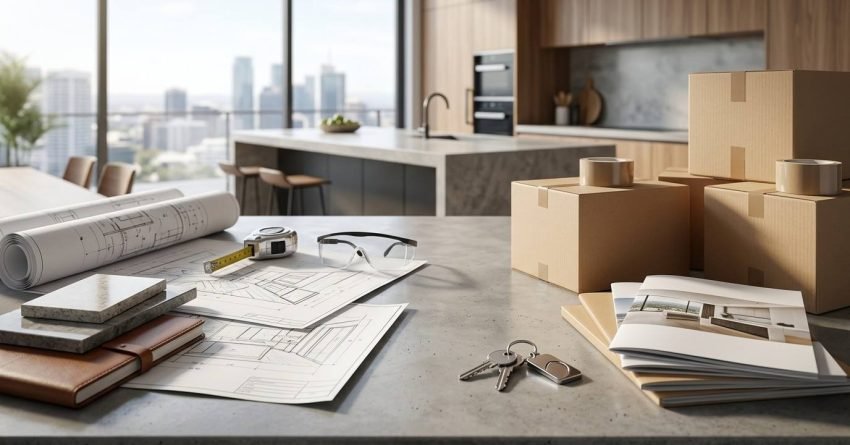
Renovating usually costs 30 to 50 per cent less than selling and buying an equivalent upgraded home in Sydney. Once you add stamp duty, agent commission, legal fees and moving costs, exiting a median Sydney home can cost $80,000 to $150,000 before you have bought anything.
That gap decides whether you stay or go.
We have run this comparison with hundreds of Sydney homeowners, and the numbers surprise people every time. Below we break down what each path actually costs, when selling genuinely wins, and how long you need to stay for a renovation to pay for itself.
Understanding the True Cost of Selling Your Home
Selling is never just a commission cheque. The costs stack up across three separate transactions: the sale, the purchase, and the move between them.
Most homeowners we speak to have not sold in eight or ten years. Their cost expectations are badly out of date.
Real Estate Agent Commissions and Marketing Fees
Agent commissions across Sydney sit between 1.8 and 2.5 per cent of the sale price, with competitive inner-city agents occasionally quoting 1.5 per cent. On a $1.5 million property, that is $22,500 to $37,500 in commission alone, and the NSW Government’s guidance on selling property confirms commission is negotiable rather than fixed.
Marketing adds another $5,000 to $15,000 depending on the campaign. Photography, video, print placement, and premium portal listings are all billed separately with most agencies.
Auction fees add $800 to $1,500 on top. Before a single offer lands, total selling costs reach $40,000 to $55,000 on a median Sydney home.
Stamp Duty on Your Next Purchase
Stamp duty is the single largest cost in the whole exercise. Revenue NSW transfer duty rates put duty on a $1.5 million purchase at roughly $67,000, and that figure climbs steeply above the median.
First-home buyers access concessions. Existing homeowners upgrading to their next property pay the full rate, and that one line item routinely exceeds the entire budget for a substantial kitchen and bathroom renovation.
Duty follows a tiered structure that steepens as values rise. Properties above $3 million attract premium rates, which makes trading up through a sale progressively more punishing at the top end.
Legal and Conveyancing Expenses
Conveyancing bills twice, once for the sale and again for the purchase. We tell clients to budget $1,500 to $3,000 per transaction, so $3,000 to $6,000 across the pair.
Contract reviews, special conditions, and settlement adjustments sit on top. Subdivisions, easements, and strata complications push legal fees well past those ranges.
Building and pest inspections on the property you are buying cost $500 to $800. Strata reports add $300 to $400. These are non-negotiable due diligence expenses that almost nobody budgets for upfront.
Moving and Temporary Accommodation Costs
Sydney removalists charge $150 to $250 per hour. A three-bedroom move lands at $1,500 to $4,000 depending on distance and access, and difficult sites double that.
Settlement dates rarely line up. A month of short-term rental plus storage reaches $4,000 to $6,000 comfortably.
Utility connections, mail redirection, and address changes add a final $500 to $1,000.

Breaking Down Renovation Costs in Sydney
Renovation costs swing hard on scope, finish level, and the condition of what you are starting with. We price every project individually, but the ranges below reflect what we see across Sydney in 2025.
Kitchen Renovation Price Ranges
Sydney kitchens run from $25,000 for a functional refresh to $80,000 and beyond for a high-end rebuild. The mid-range sits at $40,000 to $55,000, including cabinetry, benchtops, appliances and flooring.
Labour accounts for 35 to 40 per cent of the total. Plumbers, electricians, tilers and cabinet makers all carry separate rates, and benchtop plus appliance selections drive the widest cost variation.
Moving walls or relocating plumbing adds $15,000 to $30,000 to a base kitchen price. That is the line where a cosmetic job becomes a structural one.
Bathroom Renovation Investment
A standard bathroom renovation costs $15,000 to $35,000, with luxury finishes reaching $50,000. Waterproofing, tiling, and plumbing dominate the budget.
Existing condition changes everything. Older homes needing full membrane replacement, asbestos removal, or a plumbing overhaul carry a higher floor than properties needing surface updates.
Adding an ensuite to an existing bedroom costs $25,000 to $45,000 all-in. Relative to spend, it is one of the strongest value adds we build.
Structural Changes and Extensions
Home extensions cost $2,500 to $4,500 per square metre in Sydney depending on complexity and finish. A 30 square metre extension therefore lands at $75,000 to $135,000 before internal fit-out.
Second-storey additions carry a premium of $3,500 to $5,500 per square metre. Engineering, temporary structural support and longer build programmes account for the difference.
Council fees, architectural drawings and engineering reports add $10,000 to $25,000. Those costs barely scale with project size, which makes small extensions proportionally expensive.
Cosmetic Updates and Their Impact
Cosmetic work delivers the most visible change per dollar. Professional interior painting for a three-bedroom home costs $8,000 to $15,000, and new flooring runs $80 to $200 per square metre installed.
Refreshing fixtures, door hardware and lighting throughout costs $3,000 to $8,000. Pound for pound, this is the highest-return work we do.
Landscaping ranges from $10,000 to $50,000. In Sydney’s climate, a well-resolved outdoor space lifts both liveability and valuation more than most owners expect.
Renovation Costs People Forget to Budget
Three costs blow more Sydney renovation budgets than any others, and none of them appear in a standard quote comparison.
The first is contingency. We build in 10 to 15 per cent on older homes because rot, non-compliant wiring and failed waterproofing only reveal themselves once walls open up.
The second is temporary living. A whole-home or kitchen-plus-bathroom programme often means eating out or renting for six to eight weeks, which adds $3,000 to $8,000.
The third is specialist trades. Asbestos removal, structural engineering sign-off, and council approvals are billed separately and typically add $5,000 to $20,000 on pre-1990 properties.
Financial Comparison: Selling vs Renovating
A fair comparison has to price both the transaction and the outcome. When we run it properly, renovation wins more often than homeowners expect.
Transaction Costs vs Renovation Investment
Take a Sydney owner holding a $1.5 million home who wants to move into a $1.8 million one. Selling costs total roughly $45,000, purchase costs including duty add roughly $75,000, and moving adds $8,000.
That is $128,000 spent, and the living situation has not improved yet. The family has simply relocated, often into a different set of compromises.
The same $128,000 funds a full kitchen at $50,000, a bathroom at $30,000, and $48,000 of cosmetic work throughout. The result is a materially better home on the same street, with the same schools and the same neighbours.
The Numbers Side by Side
Here is the comparison on a $1.5 million Sydney home, upgrading either by moving or by renovating.
Cost Item | Sell and Buy ($1.8M) | Renovate in Place |
Agent commission | $22,500 – $37,500 | $0 |
Marketing and auction fees | $5,800 – $16,500 | $0 |
Stamp duty on purchase | ~$75,000 | $0 |
Legal and conveyancing (×2) | $3,000 – $6,000 | $0 |
Inspections and reports | $800 – $1,200 | $500 – $800 |
Moving and temporary living | $6,000 – $11,000 | $3,000 – $8,000 |
Council approvals and design | $0 | $10,000 – $25,000 |
Actual home improvement | $0 | $90,000 – $110,000 |
Total outlay | $113,100 – $147,200 | $103,500 – $143,800 |
Value retained in your asset | $0 | $60,000 – $95,000 |
The totals look similar. The final row is where the decision is actually made.
How Long Until Each Option Breaks Even
Renovation only wins if you stay long enough to hold the improvement. That is the question almost no cost calculator asks.
Transaction costs are gone the moment they are paid. Renovation spend converts partially into asset value on day one and keeps compounding with the property.
As a working rule, we tell clients that a renovation returning 60 to 80 per cent of its cost breaks even against a sale within three to five years of continued ownership. Under three years, the maths tightens considerably, and selling becomes competitive.
Over ten years, the comparison stops being close. Every avoided transaction preserves capital that keeps growing with the Sydney market rather than disappearing into duty and commission.
Equity Building Through Renovation
Renovations that add functional space or modernise a core room typically return 60 to 80 per cent of cost in immediate valuation uplift. In high-demand suburbs, well-targeted work exceeds 100 per cent.
Recovery varies sharply by project type. Kitchens and bathrooms sit at the top at 65 to 80 per cent, cosmetic refreshes including paint and flooring often clear 90 per cent, extensions land around 60 to 75 per cent, and pools and highly personalised finishes recover the least.
Selling resets your equity position entirely. Duty, commission and fees are pure expense with zero recovery, and Australian Bureau of Statistics residential property data shows how much value that permanently removes from a household balance sheet.
Renovation spend stays partly recoverable. A $50,000 kitchen returns $35,000 to $45,000 at eventual sale, while $50,000 in transaction costs returns nothing at all.
Tax and Finance Costs Often Overlooked
Selling triggers capital gains considerations on investment properties and affects main-residence exemption timing. Those consequences need an accountant, and they routinely change the answer.
Mortgage break costs apply when refinancing or switching lenders mid-sale. Exit fees, discharge fees, and new loan establishment add $2,000 to $10,000.
Renovation financing through existing home equity almost always carries a lower rate than servicing a larger mortgage on a more expensive property. Across a 30-year term, that rate difference is worth tens of thousands.

When Selling Makes More Financial Sense
Renovation is not always the answer, and we say so before quoting. Four situations make selling the correct financial decision regardless of transaction costs.
Location Limitations You Cannot Renovate
No build changes your street, your suburb or your commute. Once the location itself stops working, whether through a job relocation, a school catchment or a changed neighbourhood, selling becomes the only real option.
Properties in declining areas will not return renovation spend. Putting $100,000 into a home in a suburb with flat or falling values makes far less sense than relocating to one with growth.
Flood zones, flight paths and major infrastructure projects suppress value independently of condition. No renovation touches any of them.
Structural Issues Beyond Repair
Some properties carry problems that make renovation uneconomic. Severe foundation movement, extensive termite damage and major structural defects cost more to rectify than the finished value supports.
Heritage controls block certain modifications outright. Where council restrictions prevent the changes a family actually needs, budget stops being the constraint.
Widespread asbestos, a full electrical rewire and non-compliant plumbing together push renovation cost toward replacement value. This is exactly what a pre-renovation building assessment exists to catch, and we would rather find it before you commit.
Lifestyle Changes Requiring Different Property Types
Growing families sometimes need more bedrooms than a footprint sensibly allows. Turning a two-bedroom cottage into a genuine four-bedroom family home usually costs more than buying an existing four-bedroom house.
Downsizers face the reverse. Maintaining and upgrading a large family home you no longer need wastes capital, and selling into something smaller wins despite the duty.
Accessibility needs after a health change often demand single-level living. Some homes adapt through a ground-floor extension or granny flat, and others simply cannot.
When Renovation Delivers Better Value
Most homeowners underestimate how far a renovation budget goes once transaction costs are removed from the comparison. Three conditions make renovation the clear winner.
Properties with Good Bones in Great Locations
Older homes in established suburbs offer land size, mature gardens and character that new stock rarely matches. That foundation is difficult to buy and straightforward to build on.
Structurally sound properties needing mainly cosmetic work deliver exceptional returns. A $50,000 to $100,000 whole home renovation often adds $80,000 to $150,000 in value while avoiding $100,000 or more in transaction costs.
Heritage homes in sought-after pockets benefit most. The detail that makes them valuable cannot be replicated, so restoring and modernising beats replacing every time.
Knowing Your Suburb’s Value Ceiling
Every suburb has a ceiling price, the point beyond which buyers stop paying no matter how good the finish. Spending past it is over-capitalising, and it is the fastest way to lose money on a renovation.
We check recent top-quartile sales in your street before recommending scope. If comparable renovated homes cap at $1.9 million, spending $250,000 on a $1.7 million property leaves you underwater.
The ceiling matters far less when you are renovating to stay. A family planning ten more years is buying liveability, and full recovery at sale stops being the measure.
Renovating to sell is a different exercise entirely. There the rule is strict: spend only where recovery is proven, which in practice means paint, flooring, kitchen and bathroom.
Avoiding the Stamp Duty Trap
Duty scales with value, so every step up the ladder costs disproportionately more. Moving from $1.5 million to $2 million costs roughly $90,000 in duty alone.
Renovation creates a $2 million home from a $1.5 million one with zero duty on the improvement. The spend may match the duty, but you keep the value in your asset instead of handing it to Revenue NSW.
The advantage compounds. Across 20 years of ownership, avoiding one unnecessary sale preserves $100,000 or more in household wealth.
Maintaining Community and School Connections
Established connections never appear on a spreadsheet and still shape the decision. School continuity, neighbourhood friendships and local familiarity carry genuine value.
Renovating improves the home without disturbing any of it. The disruption and adjustment cost of relocating is real even when it resists a dollar figure.
Proximity to family, established medical relationships, and a workable commute all belong in the comparison. These factors tip close decisions toward staying more often than not.

Making Your Decision: A Practical Framework
Systematic evaluation cuts through the emotion and the agent pitch. We walk clients through the same four steps every time.
Calculating Your True Costs
Work through these in order before committing to either path.
- Get three itemised renovation quotes for the scope you actually want, not rough estimates.
- Research recent sales in your street to establish current value and the realistic post-renovation ceiling.
- Total your selling costs including commission, marketing, legal fees and stamp duty on the target purchase price.
- Add moving, temporary accommodation and any mortgage break costs to the selling column.
Then compare outcome against outlay. Renovation cost measured against improved value of the home you already own, selling cost measured against the genuine difference between your current home and the target.
Assessing Your Timeline and Tolerance
Renovation means living through a build or arranging somewhere else to be. Major work runs 8 to 16 weeks with delay risk, and your household needs to absorb that.
Selling carries a different pressure entirely, covering market uncertainty, settlement timing, and the emotional cost of leaving. That process runs three to six months from listing to settlement.
Neither path is stress-free. Knowing which kind of stress your household handles better matters more than most people allow for.
Getting Professional Assessments
A building inspector assesses renovation potential and surfaces hidden problems for $500 to $800. That spend has saved our clients far larger surprises.
A detailed builder’s costing beats an estimate every time. A valid comparison needs real numbers against your actual scope, not a per-square-metre average.
Finally, get a local agent’s appraisal of current value and realistic sale expectations. Understanding your true equity position sets both the renovation budget and the selling calculation.
Conclusion
The sell-or-renovate answer comes down to your property, your suburb ceiling, and how long you plan to stay. For most Sydney homeowners in a location that still works, sitting on a structurally sound home, renovation delivers the better financial outcome while keeping community and schools intact.
At Sydney Home Renovation, we help homeowners run this comparison honestly, including the cases where we tell you not to renovate. Across hundreds of Sydney projects, we have learned that realistic costings and a clear view of your suburb’s ceiling matter more than any sales pitch.
Talk to our team for a no-obligation consultation on your property’s renovation potential. We will give you accurate costings you can put straight up against your selling numbers and make the call with confidence.
Frequently Asked Questions
How much does it cost to sell a house in Sydney?
Selling costs 4 to 6 per cent of the sale price, including commission, marketing, legal fees, and incidentals. On a $1.5 million home, budget $60,000 to $90,000 before buying.
What renovation adds the most value to a home?
Kitchens and bathrooms deliver the strongest returns, recovering 65 to 80 per cent of cost immediately. Adding functional living space through extensions also performs strongly across Sydney’s market.
Is it worth renovating a house before selling?
Cosmetic work like paint and flooring returns well before a sale. Major renovations rarely recover full cost at immediate sale, so fix obvious defects rather than transforming the property.
How long does a major home renovation take?
Major work covering kitchen, bathroom and structural changes runs 12 to 20 weeks on site. Cosmetic renovations finish in 4 to 8 weeks, and council approval adds 6 to 12 weeks beforehand.
Can I live in my house during renovation?
Most renovations allow you to stay with some disruption. Kitchen work needs temporary cooking arrangements, and whole-house or major structural programmes usually require relocating for safety.
How do I finance a home renovation?
Home equity loans, construction loans and mortgage redraw facilities cover most renovations. Secured home lending carries lower rates than personal loans or credit cards, making equity the cheapest route.
What permits do I need for renovation in Sydney?
Minor cosmetic work needs no approval. Structural changes and extensions require council development approval or a complying development certificate, which your builder or a private certifier confirms.


