
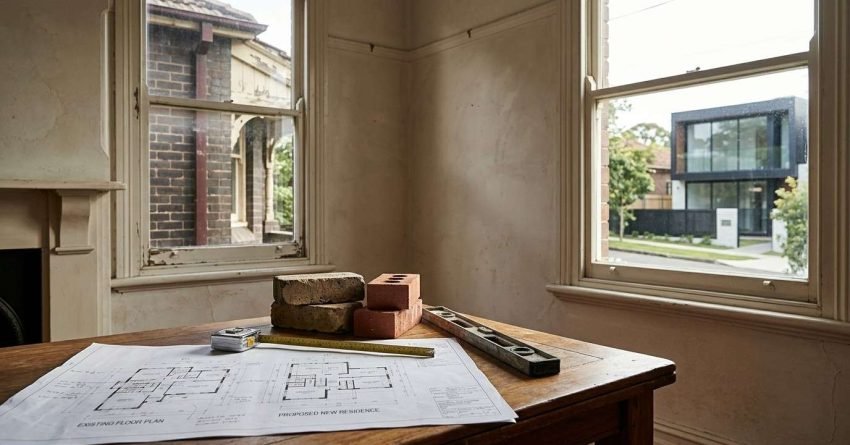
Renovation wins when your home has sound structure and a workable floor plan. Rebuilding wins when structural repairs, layout changes and system replacements stack up past roughly half the cost of a new build. That threshold decides most of the projects I assess.
We walk Sydney homeowners through this comparison every week, and the same pattern repeats. People arrive attached to one option, then the structural report and the council controls make the answer obvious.
Get it wrong, and you spend $250,000 on a renovation that leaves you with 1960s foundations and no warranty.
Understanding the Key Differences Between Knock Down Rebuild and Renovation
The two paths differ in scope, risk profile, and predictability. Here is how they compare on the factors that actually change your decision.
Factor | Major Renovation | Knock Down Rebuild |
Typical Sydney cost | $150,000–$700,000 | $500,000–$1,200,000+ |
Cost per square metre | $2,000–$4,500 | $2,500–$5,000 |
Approval pathway | CDC or DA (4–8 weeks to 4 months) | DA required (3–6 months) |
Total project duration | 3–12 months | 12–18 months |
Cost certainty | Lower — discovery risk | Higher — fixed-price common |
Recommended contingency | 20–25% | 10–15% |
Live on site during works | Often partially | No |
Structural warranty | Existing structure excluded | Full new-build warranty |
Design freedom | Limited by existing structure | Limited only by council controls |
Achievable energy rating | Typically 3–5 stars | 7 stars minimum |
Heritage-listed property | Permitted with approval | Not permitted |
What Is a Knock Down Rebuild?
A knock down rebuild demolishes your existing home and builds a new dwelling on the same block. You keep the land, the location and often the mature garden, and everything above the ground starts fresh.
The sequence runs demolition approval, site clearing, new footings, then construction. That means new wiring, new plumbing, new structure, and current building standards throughout.
Design freedom is the real prize here. We reconfigure layouts, reorient living areas toward north light, add a storey, and build in insulation and glazing performance that an older home never reaches.
What Does a Major Renovation Involve?
A major renovation modifies, extends, or upgrades what already stands. Scope ranges from new kitchens and bathrooms through to removing structural walls and adding extensions.
Renovation keeps the bones and improves everything attached to them. Original features with genuine character stay, the existing structure sets the constraints, and systems get upgraded in stages rather than all at once.
Scope varies enormously. A kitchen and bathroom refresh sits nowhere near a whole home renovation with structural work, an extension and full rewiring, so pinning down where your project lands comes before any cost comparison.
Structural and Design Limitations of Each Approach
Renovation carries inherited constraints. Your floor plan, load-bearing walls, footing capacity and ceiling heights all cap what we achieve, and working around a problem frequently costs more than removing it.
Rebuilds face a different ceiling. Setbacks, height limits, floor space ratio and landscaped area requirements govern the envelope, and in several Sydney suburbs those controls are tighter than the existing use rights your current home enjoys.
The genuine difference is predictability.
New builds follow a linear program with few surprises. Renovations expose asbestos, termite damage, perished wiring, and non-compliant previous work once the walls open, and none of it appears on a pre-purchase inspection.

Cost Comparison: Renovation vs Knock Down Rebuild in Sydney
Headline figures mislead because they exclude the items that blow budgets. Here is what each path actually costs once everything lands on the invoice.
Average Renovation Costs in Sydney
Renovation cost tracks scope, finish level, and structural complexity. Sydney renovation work generally runs $2,000 to $4,500 per square metre, with structural involvement pushing toward the upper end.
A cosmetic renovation covering kitchen, bathrooms and surface finishes costs $150,000 to $250,000 on a typical three-bedroom home. Add structural changes, an extension, and full system replacement, and the figure reaches $400,000 to $700,000.
Those numbers exclude the costs owners forget. Temporary accommodation, furniture storage, landscaping repair, and the labour premium for working around existing structure all sit outside the headline quote.
Average Knock Down Rebuild Costs in Sydney
New home construction in Sydney runs $2,500 to $5,000 per square metre for the build. Housing Industry Association cost reporting confirms Sydney sits above the national average on both materials and trade labour, and a complete rebuild including demolition and site works lands between $500,000 and $1,200,000.
Demolition adds $15,000 to $50,000 depending on dwelling size, asbestos presence and site access. Site preparation covering clearing, levelling and service connections adds another $20,000 to $40,000.
Cost certainty is the advantage. Fixed-price contracts hold far better on new builds because nobody is pricing around unknown existing conditions, so the number you sign is close to the number you pay.
Hidden Costs You Need to Factor In
Renovation’s highest hidden cost is discovery. Opening a wall reveals termite damage, undersized framing, bonded asbestos sheeting, or non-compliant previous work, and every one of those becomes a variation.
Renovation budgets overrun more often than new-build budgets, and structural renovations overrun hardest. I build 20% minimum contingency into every renovation figure I present, and 25% on anything pre-1970.
Rebuilds hide their costs elsewhere. Twelve to eighteen months of Sydney rent plus storage plus duplicate service connections add $50,000 to $80,000 on a family home, which is real money nobody puts in the comparison spreadsheet.
Council charges compound that. Section 7.11 development contributions apply to new dwellings in many Sydney LGAs and add $20,000 to $50,000, and long service levy plus utility headworks charges sit on top.
Timeline Comparison: How Long Each Option Takes
Duration changes the decision as much as cost, because every extra month of a rebuild is another month of rent. Here is how the two programs compare stage by stage.
Stage | Major Renovation | Knock Down Rebuild |
Design and documentation | 4–8 weeks | 8–12 weeks |
Approval (CDC or DA) | 4 weeks–4 months | 3–6 months |
Demolition and site prep | 1–2 weeks | 3–5 weeks |
Construction | 3–9 months | 7–11 months |
Total from first meeting | 6–14 months | 14–22 months |
Renovation buys you occupancy for part of that program. Staged work keeps a family in the house through structural and external phases, then moves them out for wet areas and flooring.
Rebuilds require you to be off-site from demolition to handover.
Factors That Influence the Right Decision for Your Property
Your circumstances decide this, not averages. Five factors carry the weight.
Assessing Your Home’s Current Structural Condition
Structural condition matters more than any other input. Sound footings, a straight roof structure, and no significant pest damage make a strong renovation case, while footing failure or extensive termite work pushes the numbers toward replacement.
Engage a structural engineer before you commit either way. The report costs $500 to $1,500 and tells you exactly what you own, covering footing movement, roof framing, wall integrity, moisture ingress and pest activity.
Homes built before 1990 almost always contain asbestos. SafeWork NSW requires licensed removal of friable material and most bonded sheeting quantities, which adds $10,000 to $50,000 to a renovation depending on extent.
The Cost Threshold That Settles Most Decisions
Here is the test I apply on site. Add every structural repair, layout change, service replacement, and compliance upgrade your renovation requires, then compare that total against the cost of a new build of the same size.
Cross 50% of new-build cost, and the rebuild almost always delivers better value. You get current standards, a full structural warranty, and no inherited defects for a proportionally small step up in spend.
Sit below 40% and renovation wins clearly. The band between those figures is where design priorities, heritage character, and how long you plan to stay decide it.
Staged Renovation as a Middle Path
Most comparisons ignore the third option. Staged renovation splits the work across two or three phases separated by twelve to twenty-four months, funded from equity and savings rather than a single large facility.
Structural and external work goes first because it protects everything after it. Kitchens, bathrooms, and finishes follow once cash flow recovers.
This path suits owners with $150,000 to $250,000 available now and a sound structure underneath. It costs more in total than a single continuous program, and it keeps the project moving without construction finance.
Location and Land Value Considerations
In Sydney’s premium suburbs, land represents 70 to 80% of total property value. Once land dominates that heavily, the existing dwelling barely registers in the valuation, and maximising what sits on the block becomes the financially rational move.
Where land and building values sit closer to balanced, renovation returns better. You improve an asset carrying real proportional value, and cost relative to value added works in your favour.
Suburb ceiling governs both paths. Every street has a price point buyers refuse to cross, and spending $700,000 improving a home into a market that caps out $300,000 below your total investment is overcapitalisation regardless of which method you chose.
Neighbourhood trajectory matters too. Streets filling with new builds punish a renovated original, while heritage pockets reward a sympathetic renovation over a new house that reads wrong on the streetscape.
Council Regulations and Heritage Overlays
Sydney councils differ sharply. Heritage overlays, conservation areas and character statements restrict or completely prevent demolition, so check your planning controls on the NSW Planning Portal before you assume rebuilding is available.
Approval pathway drives your timeline. Complying Development Certificates suit renovations meeting all deemed-to-satisfy criteria and are clear in weeks, while anything outside those parameters requires a Development Application through council.
Rebuilds nearly always need a DA, and Sydney DA determination runs 3 to 6 months, longer in councils with complex controls or where neighbour submissions arrive.
Current controls also cost you. Existing homes frequently sit closer to boundaries or occupy more floor area than today’s rules permit, and a rebuild surrenders every one of those grandfathered advantages.
Your Long-Term Plans and Lifestyle Goals
Holding period changes the answer. Selling inside five years favours renovation because you avoid overcapitalising, while a forever home justifies rebuild spend across decades of occupancy.
Requirements that structure cannot deliver force the decision. Single-level living for accessibility, a specific room configuration, or reorientation for solar access frequently sits beyond what any renovation achieves.
Household composition belongs in the calculation. Growing families need different geometry than downsizers, and designing exactly what you need carries value that no spreadsheet captures cleanly.

When Renovation Makes More Financial Sense
Renovation is the right call more often than homeowners expect. These conditions point to it clearly.
Homes with Good Bones and Minor Issues
Sound footings, a floor plan needing only modest change, and dated but functional services make renovation the obvious answer. You retain the substantial value already sitting in the structure and spend only on what affects daily living.
Character homes with genuinely irreplaceable features justify renovation on their own. High ceilings, original hardwood floors, decorative plasterwork and period joinery cost a fortune to replicate and command real premiums when done properly.
Cosmetic-led projects deliver the widest margin. Kitchens, bathrooms, and system upgrades without structural work are exactly where renovation beats rebuild by the largest dollar figure.
Budget Constraints and Financing Considerations
Renovation stages across time. Spreading spend over years suits owners without access to full rebuild funding upfront, and partial occupancy keeps rent out of the equation entirely.
Financing is simpler too. Home equity, a redraw facility, or a personal loan covers renovation, while rebuilds require construction finance with progressive drawdowns tied to inspected stages.
Construction loans cost more during the build. Interest applies only to funds drawn, but you carry the land debt simultaneously, and rates on construction facilities sit above standard variable rates for the build period.
Under $400,000 total budget, renovation wins nearly every time. Fixed demolition, site prep and service connection costs consume too much of a small rebuild budget, and what remains compromises size or finish in ways owners regret.
Preserving Character and Heritage Value
Heritage conservation areas and architecturally significant homes make renovation the only lawful path. Heritage-listed properties cannot be demolished, and contributory items inside conservation areas face restrictions tight enough to rule out rebuilding.
Beyond compliance, character carries genuine market value. Original detailing, established gardens and the settled quality of an older home read as authentic in ways new construction cannot manufacture.
Sympathetic renovation earns premiums in Sydney. Buyers pay more for a properly restored period home than for a new build imitating period style.
When Knock Down Rebuild Is the Better Investment
Starting fresh is sometimes the disciplined financial choice despite the larger number.
Homes with Significant Structural Problems
Extensive structural failure sends renovation costs past new-build cost while still leaving you standing on compromised footings. Footing failure, widespread termite damage, sustained water damage, and non-compliant structure all tip the balance decisively.
Layout drives the same outcome. Removing most internal walls and reconfiguring the entire plan means paying renovation premiums for a result new construction produces more efficiently.
Warranty settles the argument. New builds carry a statutory structural warranty; a heavily renovated old house carries a warranty on the new work only, and the original structure stays your risk permanently.
Maximising Land Value in Premium Locations
Where Sydney land exceeds $2 million, the existing dwelling represents a minor fraction of total value. Construction cost sits proportionally small against that land investment, so building to full potential is the rational move.
New construction unlocks development capacity. Building to current floor space maximums adds saleable area that renovation cannot reach when the existing footprint underuses the site.
Premium buyers arrive with expectations. Modern amenities, strong energy performance, and contemporary design achieve higher prices in these markets than even thorough renovation of an older home.
Achieving Specific Design or Energy Goals
Requirements your structure cannot accommodate make rebuilding the only route. Single-level living, particular room relationships, solar orientation and full accessibility compliance frequently sit outside renovation’s reach.
Energy performance separates the two sharply. New homes built to the current NatHERS framework reach 7 stars minimum, while renovated pre-2000 housing typically plateaus around 3 to 5 stars because wall cavities, orientation and glazing areas are already fixed.
That gap compounds across ownership. Lower heating and cooling load across a twenty-year hold represents tens of thousands in avoided energy spend and belongs in your cost comparison.

Making Your Final Decision: A Practical Framework
Four steps convert all of this into a defensible decision.
Getting Accurate Quotes for Both Options
Estimates and averages decide nothing. Get detailed quotes for both paths, which means a full scope of works built on a professional condition assessment for renovation, and a design meeting council controls for rebuild.
Make the quotes genuinely comparable. Renovation pricing needs a stated contingency for discovery work; rebuild pricing needs demolition, site preparation, and every connection cost; and both need identical finish schedules.
Three quotes per option, from builders who genuinely do that work. Variance between them exposes how differently each builder reads your scope.
Consulting the Right Professionals
Build a small team before you commit. A structural engineer confirms footing and framing condition, and an architect or building designer establishes what each path realistically delivers within your controls.
A quantity surveyor prices independently for $1,000 to $2,000 and repeatedly saves multiples of that by catching unrealistic pricing or missing scope. Your accountant reviews the financing and tax position for each option before you sign anything.
Weighing Lifestyle Factors Against Financial Returns
Not every input is financial. Renovation keeps you in your home and suburb through dust, noise, and trades, while a rebuild relocates you for 12 to 18 months and hands back a finished house.
Know your household’s tolerance honestly. Some families absorb construction chaos comfortably, and some do not, and that answer legitimately outweighs a modest cost difference.
Then test for regret. Weigh the cost of not building what you actually wanted against the cost of overspending on a rebuild when renovation reached your goals.
Conclusion
This decision turns on three inputs: your structure’s true condition, how your land value compares to your building value, and what your council controls permit. Run the cost threshold test against a new build of the same size, and the answer usually presents itself clearly.
Neither path wins universally. A sound 1970s brick home in a mid-value suburb renovates well, and a failing weatherboard on $2 million of land does not.
We assess both options for Sydney homeowners with the same independence we would want ourselves, and at Sydney Home Renovation, we price renovation and rebuild side by side so you see the real comparison. Contact our team for a property assessment and a detailed cost breakdown of both paths.
Frequently Asked Questions
Is it cheaper to knock down and rebuild or renovate in Sydney?
Renovation costs less for cosmetic and moderate projects. Once structural repairs and layout changes exceed roughly half of new-build cost, rebuilding delivers better value and a full warranty.
How long does a knock down rebuild take compared to renovation?
Rebuilds run 14 to 22 months from first meeting to handover, including approvals. Major renovations take 6 to 14 months, and simple renovations finish within 3 to 6 months.
Can I knock down and rebuild if my home is heritage listed?
No. Heritage-listed properties cannot be demolished. Homes inside conservation areas face heavy restrictions and often need heritage approval even for renovation work.
What happens to my mortgage during a knock down rebuild?
You refinance to a construction loan with progressive drawdowns tied to inspected build stages. Your existing mortgage is paid out, and the new facility covers land plus construction.
Do I need council approval for both renovation and knock down rebuild?
Yes. Many renovations qualify for a Complying Development Certificate, while all rebuilds require a Development Application taking 3 to 6 months through council.
How much contingency should I budget for renovation versus rebuild?
Allow 20 to 25% on renovations because hidden defects surface once walls open. New builds need 10 to 15%, since fixed-price contracts hold far more reliably.
Will a knock-down rebuild add more value than renovation?
In premium suburbs where land dominates value, rebuilds usually add more. Where building value is substantial, quality renovation returns better against every dollar spent.


