
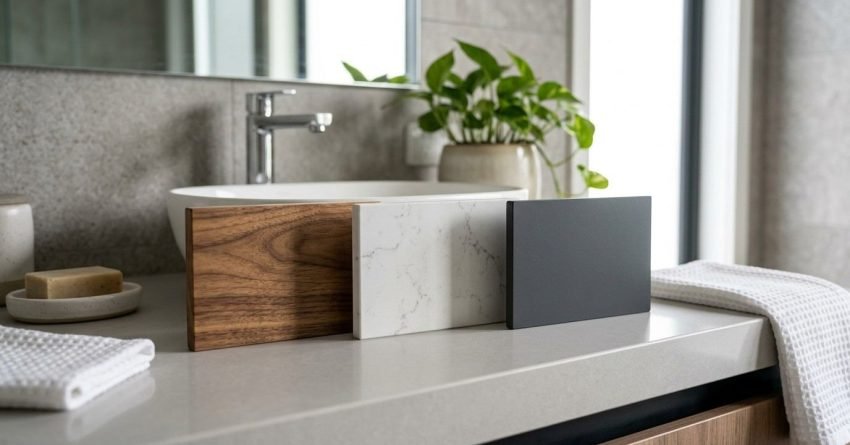
Choosing the wrong vanity material is one of the most common and most expensive mistakes I see in bathroom renovations. Timber, stone top, and laminate each perform very differently in a wet environment, and the right choice depends on your budget, your property type, and how much upkeep you’re willing to commit to.
Getting this decision right saves money and avoids regret. The wrong material in the wrong bathroom leads to swelling, staining, or a finish that dates badly within a few years.
In this guide, I compare all three materials across durability, cost, maintenance, and renovation fit so you can make a confident, informed decision before you spend a cent.
What Makes a Good Bathroom Vanity Material?
Not every material that looks good in a showroom performs well in a bathroom. The bathroom is one of the harshest environments in any home; high humidity, daily water contact, temperature swings, and cleaning chemicals all take a toll over time.
A good vanity material handles all of that without warping, staining, or deteriorating. It also needs to fit your budget and suit the overall design direction of the space.
Durability in a Wet Environment
Moisture is the primary enemy of any vanity material. Timber swells when it absorbs water. Standard particleboard delaminates. Even some stone surfaces can stain or etch if they’re not properly sealed.
The materials that perform best in bathrooms are either naturally moisture-resistant or engineered specifically to handle wet conditions. Sealing, surface treatment, and installation quality all play a role in how long a material lasts.
A vanity that’s correctly specified and properly installed will outlast one that’s been chosen purely on looks by years, sometimes by decades.
Maintenance, Cost, and Aesthetic Fit
Durability is only part of the equation. How much time and money a material demands over its lifetime matters just as much as its upfront cost.
Some materials need annual sealing. Others just need a wipe-down. The gap between low-maintenance and high-maintenance options adds up significantly over a ten-year ownership period.
Aesthetic fit matters too, but it should come after durability and maintenance in the decision hierarchy, not before.
Timber Vanities – Warmth, Character, and Real-World Trade-Offs
Timber is the most visually striking of the three options. It brings warmth, texture, and a sense of quality that laminate and stone tops alone can’t replicate. But it also demands the most respect in a bathroom environment.
I see timber vanities specified in renovations regularly, and when they’re done right, they’re genuinely beautiful. When they’re done wrong, they’re a costly problem within two or three years.
Why Homeowners Choose Timber
The appeal of timber is straightforward. Natural grain, warmth, and character give a bathroom a premium, considered feel that resonates with owner-occupiers who want their home to feel like a home, not a hotel.
Solid timber and engineered timber both offer this aesthetic. Engineered timber handles moisture better than solid timber because its layered construction is more dimensionally stable. It’s the smarter choice for most bathroom applications.
Timber also photographs well and presents strongly at resale, which matters for owner-occupiers thinking about long-term property value.
Where Timber Falls Short in Bathrooms
Timber’s biggest vulnerability is moisture. Without proper sealing and regular re-sealing, timber absorbs humidity and water, leading to swelling, warping, and surface damage.
The sealing requirement is ongoing. This isn’t a set-and-forget material. Most timber vanities need resealing every one to two years depending on the bathroom’s ventilation and usage level.
Cost is the other factor. A quality timber vanity in Sydney sits at a meaningfully higher price point than laminate. And if the bathroom has poor ventilation or the sealing is neglected, that investment deteriorates faster than it should.
Stone Top Vanities – Premium Finish With a Premium Price Tag
Stone tops, whether natural marble, granite, or engineered stone like Caesarstone, are the benchmark for bathroom luxury. They’re hard, hygienic, and visually commanding. They’re also the most expensive option in this comparison.
The stone top is typically paired with a separate vanity cabinet, which means the material choice here is specifically about the benchtop surface rather than the full unit.
The Appeal of Natural and Engineered Stone
Stone is genuinely durable. Engineered stone in particular, which dominates the Sydney market, is non-porous, scratch-resistant, and easy to clean. It doesn’t harbour bacteria the way porous surfaces can, which makes it a strong choice from a hygiene standpoint.
Natural stone like marble is stunning but requires more maintenance. It’s porous, prone to staining from toiletries, and needs sealing to perform well long-term. Engineered stone removes most of those concerns while retaining the premium aesthetic.
Stone tops also hold their visual appeal over time. They don’t chip at edges the way laminate can, and they don’t require the ongoing sealing that timber demands.
Weight, Cost, and Installation Considerations
Stone is heavy. A full stone benchtop requires cabinetry that’s structurally capable of supporting the load, and that’s a detail that catches some renovators off guard when they’re pricing the job.
Installation is more involved than laminate and requires a skilled tradesperson. The stone needs to be templated, cut, and set correctly. Any errors at that stage are expensive to fix.
In Sydney, a stone top vanity installation adds labour cost on top of the material cost, and the combined figure is the highest of the three options in this comparison.
Laminate Vanities – Budget-Friendly and More Capable Than You Think
Laminate has a reputation problem it doesn’t entirely deserve. The laminate vanities of fifteen years ago thin, prone to swelling, with edges that peeled are not what’s available today.
Modern laminate, specified correctly, is a genuinely capable bathroom material. And for investment properties or budget-conscious renovations, it’s often the smartest choice on the board.
Modern Laminate Performance and Finish Options
The key specification for bathroom laminate is HMR board High Moisture Resistance board as the substrate. Standard particleboard is not suitable for bathrooms. HMR board is engineered to resist moisture absorption, which addresses the primary failure point of older laminate vanities.
High-pressure laminate (HPL) applied over HMR board produces a surface that’s hard, cleanable, and available in a wide range of finishes, including convincing stone-look and timber-look options. The finish range has expanded significantly, and the quality gap between laminate and more expensive materials has narrowed.
For a rental property or a secondary bathroom, a well-specified laminate vanity delivers strong performance at a fraction of the cost of timber or stone.
Where Laminate Has Limits
Laminate isn’t without weaknesses. Edge chipping is the most common failure point, particularly around sink cutouts and exposed edges. Quality edge-banding and careful installation reduce this risk, but it doesn’t eliminate it entirely.
Laminate also doesn’t respond well to heat. Placing hot styling tools directly on a laminate surface causes permanent damage. In a primary bathroom with heavy daily use, this is worth factoring in.
And at resale, laminate doesn’t carry the same perceived value as timber or stone. For owner-occupiers focused on long-term property value, that perception gap is real even if the material itself performs adequately.
Side-by-Side Comparison – Timber vs Stone Top vs Laminate
| Factor | Timber | Stone Top | Laminate |
| Moisture Resistance | Moderate (sealing required) | High (engineered stone) | High (HMR board) |
| Durability | High when maintained | Very High | Moderate–High |
| Maintenance Level | High (annual resealing) | Low | Low |
| Upfront Cost (Sydney) | $$$ | $$$$ | $ |
| Aesthetic Appeal | Premium, warm | Premium, sleek | Good–Very Good |
| Resale Perception | Strong | Very Strong | Moderate |
| Best For | Owner-occupiers, design-led renovations | Luxury renovations, high-value properties | Investment properties, budget renovations |
Which Material Suits Which Renovation Scenario?
For a design-led owner-occupier renovation where budget allows, timber or stone top delivers the strongest result both aesthetically and at resale. Timber suits warmer, more organic design directions. Stone top suits contemporary, minimal bathrooms.
For an investment property renovation, laminate on HMR board is the rational choice. It performs well, costs significantly less, and holds up to tenant use without demanding ongoing maintenance from the landlord.
For a mid-range renovation owner-occupier on a moderate budget, a laminate vanity with a stone top benchtop is a popular hybrid approach that balances cost and premium finish effectively.
How to Choose the Right Vanity Material for Your Sydney Bathroom
The right material isn’t universal. It depends on who’s using the bathroom, what the property needs to achieve, and what the renovation budget actually allows.
I work through this decision with clients at the planning stage before any money is committed because getting it right here prevents costly changes later.
Owner-Occupier vs Investment Property Decisions
Owner-occupiers have more latitude to prioritise aesthetics and long-term value. The bathroom is a space they live in daily, and a material that brings genuine satisfaction over years is worth the premium.
Investment property decisions are different. The priority shifts to durability under tenant use, low maintenance demand, and cost efficiency. A laminate vanity that performs reliably for ten years without landlord intervention is a better investment outcome than a timber vanity that needs resealing every eighteen months.
The bathroom renovation decisions for investment properties framework I use with landlord clients focuses on exactly this trade-off: return on spend, not just upfront cost.
Budget Ranges and What Each Material Costs in Sydney
In Sydney, supply and installation costs for vanity materials vary meaningfully. These are realistic ranges for a standard single-basin vanity as part of a broader bathroom renovation:
Laminate vanity (HMR board, HPL finish): $800–$1,800 supplied and installed, depending on size and finish selection.
Timber vanity (engineered timber, sealed finish): $1,800–$4,500 supplied and installed, depending on species, size, and joinery complexity.
Stone top (engineered stone benchtop, separate cabinet): $2,500–$6,000+ for the combined benchtop and cabinet, depending on stone selection, edge profile, and cabinet specification.
These figures reflect Sydney market pricing as of 2025 and assume standard installation conditions. Complex layouts, custom sizing, or premium material selections push costs toward the upper end of each range.
Conclusion
Timber, stone top, and laminate each have a legitimate place in a Sydney bathroom renovation; the right choice depends on your property type, budget, and long-term goals. Timber delivers warmth and resale appeal but demands ongoing maintenance. Stone top is the premium benchmark for durability and aesthetics. Laminate, specified correctly, punches well above its price point.
Getting the material decision right at the planning stage is what separates a renovation that holds its value from one that creates problems down the track. The specification matters as much as the material itself.
At Sydney Home Renovation, we help homeowners and investors make these decisions with confidence backed by real cost transparency and construction expertise. Get in touch to talk through your bathroom renovation and find the material combination that works for your budget and your property.
Frequently Asked Questions
Is timber a good choice for a bathroom vanity?
Timber is a strong choice when it’s correctly specified and properly sealed. Engineered timber handles bathroom humidity better than solid timber. The trade-off is ongoing maintenance; resealing every one to two years keeps it performing well.
What is the most durable vanity material?
Engineered stone is the most durable vanity surface material in a bathroom environment. It’s non-porous, scratch-resistant, and requires minimal maintenance. For the full vanity unit, HMR laminate board is highly durable relative to its cost.
How much does a stone top vanity cost in Sydney?
A stone top vanity in Sydney, engineered stone benchtop plus cabinet, typically costs between $2,500 and $6,000 supplied and installed. Premium stone selections, custom sizing, and complex edge profiles push costs toward the upper end of that range.
Is laminate good enough for a bathroom renovation?
Modern laminate on HMR board is genuinely capable in a bathroom. It resists moisture, cleans easily, and comes in a wide range of finishes. For investment properties and budget renovations, it’s often the most practical and cost-effective choice available.
Which vanity material adds the most value to a home?
Stone top vanities carry the strongest resale perception and add the most measurable value in higher-end properties. Timber also presents well at resale. Laminate adds functional value but doesn’t carry the same premium perception at sale time.
Can I use solid timber in a small bathroom?
Solid timber in a small bathroom with limited ventilation is a risk. Poor airflow accelerates moisture absorption and shortens the material’s lifespan. Engineered timber is a better specification for small or poorly ventilated bathrooms; it’s more dimensionally stable under humidity.
What vanity material is easiest to maintain?
Engineered stone is the easiest vanity material to maintain; wipe it down, and it’s done. HMR laminate is a close second. Timber requires the most ongoing attention, with regular resealing needed to keep it performing and looking its best.


