The vanity is the centrepiece of any bathroom renovation, and choosing between a custom-built unit and an off-the-shelf option is one of the most consequential decisions you’ll make; it affects your budget, your timeline, and the long-term quality of the finished space. Most Sydney homeowners I work with underestimate how much this single choice ripples through the rest of the project. Get it right, and everything else falls into place. Get it wrong, and you’re either overspending on a bathroom that didn’t need it, or cutting corners in a space that deserved better.
This decision shapes your renovation budget, your project schedule, and the final impression your bathroom makes on buyers, tenants, and guests.
We cover real costs, honest trade-offs, and a clear decision framework so you can choose the right vanity for your renovation goals.
What Is a Custom Bathroom Vanity?
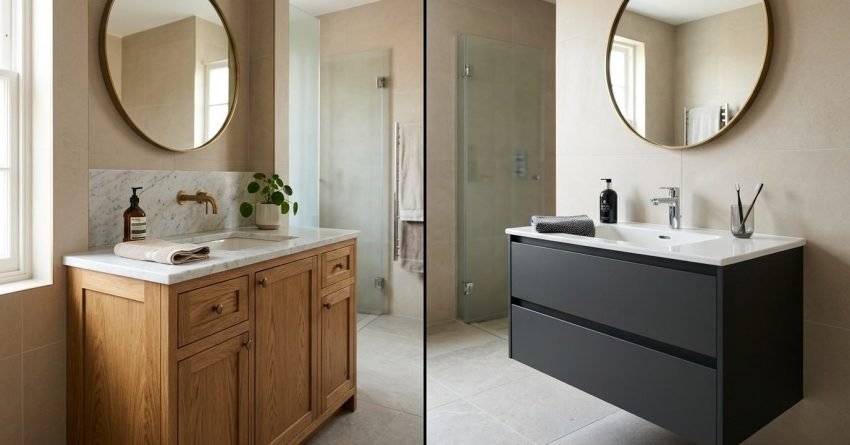
A custom bathroom vanity is a cabinet unit designed and built specifically for your bathroom. Nothing is pulled from a warehouse shelf. Every dimension, material, finish, and internal configuration is specified to suit your exact space and your personal brief.
Custom vanities are produced by local joiners, cabinet makers, or specialist bathroom fitout companies. The process starts with a site measure, moves through a design and material selection phase, and ends with fabrication and installation on-site.
How Custom Vanities Are Built and Specified
The specification process is where custom vanities earn their premium. You choose the cabinet carcass material, the door profile, the hardware, the benchtop material stone, timber, or engineered surfaces and the internal storage layout.
Soft-close hinges, integrated power points, undermount basins, and concealed plumbing are all standard considerations at this stage. A good joiner or bathroom contractor walks you through every decision with a detailed trade specification before a single piece of timber is cut.
Lead times typically run four to ten weeks from sign-off, depending on the complexity of the brief and the joiner’s current workload.
Who Typically Chooses a Custom Vanity
Owner-occupiers renovating a forever home are the most typical clients for custom vanities. They want the bathroom to feel considered and permanent, not assembled from a catalogue.
High-end property investors also go custom when the target market demands premium finishes. And architects and interior designers almost always specify custom when they’re working to a cohesive design brief that a stock unit simply cannot satisfy.
What Is an Off-the-Shelf Bathroom Vanity?
An off-the-shelf vanity is a pre-manufactured unit available in standard sizes from bathroom supply retailers, hardware chains, and online suppliers. It’s designed, built, and finished before you ever walk into the store.
You select from available sizes, typically 600mm, 750mm, 900mm, and 1200mm widths, and from a fixed range of finishes, door styles, and basin configurations. What you see is what you get.
Where Off-the-Shelf Vanities Come From
Most stock vanities sold in Australia are manufactured offshore, predominantly in China and Southeast Asia, and imported by bathroom supply companies. Local retailers like Reece, national hardware chains, and online bathroom warehouses carry large ranges at varying price points.
Some mid-range suppliers offer semi-custom options: standard carcasses with a limited selection of benchtop and door upgrades, which sit between the two categories.
Who Typically Chooses an Off-the-Shelf Vanity
Budget-conscious renovators and landlords upgrading rental properties are the primary buyers of stock vanities. The combination of lower cost and immediate availability makes them the practical choice when the renovation timeline is tight, and the budget has a firm ceiling.
First-time renovators also gravitate toward off-the-shelf options because the decision is simpler. You pick a size, pick a finish, and the unit arrives within days.
Custom Bathroom Vanity – Pros and Cons
Pros of a Custom Vanity
Exact fit for any bathroom layout. Custom vanities are built to your precise dimensions. Awkward alcoves, non-standard wall spacings, and unusual plumbing positions are all accommodated without compromise.
Premium material quality. You control what goes into the cabinet. Solid timber, moisture-resistant MDF, stone benchtops, and quality European hardware are all on the table. The result is a vanity built to last decades, not years.
Optimised storage. Internal configurations are designed around how you actually use the space. Drawer depths, shelf heights, and compartment layouts are all specified to your brief, not a generic average.
Design coherence. A custom vanity integrates with the rest of your bathroom design. The finish, profile, and proportions are matched to your tiles, tapware, and overall aesthetic in a way a stock unit rarely achieves.
Cons of a Custom Vanity
Higher upfront cost. Custom fabrication carries a significant price premium over stock options. For most Sydney bathrooms, you’re looking at a meaningful step up in spend before installation is even factored in.
Longer lead time. Four to ten weeks is standard. That lead time needs to be built into your renovation schedule from day one, or it becomes the bottleneck that delays your entire project.
Joiner dependency. You’re relying on a single trade for design, fabrication, and delivery. If the joiner is delayed, makes an error, or goes out of business mid-project, your timeline and budget absorb the impact.
Harder to replace. A custom vanity built for one bathroom doesn’t transfer to another. If you renovate again or sell the property, the unit stays, and its value is tied entirely to how well it suits the next owner’s taste.
Off-the-Shelf Bathroom Vanity – Pros and Cons
Pros of an Off-the-Shelf Vanity
Lower cost. Stock vanities are manufactured at scale, and that cost efficiency passes through to the buyer. Entry-level units start well below the custom price floor, and mid-range options offer solid quality at a fraction of the custom cost.
Immediate availability. Most stock vanities are available within days of purchase. For renovations with tight timelines, insurance repairs, rental turnarounds, or pre-sale upgrades, that speed is genuinely valuable.
Wide range of styles. The market for stock vanities is competitive and well-supplied. Matte black, brushed nickel, timber-look, and gloss white are the most popular finishes available across multiple size options.
Easy replacement. Standard sizing means a like-for-like replacement is straightforward. If the unit is damaged or the owner wants an upgrade, a matching size is readily available without a custom fabrication wait.
Cons of an Off-the-Shelf Vanity
Sizing constraints. Standard widths work for standard bathrooms. The moment your bathroom has an unusual layout, a non-standard wall spacing, or a plumbing position that doesn’t align with the stock unit’s configuration, you’re compromising.
Generic aesthetic. Stock vanities are designed to appeal to the broadest possible market. That means they rarely feel distinctive. In a high-end renovation, a stock vanity can undercut the quality of everything around it.
Variable material quality. The lower end of the stock vanity market uses materials that perform adequately in the short term but degrade faster in a high-humidity bathroom environment. Swelling carcasses, delaminating doors, and failing hinges are common complaints within five to seven years.
Limited internal configuration. The storage layout is fixed. If the standard drawer depth or shelf height doesn’t suit your needs, you adapt to the vanity rather than the vanity adapting to you.
Cost Comparison – Custom vs Off-the-Shelf in Sydney
Cost is where the two options diverge most sharply, and it’s worth being specific about what Sydney renovators are actually paying in 2026.
Typical Price Ranges for Custom Vanities in Sydney
Custom vanity pricing in Sydney varies significantly based on size, material selection, and the complexity of the brief. As a working guide:
- Entry-level custom (painted MDF, laminate benchtop, standard hardware): $2,500–$4,500 supply only
- Mid-range custom (moisture-resistant MDF, engineered stone benchtop, soft-close hardware): $4,500–$8,000 supply only
- High-end custom (solid timber, natural stone benchtop, premium European hardware): $8,000–$15,000+ supply only
Installation by a licensed plumber and carpenter adds $800–$2,000 depending on complexity. These figures reflect current Sydney joinery and trade pricing and align with cost data published by the Housing Industry Association.
Typical Price Ranges for Off-the-Shelf Vanities in Sydney
Stock vanity pricing is more predictable:
- Budget range (flat-pack, basic finish, ceramic basin): $300–$800 supply only
- Mid-range (pre-assembled, stone or solid surface top, soft-close doors): $800–$2,500 supply only
- Premium stock (designer brand, quality hardware, integrated basin): $2,500–$5,000 supply only
Plumber installation for a stock vanity typically runs $400–$900 in Sydney, depending on whether existing plumbing requires adjustment.
The cost gap between a mid-range custom and a premium stock vanity is real but narrower than most people expect. The decision often comes down to fit, finish, and longevity rather than pure dollar difference.
Which Option Adds More Value to Your Property?
This is the question property investors and owner-occupiers ask me most often, and the honest answer is: it depends on the property and the market you’re targeting.
Renovation ROI – What Sydney Buyers and Investors Look For
In Sydney’s mid-to-upper residential market, bathroom quality is a primary purchase driver. Buyers in this segment notice the difference between a considered, well-fitted custom vanity and a stock unit, and they factor it into their offer.
A well-specified bathroom renovation in a Sydney property typically returns strong value at resale, particularly when the finishes are cohesive and the workmanship is evident. Custom vanities contribute to that perception of quality in a way that stock units rarely match.
For rental properties and budget renovations, the calculus shifts. Tenants and entry-level buyers respond to cleanliness, functionality, and presentation, not to the joinery specification. A quality mid-range stock vanity, well-installed and properly finished, delivers strong rental appeal without the custom price premium.
The rule I apply: match the vanity to the property’s price point and the expectations of the buyer or tenant you’re targeting. Over-specifying a custom vanity in a budget rental is money that doesn’t come back. Under-specifying in a premium renovation leaves value on the table.

How to Decide – Custom or Off-the-Shelf?
The right choice is the one that fits your bathroom, your budget, and your renovation goals, not the one that sounds more impressive.
Key Questions to Ask Before You Choose
Work through these before you commit to either direction:
What is your firm budget ceiling? Custom vanities carry a meaningful premium. If your total bathroom renovation budget is under $15,000, a quality stock vanity is almost always the smarter allocation of funds.
What are your bathroom’s exact dimensions? Measure the available vanity space precisely. If it falls outside standard stock sizing or if your plumbing position creates a conflict, custom is often the only practical option.
What is your renovation timeline? A four-to-ten-week joinery lead time needs to be planned from the start. If your renovation has a fixed completion date, confirm the joiner’s availability before committing.
What are your long-term plans for the property? Owner-occupiers staying for ten or more years get full value from a custom vanity’s longevity and design quality. Investors planning to sell within three years may not recover the premium.
When to Compromise – Hybrid Approaches That Work
The binary choice between fully custom and fully stock isn’t the only option. Several hybrid approaches deliver strong results at a middle price point.
A semi-custom vanity uses a standard carcass with an upgraded benchtop, typically engineered stone and premium hardware. The result looks and feels custom at a cost closer to the upper end of the stock range.
Another approach: use a stock vanity carcass and commission a custom stone benchtop to suit. The benchtop is the most visible element of the vanity, and a quality stone top transforms the look of an otherwise standard unit. This combination often lands at $2,000–$4,000 all-in, well below full custom pricing.
A third option is to use a stock vanity in a secondary bathroom and invest the custom budget in the main ensuite, where the quality difference has the most impact on daily use and property presentation.
Conclusion
Custom and off-the-shelf vanities both have a legitimate place in bathroom renovation; the right choice depends entirely on your space, your budget, and what you’re trying to achieve with the renovation.
The cost gap is real, but so is the quality and fit difference. Neither option is universally better; both are tools that suit different renovation briefs and property types.
At Sydney Home Renovation, we help homeowners and investors make this decision with clear, honest guidance, and we build bathrooms that perform at every price point. Reach out to discuss your renovation brief, and we’ll give you a straight answer on which direction makes sense for your project.
Frequently Asked Questions
How long does it take to get a custom bathroom vanity made in Sydney?
Most Sydney joiners work to a four-to-ten-week lead time from design sign-off to delivery. Complex briefs with specialty materials or high-demand periods can push that to twelve weeks, so I always recommend locking in the joiner before finalising your renovation start date.
Can I get a semi-custom vanity as a middle-ground option?
Yes, and it’s an approach I recommend often. Semi-custom vanities use a standard carcass with upgraded benchtops, hardware, and door profiles. The result sits close to a custom look at a cost that’s typically thirty to fifty percent lower than full custom fabrication.
Does a custom vanity increase bathroom resale value?
In Sydney’s mid-to-upper market, a well-specified custom vanity contributes to the overall quality perception that buyers factor into their offers. In budget properties and rental stock, the premium rarely returns in full; a quality stock vanity is the smarter investment at that price point.
What materials are used in custom bathroom vanities?
The most common combinations in Sydney custom vanities are moisture-resistant MDF carcasses with engineered stone benchtops, or solid timber frames with natural stone tops. Hardware typically includes soft-close European hinges and undermount or integrated basins, with tapware specified separately.
Are off-the-shelf vanities lower quality than custom ones?
Not categorically. Mid-range and premium stock vanities from reputable suppliers use solid materials and quality hardware that perform well for many years. The quality gap is most pronounced at the budget end of the stock market, where carcass materials and hardware degrade faster in a high-humidity bathroom environment.