Hiring the right contractor for a strata bathroom renovation in NSW is not the same as hiring for a standard home renovation. Strata schemes come with owners corporation approval requirements, strict waterproofing compliance obligations, shared infrastructure risks, and by-law frameworks that most general builders simply are not equipped to navigate. Get the contractor selection wrong and you risk unapproved work, defect liability, and disputes with your strata manager that can stall or undo the entire project.
Strata bathroom renovations in Sydney are increasingly common as owners upgrade ageing lots, and the regulatory environment has tightened considerably under the Strata Schemes Management Act 2015. Understanding what is required before a single tile comes off the wall is the difference between a smooth renovation and a costly compliance failure.
We cover everything you need to know, from strata approval and contractor credentials to cost breakdowns, hidden expenses, and managing the build inside a strata building.
What Makes Strata Bathroom Renovations Different
A strata bathroom renovation operates inside a legal and physical environment that does not exist in freestanding homes. The bathroom sits within your lot, but the pipes, waterproofing membranes, and structural elements often connect to or affect common property. That distinction changes everything about how the work must be planned, approved, and executed.
Owners corporations in NSW have the authority to set conditions on renovation work, require specific trades, and reject applications that do not meet their by-laws. A contractor who has never worked in a strata building will not know how to navigate that process, and the consequences of getting it wrong fall on the lot owner, not the builder.
Shared Infrastructure and Owner Responsibility
The bathroom in your strata lot shares drainage, water supply lines, and structural elements with the building. Under the Strata Schemes Management Act 2015, common property includes pipes and cables that serve more than one lot, which means any work that touches those elements requires owners corporation involvement.
Waterproofing is the most critical shared-infrastructure issue in a strata bathroom. A failed membrane does not just damage your lot, it can cause water ingress into the lot below, triggering defect claims and significant rectification costs. The lot owner carries responsibility for ensuring the waterproofing within their lot meets the required standard.
Why Standard Contractors Often Get It Wrong
Most licensed builders and bathroom renovators work in freestanding homes where the only approval required is a council DA or a complying development certificate. Strata adds a separate approval layer — the owners corporation, with its own documentation requirements, timeframes, and conditions.
Standard contractors routinely underestimate the waterproofing compliance requirements specific to strata, fail to submit a compliant renovation application, and do not understand the working hour restrictions imposed by strata by-laws. These are not minor oversights. They are the most common reasons strata bathroom renovations stall, attract defect notices, or result in disputes between lot owners and their owners corporation.
Strata Approval Before Work Begins
No structural or wet area work in a strata bathroom starts without owners corporation approval. This is not optional and it is not a formality. The approval process exists to protect common property, neighbouring lots, and the structural integrity of the building.
In NSW, the Strata Schemes Management Act 2015 classifies renovation work into three categories, cosmetic, minor, and major, and each category carries different approval requirements. Bathroom renovations almost always fall into the minor or major category, which means a formal application to the owners corporation is required before any work commences.
What Requires a By-Law or Special Resolution
Cosmetic work, painting, replacing tapware, installing shelving, does not require owners corporation approval. Everything beyond that does.
Minor renovations, which include tile removal and replacement, vanity upgrades, and non-structural plumbing changes, require owners corporation approval by ordinary resolution. Major renovations, anything that affects waterproofing membranes, structural elements, or common property, require a special resolution and, in most cases, a registered by-law. The by-law records the approved scope of works and assigns ongoing maintenance responsibility to the lot owner.
How to Prepare a Compliant Renovation Application
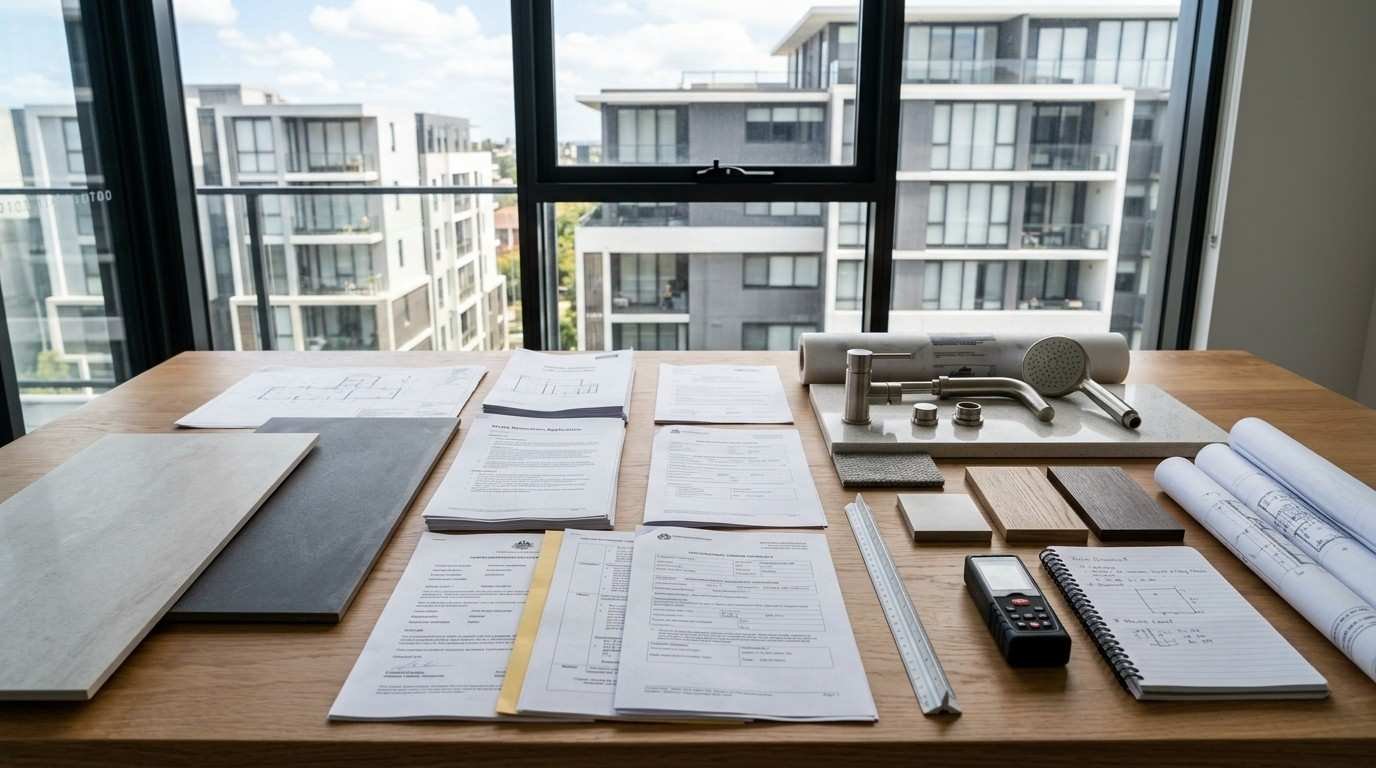
A compliant renovation application to the owners corporation includes a detailed scope of works, plans or drawings showing the proposed changes, the names and licence numbers of all trades involved, evidence of public liability insurance for each contractor, and a waterproofing specification that references AS 3740.
The strata manager reviews the application and presents it to the owners corporation committee or at a general meeting, depending on the resolution type required. Timeframes vary, allow a minimum of four to six weeks for approval before scheduling any trades. A contractor experienced in strata renovations will help you prepare this documentation correctly the first time, which avoids delays caused by incomplete or non-compliant submissions.
What to Look for When Hiring a Strata Renovation Contractor
The contractor you hire for a strata bathroom renovation needs more than a builder’s licence and a good portfolio. They need demonstrated experience working inside strata schemes, a clear understanding of the approval process, and the right credentials for wet area compliance. These are non-negotiable selection criteria.
We work with homeowners and investors across Sydney on strata bathroom renovations, and the most common mistake we see is choosing a contractor based on price alone without verifying strata-specific experience. A cheaper quote from a contractor who has never worked in a strata building almost always costs more in the end.
Licensing, Insurance, and Strata Experience
In NSW, any bathroom renovation involving structural work, waterproofing, or plumbing requires a contractor licence issued by NSW Fair Trading. The contractor must hold a current contractor licence, not just a tradesperson certificate, and must be able to provide their licence number for inclusion in the renovation application.
Public liability insurance is mandatory, and the owners corporation will require a certificate of currency before approving the application. Home building compensation (formerly known as home warranty insurance) is required for residential building work over $20,000. Ask for all three documents before signing any contract.
Waterproofing Credentials and Compliance
Waterproofing is the single most regulated element of a strata bathroom renovation. In NSW, waterproofing in wet areas must comply with AS 3740, the Australian Standard for waterproofing of domestic wet areas. The waterproofing must be carried out by a licensed waterproofer, and the work must be inspected and certified before tiling commences.
A contractor who subcontracts the waterproofing to an unlicensed trade, or who skips the inspection step to save time, creates a defect liability risk that sits with the lot owner for years after the renovation is complete. Verify that your contractor uses a licensed waterproofer and can provide a waterproofing compliance certificate on completion.
Communication and Coordination with Strata Managers
A strata bathroom renovation involves more stakeholders than a standard home renovation. The strata manager, the owners corporation committee, neighbouring lot owners, and the building manager all have a role in the process. A contractor who cannot communicate clearly with each of these parties will create friction that delays the project.
The best strata renovation contractors treat the strata manager as a key project stakeholder from day one. They submit works notices on time, provide access schedules in advance, notify neighbouring lots before noisy work begins, and keep the strata manager updated on progress. This level of coordination is what separates a smooth strata renovation from a contentious one.
Scoping the Work, What a Strata Bathroom Renovation Covers
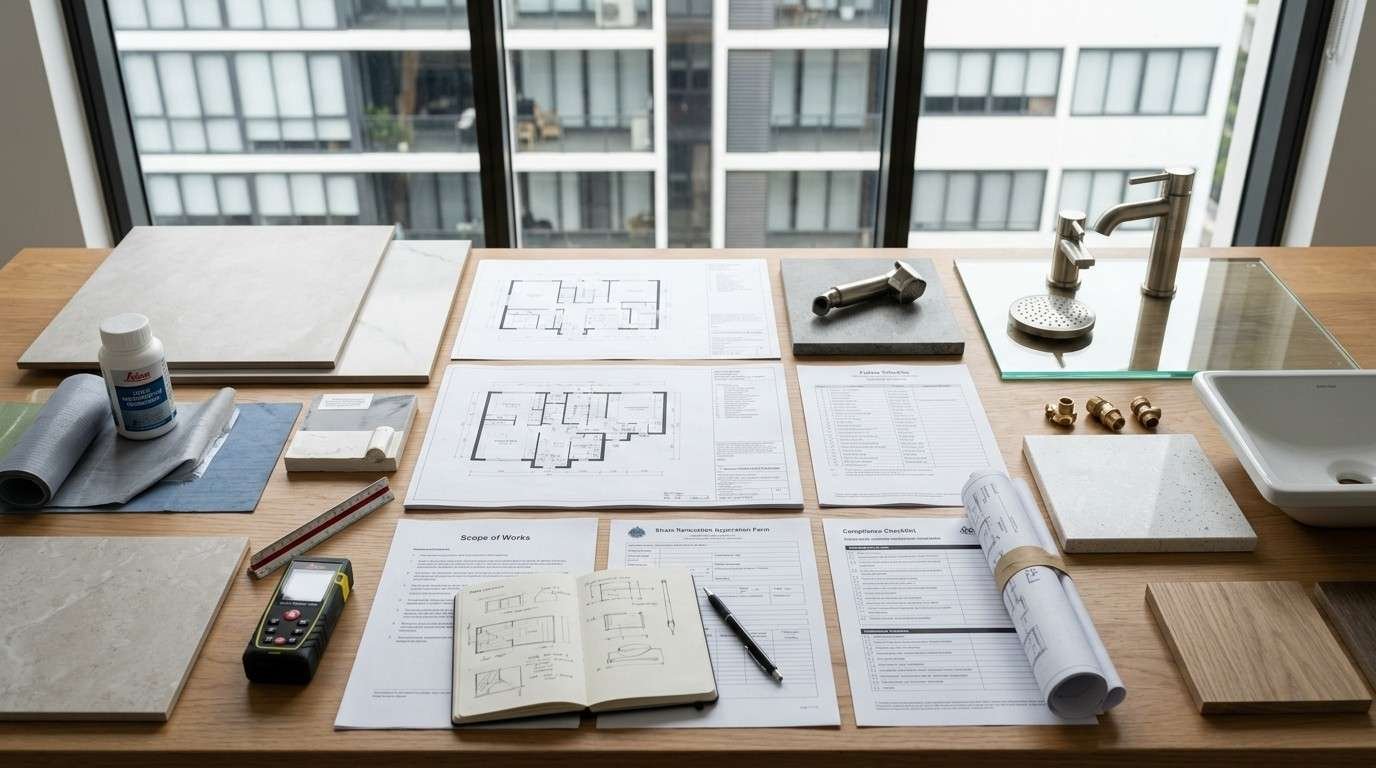
Defining the scope of a strata bathroom renovation requires a clear understanding of where the lot boundary sits and what elements fall within the lot owner’s responsibility. The scope determines the approval category, the trades required, the compliance obligations, and ultimately the cost.
A well-scoped renovation brief is also the foundation of a compliant application to the owners corporation. Vague or incomplete scope descriptions are the most common reason applications are rejected or sent back for revision.
Wet Area Compliance and Waterproofing Standards
Every strata bathroom renovation that involves tile removal triggers a waterproofing obligation. Once the existing tiles come off, the waterproofing membrane beneath them is exposed and must be inspected. In most cases, the membrane needs to be replaced entirely before new tiles go down.
The waterproofing must comply with AS 3740, which specifies membrane type, application method, coverage area, and minimum upstand heights around the shower recess, bath, and floor waste. These are not optional specifications, they are the minimum standard required for a compliant wet area in NSW.
Fixtures, Fittings, and Finishes Within Lot Boundaries
Within the lot boundary, the owner has the right to choose their own fixtures, fittings, and finishes, subject to the approved scope of works. This includes the vanity, toilet suite, tapware, shower screen, tiles, and accessories.
The owners corporation does not have the right to dictate aesthetic choices within the lot, but it can impose conditions on the type of work carried out and the trades used. Any fixture or fitting that connects to shared plumbing infrastructure, such as a new toilet or a relocated shower, requires a licensed plumber and must comply with the National Construction Code and relevant Australian Standards.
Cost Considerations for Strata Bathroom Renovations in NSW
A strata bathroom renovation in Sydney costs more than an equivalent renovation in a freestanding home. The additional cost comes from the approval process, the mandatory waterproofing compliance requirements, the strata-specific site management obligations, and the higher level of coordination required across multiple stakeholders.
Budget planning for a strata bathroom renovation needs to account for all of these layers, not just the labour and materials. Owners who budget only for the physical build consistently run into cost overruns when the strata-specific costs emerge mid-project.
Labour, Materials, and Strata-Specific Costs
A mid-range strata bathroom renovation in Sydney, full tile replacement, new vanity, toilet suite, shower screen, tapware, and compliant waterproofing, typically ranges from $18,000 to $35,000 depending on the size of the bathroom, the quality of fixtures selected, and the complexity of the plumbing layout.
Labour accounts for the largest share of the budget. Tiling, waterproofing, plumbing, and electrical work are all licensed trades in NSW, and each must be engaged separately or through a head contractor who coordinates the full scope. Strata-specific costs on top of the standard build include the owners corporation application fee (typically $500 to $1,500 depending on the scheme), by-law registration fees if required, and the cost of preparing compliant documentation for the application.
Hidden Costs That Catch Owners Off Guard
The costs that most commonly catch strata owners off guard are not the obvious ones. Defect rectification is the biggest risk, if the waterproofing fails after the renovation is complete and water ingresses into the lot below, the rectification cost falls on the lot owner and can run into tens of thousands of dollars.
By-law registration fees, which are paid to NSW Land Registry Services, add several hundred dollars to the project cost and are often not included in contractor quotes. Access restrictions in strata buildings, limited lift access, restricted working hours, mandatory rubbish removal via designated areas, add time to the build and therefore cost. And if the renovation application is rejected or requires resubmission, the delay costs money in rescheduled trades and extended project timelines.
Managing the Renovation Process in a Strata Building
Once approval is granted and the contractor is engaged, managing the renovation inside a strata building requires a level of site discipline that does not apply in a freestanding home. The building is occupied, common areas are shared, and the owners corporation has the right to enforce its by-laws throughout the build.
A contractor who understands strata site management will brief their trades on the building’s rules before work starts, not after the first complaint from a neighbour.
Working Hours, Noise Rules, and Common Area Access
Most strata schemes in NSW impose working hour restrictions through their by-laws. Standard permitted hours for noisy renovation work are typically Monday to Friday, 7am to 5pm, and Saturday, 8am to 1pm. Sunday and public holiday work is generally prohibited.
These hours are not negotiable with the contractor, they are set by the owners corporation and enforced by the strata manager. Any breach of the working hour by-law can result in the renovation being suspended until the owners corporation resolves the complaint. Lift access for materials and waste removal must be scheduled in advance and coordinated with the building manager to avoid conflicts with other residents.
Protecting Common Property During the Build
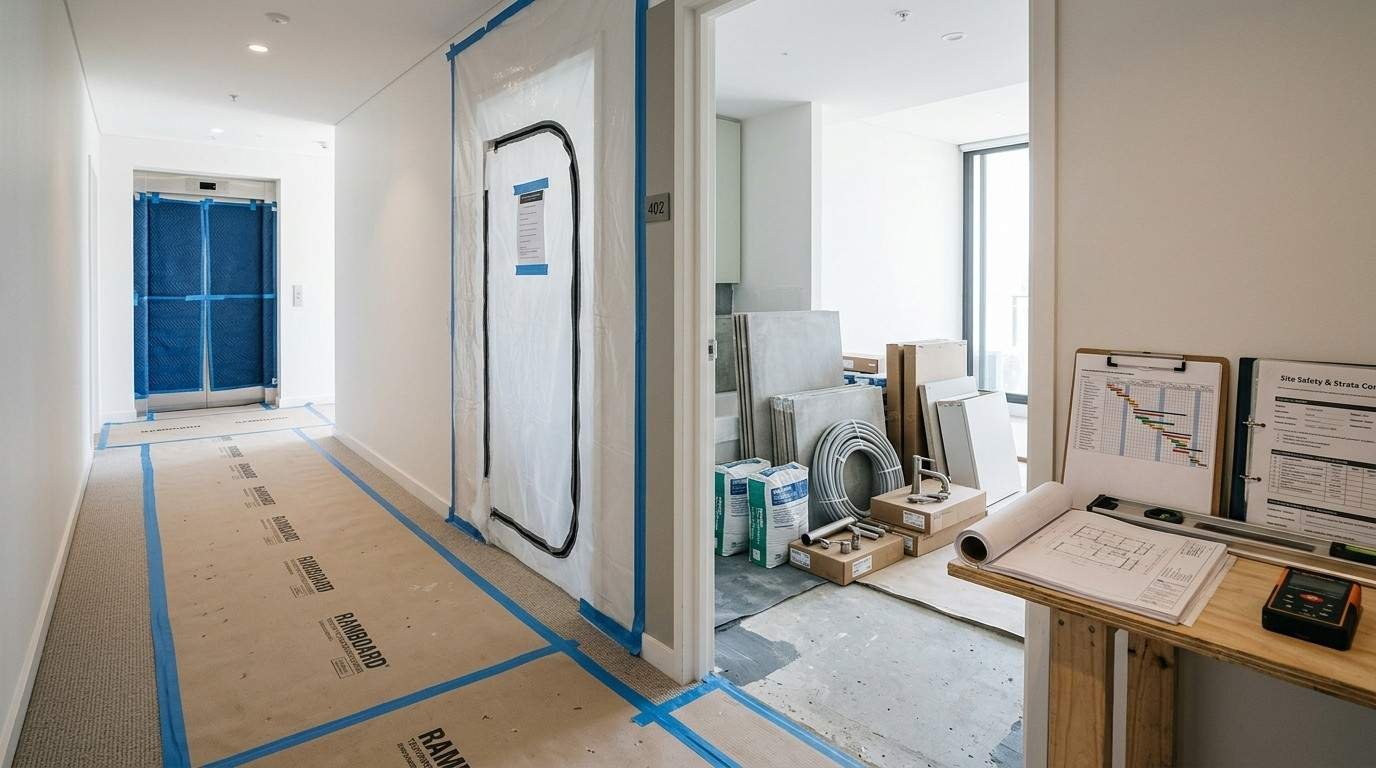
The contractor is responsible for protecting common property throughout the renovation. This includes laying floor protection in corridors and lift lobbies, padding lift interiors during materials delivery, and ensuring that waste is removed via the designated rubbish area rather than left in common areas.
If common property is damaged during the renovation, a scratched lobby floor, a damaged lift door, a cracked stairwell wall, the cost of rectification falls on the lot owner, not the owners corporation. A contractor who does not take common property protection seriously creates a liability that the owner carries long after the renovation is finished.
Frequently Asked Questions
Do I need strata approval for a bathroom renovation in NSW?
Yes. Any bathroom renovation beyond cosmetic changes, including tile removal, waterproofing, plumbing alterations, or fixture replacement, requires owners corporation approval in NSW. The approval category depends on the scope of work, and major renovations require a registered by-law.
What licences should a strata bathroom contractor hold?
The contractor must hold a current contractor licence issued by NSW Fair Trading. Waterproofing must be carried out by a licensed waterproofer. Plumbing work requires a licensed plumber. All trades must carry public liability insurance, and the head contractor must hold home building compensation cover for work over $20,000.
How long does a strata bathroom renovation take?
Allow four to six weeks for owners corporation approval before work starts. The physical renovation typically takes two to three weeks for a standard bathroom, depending on scope and trade availability. Factor in the waterproofing inspection and cure time, which adds two to three days before tiling can commence.
Who is responsible if a contractor damages common property?
The lot owner is responsible. If a contractor damages common property during a renovation, the cost of rectification falls on the lot owner, not the owners corporation. This is why contractor selection matters, choose a contractor with strata experience who takes common property protection seriously from day one.
Can I use any licensed builder for a strata bathroom renovation?
A licensed builder can legally carry out the work, but strata experience is essential. A builder unfamiliar with strata approval processes, by-law requirements, and owners corporation documentation will create delays and compliance risks. Always verify strata-specific experience before engaging any contractor.
What is a works notice and do I need one?
A works notice is a formal notification to the owners corporation and neighbouring lot owners that renovation work is about to commence. Most strata schemes require a works notice to be submitted at least five to ten business days before work starts. Your contractor should prepare and submit this as part of the project coordination process.
How do I get quotes for a strata bathroom renovation in Sydney?
Contact contractors who specifically list strata renovation experience. Provide each contractor with the bathroom dimensions, a description of the proposed scope, and a copy of the relevant strata by-laws. Ask each contractor to itemise their quote so you can compare labour, materials, waterproofing, and strata-specific costs separately.
Conclusion
Strata bathroom renovations in NSW sit at the intersection of construction compliance, strata law, and building management, and getting all three right requires a contractor who understands the full picture. The approval process, waterproofing obligations, and site management requirements are not obstacles to work around. They are the framework that protects your investment and your relationship with the owners corporation.
Choosing the right contractor from the start is the single most important decision in a strata bathroom renovation. Experience, credentials, and communication matter more than price when the regulatory environment is this specific.
At Sydney Home Renovation, we manage strata bathroom renovations across Sydney from application to completion. Reach out to our team and we will walk you through the approval process, scope the work correctly, and deliver a renovation that meets every compliance requirement, on budget and without the strata headaches.