
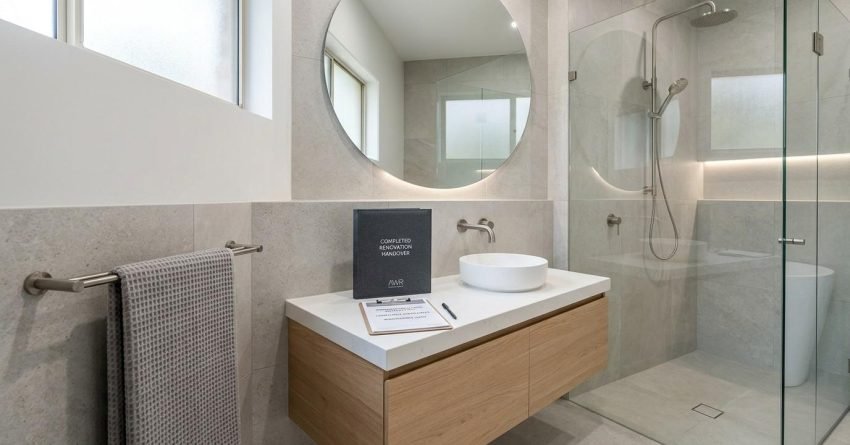
Investment property renovation is the process of upgrading, repairing, or transforming a residential property to increase its rental yield, capital value, or market appeal. In Sydney’s competitive property market, a well-planned renovation is one of the most direct levers investors have for improving financial performance.
Getting this wrong is expensive. Overcapitalising, underestimating hidden costs, or choosing the wrong upgrades can erode returns and extend vacancy periods far beyond what any rental income can recover.
This guide covers everything investors need to know from renovation types, Sydney cost benchmarks, and budgeting frameworks to ROI-focused upgrades, planning approvals, tax implications, and how to choose a contractor who delivers.
What Is Investment Property Renovation?
Investment property renovation refers to any planned improvement work carried out on a property held for rental income or capital growth purposes. It sits at the intersection of construction management and property investment strategy and the decisions made here directly affect financial outcomes.
Defining Renovation in the Context of Investment Property
A renovation, in the investment context, is any work that improves the condition, functionality, or presentation of a property beyond its current state. This ranges from a fresh coat of paint and new flooring to a complete structural overhaul. The defining characteristic is intent: the work is done to improve the property’s performance as an asset, not simply to maintain it.
Maintenance and renovation are not the same thing. Fixing a leaking tap is maintenance. Replacing the entire bathroom to increase rental appeal is a renovation. This distinction matters significantly for tax treatment, budgeting, and return calculations.
Owner-Occupier vs. Investor Renovation Goals
Owner-occupiers renovate for lifestyle. Investors renovate for returns. That difference shapes every decision from the specification tier of fittings to the choice of finishes and the total budget allocated.
An owner-occupier might spend $25,000 on a bathroom because they want to enjoy it. An investor renovating the same bathroom in a comparable Sydney suburb needs to ask whether that spend will generate a measurable increase in weekly rent or sale price. The answer determines the scope, not personal preference.
We see this misalignment regularly. Investors who approach a renovation with an owner-occupier mindset tend to overcapitalise and the numbers rarely recover.
Why Renovate an Investment Property?
The case for renovating an investment property comes down to three measurable outcomes: higher rent, stronger capital growth, and better tenant quality. When a renovation is planned and executed well, it delivers on all three simultaneously.
Increasing Rental Yield Through Strategic Upgrades
Rental yield is the annual rental income expressed as a percentage of the property’s value. A targeted renovation particularly in high-impact areas like bathrooms and kitchens can increase weekly rent by $50 to $150 or more in Sydney’s inner and middle-ring suburbs, depending on the property type and current condition.
That uplift compounds over time. A $100-per-week rent increase generates an additional $5,200 per year. Against a $15,000 bathroom renovation, that represents a payback period of under three years before accounting for any capital value improvement.
Capital Growth and Long-Term Property Value
Beyond rental income, a well-executed renovation can meaningfully increase a property’s market value. CoreLogic’s research on renovation premiums consistently shows that updated kitchens and bathrooms are among the strongest drivers of valuation uplift in the Australian residential market.
In Sydney, where median house prices remain among the highest in the country, even a modest percentage increase in value translates to significant dollar gains. A renovation that adds 3–5% to a $900,000 property delivers $27,000–$45,000 in equity often from a spend of $20,000–$35,000.
Attracting and Retaining Quality Tenants
Presentation drives tenant quality. Properties that are clean, functional, and well-finished attract tenants who take better care of them, stay longer, and cause fewer disputes. Vacancy periods are shorter, turnover costs are lower, and property management becomes less reactive.
This is not a soft benefit. Vacancy is one of the most damaging costs in a rental portfolio. Every week a property sits empty in Sydney costs the investor the equivalent of the weekly rent plus ongoing holding costs. A renovation that reduces average vacancy by even two weeks per year pays for itself faster than most investors expect.
Types of Investment Property Renovations
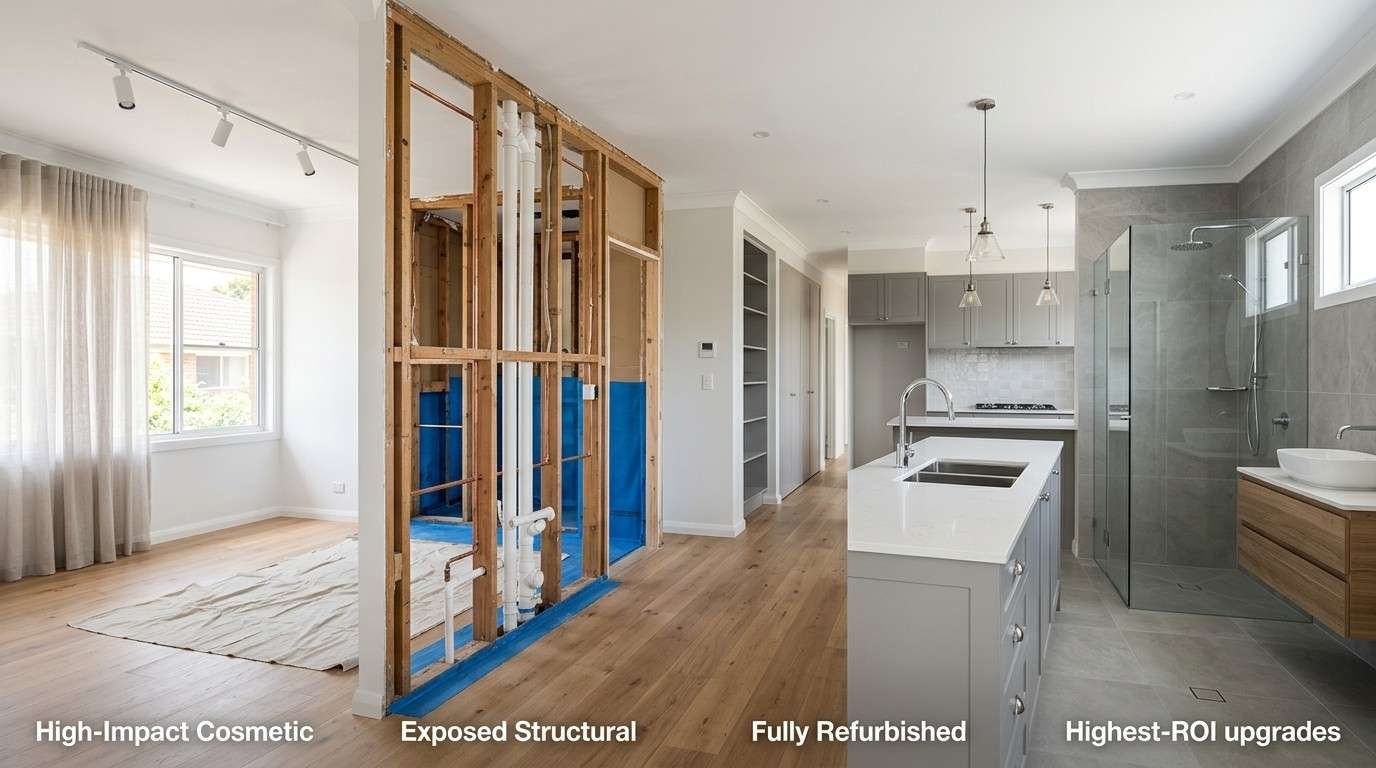
Not all renovations are created equal. The type of renovation you undertake should be matched to the property’s current condition, the target tenant demographic, the suburb’s price ceiling, and the budget available. We categorise investment renovations into four broad types.
Cosmetic Renovations (Low Cost, High Visual Impact)
Cosmetic renovations focus on presentation without touching the structure or services. This includes painting, flooring replacement, light fixture upgrades, new blinds, landscaping, and minor fixture updates. Costs typically range from $5,000 to $20,000 for a standard Sydney investment property.
The return on cosmetic work is often the strongest of any renovation type not because the dollar uplift is the largest, but because the spend is low relative to the improvement in perceived quality. A tired property with fresh paint, new carpet, and updated lighting photographs better, rents faster, and commands a higher weekly rate.
Structural and Functional Renovations
Structural renovations address the bones of the property roofing, waterproofing, electrical rewiring, plumbing upgrades, and subsidence or foundation work. These are not discretionary. They are required to make the property safe, compliant, and insurable.
Structural work is rarely glamorous, and it rarely generates a direct rental uplift proportional to its cost. But neglecting it creates liability, accelerates deterioration, and can make the property untenantable. We treat structural work as a prerequisite, not an upgrade.
Full Property Refurbishments
A full refurbishment involves a comprehensive overhaul of the entire property new kitchen, new bathrooms, new flooring, updated electrical and plumbing, fresh paint throughout, and often external works. In Sydney, a full refurbishment of a three-bedroom house typically costs between $80,000 and $180,000 depending on specification and scope.
Full refurbishments are appropriate when a property has been significantly neglected, when it was purchased below market value specifically for renovation, or when the investor is preparing the property for sale rather than ongoing rental. The financial case needs to be modelled carefully before committing to this scale of work.
Bathroom and Kitchen Renovations as Priority Upgrades
Within any renovation scope, bathrooms and kitchens consistently deliver the strongest return on investment. These two rooms drive tenant decisions more than any other part of the property. A dated bathroom with cracked tiles, poor waterproofing, and a stained vanity signals neglect regardless of how well the rest of the property presents.
We cover bathroom renovation costs and budgeting in detail in a dedicated guide, including labour rates, material tiers, and what a realistic Sydney bathroom renovation actually costs at each specification level.
How Much Does Investment Property Renovation Cost in Sydney?
Sydney renovation costs are among the highest in Australia, driven by trade labour rates, material costs, and the complexity of working within established residential areas. Understanding the cost landscape before committing to a scope is essential for avoiding budget blowouts.
Typical Cost Ranges by Renovation Type
The table below provides orientation-level cost benchmarks for common investment property renovation types in Sydney. These are indicative ranges actual costs depend on property size, condition, specification tier, and contractor.
| Renovation Type | Typical Cost Range (Sydney) |
| Cosmetic refresh (paint, flooring, fixtures) | $5,000 – $20,000 |
| Bathroom renovation (standard) | $15,000 – $35,000 |
| Kitchen renovation (standard) | $20,000 – $45,000 |
| Laundry renovation | $5,000 – $12,000 |
| Full property refurbishment (3BR house) | $80,000 – $180,000 |
| Structural/compliance work | $10,000 – $60,000+ |
These figures align with Archicentre Australia’s renovation cost benchmarks, which track residential construction pricing across Australian capital cities.
Labour Costs and Trade Rates in Sydney
Labour is the largest single cost component in most Sydney renovations. Licensed tradespeople tilers, plumbers, electricians, carpenters, and waterproofers charge day rates that reflect Sydney’s cost of living, licensing requirements, and demand pressure.
As a general benchmark, expect to pay $80–$120 per hour for licensed trades in Sydney, with specialist trades such as waterproofing and electrical work at the higher end of that range. Project management, if provided by a head contractor, typically adds 15–25% to the total trade cost.
Material Allowances and Specification Tiers
Material costs vary significantly based on specification tier. A budget-tier bathroom renovation uses entry-level tiles, a standard vanity, and basic tapware. A mid-range renovation uses rectified porcelain tiles, a semi-custom vanity, and quality tapware from brands like Caroma or Methven. A premium renovation uses large-format stone-look tiles, custom joinery, and designer fixtures.
For investment properties, mid-range specification is almost always the right call. Budget finishes deteriorate faster, require more frequent replacement, and signal low quality to prospective tenants. Premium finishes rarely generate a rental premium that justifies the additional spend in most Sydney investment suburbs.
Budgeting for an Investment Property Renovation
A renovation budget is not a wish list. It is a financial plan with defined inputs, realistic allowances, and built-in contingency. Investors who approach budgeting with discipline consistently outperform those who estimate loosely and adjust as they go.
Building a Realistic Renovation Budget
A realistic renovation budget starts with a detailed scope of works a written description of every item to be completed, the specification for each item, and the trade responsible. Without a defined scope, quotes are incomparable and cost control is impossible.
We build budgets from the scope up, not from a round number down. “I want to spend $30,000 on the bathroom” is not a budget. “I want to replace the floor tiles, wall tiles, vanity, toilet, shower screen, tapware, and exhaust fan, with mid-range specification throughout” is a scope and from that scope, a realistic budget can be built.
Contingency Planning and Hidden Costs
Every renovation budget needs a contingency allowance. For investment properties in Sydney, we recommend a minimum of 15% of the total project cost as contingency. For older properties particularly those built before 1990 20% is more appropriate.
Hidden costs are not rare. They are predictable. Waterproofing failures behind existing tiles, asbestos in pre-1990 properties, undersized electrical boards, and non-compliant plumbing are discovered regularly once walls are opened. Safe Work NSW’s guidance on asbestos in residential properties outlines the identification and removal obligations that apply to pre-1990 Sydney homes costs that must be factored into any renovation budget for older stock.
Prioritising Spend for Maximum ROI
Not every dollar in a renovation budget delivers equal return. We prioritise spend based on three criteria: tenant visibility (will tenants see and value this?), durability (will it last 10+ years with normal rental use?), and compliance (is it required to make the property safe and legal?).
Bathrooms and kitchens rank highest on tenant visibility. Waterproofing and electrical compliance rank highest on safety. Flooring ranks highly on both durability and visual impact. Feature walls, statement lighting, and decorative elements rank lowest they cost money, date quickly, and rarely influence rental decisions.
Planning and Approvals for Investment Renovations in Sydney
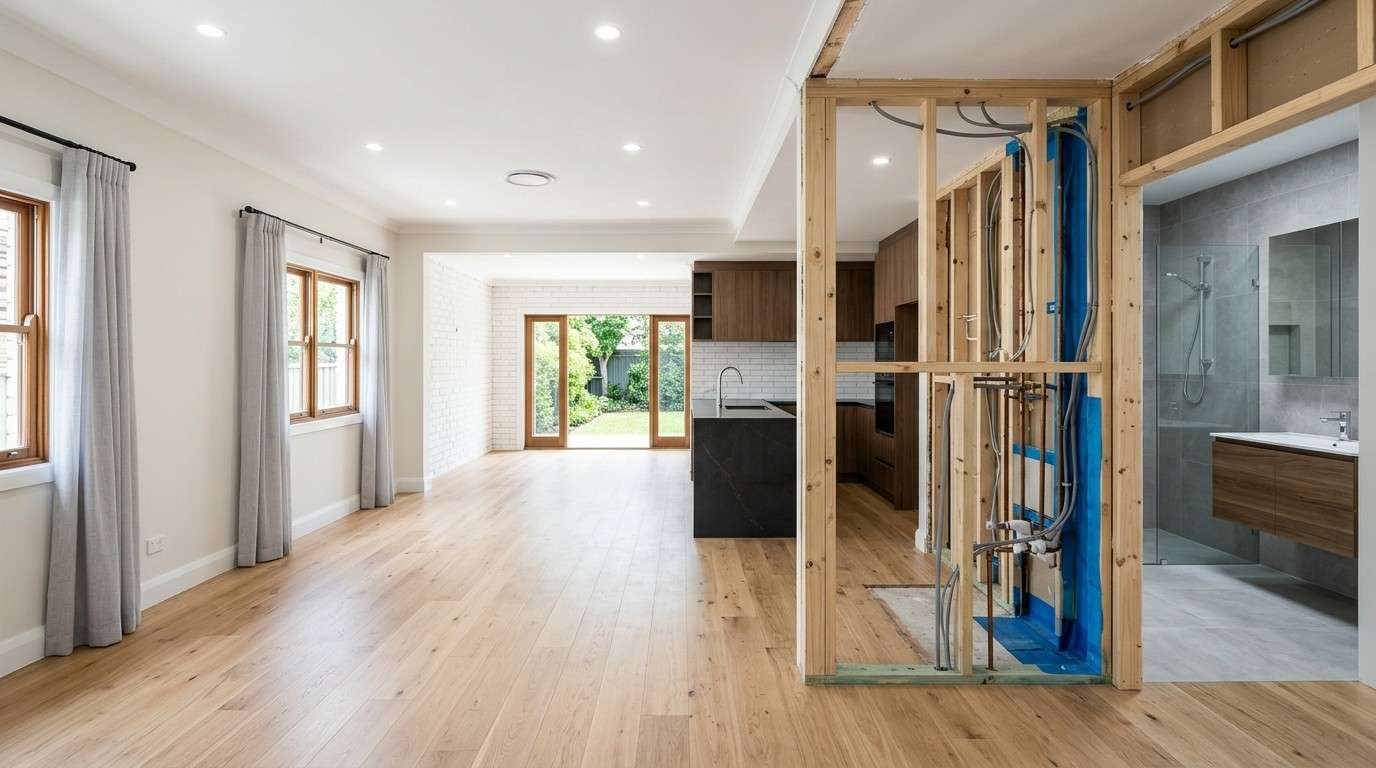
Renovation work in Sydney is regulated by the NSW planning system, the Building Code of Australia, and for strata properties the relevant owners corporation. Understanding what requires approval before starting work protects investors from stop-work orders, fines, and costly rectification.
When Council Approval Is Required
Most cosmetic renovations painting, flooring, fixture replacement do not require council approval. Structural work, additions, changes to the building envelope, and certain plumbing and electrical works do. In NSW, the planning framework distinguishes between exempt development (no approval needed), complying development (fast-track approval via a private certifier), and development applications (full council assessment).
NSW Planning Portal’s exempt and complying development codes provide the definitive reference for what falls into each category. We always check this before scoping work the cost of a stop-work order far exceeds the cost of getting the approval right upfront.
Owner-Builder Licences and Contractor Obligations
In NSW, any residential building work valued at over $10,000 must be carried out by a licensed contractor or a licensed owner-builder. NSW Fair Trading’s licensing requirements specify that contractors must hold a current contractor licence and provide a written contract for work over $20,000, along with home building compensation (HBC) insurance for work over $20,000.
Investors who engage unlicensed contractors to save money expose themselves to significant risk including uninsured defects, inability to claim on insurance, and potential liability for injuries on site.
Strata and Tenancy Considerations
For investment properties within strata schemes, additional approval layers apply. Any work affecting common property, the building structure, or external appearance requires written approval from the owners corporation before work begins. Failure to obtain this approval can result in mandatory reinstatement at the investor’s cost.
For tenanted properties, the Residential Tenancies Act 2010 (NSW) governs the rights and obligations of landlords undertaking renovation work. Tenants must be given appropriate notice, and significant works may trigger relocation rights or rent abatement obligations.
Choosing the Right Renovation Contractor in Sydney
The contractor you choose determines the outcome of your renovation more than any other single decision. A skilled, transparent contractor delivers on scope, on budget, and on time. A poor one creates disputes, defects, and cost blowouts that take years to resolve.
What to Look for in a Renovation Contractor
The non-negotiables: a current NSW contractor licence (verifiable via the NSW Fair Trading licence check), home building compensation insurance for projects over $20,000, a clear written contract, and a track record of completed investment property renovations in Sydney.
Beyond compliance, look for contractors who provide detailed, itemised quotes not lump-sum figures. A contractor who can break down labour, materials, and margin by trade demonstrates cost transparency and project control. That transparency is the foundation of a productive working relationship.
Getting Quotes and Comparing Scope
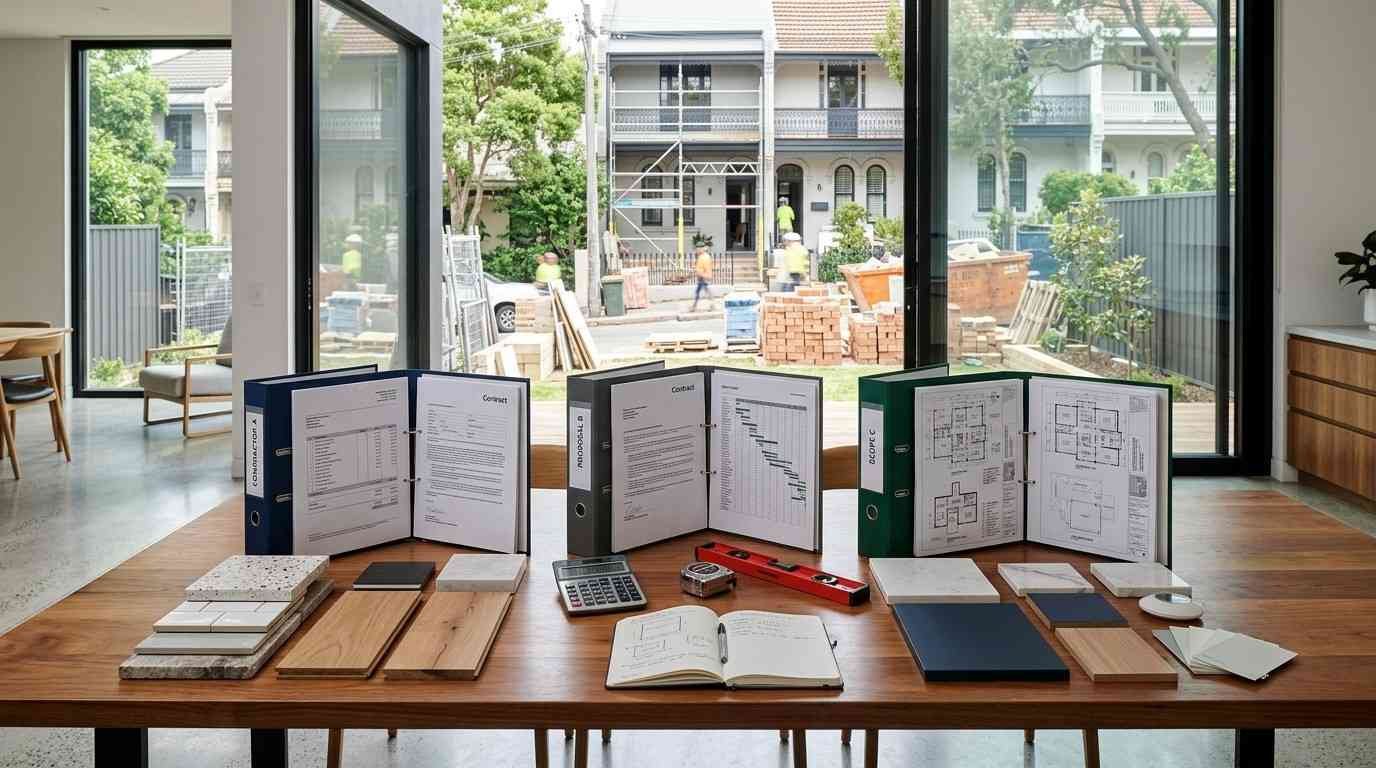
Three quotes is the standard recommendation, but three quotes are only useful if they are based on the same scope of works. Without a defined scope document, each contractor quotes what they think the job involves and the resulting figures are incomparable.
We recommend preparing a written scope before approaching contractors. Share the same document with each, and ask each contractor to quote against it line by line. This makes comparison straightforward and reveals which contractors have genuinely understood the brief.
Red Flags and How to Avoid Dodgy Builders
The warning signs are consistent: requests for large upfront deposits (more than 10% before work begins), reluctance to provide a written contract, inability to provide licence or insurance documentation, and pressure to start immediately without a signed agreement.
In NSW, the maximum deposit for residential building work is 10% of the contract price. Any contractor requesting more than this is operating outside the legal framework and that is a clear signal to walk away.
Renovation ROI Which Upgrades Add the Most Value?
Return on renovation investment is not uniform. Some upgrades generate measurable rental and capital value uplift. Others consume budget without moving the needle. Understanding which is which is the difference between a renovation that performs and one that simply costs money.
Bathroom Renovations and Rental Appeal
Bathrooms are the single highest-impact renovation for rental properties. A dated, poorly maintained bathroom is the most common reason prospective tenants reject a property and the most common reason existing tenants leave. A clean, functional, well-finished bathroom signals that the property is well-managed and worth the asking rent.
In Sydney’s rental market, a mid-range bathroom renovation costing $18,000–$25,000 can generate a weekly rent increase of $50–$100 in most middle-ring suburbs. That represents a gross yield improvement of $2,600–$5,200 per year a payback period of four to ten years on the renovation spend alone, before accounting for reduced vacancy and capital value uplift.
Kitchen Upgrades and Capital Value
Kitchens drive capital value more than any other single room. Domain’s research on renovation impact consistently identifies updated kitchens as a top driver of buyer willingness to pay in the Sydney residential market.
For investors holding for capital growth, a kitchen renovation is often the most financially justified upgrade. For investors focused purely on rental yield, the kitchen matters but the bathroom typically delivers a faster payback. The right priority depends on the investment strategy and the property’s current condition.
Kerb Appeal, Flooring, and Cosmetic Wins
First impressions drive tenant decisions before they walk through the door. External painting, garden tidying, a new front door, and clean driveway surfaces cost relatively little and have a disproportionate impact on how a property photographs and presents at inspection.
Internally, flooring is the single most impactful cosmetic upgrade. Replacing worn carpet with durable hybrid flooring throughout a three-bedroom property typically costs $4,000–$8,000 in Sydney and the visual transformation is immediate. New flooring makes every other element of the property look better.
Managing an Investment Property Renovation Remotely
Many Sydney investors do not live near their investment properties. Managing a renovation from a distance adds complexity but it is entirely manageable with the right systems, the right contractor, and clear communication protocols established before work begins.
Communication and Project Coordination
Remote renovation management depends on structured communication. We establish a weekly update cadence with every client a brief written summary of work completed, work scheduled for the following week, any variations to scope or cost, and photographic documentation of progress.
This is not optional. Without regular, structured updates, small issues become large ones before the investor is aware of them. A contractor who resists this level of communication is a contractor who is not confident in their own project management.
Timelines, Vacancy Periods, and Minimising Rental Loss
Every week a property is vacant during renovation is a week of lost rental income. In Sydney, where weekly rents for investment properties commonly range from $500 to $1,200+, a four-week renovation that runs to six weeks costs the investor $1,000–$2,400 in unplanned rental loss on top of any cost overruns.
We plan renovation timelines with vacancy cost built into the financial model. A contractor who provides a realistic programme with trade sequencing, lead times for materials, and buffer for inspections is worth more than one who quotes a shorter timeline they cannot deliver.
Tax, Depreciation, and Financial Considerations
The tax treatment of renovation costs is one of the most misunderstood areas of investment property ownership. Getting it right can significantly improve the after-tax return on a renovation. Getting it wrong creates compliance risk and missed deductions.
Immediate Deductions vs. Capital Works Deductions
The Australian Taxation Office distinguishes between repairs and maintenance (immediately deductible) and capital improvements (deductible over time as capital works). A repair restores something to its original condition. An improvement makes it better than it was. This distinction determines how the cost is treated for tax purposes.
Replacing a broken tile is a repair immediately deductible. Retiling the entire bathroom is a capital improvement deductible at 2.5% per year over 40 years under Division 43 of the Income Tax Assessment Act 1997. The ATO’s guidance on rental property deductions provides the definitive framework for categorising renovation costs correctly.
Depreciation Schedules and Quantity Surveyors
Plant and equipment within a renovation hot water systems, exhaust fans, dishwashers, carpet depreciates at different rates under Division 40. A quantity surveyor’s depreciation schedule identifies every depreciable asset installed during a renovation and calculates the annual deduction available to the investor.
For a renovation costing $30,000–$50,000, a depreciation schedule typically costs $600–$900 and generates thousands of dollars in additional annual deductions. The return on that investment is almost always positive within the first year.
Renovation Costs and Capital Gains Tax Implications
Capital improvements to an investment property increase the property’s cost base for capital gains tax (CGT) purposes. This means that when the property is eventually sold, the renovation costs reduce the taxable capital gain a meaningful benefit for investors holding for long-term capital growth.
Keeping detailed records of all renovation costs contracts, invoices, receipts, and payment records is essential. These records form the evidence base for the cost base calculation at the time of sale. We recommend maintaining a dedicated renovation file for every project, regardless of scale.
Common Renovation Mistakes Investors Make
The most expensive renovation mistakes are not the ones that happen on site. They are the ones made in the planning phase before a single trade has been engaged. We see the same errors repeatedly, and they are almost entirely avoidable.
Over-Capitalising for the Suburb
Every suburb has a price ceiling a point beyond which additional spend does not generate proportional value uplift. Renovating a property to a specification that exceeds what the local market supports is overcapitalisation, and it is one of the most common and costly mistakes investors make.
The test is simple: what do comparable properties in the same street rent for and sell for? If the best-presented property in the suburb achieves $650 per week, a renovation that costs $80,000 to achieve $680 per week is not a sound investment. The specification must be calibrated to the market, not to personal taste.
Underestimating Scope and Hidden Costs
Scope creep and hidden costs are the two most reliable drivers of renovation budget blowouts. Scope creep happens when additional work is added during the project without a corresponding budget adjustment. Hidden costs emerge when existing conditions waterproofing failures, asbestos, non-compliant wiring are discovered once work begins.
Both are manageable with the right preparation. A detailed pre-renovation inspection by a licensed building inspector reduces the likelihood of hidden cost surprises. A clearly defined scope of works with a written variation process reduces scope creep. Neither eliminates risk entirely, but both reduce it significantly.
Choosing Aesthetics Over Durability
Investment properties are not show homes. They are working assets that need to withstand years of tenant use, periodic vacancy, and routine maintenance. Finishes chosen for visual impact without regard for durability create ongoing maintenance costs that erode the renovation’s return over time.
Hybrid flooring outperforms carpet in rental properties it is harder-wearing, easier to clean, and more resistant to damage. Rectified porcelain tiles outperform natural stone in bathrooms they are less porous, easier to maintain, and more forgiving of tenant use. Durability is a financial decision, not just a practical one.
Frequently Asked Questions
What is the average cost of renovating an investment property in Sydney?
The average cost depends heavily on scope and specification. A cosmetic refresh costs $5,000–$20,000. A full bathroom or kitchen renovation runs $15,000–$45,000. A complete property refurbishment typically costs $80,000–$180,000 for a three-bedroom Sydney home.
Do I need council approval to renovate an investment property in NSW?
Cosmetic work painting, flooring, fixture replacement generally does not require approval. Structural work, additions, and changes to plumbing or electrical systems may require complying development approval or a full development application under the NSW planning framework.
How do I avoid overcapitalising on a renovation?
Research comparable properties in the same suburb before setting your specification. The renovation standard should match the market ceiling, not exceed it. A quantity surveyor or experienced local contractor can help calibrate scope to the suburb’s rental and sale price benchmarks.
What renovations add the most value to a rental property?
Bathrooms and kitchens consistently deliver the strongest return in Sydney’s rental market. Flooring replacement and external presentation upgrades offer strong cosmetic impact at relatively low cost. Structural and compliance work is essential but rarely generates direct rental uplift.
Can I claim renovation costs as a tax deduction?
Repairs and maintenance are immediately deductible. Capital improvements are deductible over time as capital works at 2.5% per year. Plant and equipment depreciates under separate schedules. A quantity surveyor’s depreciation report maximises the deductions available from any renovation.
How long does an investment property renovation take?
A bathroom renovation typically takes two to four weeks. A kitchen renovation takes three to five weeks. A full property refurbishment can take eight to sixteen weeks depending on scope, trade availability, and material lead times. Vacancy periods should be factored into the financial model before work begins.
Should I renovate before or after finding a tenant?
Renovating before finding a tenant allows the property to be presented at its best, commands a higher weekly rent from the outset, and avoids the disruption of renovating around an existing tenancy. The rental loss during renovation is typically recovered within the first six to twelve months of the higher rent.
Conclusion
Investment property renovation in Sydney is a financial decision before it is a construction one. The type of renovation, the specification tier, the contractor, and the budget discipline all determine whether the project delivers the rental yield, capital growth, and tenant quality outcomes the investor is targeting.
Every section of this guide connects to a deeper resource from bathroom renovation cost breakdowns to tax depreciation strategies and contractor selection frameworks. The cluster of guides linked throughout this page gives investors the detail they need at each decision point.
At Sydney Home Renovation, we help investors renovate with confidence transparent pricing, clear communication, and end-to-end project delivery that keeps your renovation on budget, on schedule, and built for long-term value.


