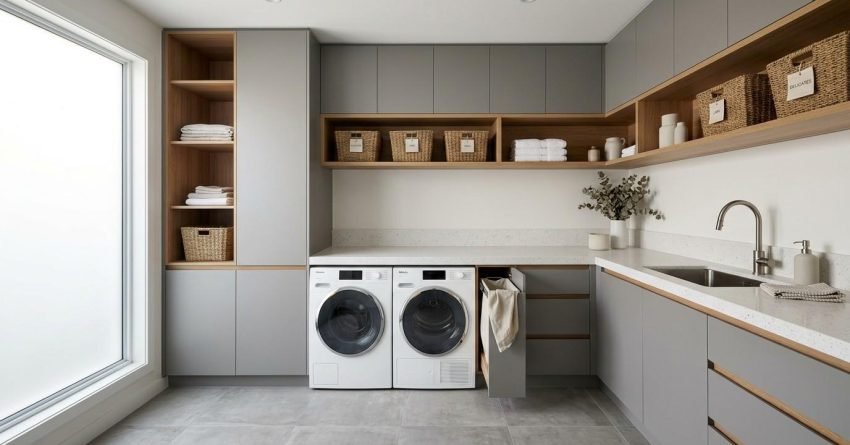
Laundry cabinetry covers every storage system built into a laundry room from wall-mounted cupboards and base units to tall linen towers and integrated appliance enclosures. It shapes how functional, organised, and visually cohesive your laundry space becomes. For Sydney homeowners, renovators, and property investors, the right cabinetry decision directly affects daily usability, renovation budgets, and long-term property value.
Getting this wrong costs more than money. A poorly planned laundry cabinet layout creates wasted space, moisture damage, and a room that never quite works problems that are expensive to fix after the fact.
This guide covers cabinet types, materials, door styles, hardware, Sydney-specific costs, layout planning, flat-pack versus custom options, and how to choose the right solution for your home or investment property.
What Is Laundry Cabinetry?
Laundry cabinetry is the collective term for purpose-built storage units designed specifically for laundry rooms including wall cabinets, base units, tall towers, and integrated shelving systems. Unlike general storage furniture, laundry cabinetry is engineered to handle the humidity, heat, and daily wear that a working laundry environment produces.
We use the term broadly to cover everything from a single overhead cupboard above a washing machine to a fully fitted room with floor-to-ceiling storage, concealed appliances, and pull-out accessories. The scope matters because the type of cabinetry you choose determines your material options, your cost range, and the trades involved in installation.
How Laundry Cabinets Differ From Kitchen and Bathroom Cabinetry
Laundry cabinets share construction principles with kitchen and bathroom cabinetry but serve a distinct functional brief. Kitchen cabinets prioritise food-safe surfaces and cooking workflow. Bathroom vanities focus on compact wet-area storage. Laundry cabinetry, by contrast, must accommodate large appliances, cleaning chemicals, linen storage, and often a utility sink all within a space that is frequently smaller than either a kitchen or bathroom.
The moisture exposure in a laundry is also more sustained. Steam from dryers, splashing from tubs, and condensation from cold-water pipes mean that material selection is more critical here than in most other rooms. We always specify moisture-resistant substrates as a baseline, not an upgrade.
The Role Cabinetry Plays in a Functional Laundry Room
Well-designed laundry cabinetry does three things: it hides the mess, organises the workflow, and makes the room feel intentional rather than incidental. In Sydney homes where laundries are often compact tucked into a hallway, under a staircase, or squeezed into a corner cabinetry is the primary tool for making a small space work hard.
For property investors, cabinetry is also a visible quality signal. A fitted laundry with cohesive storage reads as a finished, well-maintained property. That perception influences rental appeal and resale value in ways that are disproportionate to the cost of the cabinetry itself.
Types of Laundry Cabinets
Laundry cabinets come in several distinct configurations, and most well-planned laundries combine two or more types to maximise storage across different zones of the room. Understanding what each type does and where it works best is the starting point for any layout decision.
Wall-Mounted Cabinets
Wall-mounted cabinets sit above the bench, appliances, or utility sink and are the most common laundry storage solution in Australian homes. They keep frequently used items detergents, stain removers, and cleaning supplies at eye level and within easy reach without consuming floor space.
In Sydney laundries, wall cabinets typically run 300–400mm deep and 600–900mm tall. Deeper cabinets are possible but can feel oppressive in a narrow room. We generally recommend 350mm as the practical sweet spot: deep enough to store bulky items, shallow enough to maintain clearance above a front-loader.
Base Cabinets and Under-Bench Storage
Base cabinets form the foundation of a fitted laundry. They sit at floor level, support the bench surface, and provide the bulk of accessible storage drawers for small items, cupboards for larger ones, and dedicated spaces for bins or laundry baskets.
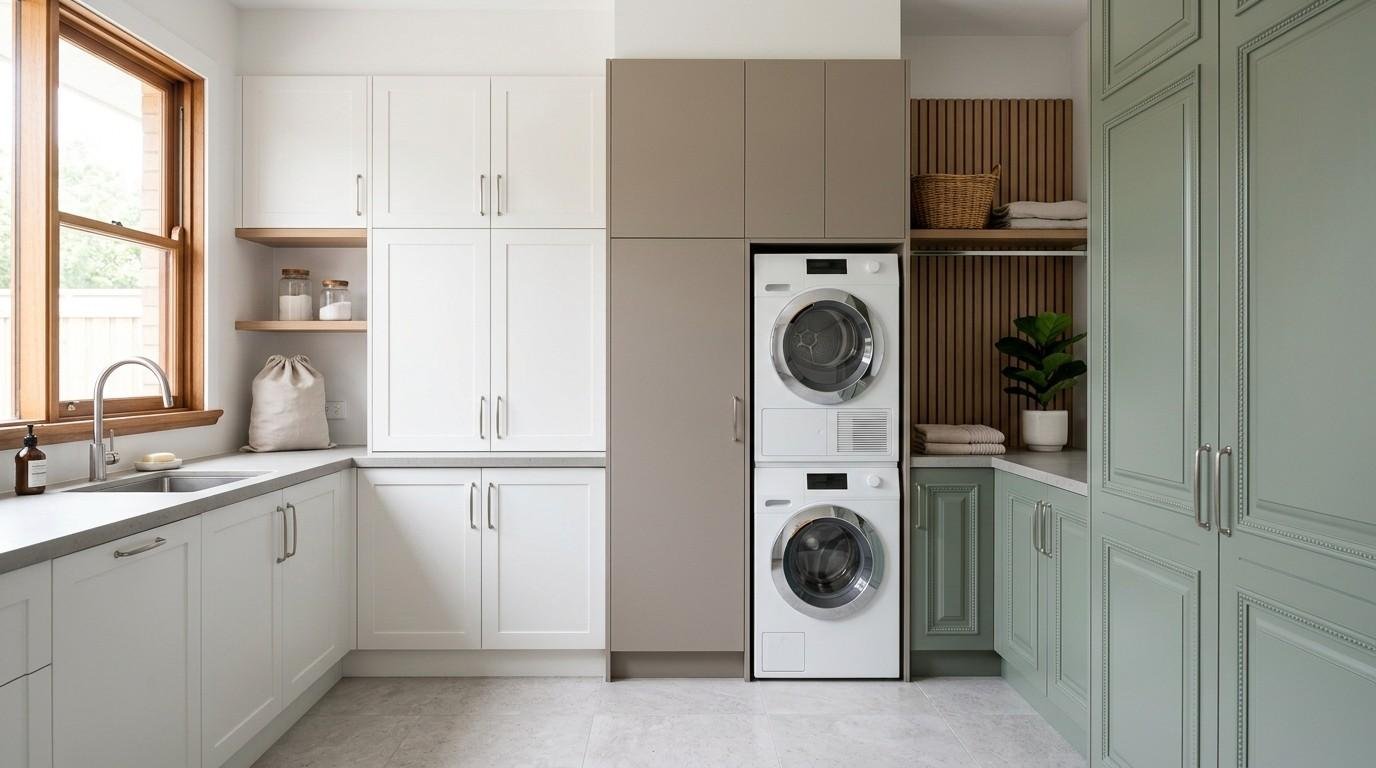
Standard base cabinet height in Australia is 870mm to bench top, which aligns with ergonomic working height for most adults. Under-bench space is also where appliances are often integrated: a front-load washer and dryer can be stacked or placed side by side within a base cabinet frame, with doors that conceal them entirely when not in use.
Tall and Floor-to-Ceiling Cabinets
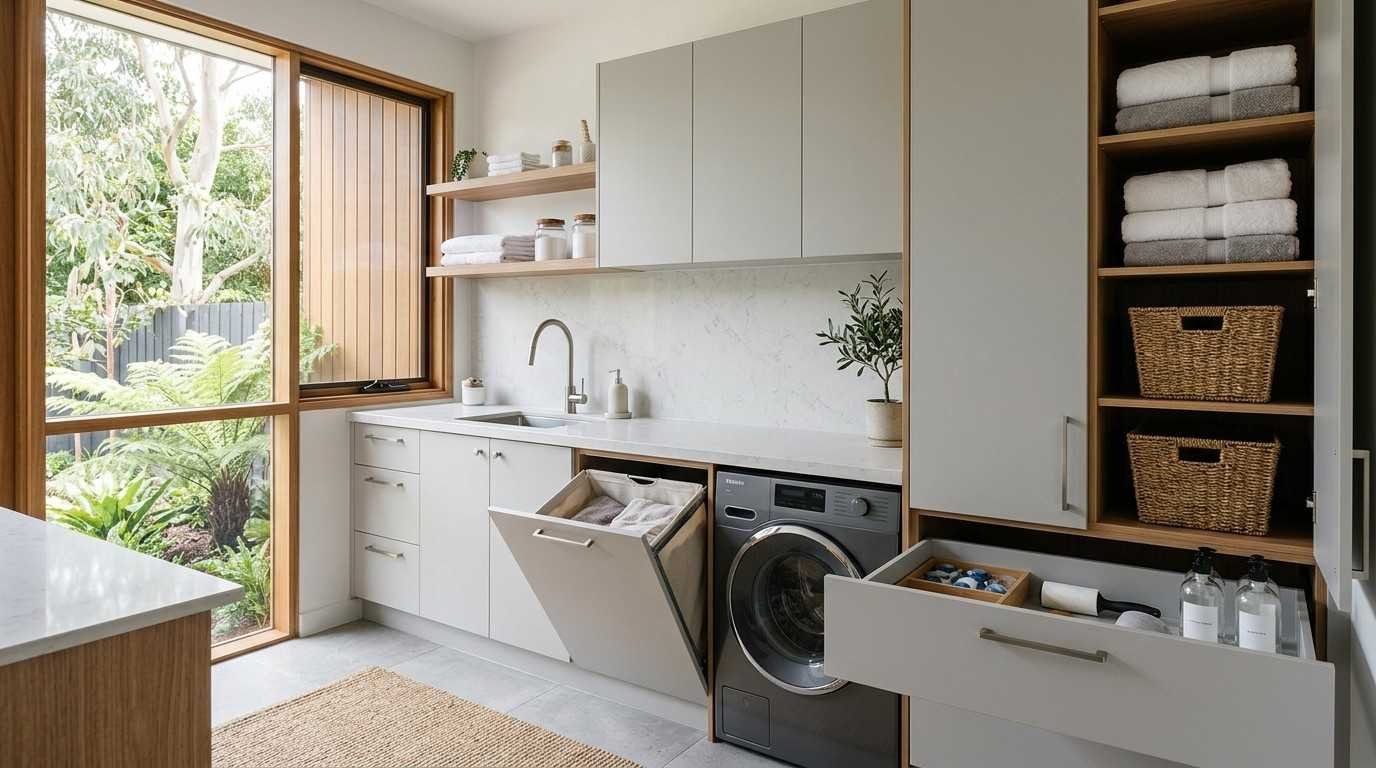
Tall cabinets sometimes called pantry-style or linen towers run from floor to ceiling and offer the highest storage density of any cabinet type. In a laundry, they typically house linen, cleaning equipment, a broom and mop, or a concealed ironing board.
Floor-to-ceiling cabinetry also has a visual benefit: it makes a small room feel taller and more resolved. When the cabinetry runs the full height of the wall, the eye reads the room as intentionally designed rather than improvised. This is particularly effective in Sydney terrace houses and apartments where laundry spaces are compact.
Open Shelving vs. Closed Cabinet Systems
Open shelving is a lower-cost alternative to full cabinet systems and works well for items that are used frequently and don’t need to be hidden. Folded towels, baskets, and decorative storage containers all suit open shelving.
The practical limitation is dust accumulation and the visual noise of an exposed laundry. In a working laundry as opposed to a styled one open shelving tends to look cluttered within weeks. We recommend closed cabinets as the primary storage system, with open shelving used selectively for display or frequently accessed items only.
Laundry Linen Cabinets and Hamper Units
Linen cabinets are tall, narrow units designed specifically for storing folded linen, towels, and bedding. Hamper units integrate a pull-out or drop-in laundry basket into a base cabinet frame, keeping dirty laundry contained and out of sight.
Both are purpose-built accessories that improve workflow significantly. A hamper unit positioned near the washing machine eliminates the need for a freestanding basket on the floor a small change that makes a meaningful difference in a compact laundry.
Laundry Cabinet Materials: What They’re Made From
Material selection is the single most consequential decision in laundry cabinetry. The wrong substrate in a high-moisture environment will swell, delaminate, or warp within a few years turning a renovation investment into a replacement cost. We break down the main options by performance, cost, and appropriate application.
Moisture-Resistant MDF and HMR Board
High Moisture Resistant (HMR) MDF is the industry-standard substrate for laundry cabinetry in Australia. It is engineered MDF with a moisture-resistant resin binder that significantly reduces swelling when exposed to humidity. HMR board is not waterproof it will still swell if submerged or repeatedly saturated but it performs reliably in the ambient humidity of a working laundry.
HMR board is the most common carcass and door material in mid-range laundry cabinetry. It machines cleanly, accepts a wide range of finishes, and costs less than plywood or solid timber. For most Sydney laundries, HMR board with a quality finish is the practical and cost-effective baseline.
Plywood Carcasses: Durability in Humid Environments
Structural plywood particularly marine-grade or formaldehyde-free cabinet-grade plywood outperforms MDF in moisture resistance and structural rigidity. Plywood carcasses are less likely to sag under heavy loads and hold screws and fixings more securely over time.
The trade-off is cost. Plywood carcasses typically add 15–25% to the cabinet cost compared to HMR MDF. For a laundry that will see heavy daily use, or in a home where longevity is the priority, plywood carcasses are worth the premium. We specify them as standard in our custom laundry builds for this reason.
Solid Timber: Premium Appeal and Practical Limits
Solid timber cabinetry brings warmth and character that no engineered board can replicate. Hardwoods like American oak, blackbutt, and spotted gum are popular in premium Sydney renovations and photograph beautifully.
The practical limitation is movement. Solid timber expands and contracts with changes in humidity and temperature a characteristic that is manageable in a living room but problematic in a laundry. Doors can warp, joints can open, and finishes can crack if the timber is not properly sealed and the room is not adequately ventilated. We use solid timber selectively in laundries typically for door fronts or feature elements rather than as the primary carcass material.
Melamine and Laminate Finishes
Melamine is a thermally fused paper-and-resin surface applied to MDF or particleboard. It is the most common finish in flat-pack cabinetry and offers a clean, consistent appearance at a low cost. Melamine is durable for light use but can chip at edges and is difficult to repair invisibly.
High-pressure laminate (HPL) is a thicker, more durable surface that resists impact, moisture, and abrasion better than standard melamine. HPL is the preferred finish for laundry cabinetry that will see heavy daily use it holds up to cleaning chemicals, steam, and repeated contact far better than melamine over a 10-year horizon.
Polyurethane and Two-Pack Finishes
Polyurethane (PU) and two-pack finishes are spray-applied coatings that produce a smooth, hard, paint-like surface on MDF or plywood doors. They offer a premium appearance particularly in matte and satin sheens and are significantly more durable than melamine.
Two-pack finishes are the standard in custom cabinetry and are what most homeowners are referring to when they describe a “painted” cabinet look. They are more expensive than melamine but more repairable, more consistent in colour, and more resistant to moisture ingress at edges and joins. In a laundry environment, the edge-sealing quality of a two-pack finish is a meaningful durability advantage.
Door Styles and Finish Options
The door style you choose defines the visual character of your laundry more than any other single decision. It also affects cost, lead time, and the range of materials available to you.
Flat-Pack vs. Custom-Made Cabinet Doors
Flat-pack doors come pre-made in standard sizes and are the most affordable option. They suit laundries with standard dimensions and straightforward layouts. The limitation is that standard sizes rarely align perfectly with non-standard spaces gaps, filler panels, and compromised proportions are common outcomes.
Custom-made doors are manufactured to exact dimensions and can accommodate any layout, ceiling height, or appliance configuration. The cost premium is real but so is the result: a custom door set fits the space precisely, reads as intentional, and eliminates the visual compromises that flat-pack solutions often require.
Shaker, Slab, and Profile Door Styles
Shaker doors characterised by a recessed centre panel and a simple frame are the most popular laundry door style in Sydney renovations. They work across a wide range of interior styles, from contemporary to transitional, and are available in both flat-pack and custom formats.
Slab doors are flat, frameless panels with no profile detail. They suit modern and minimalist interiors and are the easiest to clean an advantage in a laundry environment. Profile doors add decorative routing or moulding detail and suit more traditional or classic interior schemes.
Colour and Finish Trends for Sydney Laundries
White and off-white remain the dominant colour choices for Sydney laundry cabinetry they reflect light in typically small spaces and maintain a clean, neutral aesthetic. Warm whites, soft greiges, and pale sage greens have grown in popularity as homeowners look to bring more character into utility spaces.
Matte finishes are preferred over gloss in contemporary laundry design. Gloss shows fingerprints and water marks more readily a practical disadvantage in a room that sees daily use. Satin and matte two-pack finishes offer the same premium appearance with significantly better day-to-day practicality.
Hardware, Fittings, and Internal Accessories
Hardware and internal fittings are where a laundry cabinet system moves from storage to a genuinely functional workspace. The quality of hinges, drawer runners, and pull-out systems determines how the cabinetry performs over years of daily use not just how it looks on installation day.
Hinges, Handles, and Soft-Close Mechanisms
Concealed hinges are standard in contemporary laundry cabinetry. They are adjustable, invisible when the door is closed, and available in soft-close variants that prevent doors from slamming. In a laundry where doors are opened and closed repeatedly throughout the day soft-close hinges are a worthwhile specification, not a luxury.
Handles are a finishing detail that significantly affects the visual character of the cabinetry. Integrated finger-pull profiles (no visible handle) suit minimalist designs. Bar handles in brushed nickel, matte black, or brushed brass are the most popular hardware choices in Sydney laundry renovations currently.
Pull-Out Drawers, Laundry Baskets, and Ironing Boards
Pull-out internal systems transform base cabinets from simple cupboards into organised, accessible storage. Pull-out laundry baskets typically two or three separate bins for sorting are one of the most practical upgrades available in a fitted laundry. They keep dirty laundry contained, sorted, and out of sight without requiring a separate freestanding hamper.
Concealed pull-out ironing boards are a space-saving solution that works particularly well in compact Sydney laundries. They fold flat into a base or tall cabinet and pull out to a full working height when needed. The mechanism adds cost typically $300–$600 for the unit alone but eliminates the need to store a freestanding ironing board elsewhere in the home.
Overhead Cabinet Lifters and Appliance Integration
Overhead cabinet lifters pneumatic or electric mechanisms that raise and lower wall cabinet doors are a premium fitting that improves accessibility in tall or deep overhead cabinets. They are particularly useful above stacked appliances where reaching into a standard overhead cabinet requires awkward stretching.
Appliance integration concealing a washing machine, dryer, or both behind cabinet doors is increasingly common in Sydney laundry renovations. It requires careful planning around ventilation, door clearance, and appliance dimensions, but the result is a laundry that reads as a cohesive fitted room rather than a utility space with exposed white goods.
How Much Does Laundry Cabinetry Cost in Sydney?
Laundry cabinetry costs in Sydney vary significantly depending on the cabinet type, material quality, finish, hardware specification, and whether you choose flat-pack or custom-made. We break down the realistic cost ranges across three tiers so you can plan your budget with accurate expectations.
Budget Laundry Cabinet Costs (Flat-Pack and DIY)
Flat-pack laundry cabinet systems from retailers such as IKEA, Bunnings, and Kaboodle start from approximately $800–$2,500 for a basic configuration typically a wall cabinet, a base unit, and a bench top. This price covers materials only; installation adds further cost.
DIY installation of flat-pack cabinetry is feasible for homeowners with basic carpentry skills, but laundry installations often involve plumbing connections, electrical considerations, and wall fixings that require licensed trades. A realistic all-in budget for a flat-pack laundry cabinet installation in Sydney including materials, bench top, and basic trade costs sits between $2,000 and $5,000 for a small to medium laundry.
Mid-Range Custom Cabinetry Pricing
Mid-range custom laundry cabinetry manufactured to measure by a local cabinet maker or joinery company typically costs between $5,000 and $12,000 supply and install for a complete laundry fit-out. This range covers HMR MDF carcasses, two-pack or laminate door fronts, soft-close hardware, a stone or laminate bench top, and standard internal fittings.
At this price point, you get a cabinetry system that fits your space precisely, uses better materials than flat-pack, and is installed by experienced trades. For most Sydney homeowners renovating a primary residence, mid-range custom cabinetry represents the best balance of quality, longevity, and cost.
Premium and Fully Custom Laundry Cabinet Costs
Premium custom laundry cabinetry using plywood carcasses, two-pack finishes, stone bench tops, integrated appliances, and high-specification hardware typically ranges from $12,000 to $25,000 or more for a fully fitted laundry room.
At this level, the cabinetry is designed and built as a bespoke piece of joinery. Every dimension, finish, and fitting is specified to the homeowner’s brief. Premium laundry cabinetry is most common in high-end renovations, new builds, and properties where the laundry is a visible, designed space rather than a purely functional utility room.
What Drives the Cost of Laundry Cabinetry Up or Down
Several variables move the cost of laundry cabinetry significantly in either direction. Material choice is the largest single driver: plywood carcasses cost more than HMR MDF; two-pack finishes cost more than melamine; stone bench tops cost more than laminate. Each upgrade compounds.
Layout complexity also affects cost. A simple run of cabinets along one wall is straightforward to manufacture and install. An L-shaped or U-shaped layout with corner solutions, appliance integration, and ceiling-height towers requires more design time, more complex joinery, and more installation hours. Access constraints a narrow doorway, a tight staircase, or a laundry on an upper floor add further cost.
Supply and Installation: What’s Included and What’s Extra
Cabinet supply and installation costs are often quoted separately, and the gap between the two can surprise homeowners who budget only for the cabinetry itself. Installation typically adds 20–35% to the supply cost, depending on the complexity of the fit-out.
What is often not included in a cabinetry quote: plumbing connections for a new tub or relocated sink, electrical work for new power points or lighting, tiling, flooring, and painting. A complete laundry renovation cabinetry plus all associated trades typically costs $8,000–$30,000 in Sydney depending on scope, finishes, and the condition of the existing space.
Planning Your Laundry Cabinet Layout
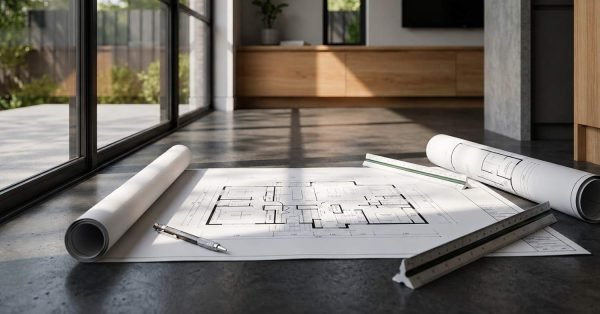
A well-planned laundry layout makes the cabinetry work harder and the room feel larger. Poor planning even with quality cabinetry produces a space that is frustrating to use and difficult to modify later.
Measuring Your Laundry Space Correctly
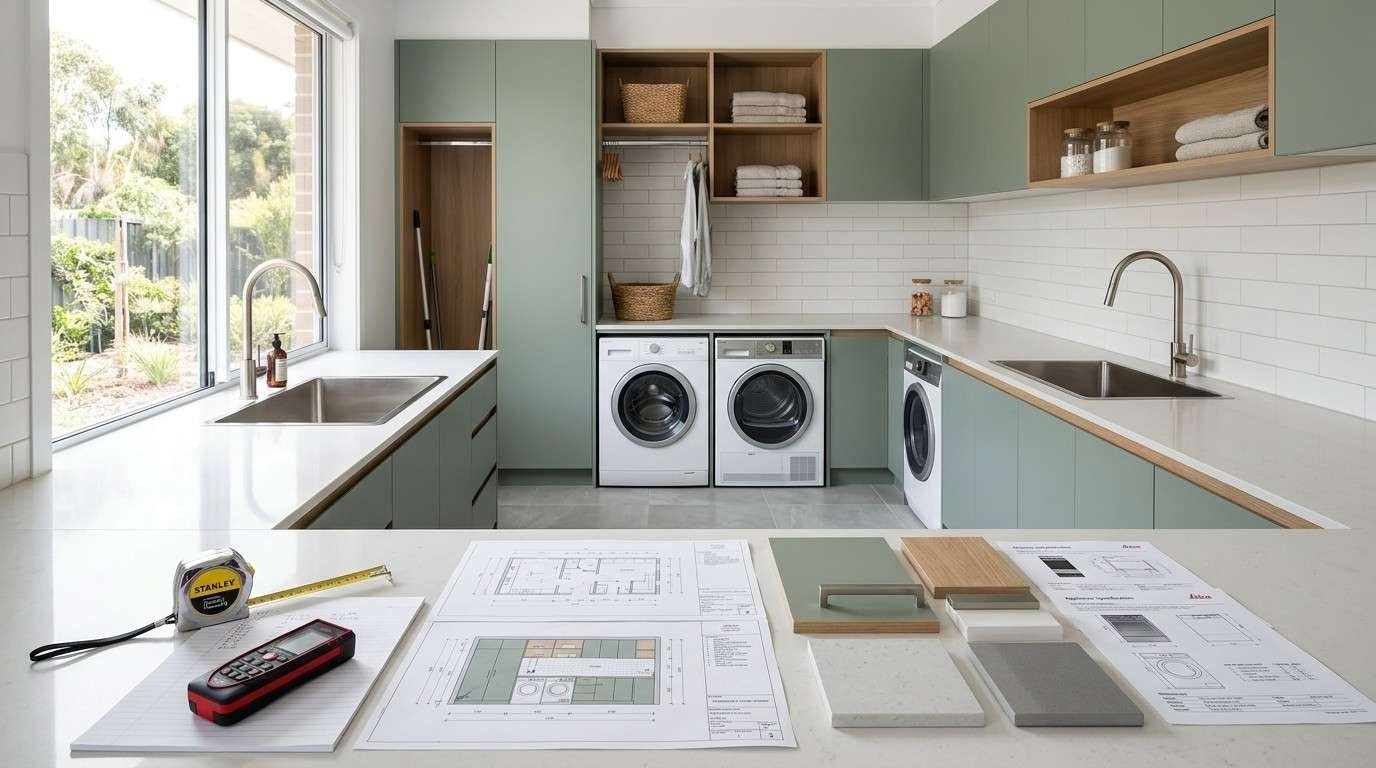
Accurate measurement is the foundation of any successful laundry cabinet project. We measure floor-to-ceiling height at multiple points (ceilings are rarely perfectly level), wall-to-wall width at bench height and at floor level (walls are rarely perfectly plumb), and the position of every fixed element: windows, doors, power points, plumbing rough-ins, and exhaust vents.
Standard cabinet dimensions are designed around round numbers 600mm, 900mm, 1200mm that rarely align perfectly with real-world laundry dimensions. Filler panels, scribed edges, and custom-sized end panels bridge the gap between standard cabinet sizes and actual wall dimensions. In a custom cabinet project, this is handled in the design phase; in a flat-pack project, it requires careful planning before ordering.
Appliance Placement and Cabinet Coordination
Appliance placement determines the cabinet layout more than any other single factor. The washing machine and dryer whether side by side or stacked define the base cabinet configuration. The tub or utility sink determines the plumbing rough-in location. The position of the dryer determines the exhaust vent location, which in turn affects what can be built above it.
We always confirm appliance dimensions including door swing clearance and service access requirements before finalising a cabinet layout. A washing machine door that cannot open fully because a base cabinet is 50mm too close is a common and entirely avoidable problem.
Storage Needs Assessment: What to Plan For
Before specifying cabinet types and quantities, we work through a storage needs assessment with every client. The questions are practical: How much linen does the household store? Is there a need for a dedicated cleaning cupboard? Does the ironing board live in the laundry? Are there pets whose supplies need storage? Is there a need for a dedicated space for a second refrigerator or freezer?
The answers directly determine the ratio of wall cabinets to base cabinets to tall storage, the number of drawers versus doors, and whether specialist fittings like pull-out baskets or concealed ironing boards are worth including. Storage planning done before the cabinet order is placed costs nothing. Storage planning done after installation costs significantly more.
Flat-Pack vs. Custom Laundry Cabinets: Which Is Right for You?
The flat-pack versus custom decision is one of the most common questions we field from Sydney homeowners. The honest answer is that both are valid the right choice depends on your budget, your space, and your expectations for the finished result.
Flat-Pack Cabinets: Pros, Cons, and Best Use Cases
Flat-pack cabinets offer genuine value for straightforward laundry spaces with standard dimensions. They are significantly cheaper than custom options, widely available, and can be installed relatively quickly. For a rental property laundry or a budget renovation where cost control is the primary objective, flat-pack is a rational choice.
The limitations are real, however. Standard sizes rarely fit non-standard spaces without visible compromises. Material quality particularly the substrate and edge banding is generally lower than custom cabinetry. And the design flexibility is limited: you work within the manufacturer’s range of sizes, finishes, and configurations rather than designing from a blank page.
Custom Cabinetry: When the Investment Makes Sense
Custom laundry cabinetry makes sense when the space is non-standard, when the finish quality matters to the homeowner, or when the laundry is a visible part of the home rather than a hidden utility room. It also makes sense when the renovation is intended to add measurable value to the property a custom-fitted laundry reads as a quality finish in a way that flat-pack cabinetry does not.
The investment in custom cabinetry is recovered partly through longevity better materials and construction mean a longer service life and partly through the precision fit that eliminates the visual compromises of standard sizing. For a primary residence where the homeowner intends to stay for 10 or more years, custom cabinetry is almost always the better long-term decision.
Laundry Cabinetry for Renovators and Property Investors
For renovators and property investors, laundry cabinetry decisions are financial decisions as much as design ones. The goal is to maximise the return on every dollar spent which means choosing materials and finishes that hold up, appeal to buyers or tenants, and do not require replacement within the investment horizon.
Cabinetry Choices That Add Resale Value
A fitted laundry with cohesive, quality cabinetry consistently performs well in Sydney property appraisals. Real estate agents in Sydney’s competitive market regularly cite a well-presented laundry as a point of difference particularly in apartments and townhouses where laundry spaces are compact and buyers scrutinise storage carefully.
The cabinetry choices that add the most resale value are those that read as permanent and intentional: floor-to-ceiling storage, integrated appliances, stone or quality laminate bench tops, and a consistent finish that matches the broader interior palette. Flat-pack cabinetry with visible standard sizing and basic melamine finishes rarely achieves the same buyer response.
Rental Property Laundry Cabinetry: Durability Over Aesthetics
For rental properties, the calculus shifts toward durability and ease of maintenance. High-pressure laminate finishes outperform two-pack in a rental context they are more resistant to impact, easier to clean, and less susceptible to chipping from rough handling. Darker colours hide wear better than white in a high-turnover rental.
Hardware specification matters too. Soft-close hinges and drawer runners that are rated for high-cycle use 50,000 cycles or more will outlast budget hardware by years in a rental property. The upfront cost difference is modest; the maintenance saving over a 10-year tenancy is significant.
How to Choose the Right Laundry Cabinetry for Your Home
Choosing laundry cabinetry is a decision with a 10–20 year horizon. The choices you make now on materials, finishes, layout, and supplier will determine how the space performs and how it looks for the life of the renovation.
Matching Cabinetry to Your Budget and Timeline
Start with a realistic budget that includes supply, installation, and associated trades not just the cabinet cost. A common mistake is budgeting for cabinetry supply and then being surprised by installation, plumbing, and electrical costs that were never included in the initial quote.
Timeline matters too. Custom cabinetry typically has a lead time of 4–8 weeks from design sign-off to installation. Flat-pack is available immediately but requires installation time. If your renovation has a fixed completion date a settlement date, a tenancy start date, or a staged renovation schedule the lead time of your cabinetry supplier needs to be factored in from the beginning.
Working With a Renovation Contractor vs. DIY Supply
Working with a renovation contractor who coordinates cabinetry supply and installation alongside plumbing, electrical, and tiling trades simplifies the project significantly. A single point of contact manages the sequencing, the trades, and the quality control reducing the risk of coordination errors that are common when homeowners manage multiple suppliers independently.
DIY supply purchasing cabinetry directly from a manufacturer or retailer and coordinating your own trades can save money but requires time, project management experience, and a clear understanding of the sequencing dependencies between trades. It is a viable approach for experienced renovators; it is a significant risk for first-timers.
Questions to Ask Before You Commit
Before committing to a laundry cabinetry supplier or contractor, we recommend asking: What substrate and finish are used in the carcass and door construction? What is the warranty on the cabinetry and hardware? Is installation included in the quote, and what trades are excluded? What is the lead time from design approval to installation? Can I see examples of completed laundry projects in a similar price range?
The answers reveal the quality of the product and the professionalism of the supplier. A contractor who cannot answer these questions clearly is a contractor who is unlikely to deliver a result you will be satisfied with in 10 years.
Conclusion
Laundry cabinetry spans a wide range of types, materials, finishes, and price points from budget flat-pack systems to fully custom joinery. Understanding how each element connects helps you make decisions that serve your home and budget for the long term.
The right cabinetry choice depends on your space, your renovation goals, and whether you are optimising for daily liveability, resale value, or rental durability. Each path has a clear set of materials, fittings, and cost expectations that we have mapped across this guide.
At Sydney Home Renovation, we help homeowners and investors plan and deliver laundry cabinetry that fits precisely, performs reliably, and adds lasting value contact us to start your project with a clear brief and an honest budget.
Frequently Asked Questions
What type of cabinet is best for a laundry room?
Wall-mounted cabinets combined with base units and at least one tall storage tower give the most functional result. The combination maximises storage across all zones of the room without consuming unnecessary floor space.
How much does it cost to install laundry cabinets in Sydney?
A complete laundry cabinet installation in Sydney typically costs between $2,000 and $25,000 depending on whether you choose flat-pack or custom cabinetry, the materials specified, and the complexity of the fit-out including associated trades.
What material is most durable for laundry cabinetry?
Plywood carcasses with high-pressure laminate or two-pack door finishes offer the best durability in a laundry environment. HMR MDF is a reliable and cost-effective alternative for most residential applications.
Can I use kitchen cabinets in a laundry room?
Kitchen cabinets can be used in a laundry room, but they are not purpose-designed for the humidity levels and functional requirements of a working laundry. Moisture-resistant substrates and appropriate finishes are essential regardless of the cabinet origin.
How long does laundry cabinet installation take?
A standard laundry cabinet installation takes one to two days for the cabinetry itself. A complete laundry renovation including plumbing, electrical, tiling, and cabinetry typically takes one to two weeks depending on scope and trade sequencing.
Do laundry cabinets add value to a home?
Yes. A well-fitted laundry with quality cabinetry consistently adds perceived and measurable value in Sydney property appraisals. Buyers and tenants respond positively to organised, cohesive laundry storage particularly in compact spaces where storage is limited.
What is the difference between flat-pack and custom laundry cabinets?
Flat-pack cabinets come in standard sizes and are assembled on-site from pre-manufactured components. Custom cabinets are manufactured to exact dimensions for a specific space. Custom cabinetry offers better fit, higher material quality, and greater design flexibility at a higher cost.