We get asked this a lot: the term “granny flat” comes from the original purpose these small, self-contained dwellings served: housing elderly parents or grandparents on the same property as their adult children. The name stuck because it described exactly who lived there, and it has outlasted the family arrangement that inspired it.
Knowing where the name comes from helps us explain what a granny flat actually is today, how it’s defined under planning law, and why it remains one of the most in-demand property additions for Sydney homeowners and investors.
Where the Name “Granny Flat” Actually Comes From
The phrase “granny flat” is informal and colloquial. It was never a legal or architectural classification.
It emerged organically in mid-twentieth century English-speaking countries to describe a simple idea: a separate living space built on a family property so an older relative could live nearby without sharing the main home.
The name captured both the occupant and the structure in two words. It was practical, descriptive, and immediately understood, which is exactly why it spread so quickly and has never been replaced in everyday conversation, even as official terminology changed.
The Original Purpose Behind the Name
In the decades following World War II, multigenerational living arrangements became increasingly common across Australia and the UK. Families wanted to keep ageing parents close, but privacy and independence mattered on both sides.
A small, self-contained dwelling on the same block solved both problems. These structures were typically modest: a bedroom, a bathroom, a small kitchen, and a living area designed for one or two people who needed proximity to family support without giving up their own front door.
The occupant was almost always a grandmother or grandfather. The name followed naturally.
How the Term Spread Into Common Use
As these structures became more common, the term moved beyond family conversations into real estate listings, building permits, and local council discussions. By the 1980s and 1990s, “granny flat” was widely understood across Australia as shorthand for any small secondary dwelling on a residential property, regardless of who actually lived there.
We see the same pattern in the UK and New Zealand, where the term took hold in everyday use well before formal planning language caught up.
The informal name proved more durable than any formal alternative. Planners, builders, real estate agents, and homeowners all used it, and it required no explanation. We still see that linguistic staying power today, even though the people living in these dwellings are no longer exclusively grandparents.
What Granny Flats Are Called Today and Why It Matters
In official planning and construction contexts, we’ve largely moved past the term “granny flat” in favour of more precise language. In New South Wales, the correct planning term is secondary dwelling, and that distinction determines how a structure is assessed, approved, and regulated under the State Environmental Planning Policy (Housing) 2021.
A secondary dwelling is a self-contained dwelling established in conjunction with another dwelling, known as the principal dwelling, on the same lot, sharing the same title. This covers what most people still call a granny flat, whether it’s attached to the main home, detached in the backyard, or converted from an existing garage or studio.
Official Terms Used in Sydney and NSW Planning
We find that Sydney homeowners and property investors encounter several terms when researching a secondary dwelling:
- Secondary dwelling: The NSW planning term used in development applications and council assessments
- Granny flat: The colloquial term still used by builders, real estate agents, and homeowners
- Accessory dwelling unit (ADU): An American term occasionally referenced in planning literature but not used in NSW
- Dual occupancy: A different planning category involving two dwellings on one lot, typically with separate titles
Knowing which term applies in which context avoids confusion when we’re dealing with councils, certifiers, and builders together.
How the Definition Has Evolved Beyond the Name
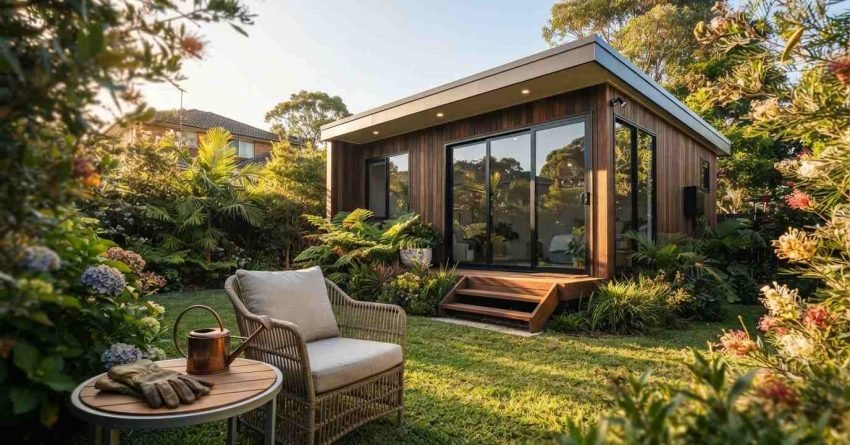
The granny flat of today bears little resemblance to the modest post-war structure the name originally described. We now build modern secondary dwellings in Sydney to full residential standards, complete with contemporary kitchens, full bathrooms, dedicated laundry facilities, and outdoor living areas.
Many are architecturally designed and finished to the same standard as the principal dwelling. The occupants have changed just as much as the structures we now see: adult children, long-term tenants, short-stay guests, and home office or studio spaces filling these dwellings.
For property investors, a well-built secondary dwelling generates rental income that can meaningfully offset mortgage repayments. For owner-occupiers, it adds usable space and long-term property value. The name has stayed the same, but the purpose, the standard, and the financial case for building one have all expanded considerably.
Conclusion
The term “granny flat” came from a simple family arrangement: a small, separate dwelling built to house an elderly relative on the same property. The name described the occupant, and it stuck.
Today, the structure has evolved well past that original purpose. For Sydney homeowners and investors, a secondary dwelling is a serious asset, whether the goal is rental income, multigenerational living, or long-term capital growth.
At Sydney Home Renovation, we help homeowners and investors plan, design, and build secondary dwellings that meet NSW planning requirements and deliver lasting value. Contact us to start your project with a clear plan and honest pricing.
Frequently Asked Questions
Is “granny flat” an official planning term in NSW?
No. In NSW, the official planning term is “secondary dwelling.” Granny flat is a colloquial term widely used in conversation but not found in formal planning legislation.
What is the difference between a granny flat and a secondary dwelling?
They refer to the same structure. Secondary dwelling is the legal planning classification used in NSW, while granny flat is the informal name people use day to day.
Can anyone live in a granny flat, or just elderly relatives?
Anyone can live in a granny flat. The name reflects its original use, but there are no legal restrictions on who occupies a secondary dwelling in NSW today.
When did granny flats become popular in Australia?
Granny flats became common in Australia during the post-war decades of the 1950s and 1960s, driven by multigenerational family living arrangements at the time.
Does the name affect how a granny flat is approved or built?
No. Approval and construction are governed by NSW planning legislation, not the informal name, and depend on meeting the standards set for a secondary dwelling.