
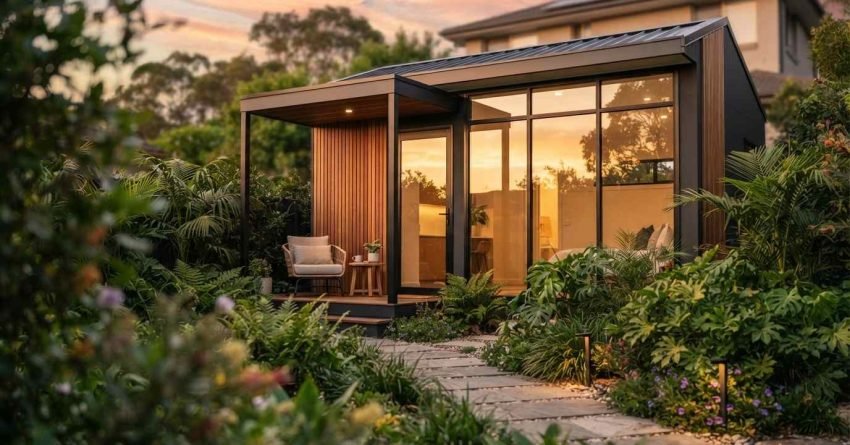
A granny flat is now officially called a secondary dwelling across New South Wales, including Sydney. This is the term we use in planning legislation, council documentation, and development applications throughout the state.
The informal name “granny flat” is still widely understood, but secondary dwelling is the correct legal and planning term. We find that knowing the difference matters when homeowners are applying for approval, researching their property rights, or planning a build.
The Modern Term for a Granny Flat
A secondary dwelling is a self-contained residential unit located on the same lot as a principal dwelling. It has its own living space, kitchen, bathroom, and separate entry. In NSW, secondary dwellings are governed by the State Environmental Planning Policy (Housing) 2021, which sets out size limits, site coverage rules, and approval pathways.
Under this policy, most secondary dwellings are capped at 60 square metres of floor area, and the property generally needs a minimum lot size of 450 square metres in most residential zones. We regularly see these thresholds catch homeowners off guard when they assume any backyard structure qualifies automatically.
The term applies whether the dwelling is attached to the main home, detached in the backyard, or converted from an existing structure such as a garage. The defining feature is that it sits on the same title as the primary residence and cannot be subdivided or sold separately.
Why the Terminology Changed
The shift from “granny flat” to secondary dwelling reflects a broader change in how NSW planning policy treats these structures. The older term was informal and implied a single-use housing for an elderly relative.
The updated terminology recognises that these dwellings serve multiple purposes. We see them used for housing adult children, generating rental income, accommodating carers, and increasing housing density on existing residential lots.
NSW planning reforms over the past decade have progressively expanded the rules around secondary dwellings to address housing supply. The language changed alongside the policy to reflect that expanded role.
Which Terms Are Used in NSW and Sydney
In Sydney and across NSW, the primary official term is secondary dwelling. We also come across the term ancillary dwelling in some local council documents, particularly in older development control plans that have not yet been updated to align with current state policy.
This creates a practical wrinkle. A council’s DCP might still reference “ancillary dwelling” while the governing SEPP uses “secondary dwelling,” and when the two disagree, the state policy takes precedence for size and pathway rules.
In other Australian states, similar structures may be called granny flats, dependent persons’ units, or ancillary accommodation. We recommend using secondary dwelling in all formal correspondence and applications with a Sydney council, a certifier, or a state planning portal.
How the New Name Affects Planning and Property Decisions
Using the correct term is not just a formality. Secondary dwelling is the classification that triggers specific planning rules, size allowances, and approval pathways under NSW legislation.
We have seen incorrect or outdated terminology in a development application cause delays or result in the application being assessed under the wrong framework. Getting this right from the first submission avoids that entirely.
Under the current NSW Housing SEPP, secondary dwellings in most residential zones can be approved as complying development, which is a faster, council-independent pathway. This only applies when the proposal meets the specific criteria attached to the secondary dwelling classification.
The Secondary Dwelling Approval Process, Step by Step
We walk clients through the same general sequence on almost every secondary dwelling project.
- Confirm zoning and lot eligibility: check minimum lot size and zoning against the Housing SEPP.
- Check the Complying Development criteria: assess whether the design fits CDC rules for a faster pathway.
- Engage a certifier or council: lodge either a Complying Development Certificate or a full Development Application.
- Prepare supporting documentation: site plans, floor plans, and a Statement of Environmental Effects if a DA is required.
- Receive approval and begin construction: timelines vary depending on the pathway chosen.
Choosing the wrong pathway at step one is the single most common cause of delay we encounter.
How Much Does a Secondary Dwelling Cost in Sydney?
Cost varies with size, site conditions, and finish level, but we typically see Sydney secondary dwelling builds land between $150,000 and $280,000 for a standard detached unit. Garage conversions and attached options can sit below this range, while sloped or difficult sites push costs higher.
The approval pathway also affects the budget indirectly. A Complying Development approval is generally faster and cheaper to process than a full DA, which reduces holding costs and gets the build underway sooner.
What This Means for Sydney Homeowners and Investors
For homeowners, understanding the correct term helps us navigate council websites, speak confidently with certifiers, and ensure applications are lodged correctly from the start. For property investors, the secondary dwelling classification affects how the structure is described in rental listings, lease agreements, and property valuations.
A well-approved secondary dwelling can lift a property’s rental yield meaningfully, since it effectively adds a second income stream on one title. We find lenders and valuers also treat a correctly classified and approved secondary dwelling far more favourably than an unapproved or ambiguous structure.
Getting the classification right early keeps the project on the correct approval track and avoids costly rework later.
Secondary Dwelling vs. Other Dwelling Types – Key Distinctions
Secondary dwellings are sometimes confused with dual occupancies and boarding houses, but these are distinct classifications with different rules. A dual occupancy involves two dwellings on one lot that can be strata-titled and sold separately. A secondary dwelling cannot be separated from the principal dwelling on title.
A studio or bedsit within the main home is not a secondary dwelling unless it meets the self-contained criteria and is formally approved as one. Unapproved structures, regardless of what they are called, carry legal and financial risk for owners and investors.
We always advise using the correct classification from the planning stage. It protects the investment and ensures the dwelling is insurable, leasable, and legally recognised.
Conclusion
The new name for a granny flat is secondary dwelling the official term we use in NSW planning legislation, development applications, and council assessments across Sydney.
For homeowners and investors, using the right term from the start ensures the project is assessed correctly, approved efficiently, and built to a standard that protects long-term property value.
At Sydney Home Renovation, we guide our clients through every stage of secondary dwelling planning and construction, from confirming the right approval pathway to delivering a finished build on budget and on schedule.
Frequently Asked Questions
Is a granny flat the same as a secondary dwelling?
Yes. Secondary dwelling is the official planning term in NSW. Granny flat is the informal name for the same structure. We use secondary dwelling in all council and certification documents.
What is a secondary dwelling in NSW?
A secondary dwelling is a self-contained unit on the same lot as a principal dwelling. It must have its own kitchen, bathroom, and entry, and cannot be sold separately from the main home.
Can I still call it a granny flat when applying for approval?
Informally, yes. Most certifiers and councils understand the term, but the formal application needs to use secondary dwelling so it gets assessed under the correct planning framework.
Does the new name affect how a secondary dwelling is taxed or rented?
The classification affects how the dwelling is described in lease agreements and valuations. Tax treatment depends on use and ownership structure, so we recommend consulting a property accountant for advice specific to your situation.
What is the difference between a secondary dwelling and an accessory dwelling unit?
An accessory dwelling unit is a term used in the United States. In NSW and Sydney, the equivalent term is secondary dwelling, with planning rules, size limits, and approval pathways specific to NSW legislation.


