
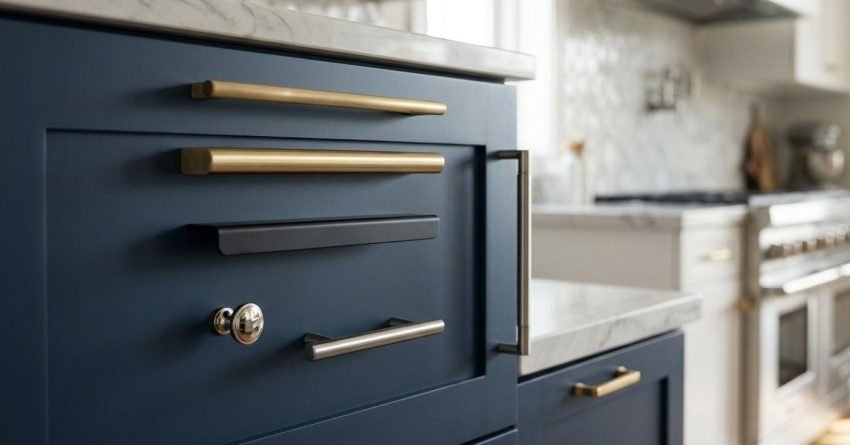
For most cabinets, we find pulls sized at one-third the width of the door or drawer look best. That typically means 3 to 4 inch pulls for standard doors and 5 to 8 inch pulls for wide drawers.
Getting this proportion right is the single biggest factor in whether your hardware looks intentional or awkward.
Cabinet pulls are a small detail with an outsized visual impact. Choose a pull that is too short, and it looks lost on a wide drawer front. Go too long, and it overwhelms a narrow door.
The right size creates balance, reinforces your design style, and makes the whole room feel considered. This guide covers standard sizing rules, room-by-room recommendations, common mistakes, style matching, and what cabinet pulls cost in Sydney, so you can make a confident, well-informed decision before you buy.
What Are Cabinet Pulls and Why Size Matters
Cabinet pulls are the hardware handles mounted on cabinet doors and drawer fronts that allow you to open and close them. They come in a wide range of lengths, profiles, finishes, and styles, from slim bar pulls to chunky cup handles, and their size directly shapes how a kitchen, bathroom, or laundry reads visually.
Size matters for two reasons: function and proportion. A pull that is too small is uncomfortable to grip, especially on a heavy drawer. A pull that is poorly proportioned to the cabinet face creates visual tension that most people notice even if they cannot name the cause.
The Role of Cabinet Pulls in Kitchen and Bathroom Design
Cabinet pulls are one of the most cost-effective ways to change the feel of a room without replacing the cabinetry itself. In a kitchen renovation, hardware is often the last decision made, but we think it should be one of the first, because pull size influences how you plan hole drilling, door overlay, and overall visual weight.
In bathroom vanity design, pulls carry even more visual weight because the cabinet faces are typically smaller and the room is more intimate. A single oversized pull on a narrow vanity door can throw off the entire composition.
How Pull Size Affects Function and Visual Balance
Pull size affects grip comfort, ease of use, and the visual rhythm of a cabinet run. Longer pulls on wide drawers give you a natural two-handed grip and distribute force evenly across the drawer front, reducing wear on the mounting points over time.
Visually, pull length creates a horizontal or vertical line on the cabinet face. When that line is proportionate, roughly one-third of the cabinet’s width, it anchors the hardware to the door or drawer without competing with it. When it is too short or too long, the imbalance is immediately visible.

Standard Cabinet Pull Sizes and What They Mean
Cabinet pull sizes are measured by centre-to-centre (CTC) distance, the measurement between the two screw holes. This is the number we always ask clients to check first when ordering pulls, because it determines whether the hardware fits existing hole spacing or requires new drilling.
Overall length is always longer than the CTC measurement. A pull with a 5-inch CTC might have an overall length of 6.5 to 7 inches once you include the end caps or decorative terminals.
We recommend confirming both measurements before purchasing.
Small Pulls (3–4 Inch Centre-to-Centre)
Small pulls with a 3- to 4-inch CTC suit narrow cabinet doors, small drawer fronts, and bathroom vanity doors under 18 inches wide. They work well in compact spaces where a longer pull feels oversized or visually heavy.
In a Sydney bathroom renovation, 3-inch pulls are a common choice for single-door vanity cabinets and medicine cabinet doors. They are also the standard size for upper kitchen cabinets, where door widths typically range from 12 to 18 inches.
Medium Pulls (4–5 Inch Centre-to-Centre)
Medium pulls in the 4- to 5-inch CTC range are the most versatile and widely used size in residential cabinetry. They suit standard kitchen cabinet doors (18 to 24 inches wide), medium drawer fronts, and bathroom vanities with double doors.
This size range is where most homeowners land when following the one-third rule, and it is the size we see most commonly stocked by hardware suppliers in Sydney. If you are renovating a standard kitchen or bathroom and want a safe, proportionate choice, a 4 to 5 inch pull is rarely wrong.
Large and Oversized Pulls (6–12 Inch Centre-to-Centre)
Large pulls from 6 to 12 inches CTC suit wide drawer fronts, pantry doors, and statement cabinetry. They have become increasingly popular in contemporary kitchen design, where long bar pulls running nearly the full width of a drawer front create a sleek, architectural look.
A 12-inch pull on a 36-inch-wide drawer front is a deliberate design choice. It prioritises visual drama over strict proportion rules, and it works well in modern and minimalist kitchens but can look out of place in traditional or transitional styles where hardware is expected to be more restrained.
How to Choose the Right Cabinet Pull Size for Your Cabinets
Choosing the right pull size starts with measuring your cabinet doors and drawer fronts, then applying a simple proportion rule. The goal is hardware that looks like it belongs, not hardware chosen because it was on sale or came in the right finish.
Matching Pull Size to Cabinet Door Width
For cabinet doors, we recommend a pull that is one-third the height of the door when mounted vertically, or one-third the width when mounted horizontally. Most pulls on doors are mounted vertically, so door height is the relevant measurement.
A standard upper kitchen cabinet door at 30 inches tall suits a pull with a 3 to 4 inch CTC. A tall pantry door at 84 inches suits a longer pull, typically 5 to 8 inches, to maintain visual proportion at that scale.
Matching Pull Size to Drawer Width
For drawers, the proportion rule applies to drawer width. A drawer front that is 24 inches wide suits a pull with a CTC of approximately 6 to 8 inches, roughly one-third of the total width.
Wide drawers (30 to 36 inches) are where long bar pulls come into their own. A pull running 10 to 12 inches across a 36-inch drawer front looks intentional and contemporary, while the same pull on a 12-inch drawer front looks absurd.
| Drawer Width | Recommended Pull CTC |
| 12 inches | 3–4 inches |
| 18 inches | 4–5 inches |
| 24 inches | 5–6 inches |
| 30 inches | 6–8 inches |
| 36 inches | 8–12 inches |
Using Two Pulls on Extra-Wide Drawers
On drawer fronts wider than 36 inches, a single pull often stops being the right answer. We frequently recommend two pulls mounted symmetrically, spaced roughly a third of the way in from each edge, rather than one oversized pull stretched to fill the space.
This approach improves grip and weight distribution on heavy drawers, and it keeps the hardware proportionate even on very wide fronts. It is common in pantry drawers and large kitchen island drawers where a single pull would otherwise need to be unreasonably long.
The One-Third Rule for Cabinet Hardware Sizing
The one-third rule is the most reliable starting point for cabinet pull sizing. Choose a pull that is approximately one-third the width, for drawers, or one-third the height, for doors, of the cabinet face it will be mounted on.
This rule works because it creates visual balance without the hardware dominating the cabinet face. It is not a rigid law; contemporary design often breaks it intentionally, but it remains the safest default for homeowners who want hardware that looks professionally chosen.
Where to Position Pulls Vertically and Horizontally
Sizing is only half the equation. Placement height and orientation matter just as much for the finished look.
On cabinet doors, we typically position pulls in the corner nearest the opening edge, roughly 2.5 to 3 inches down from the top on upper cabinets and 2.5 to 3 inches up from the bottom on base cabinet doors. On drawer fronts, pulls are centred both vertically and horizontally unless the drawer is unusually tall, in which case we shift them slightly toward the top edge for easier reach.
Consistency matters more than the exact number. Once you choose a placement height, we recommend applying it uniformly across every cabinet in the run so the hardware reads as one continuous design decision rather than a series of individual choices.

Cabinet Pull Size by Room and Cabinet Type
The right pull size varies by room because cabinet dimensions, usage patterns, and design expectations differ between a kitchen, a bathroom, and a laundry. What works beautifully on a kitchen base cabinet may look oversized on a bathroom vanity door.
Best Pull Sizes for Kitchen Cabinets
Kitchen cabinetry covers the widest range of cabinet sizes in any home, so pull sizing needs consideration door by door and drawer by drawer rather than as a single decision.
For upper kitchen cabinets (typically 12 to 18 inches wide), a 3 to 4 inch pull is the standard choice. For base cabinet doors (18 to 24 inches wide), a 4 to 5 inch pull works well, and for base cabinet drawers (24 to 36 inches wide), a 5 to 8 inch pull, or longer for a contemporary look, is appropriate.
Many of the Sydney homeowners we work with choose a single pull size for all doors and a longer pull for all drawers, creating a two-size system that looks cohesive without being monotonous.
Best Pull Sizes for Bathroom Vanity Cabinets
Bathroom vanity cabinets are typically narrower than kitchen cabinets, so pull sizing needs to be more restrained. A single-door vanity cabinet (12 to 18 inches wide) suits a 3 to 4 inch pull, while a double-door vanity (30 to 36 inches wide) suits a 4 to 5 inch pull per door.
For bathroom drawer fronts, common on modern floating vanities, the same one-third rule applies. A 24-inch-wide bathroom drawer front suits a 5- to 6-inch pull, and going longer than this in a bathroom can feel disproportionate given the smaller scale of the room.
In Sydney bathroom renovations, slim bar pulls in brushed nickel or matte black are currently the most popular choice for vanity hardware, typically in the 4 to 5 inch CTC range.
Best Pull Sizes for Laundry and Utility Cabinets
Laundry and utility cabinets are often overlooked in hardware planning, but they benefit from the same proportion principles. Standard laundry cabinet doors (18 to 24 inches wide) suit a 4 to 5 inch pull, and laundry drawers suit the same sizing as kitchen drawers of equivalent width.
Because laundry spaces are functional rather than decorative, we often see homeowners choose a simpler, more affordable pull style in the same size range, prioritising grip comfort and durability over visual statement.
How Cabinet Pull Size Relates to Style and Finish
Pull size does not exist in isolation. The style of your cabinetry, the profile of the pull itself, and the finish you choose all interact to create a final impression that is either cohesive or conflicted.
Matching Pull Size to Cabinet Style (Shaker, Flat-Front, Raised Panel)
Shaker cabinets are the most versatile style and suit a wide range of pull sizes. A 3- to 5-inch bar pull or cup pull works well on shaker doors, and longer bar pulls (6 to 8 inches) on shaker drawers create a contemporary-traditional hybrid that we’re seeing more often in Sydney renovations right now.
Flat-front (slab) cabinets are the natural home of the long bar pull. The clean, uninterrupted surface of a flat-front door or drawer is built to carry a longer, more architectural pull, and a 5 to 12 inch bar pull on flat-front cabinetry looks intentional and modern.
Raised panel cabinets suit shorter, more traditional pulls, typically 3 to 4 inches, in a bin pull, cup pull, or bail pull style. Long bar pulls on raised panel doors can look stylistically mismatched.
How Finish and Profile Thickness Affect Perceived Size
A pull’s visual size is not just about its CTC measurement. A thick, chunky pull profile in a dark matte finish reads as larger and heavier than a slim bar pull of the same CTC in a polished chrome finish.
If you want hardware that recedes visually and lets the cabinetry speak, choose a slim profile in a finish close to the cabinet colour. If you want hardware that makes a statement, choose a thicker profile in a contrasting finish. Both are valid, but the choice should be deliberate, not accidental.
Cabinet Pulls vs. Knobs: Which Should You Choose
Pulls and knobs solve the same problem differently. Knobs are single-point fixings, typically 1 to 1.5 inches in diameter, and work well on doors or narrow drawers where a full-length grip is not needed.
We generally recommend pulls for drawers, especially wider ones, because the two-handed grip distributes force more evenly and reduces strain on the mounting screws over time. Knobs remain a strong choice for cabinet doors, particularly in traditional or shaker-style kitchens where a smaller hardware footprint suits the design.
Many Sydney homes we renovate use a mixed approach: knobs on doors, pulls on drawers. This combination is functional and visually balanced, provided the finish is matched across both.
Common Cabinet Pull Sizing Mistakes to Avoid
Even experienced renovators make hardware sizing errors. These are the most common mistakes we see in Sydney kitchen and bathroom renovations, and how to avoid them.
Choosing pulls by finish before size is a common trap. Most people fall in love with a finish- brushed brass, matte black, satin nickel- and then try to make the size work. Size should come first; find the right proportion, then find that proportion in your preferred finish.
Using the same size pull on all cabinets regardless of width causes problems too. A 3-inch pull looks fine on a 12-inch upper cabinet door, but the same pull on a 36-inch-wide drawer front looks like a mistake. Size your pulls to each cabinet face individually.
Ignoring the CTC measurement and ordering by overall length is another frequent error. If your existing holes are drilled at a 3-inch CTC and you order a pull with a 3.5-inch CTC, it will not fit without re-drilling. Always confirm CTC before ordering.
Underestimating the visual weight of oversized pulls in small rooms trips up many renovators. A 12-inch bar pull that looks stunning in a large open-plan kitchen can overwhelm a small galley kitchen or compact bathroom. Scale your hardware to the room, not just the cabinet.
Mixing too many sizes without a clear system creates visual noise. Using three or four different pull sizes across a kitchen rarely reads as intentional. A two-size system, one size for doors, one for drawers, is the most cohesive approach for most homes.

How Much Do Cabinet Pulls Cost in Sydney?
Cabinet pull pricing in Sydney varies significantly based on material, brand, finish, and where you purchase. Understanding the price tiers helps you allocate your hardware budget without overspending on pulls that will not meaningfully improve the outcome.
Budget Cabinet Pulls ($5–$15 per pull)
Entry-level pulls in this range are typically made from zinc alloy or lower-grade stainless steel. They are available at Bunnings, IKEA, and online hardware retailers, with limited finish options, usually chrome, brushed nickel, or matte black, and basic profile choices.
For a rental property or investment renovation where durability and cost efficiency matter more than design distinction, budget pulls are a practical choice. A full kitchen of 30 to 40 pulls at this price point costs $150 to $600 in hardware alone.
Mid-Range Cabinet Pulls ($15–$40 per pull)
Mid-range pulls offer significantly better material quality, more finish options, and more refined profiles. Solid brass, stainless steel, and quality zinc alloy pulls in this range are available from suppliers like Häfele and local Sydney hardware specialists.
This is the sweet spot for most owner-occupier renovations we manage. A kitchen with 35 pulls at an average of $25 per pull represents $875 in hardware, a meaningful but manageable budget line that delivers a noticeably better result than budget options.
Premium and Designer Cabinet Pulls ($40–$100+ per pull)
Premium pulls from brands like Armac Martin or bespoke Australian hardware designers are made from solid brass or bronze, hand-finished, and built to last decades. They are a genuine investment in quality and design.
For a high-end Sydney kitchen or bathroom renovation where the cabinetry itself represents a significant investment, premium pulls are worth considering. The hardware cost on a full kitchen at this tier can reach $1,500 to $4,000, but on a $30,000 to $50,000 kitchen renovation, that represents a small percentage of the total budget for a detail touched every single day.
Conclusion
Cabinet pull sizing comes down to proportion, room scale, and cabinet type. The one-third rule gives you a reliable starting point: roughly one-third the width of the drawer or one-third the height of the door, and from there, style preferences and finish choices refine the decision.
Getting the size right before falling in love with a finish is the single most important step most homeowners skip.
At Sydney Home Renovation, we help homeowners and property investors make these decisions as part of a fully coordinated renovation process, from cabinetry layout and hardware specification through to installation and final finish. If you are planning a kitchen or bathroom renovation in Sydney and want guidance on hardware selection, cabinetry sizing, or full renovation budgeting, contact Sydney Home Renovation today for honest, practical advice and transparent pricing that keeps your renovation on track from the first decision to the last detail.
Frequently Asked Questions
What size cabinet pull is most popular?
The most popular cabinet pull size for residential kitchens is the 4 to 5 inch centre-to-centre range, which suits standard cabinet doors and medium drawer fronts. For contemporary kitchens with wide drawer fronts, longer bar pulls in the 8 to 12 inch range have become increasingly common.
Should cabinet pulls be the same size throughout the kitchen?
Not necessarily. Most designers recommend using one pull size for all doors and a longer pull for all drawers, a two-size system that creates visual consistency without being rigid. Using the exact same pull on every cabinet regardless of size often looks disproportionate on wider drawers.
How do I measure cabinet pull size?
Cabinet pull size is measured by the centre-to-centre (CTC) distance between the two mounting screw holes. This is the critical measurement for ordering, as it determines whether the pull will fit your existing hole spacing.
What size pulls for a 30-inch drawer?
For a 30-inch-wide drawer front, a pull with a 6 to 8-inch centre-to-centre measurement is the proportionate choice based on the one-third rule. In a contemporary kitchen, many homeowners choose a longer 10 to 12 inch pull for a more architectural, statement look.
Are longer pulls better for large cabinets?
Longer pulls are more proportionate on large cabinets and wide drawer fronts, and they also offer better ergonomics since a longer grip distributes force more evenly. However, longer pulls on small or narrow cabinets look out of proportion and should be avoided.
Can I mix different pull sizes in the same room?
Yes, but with intention. The most cohesive approach is a two-size system: one size for all doors and a longer size for all drawers. Mixing three or more sizes without a clear logic creates visual noise.
How do cabinet pull sizes differ from knob sizes?
Cabinet knobs are measured by diameter rather than CTC distance, since they use a single mounting screw. A standard cabinet knob is typically 1 to 1.5 inches in diameter, while pulls are measured CTC between two screws.


