
$100,000 is a serious amount of money. In Sydney’s property market, we consistently see a full bathroom renovation deliver one of the highest returns of any way to spend it. For homeowners, first-time renovators, and property investors, a well-planned bathroom renovation at this budget level can transform a tired, dated space into a premium asset that adds measurable value to your property.
That’s only true if the money is allocated correctly.
Sydney’s renovation market is unforgiving when budgets are poorly planned. Labour costs are among the highest in Australia, material prices have risen sharply, and hidden structural issues can surface without warning. Knowing exactly where your $100,000 goes, and where it shouldn’t, is the difference between a renovation that pays off and one that drains your finances.
Quick answer: $100,000 is enough to fully gut and rebuild a Sydney bathroom to a premium standard, covering all trades, quality fixtures, waterproofing compliance, and a contingency buffer. Labour typically consumes 45–55% of the budget, and the biggest risk to your return is poor allocation, not the budget size itself.
This guide breaks down everything we think you need to know: realistic cost allocations, labour and materials benchmarks, hidden expenses to plan for, and the upgrades that deliver the strongest return in Sydney’s competitive property market.
Why a Bathroom Renovation Is One of the Smartest Uses of $100,000 in Sydney
Not every home improvement delivers equal financial return. Kitchen renovations, landscaping, and extensions all have their place. But in Sydney’s property market, we’ve found that a high-quality bathroom renovation consistently ranks among the strongest performers for return on investment. At the $100,000 budget level, you’re not just refreshing a room, you’re repositioning a property.
For owner-occupiers, a premium bathroom renovation eliminates the daily frustration of an outdated, poorly functioning space. For investors and landlords, a well-executed bathroom renovation at this budget level can justify higher rental yields, attract better-quality tenants, and accelerate sale timelines in a competitive market.
The key is understanding what $100,000 actually buys in Sydney, and making sure every dollar works toward a clear outcome.
Is a Bathroom the Best Use of $100,000, or Should You Renovate the Kitchen Instead?
This is a question we hear often from clients weighing up where to direct their budget. Kitchens and bathrooms both rank near the top of renovation ROI research, but they behave differently at the $100,000 mark.
A $100,000 kitchen renovation in Sydney often stretches further on cabinetry and benchtops than on structural change, because kitchens rarely carry the same waterproofing and compliance burden as bathrooms. A $100,000 bathroom renovation, by contrast, allows a genuinely complete rebuild, structure, waterproofing, trades, and finishes, without needing to compromise anywhere.
Our view: if your existing bathroom is over 15 years old or has any waterproofing concerns, the bathroom is the smarter first move. It protects the rest of the property from water damage risk while delivering comparable or stronger resale uplift than a kitchen at the same budget.
Return on Investment: What Bathroom Renovations Deliver in Sydney’s Property Market
Sydney property values are among the highest in Australia, which means the dollar-for-dollar return on a quality bathroom renovation is proportionally stronger here than in most other cities. According to CoreLogic’s renovation ROI research, a well-executed bathroom renovation in Sydney can add between 3% and 5% to a property’s resale value, depending on the suburb, the quality of finishes, and the condition of the existing bathroom.
On a Sydney property valued at $1.5 million, close to the city’s median house price, a 3% uplift represents $45,000 in added value. At 5%, that figure reaches $75,000. Factor in improved liveability, rental appeal, and reduced maintenance costs, and the financial case for spending $100,000 on a bathroom renovation becomes compelling.
The caveat is execution. A poorly managed renovation that runs over budget, uses substandard materials, or cuts corners on waterproofing will not deliver those returns.
How a $100,000 Budget Positions You in the Sydney Renovation Market
In Sydney, bathroom renovation budgets broadly fall into three tiers.
| Budget Tier | Range | What’s Included |
| Entry-Level | $15,000 – $30,000 | Cosmetic updates, basic fixture replacements, surface-level tiling |
| Mid-Range | $30,000 – $60,000 | Full strip-outs, new waterproofing, quality fixtures, tiling |
| Premium | $60,000+ | High-end finishes, custom joinery, heated floors, full structural work |
At $100,000, you are firmly in the premium tier. This budget allows for a complete gut and rebuild of a full bathroom or ensuite, including all trades, quality materials, premium fixtures, and a contingency buffer for unexpected costs.
What separates a $100,000 bathroom from a $40,000 bathroom isn’t just the finishes. It’s the depth of the structural work, the quality of the waterproofing system, the calibre of the trades involved, and the level of project coordination that keeps everything on schedule and on budget. 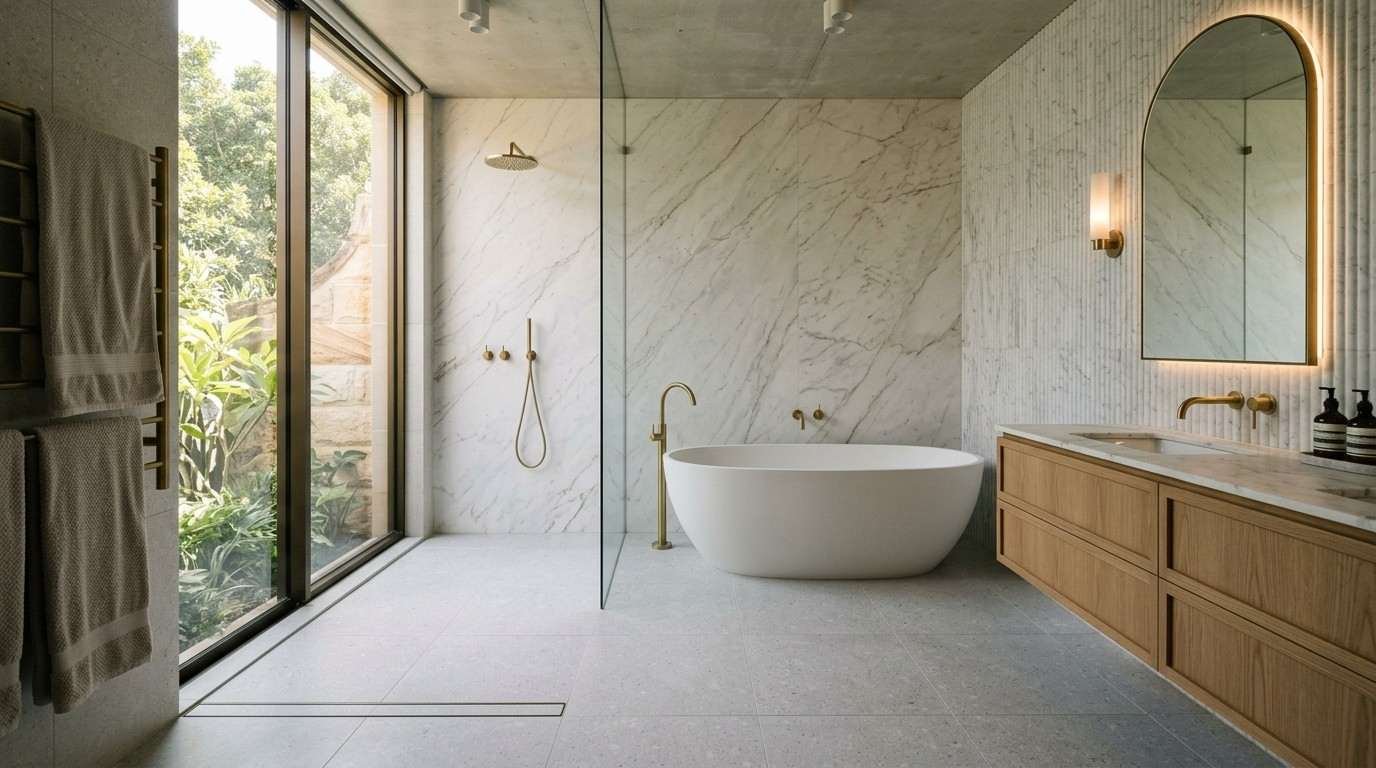
What Does a $100,000 Bathroom Renovation Actually Include?
This is the question most homeowners and investors need answered before anything else. A $100,000 bathroom renovation budget in Sydney is substantial, but it is not unlimited. Understanding what is realistically included at this price point prevents the most common source of renovation disappointment: the gap between expectation and reality.
At this budget, you can expect a complete strip-out of the existing bathroom, full structural and waterproofing work, new plumbing and electrical rough-in, quality tiling, premium fixtures and fittings, custom or semi-custom vanity, heated towel rails, and a high-quality shower system.
What you cannot expect is unlimited square footage, bespoke imported materials, or structural changes that require significant engineering work, unless those are specifically scoped and priced.
Full Bathroom Gut and Rebuild: What’s Covered at This Budget
A full gut and rebuild means removing everything down to the structural substrate: tiles, waterproofing membrane, plumbing fixtures, electrical fittings, vanity, bath, shower, and any existing joinery. We recommend this approach for any bathroom more than 15 to 20 years old, because the existing waterproofing membrane sits at or near the end of its serviceable life.
At $100,000, a full gut and rebuild of a standard Sydney bathroom (typically 5 to 8 square metres for a main bathroom, or 3 to 5 square metres for an ensuite) is entirely achievable with premium finishes. For larger bathrooms of 10 square metres or more, the same budget still delivers a high-quality result, but material and tiling costs run proportionally higher.
The scope of a full rebuild at this budget level typically includes: demolition and disposal, new waterproofing to AS 3740 standards, plumbing rough-in and fixture installation, electrical rough-in and lighting installation, full tiling to walls and floor, vanity and mirror installation, shower screen or frameless glass installation, bath installation where applicable, and all finishing work including silicone, grout sealing, and hardware.
Labour Costs in Sydney: Where the Majority of Your Budget Goes
Labour is the single largest cost component in any Sydney bathroom renovation, and it’s the area where the most significant price variation exists between contractors. In Sydney, licensed trade labour rates are among the highest in Australia, reflecting the city’s cost of living, licensing requirements, and demand for skilled tradespeople.
For a full bathroom renovation at the $100,000 level, labour typically accounts for 45% to 55% of the total budget. On a $100,000 project, that means $45,000 to $55,000 goes to the combined cost of your builder or project manager, licensed plumber, licensed electrician, waterproofer, tiler, and any specialist trades such as glaziers or cabinet makers.
Breaking this down further: a licensed plumber in Sydney typically charges between $120 and $180 per hour, with a full bathroom renovation requiring 20 to 40 hours of plumbing work depending on complexity. A licensed electrician runs at similar rates. Tiling labour in Sydney ranges from $60 to $120 per square metre depending on tile format, pattern complexity, and substrate preparation required.
A project manager or builder coordinating all trades typically charges either a fixed management fee or a percentage of the total project cost, usually between 15% and 20%. Licensed trades carry insurance, comply with Australian Standards, and produce work that can be certified, which matters enormously for waterproofing compliance, insurance claims, and future property sales.
Materials, Tiles, and Fittings Allowance at the $100,000 Level
At a $100,000 budget, the materials and fittings allowance, the portion covering tiles, fixtures, vanity, shower screen, bath, tapware, lighting, and accessories, typically sits between $30,000 and $45,000 depending on the labour allocation and project scope.
This is a meaningful allowance that opens access to quality Australian and imported tile ranges, premium tapware brands such as Caroma, Methven, or Brodware, frameless or semi-frameless shower screens, freestanding or built-in baths, and custom or semi-custom vanity units. It doesn’t, however, extend to the very top tier of imported European fixtures or fully bespoke joinery without trade-offs elsewhere.
Tiles alone can consume a significant portion of this allowance. Large-format porcelain tiles in 600x1200mm or 800x800mm formats, popular in contemporary Sydney bathrooms, range from $60 to $200 per square metre for the tile itself, before installation. A standard bathroom requiring 25 to 35 square metres of tiling can represent a materials cost of $1,500 to $7,000 for tiles alone.
Tapware and fixtures are another area where the budget can move quickly. A quality shower system with overhead rain shower, hand shower, and wall mixer from a reputable Australian brand costs between $800 and $2,500. A freestanding bath from a quality supplier ranges from $1,500 to $5,000. A custom vanity with stone top ranges from $3,000 to $8,000 depending on size and specification.
How to Allocate a $100,000 Bathroom Renovation Budget in Sydney
Budget allocation is where most renovation projects either succeed or fail. Having $100,000 available doesn’t automatically mean the renovation is well-managed. It means you have the resources to do it properly, provided those resources are directed correctly from the outset.
The most common mistake homeowners make is front-loading the budget on visible finishes such as expensive tiles, designer tapware, and statement baths, while underallocating for labour, waterproofing, and contingency. The result is a bathroom that looks impressive on the surface but has structural or compliance issues underneath.
Recommended Budget Breakdown by Trade and Category
The following allocation framework is based on a full gut-and-rebuild bathroom renovation in Sydney at the $100,000 budget level. These figures represent realistic ranges rather than fixed amounts, as every project has unique variables.
| Category | Estimated Allocation | Percentage of Budget |
| Builder / Project Management | $12,000 – $18,000 | 12% – 18% |
| Licensed Plumbing | $8,000 – $14,000 | 8% – 14% |
| Licensed Electrical | $4,000 – $7,000 | 4% – 7% |
| Waterproofing (to AS 3740) | $2,500 – $4,500 | 2.5% – 4.5% |
| Tiling (Labour) | $5,000 – $10,000 | 5% – 10% |
| Demolition and Disposal | $2,000 – $4,000 | 2% – 4% |
| Tiles and Adhesives | $3,000 – $8,000 | 3% – 8% |
| Fixtures and Fittings | $8,000 – $15,000 | 8% – 15% |
| Vanity, Mirror, and Storage | $3,000 – $8,000 | 3% – 8% |
| Shower Screen / Glass | $2,000 – $5,000 | 2% – 5% |
| Lighting and Electrical Fittings | $1,500 – $3,500 | 1.5% – 3.5% |
| Contingency (10–15%) | $10,000 – $15,000 | 10% – 15% |
The contingency allocation is non-negotiable on any renovation project. In Sydney’s older housing stock, particularly homes built before 1990, the likelihood of encountering unexpected structural issues, outdated plumbing configurations, or non-compliant electrical work behind the walls is high.
A 10% to 15% contingency buffer is not pessimism. It is sound financial planning.
Structural and Waterproofing Costs You Cannot Skip
Waterproofing is the most critical technical element of any bathroom renovation, and it’s the area where cutting costs creates the most serious long-term consequences. A failed waterproofing membrane doesn’t just cause cosmetic damage. It causes structural timber rot, mould growth, damage to adjacent rooms, and in severe cases, structural failure that can cost tens of thousands of dollars to remediate.
In New South Wales, bathroom waterproofing must comply with AS 3740 (Waterproofing of Domestic Wet Areas). This standard specifies the minimum requirements for membrane type, application method, coverage area, and curing time. Compliance is a legal requirement, and non-compliant waterproofing will not be certified by a building inspector.
At the $100,000 budget level, there’s no reason to compromise on waterproofing. A properly specified and applied waterproofing system for a standard Sydney bathroom costs between $2,500 and $4,500, a small fraction of the total budget that protects the entire investment.
Where to Spend More and Where to Save Without Compromising Quality
At $100,000, you have genuine flexibility to make considered choices about where to invest and where to exercise restraint. The principle is straightforward: spend more on elements that affect structural integrity, compliance, and long-term durability.
Spend more on waterproofing membrane quality, plumbing rough-in (particularly if relocating fixtures), frameless shower glass, and tapware from reputable brands with strong warranty support. Exercise restraint on decorative accessories that can be upgraded later, towel rails and hooks, and tile grout colour.
One area where many Sydney homeowners overspend unnecessarily is imported European tiles, when equivalent quality Australian or Asian-manufactured porcelain tiles are available at significantly lower cost. The visual difference is often negligible. The price difference can be $50 to $100 per square metre.
Hidden Costs That Can Blow a $100,000 Bathroom Budget
Even with a $100,000 budget and a well-structured allocation plan, hidden costs remain the most common cause of renovation budget overruns in Sydney. These are costs that cannot be identified until the demolition phase reveals what’s behind the walls, under the floor, and inside the ceiling cavity.
Asbestos, Mould, and Structural Surprises Behind the Walls
Sydney has a large proportion of homes built between the 1940s and 1980s, many of which contain asbestos-containing materials in bathroom wall sheeting, floor adhesives, and ceiling materials. Under SafeWork NSW regulations, asbestos removal must be carried out by a licensed asbestos removalist for quantities above 10 square metres. The cost of professional removal and disposal typically ranges from $2,000 to $6,000 for a standard bathroom.
Mould remediation is another common hidden cost in Sydney bathrooms, particularly in older homes where the original waterproofing has failed. Remediation costs range from $500 to $3,000 depending on the extent of the mould.
Structural timber damage, caused by years of water ingress from a failed waterproofing membrane, is the most expensive hidden cost category. Replacing damaged floor joists, wall studs, or subfloor sheeting can add $3,000 to $10,000 or more to a project.
Council Approvals, Permits, and Compliance Costs in NSW
Most standard bathroom renovations in NSW, those that don’t involve structural changes, additions to the building footprint, or changes to the building’s external appearance, fall under exempt development and don’t require a Development Application or Construction Certificate.
If your renovation involves relocating plumbing beyond minor adjustments, altering load-bearing walls, or changing the bathroom’s footprint, a Construction Certificate or Complying Development Certificate may be required. In Sydney, the cost of obtaining a CDC through a private certifier typically ranges from $1,500 to $4,000 depending on the scope of work.
All plumbing work is completed by a licensed plumber who issues a Certificate of Compliance upon completion, and all electrical work is completed by a licensed electrician who issues their own Certificate of Compliance. These documents must be disclosed in any future property sale.
Scope Creep: How Small Decisions Add Up to Big Overruns
Scope creep is the gradual expansion of a renovation project beyond its original specification. It’s the most insidious form of budget overrun because it happens incrementally, one small decision at a time.
Each individual decision may seem minor. A frameless shower screen upgrade might add $1,500. Heated floor matting might add $800. Extending tiling to the hallway might add $2,000.
Together, these three decisions add $4,300 to the project. The most effective defence against scope creep is a detailed, fixed-scope contract agreed before work begins, combined with a clear internal rule: any change to the agreed scope requires a written variation order with a confirmed cost before work proceeds.
Maximising Value: Which Upgrades Add the Most to Your Sydney Property
At $100,000, you have the budget to make genuinely value-adding choices, not just cosmetic improvements. The answer depends partly on the property type, the suburb, and the target buyer or tenant profile. A premium ensuite in a $2 million Mosman home has different value drivers than a functional main bathroom in a $900,000 Parramatta apartment.
High-ROI Fixtures and Fittings Worth the Premium Price
Certain fixtures and fittings consistently deliver strong return on investment in Sydney’s property market because they signal quality to buyers and tenants, reduce maintenance costs, and have long serviceable lives.
Frameless shower screens are one of the highest-ROI investments in a bathroom renovation. They are visually striking, easy to clean, and immediately communicate a premium finish. The cost difference between a semi-frameless and a fully frameless screen is typically $800 to $1,500.
Heated towel rails are a low-cost, high-perceived-value addition. A quality heated towel rail costs between $300 and $800 installed. Underfloor heating, specifically electric heating mats installed beneath floor tiles, adds genuine comfort at an installed cost typically between $1,200 and $2,500.
Quality tapware from reputable brands with long warranty periods, such as Caroma, Methven, Brodware, or Rogerseller, signals quality and reduces the likelihood of maintenance issues. The cost difference between budget tapware and quality tapware is often $500 to $1,500 for a full bathroom set.
Luxury Finishes vs. Practical Upgrades: Making the Right Call
The distinction between luxury finishes and practical upgrades matters at the $100,000 budget level. Luxury finishes such as imported Italian marble, bespoke handmade tiles, and custom-fabricated joinery are beautiful and appropriate for certain high-end properties. They don’t always deliver proportional return on investment, particularly in mid-market Sydney suburbs.
Practical upgrades, quality waterproofing, properly specified plumbing, energy-efficient lighting, and durable large-format tiles deliver return through reduced maintenance costs, compliance certainty, and broad buyer appeal.
Our recommended approach at $100,000 is to allocate the majority of the budget to practical, high-quality fundamentals, and reserve a defined portion, perhaps $8,000 to $12,000, for one or two statement design elements.
Water-Efficient Fixtures: A Smart Add at This Budget
Water efficiency deserves a place in your specification, not just for environmental reasons but for genuine long-term cost savings. Fixtures with a high WELS (Water Efficiency Labelling Scheme) rating, particularly showerheads, toilets, and tapware, use significantly less water without any noticeable reduction in performance.
A WELS 4-star or higher showerhead can reduce water use by up to 40% compared to older fixtures. The price premium for high-WELS-rated fixtures over standard alternatives is usually modest, often $100 to $300 across a full fixture set.
Buyers and tenants increasingly ask about water efficiency, particularly in investment properties where utility costs are a shared consideration.
Ensuite vs. Main Bathroom: Where Does $100,000 Work Harder?
This is a question property investors and homeowners planning to sell frequently ask, and the answer is nuanced. In Sydney’s property market, the presence of a quality ensuite is a significant value driver, particularly for properties targeting the family buyer segment.
If the main bathroom is in poor condition, outdated, poorly waterproofed, or functionally inadequate, it actively suppresses the property’s value and appeal regardless of how good the ensuite is. In this case, the main bathroom renovation takes priority.
For investors managing rental properties, the main bathroom is typically the higher priority because it’s used by all occupants and has the greatest impact on tenant satisfaction and rental yield.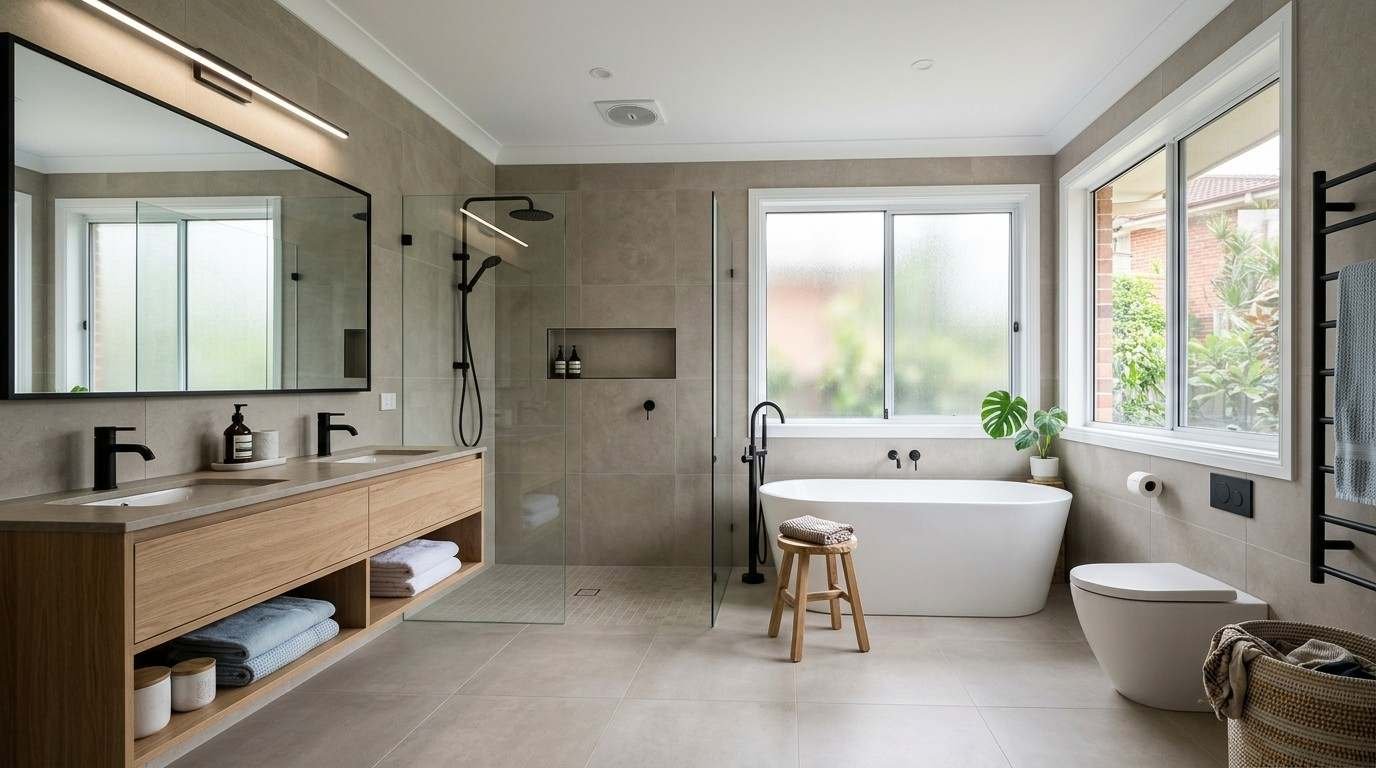
What Do Sydney Homeowners Most Commonly Ask About Spending $100,000 on a Bathroom?
The questions below represent the most common concerns and decision points for Sydney homeowners, first-time renovators, and property investors considering a $100,000 bathroom renovation.
How Long Does a $100,000 Bathroom Renovation Take in Sydney?
Timeline is one of the most underestimated aspects of bathroom renovation planning. Homeowners frequently assume that a higher budget means a faster project, but in Sydney’s trade market, timeline is driven by trade availability, material lead times, and project complexity rather than budget alone.
A full gut-and-rebuild bathroom renovation at the $100,000 level in Sydney typically takes between 6 and 12 weeks from contract signing to practical completion.
Project Timeline Breakdown from Planning to Completion
| Phase | Typical Duration | Key Activities |
| Design and Specification | 2 – 4 weeks | Finalise scope, select materials, confirm fixtures |
| Material Procurement | 2 – 4 weeks | Order tiles, fixtures, vanity, shower screen |
| Demolition | 1 – 2 days | Strip-out, disposal, substrate inspection |
| Structural and Waterproofing | 3 – 5 days | Frame repairs, waterproofing membrane, curing |
| Plumbing Rough-In | 2 – 3 days | Relocate or extend plumbing as required |
| Electrical Rough-In | 1 – 2 days | Lighting, exhaust fan, heated floor wiring |
| Tiling | 3 – 7 days | Floor and wall tiling, grouting, sealing |
| Fixture Installation | 2 – 3 days | Vanity, shower screen, bath, tapware, accessories |
| Finishing and Inspection | 1 – 2 days | Silicone, touch-ups, compliance checks |
The most common cause of timeline blowouts in Sydney bathroom renovations is material lead times. Large-format tiles, custom vanities, and frameless shower screens often have lead times of 3 to 8 weeks from order to delivery.
Should You Use a Builder or Manage Trades Yourself on a $100,000 Renovation?
This is one of the most consequential decisions a homeowner or investor makes when planning a bathroom renovation. The appeal of managing trades directly is understandable. The risks are significant, particularly at the $100,000 budget level.
Owner-Builder vs. Licensed Contractor: Cost and Risk Comparison
An owner-builder arrangement can theoretically save the builder’s management fee of $12,000 to $18,000. In practice, the savings are rarely as large as anticipated, and the risks are substantial.
Coordinating multiple licensed trades requires construction scheduling knowledge, an understanding of trade dependencies, and the ability to manage delays and variations in real time. Scheduling errors without this knowledge cause significant delays and additional costs.
In NSW, owner-builder permits are required for work valued above $10,000, and there are restrictions on how frequently an owner-builder permit can be obtained. Owner-built work carries reduced warranty protection compared to work completed by a licensed builder.
We consistently see the risk-adjusted case for using a licensed builder or renovation contractor as strong at this budget level. The management fee buys not just coordination, but accountability, warranty coverage, and the contractor’s established relationships with reliable trades.
What a Full-Service Renovation Contractor Provides at This Budget Level
A full-service renovation contractor at the $100,000 budget level provides end-to-end project management: scope development, detailed cost planning, trade procurement and scheduling, material procurement support, on-site supervision, quality control, compliance management, and defect rectification.
A reputable contractor provides a fixed-price contract, meaning the agreed scope is delivered at the agreed price, with any variations documented and priced before work proceeds.
A full-service contractor also carries the appropriate licences and insurances: a contractor licence issued by NSW Fair Trading, public liability insurance, and home building compensation (HBC) insurance for projects above $20,000. HBC insurance protects you if the contractor becomes insolvent, dies, or disappears before completing the work, while separate contract works insurance covers physical damage to the property during construction itself.
What Warranty Should You Expect on a $100,000 Bathroom Renovation?
This is a question we think doesn’t get asked enough. In NSW, licensed builders are required to provide statutory warranty periods, typically 6 years for major structural defects and 2 years for non-structural defects, under home building compensation legislation.
At the $100,000 budget level, you should expect these statutory minimums as a baseline, plus manufacturer warranties on individual fixtures, which commonly range from 5 to 15 years depending on the brand. A reputable contractor will also stand behind their workmanship beyond the statutory minimum, and it’s worth asking for this in writing before signing.
Financing a $100,000 Bathroom Renovation in Sydney
For many homeowners and investors, $100,000 represents a significant financial commitment that requires careful consideration of how the renovation will be funded.
Using Home Equity, Renovation Loans, and Cash: Pros and Cons
Home equity financing, accessed through a home equity loan or by redrawing from an existing mortgage, is typically the lowest-cost financing option for homeowners with sufficient equity in their property. The trade-off is that the loan is secured against the property.
Renovation loans, unsecured personal loans specifically for home improvement, offer faster approval and don’t require the property as security, but carry higher interest rates. For a $100,000 renovation, the interest cost over a 5-year loan term at a typical personal loan rate can add $15,000 to $25,000 to the total cost of the project.
Cash financing eliminates interest costs entirely and provides the strongest negotiating position with contractors. The trade-off is the opportunity cost of deploying capital that could otherwise be invested elsewhere.
For investment property renovations, the financing decision benefits from consultation with an accountant. The Australian Taxation Office treats renovation costs differently depending on whether the work is classified as a repair, an improvement, or capital expenditure. Repairs are generally deductible immediately, while capital improvements are depreciated over time, and this distinction changes what you can claim and when.
How to Stage a Renovation If $100,000 Is Your Total Budget
If $100,000 represents the absolute ceiling of your renovation budget, staging the renovation is a risk management strategy worth considering. Staging means completing the renovation in two phases: the first phase covering all structural, waterproofing, plumbing, and electrical work, and the second phase covering premium finishes, custom joinery, and decorative elements.
This approach isn’t ideal, a single, well-coordinated renovation is always more cost-efficient than two separate projects. But it’s a pragmatic option for homeowners who want to avoid debt while still achieving a quality outcome.
Renovating a Bathroom in a Sydney Strata Apartment
If your property sits within a strata scheme, your bathroom renovation carries an extra layer of process that houses don’t face. Most strata bylaws require written approval from the owners corporation before work begins, particularly for anything touching waterproofing, plumbing stacks, or floor structure shared with the unit below.
Strata approval typically adds 2 to 6 weeks to your project timeline. Waterproofing compliance carries extra weight in apartments, since a failed membrane can cause water damage to the unit below and create a dispute with your strata scheme.
Budget an additional $500 to $2,000 for strata application fees, engineering reports if required, and any make-good obligations specified in your bylaws.
How to Choose the Right Bathroom Renovation Contractor in Sydney
Choosing the right contractor is the single most important decision in a $100,000 bathroom renovation. The contractor you select determines the quality of the workmanship, the reliability of the timeline, the accuracy of the budget, and the level of stress you experience throughout the project.
Questions to Ask Before Signing Any Renovation Contract
Before signing a contract with any bathroom renovation contractor in Sydney, ask the following questions and verify the answers independently.
Are you licensed with NSW Fair Trading? Ask for the contractor licence number and verify it directly through the NSW Fair Trading licence check portal.
Do you carry public liability insurance and home building compensation insurance? Ask for certificates of currency for both policies. Can you provide a fixed-price contract that specifies the full scope of work, the agreed price, the payment schedule, and the process for managing variations?
Can you provide references from at least two or three recent bathroom renovation projects in Sydney? Follow up by contacting those clients directly.
Red Flags in Quotes and Contracts That Signal Budget Risk
A quote significantly lower than other quotes, by 20% or more, is almost always a sign that the scope is incomplete, the contractor is unlicensed, or the quality of materials and labour is below standard.
A contract that doesn’t specify materials by brand, model, and specification is a risk, since vague specifications allow a contractor to substitute lower-quality materials after signing with no recourse for the homeowner. A payment schedule requiring more than 10% upfront before work begins is a red flag too.
A contractor reluctant to provide a written contract should not be engaged for a $100,000 renovation under any circumstances.
Conclusion
A $100,000 bathroom renovation in Sydney is one of the most financially sound decisions a homeowner or property investor can make, provided the budget is allocated correctly, the right contractor is engaged, and the project is managed with discipline from planning through to completion. Sydney’s strong property market and the genuine ROI that quality bathroom renovations deliver make this budget level a compelling investment in your property’s future.
The difference between a renovation that pays off and one that doesn’t rarely comes down to the size of the budget. It comes down to how disciplined you are about allocation, how honest your contractor is about scope, and how much respect you give to the unglamorous fundamentals like waterproofing and compliance.
We bring transparent cost planning, skilled trade coordination, and honest pricing to every project we manage at Sydney Home Renovation. We understand that $100,000 is a significant commitment, and if you’re ready to move forward with a bathroom renovation that stays on budget, on schedule, and built to last, we’d welcome the chance to talk through a detailed consultation and fixed-price quote.
Frequently Asked Questions
Is $100,000 enough for a full bathroom renovation in Sydney?
Yes, $100,000 is a strong budget for a full gut-and-rebuild bathroom renovation in Sydney. It covers all trades, quality materials, premium fixtures, and a contingency buffer for unexpected costs.
How much of a $100,000 bathroom budget goes to labour in Sydney?
Labour typically accounts for 45% to 55% of a bathroom renovation budget in Sydney. On a $100,000 project, that’s approximately $45,000 to $55,000 covering builder, plumber, electrician, waterproofer, and tiler.
What hidden costs should I plan for in a Sydney bathroom renovation?
The most common hidden costs include asbestos removal ($2,000–$6,000), mould remediation ($500–$3,000), and structural timber repairs ($3,000–$10,000+). A 10–15% contingency buffer absorbs these.
Does a bathroom renovation add value to a Sydney property?
Yes, a well-executed bathroom renovation in Sydney can add between 3% and 5% to a property’s resale value. On a $1.5 million property, that’s $45,000 to $75,000 in added value.
How long does a $100,000 bathroom renovation take in Sydney?
A full gut-and-rebuild renovation at this level typically takes 6 to 12 weeks from contract signing to practical completion. Material lead times are the most common cause of delays.
Should I use a licensed builder or manage trades myself for a $100,000 bathroom renovation?
Using a licensed builder or full-service renovation contractor is strongly recommended at this budget level. The risks of managing trades directly typically outweigh the potential savings.
What is the most important thing to spend money on in a bathroom renovation?
Waterproofing is the most critical investment. A properly specified system to AS 3740 standards protects the entire renovation and only costs $2,500 to $4,500 for a standard Sydney bathroom.
Are water-efficient fixtures worth the extra cost in a Sydney renovation?
Yes, WELS 4-star or higher fixtures reduce water use significantly with only a modest price premium, often $100 to $300 across a full set.


