
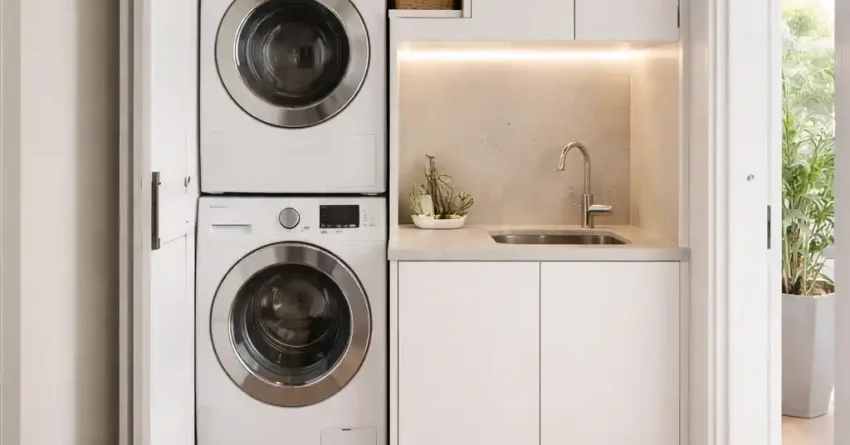
A European laundry tucks your washer, dryer, and utility essentials behind closed cabinetry, reclaiming floor space that traditional laundry rooms waste. For Sydney homeowners dealing with compact floorplans, this design approach turns overlooked hallways, bathroom corners, and kitchen nooks into fully functional wash zones.
This guide covers what European laundry design actually involves, realistic costs for Sydney renovations, layout ideas for different home types, and the planning steps that keep your project on budget and built to last.
What Is European Laundry Design?
A European laundry is a concealed laundry system integrated into cabinetry, typically within a cupboard, hallway, bathroom, or kitchen. Instead of dedicating an entire room to washing and drying, the European approach hides appliances and utility fixtures behind joinery doors so the space serves double duty.
The concept originated in European apartments where square metreage is limited and every centimetre counts. It has become one of the fastest-growing renovation trends in Australian cities, particularly in Sydney where median apartment sizes continue to shrink and buyers expect smart spatial solutions.
Key Principles Behind the European Laundry Approach
European laundry design is built on three core principles.
Concealment. Appliances, plumbing connections, and cleaning supplies sit behind closed doors. When the cabinetry is shut, the laundry disappears entirely.
Vertical stacking. Washers and dryers are stacked rather than placed side by side, cutting the horizontal footprint roughly in half. Shelving above and below the stack maximises every vertical centimetre.
Multi-use space. The area housing the laundry also functions as a hallway, part of a bathroom, or an extension of the kitchen. No floor space is single-purpose.
How European Laundry Design Differs from Traditional Australian Laundries
A traditional Australian laundry is a standalone room, usually 4 to 8 square metres, with a dedicated trough, separate hot and cold taps, a floor drain, and enough room for a freestanding washer and dryer side by side. It often includes a door to the backyard for clothesline access. For a full breakdown of what a complete laundry renovation involves across all formats — European and traditional — the Complete Guide to Laundry Renovation covers scope, costs, and planning in detail.
A European laundry compresses that functionality into as little as 1 to 2 square metres. The trough is replaced by a compact undermount or inset sink. Tapware is streamlined. Appliances are stacked and enclosed. There is no dedicated room, just a section of cabinetry within an existing space.
The trade-off is clear. You gain usable living area. You lose the large benchtop, the deep trough, and the standalone utility room. For many Sydney homes, especially apartments, townhouses, and older terraces, that trade-off makes strong financial and practical sense.
Why Sydney Homeowners Are Choosing European Laundry Designs
European laundries are not just a design trend. They solve real problems that Sydney homeowners face every day: limited space, rising property costs, and the need to extract maximum function from every room.
Space Efficiency in Sydney Apartments and Terraces
Sydney’s housing stock includes a high proportion of apartments, terraces, and semi-detached homes where floor space is at a premium. A dedicated laundry room in a 60-square-metre apartment consumes roughly 8 to 12 percent of the total living area. Converting that room into a European laundry and reallocating the freed space to a study nook, storage wall, or expanded living zone changes how the entire home functions.
In older inner-west terraces and eastern suburbs semis, the laundry is often a lean-to addition at the rear of the property. These spaces are poorly insulated, awkwardly shaped, and disconnected from the main living areas. A European laundry relocation brings the wash function indoors, into a purpose-built joinery unit that integrates with the rest of the renovation.
Property Value and Buyer Appeal
Buyers and renters in Sydney respond to perceived space. A well-executed European laundry makes a home feel larger without adding a single square metre. Real estate agents consistently report that concealed laundries are a selling point in the apartment and townhouse market, particularly for properties under 100 square metres.
For property investors, the calculation is straightforward. Removing a standalone laundry and replacing it with a European design can free up enough space to create a second bathroom, enlarge a bedroom, or add a home office. Each of those changes has a measurable impact on rental yield and resale value. Homeowners planning broader upgrades alongside a European laundry will find the whole home renovation planning guide useful for understanding how individual room changes interact with overall project budgets and timelines.
Seamless Integration with Open-Plan Living
Open-plan layouts dominate modern Sydney renovations. A traditional laundry with a visible door and audible appliances disrupts the clean sightlines that open-plan living depends on. A European laundry, concealed behind handleless cabinetry or integrated into a butler’s pantry, maintains visual continuity from kitchen to living area.
When the joinery doors are closed, there is no indication that a fully operational laundry sits behind them. That seamless integration is a core reason architects and interior designers specify European laundries in contemporary Sydney projects.
Essential Features of a European Laundry
Every European laundry shares a set of functional components. The quality and configuration of these components determine whether the finished result works smoothly or creates ongoing frustration.
Concealed Cabinetry and Joinery
The cabinetry is the most visible and most important element. Doors must open wide enough to load and unload appliances comfortably. Bi-fold doors, pocket doors, and barn-style sliding doors are the most common solutions. Standard hinged doors work in wider openings but can block adjacent walkways in tight hallways.
Internally, the joinery needs adjustable shelving, pull-out hamper drawers, and dedicated space for detergent, cleaning products, and ironing supplies. Soft-close hinges and quality runners are not optional. These components get heavy daily use.
Material choices range from polyurethane-painted MDF for a clean, modern finish to timber veneer or laminate for durability and cost efficiency. The exterior finish should match surrounding cabinetry so the laundry unit reads as part of the room, not an afterthought.
Compact Appliance Configuration
Stacked washer-dryer combinations are the standard for European laundries. Front-loading machines are essential because top-loaders cannot be stacked and require overhead clearance that enclosed cabinetry does not provide.
The two main options are a separate washer and dryer stacked with a stacking kit, or an all-in-one washer-dryer combo unit. Separate machines offer better drying performance and larger load capacities. Combo units save vertical space but typically have smaller drying capacities and longer cycle times.
Appliance depth matters. Standard front-loaders are 600mm deep. The cabinetry enclosure needs at least 650mm internal depth to accommodate the machine plus hose connections at the rear. Measure before you buy. An appliance that protrudes past the cabinet doors defeats the purpose of concealment.
Integrated Benchtops and Sinks
A small benchtop above or beside the appliance stack provides a folding surface and a place to sort laundry. Even 400mm of bench space makes a practical difference.
The sink in a European laundry is typically a compact undermount or inset basin, not a full-size laundry trough. A 300mm to 450mm wide sink handles hand-washing, soaking, and filling buckets without consuming excessive bench real estate. Choose a sink with a deeper bowl if you regularly hand-wash delicates.
Tapware should be a single-lever mixer for simplicity. Wall-mounted mixers save bench space. If the European laundry sits within a bathroom, the laundry sink can sometimes double as the bathroom basin with careful layout planning — a configuration explored in detail in the complete guide to bathroom renovation.
Ventilation and Moisture Management
Ventilation is the single most overlooked element in European laundry design. Enclosing a washer and dryer inside cabinetry without adequate airflow creates condensation, mould, and premature appliance failure.
At minimum, the cabinetry needs ventilation slots or grilles at the top and bottom of the enclosure to allow passive airflow. In bathrooms and internal spaces without windows, a dedicated exhaust fan ducted to the exterior is essential. Heat-pump dryers produce significantly less moisture than vented or condenser dryers and are the preferred choice for enclosed European laundries.
If you are using a condenser dryer, ensure the condensation tank is accessible for emptying, or plumb the drain hose directly into the waste pipe. Ignoring moisture management is the fastest way to turn a beautiful European laundry into a maintenance problem.
European Laundry Design Ideas for Every Home Layout
The best European laundry design depends on your existing floorplan, available plumbing points, and how much space you can allocate. Here are four proven layouts that work across Sydney’s most common home types.
Hallway and Cupboard Conversions
A hallway cupboard is one of the simplest locations for a European laundry. The cupboard needs to be at least 600mm deep and 1200mm wide to fit a stacked washer and dryer with a sliver of shelving beside or above the stack.
Bi-fold doors are the best choice for hallway installations because they fold flat against the interior walls of the cupboard, keeping the hallway clear when the laundry is in use. Louvred doors or doors with integrated ventilation grilles help with airflow in hallways that lack mechanical ventilation.
Plumbing is the main constraint. If the hallway shares a wall with a bathroom or kitchen, connecting to existing water supply and waste lines is relatively straightforward. If the nearest plumbing is several metres away, the cost of running new lines increases significantly.
Kitchen-Integrated European Laundries
Placing the European laundry within the kitchen joinery is common in studio apartments and one-bedroom units where the kitchen is the only space with plumbing access. The laundry stack sits at one end of the kitchen cabinetry run, behind doors that match the rest of the kitchen. Homeowners considering this layout as part of a broader kitchen update will find the complete guide to kitchen renovation a useful reference for joinery integration, plumbing proximity, and budget planning.
This layout works best when the laundry is positioned at the far end of the kitchen, away from the primary cooking and preparation zone. Placing it next to the sink simplifies plumbing connections. A small section of benchtop between the laundry cupboard and the main kitchen bench provides a visual and functional buffer.
The key consideration is noise. Running a wash cycle while cooking or entertaining is unavoidable in a kitchen-integrated layout. Choose appliances with low decibel ratings and anti-vibration technology to minimise disruption.
Bathroom-Laundry Combinations
Combining the laundry with the bathroom is the most popular European laundry configuration in Sydney apartments and townhouses. The bathroom already has water supply, drainage, waterproofing, and ventilation, so adding laundry appliances requires minimal additional plumbing work.
The most common arrangement places the stacked washer and dryer in a tall joinery unit beside the vanity or at the end of the bathroom opposite the shower. The joinery doors match the bathroom cabinetry for a cohesive look.
Waterproofing is critical. Australian Standard AS 3740 requires waterproofing in wet areas, and the laundry section of a bathroom-laundry combination must meet those requirements. Your contractor needs to ensure the waterproofing membrane extends to cover the floor and walls behind and beneath the appliances.
Dedicated Laundry Rooms with European Styling
If you have the luxury of a dedicated laundry room but want the clean, concealed aesthetic of European design, you can apply the same principles on a larger scale. Floor-to-ceiling joinery conceals appliances, cleaning supplies, and utility connections. The room reads as a sleek utility space rather than a cluttered wash room.
In this configuration, you gain the best of both worlds. The full functionality of a dedicated room, including a larger sink, more bench space, and room for a drying rack, combined with the visual discipline of European design. This approach suits larger Sydney homes, particularly new builds and major renovations where the laundry room is part of a whole-home joinery package
How Much Does a European Laundry Cost in Sydney?
Cost is the question every homeowner asks first. The answer depends on the complexity of the installation, the quality of materials, and whether new plumbing and electrical work is required.
Typical Cost Ranges for European Laundry Renovations
| Renovation Scope | Estimated Cost (Sydney, 2024–2025) |
| Basic European laundry (cupboard conversion, existing plumbing) | $4,000 to $8,000 |
| Mid-range European laundry (custom joinery, new tapware, minor plumbing) | $8,000 to $15,000 |
| High-end European laundry (premium joinery, stone benchtop, full plumbing relocation) | $15,000 to $25,000+ |
| Bathroom-laundry combination (full renovation including European laundry) | $20,000 to $40,000+ |
These figures include labour, materials, and joinery but exclude the cost of new appliances. A quality front-loading washer and dryer pair adds $1,500 to $4,000 depending on brand and features.
Labour, Materials, and Joinery Breakdown
Joinery and cabinetry represent the largest single cost, typically 40 to 50 percent of the total budget. Custom joinery built to fit your specific dimensions costs more than flat-pack or semi-custom options but delivers a superior finish and better long-term durability.
Plumbing accounts for 15 to 25 percent. If you are connecting to existing plumbing points within the same wall cavity, costs stay low. Relocating plumbing to a new position, especially in concrete slab apartments, increases the plumbing budget substantially.
Electrical work covers a dedicated power point for the dryer (most dryers require a separate circuit), lighting inside the cabinetry, and any exhaust fan installation. Budget 10 to 15 percent for electrical.
Finishing trades including tiling, painting, waterproofing, and benchtop installation make up the remaining 15 to 25 percent.
Hidden Costs and Budget Considerations
Several costs catch homeowners off guard during European laundry renovations.
Waterproofing. If the laundry is located in or adjacent to a wet area, waterproofing is mandatory under the Building Code of Australia. This adds $1,000 to $2,500 depending on the area involved.
Structural modifications. Removing a wall to create space or widening a cupboard opening may require a structural engineer’s assessment and a beam installation. Budget $1,500 to $4,000 for structural work if walls are being altered.
Strata and council approvals. In Sydney apartments, any work affecting common property, plumbing stacks, or external walls requires strata approval. Some councils also require development applications for changes to wet areas. Allow time and budget for application fees and potential delays.
Make-good work. When you remove an existing laundry room, the vacated space needs new flooring, wall finishes, and potentially a new ceiling. These make-good costs are easy to overlook when budgeting for the European laundry itself.
How to Plan a European Laundry Renovation
A successful European laundry renovation starts with accurate measurements, a realistic budget, and a clear understanding of the technical requirements.
Measuring Your Space and Setting a Realistic Budget
Start by measuring the available space in three dimensions: width, depth, and height. Record the position of existing plumbing points, power outlets, and ventilation openings. Note any obstacles such as structural columns, pipes, or meter boxes that cannot be moved.
With measurements in hand, set a budget that includes a 10 to 15 percent contingency for unexpected costs. European laundry renovations in older Sydney homes frequently uncover issues behind walls, including deteriorated plumbing, asbestos-containing materials, or non-compliant wiring, that add to the final cost.
Prioritise spending on joinery quality and ventilation. These two elements have the greatest impact on daily usability and long-term durability. You can save money on tapware and accessories without compromising the overall result.
Choosing the Right Appliances and Fittings
Select your appliances before finalising the joinery design, not after. The cabinetry must be built around the exact dimensions of your chosen washer and dryer. Changing appliances after the joinery is built can mean expensive modifications.
Front-loading washers with a 7kg to 9kg capacity suit most households. Dryers with heat-pump technology are strongly recommended for European laundries because they produce significantly less heat and moisture than vented models.
For fittings, choose a compact mixer tap, a stainless steel or composite undermount sink, and pull-out accessories such as hamper baskets and fold-down ironing boards. Every fitting should earn its place. In a European laundry, there is no room for items that do not serve a daily function.
Plumbing, Electrical, and Waterproofing Requirements
European laundries require hot and cold water supply, a waste drain for the washing machine and sink, a dedicated electrical circuit for the dryer, and adequate ventilation.
If the laundry is being installed in a new location, a licensed plumber must connect to the existing supply and waste lines. In slab-on-ground apartments, this may involve core-drilling through concrete, which adds cost and requires strata approval.
Electrical work must be carried out by a licensed electrician. Most dryers draw significant current and need a dedicated circuit to avoid overloading shared circuits. An electrician can also install internal cabinet lighting and a hardwired exhaust fan if required.
Waterproofing must comply with AS 3740. If the European laundry is located within a bathroom or other wet area, the waterproofing membrane must be applied by a licensed waterproofer and inspected before tiling or cabinetry installation proceeds.
Working with a Renovation Contractor in Sydney
A European laundry renovation involves multiple trades: cabinetmaker, plumber, electrician, tiler, waterproofer, and sometimes a structural engineer. Coordinating these trades yourself is possible but time-consuming and risky if sequencing goes wrong.
An experienced renovation contractor manages trade scheduling, ensures compliance with Australian standards, and handles strata or council approvals on your behalf. When selecting a contractor, ask for examples of completed European laundry projects, request a detailed written quote with itemised costs, and confirm that all tradespeople hold current NSW licences and insurance.
Get clarity on the project timeline before work begins. A straightforward cupboard conversion may take one to two weeks. A full bathroom-laundry combination renovation typically runs four to six weeks depending on complexity and material lead times.
Common European Laundry Design Mistakes to Avoid
European laundries look simple in photos. In practice, several common mistakes undermine both the aesthetics and the functionality of the finished result.
Underestimating Ventilation Needs
This is the most frequent mistake. Homeowners and even some builders treat ventilation as an afterthought, assuming that opening the cabinet doors after a dryer cycle is sufficient. It is not.
Without proper ventilation, moisture accumulates inside the cabinetry, promoting mould growth on interior surfaces and reducing the lifespan of both the joinery and the appliances. Install ventilation grilles in the cabinetry and, in enclosed spaces, a ducted exhaust fan. Heat-pump dryers reduce but do not eliminate the need for airflow.
Choosing Form Over Function
A European laundry that looks beautiful but is difficult to use daily will become a source of frustration. Doors that do not open wide enough to load a full basket. Shelves positioned too high to reach comfortably. A sink too small to soak a single shirt.
Test the ergonomics of your design before construction begins. Stand in the space. Mime the actions of loading the washer, reaching for detergent, folding clothes, and emptying the dryer. If any movement feels awkward, adjust the design now rather than after the joinery is installed.
Ignoring Plumbing and Drainage Constraints
Moving a laundry to a location far from existing plumbing points increases cost and introduces risk. Long waste pipe runs require adequate fall for gravity drainage. If the fall is insufficient, waste water pools in the pipe, causing blockages and odours.
In apartment buildings, connecting to the building’s plumbing stack may be restricted by strata by-laws. Always confirm plumbing feasibility with a licensed plumber and obtain strata approval before committing to a location for your European laundry.
European Laundry vs Traditional Laundry: Which Is Right for You?
The choice between a European laundry and a traditional laundry depends on your home’s size, your household’s laundry habits, and your renovation goals.
Space, Cost, and Lifestyle Comparison
| Factor | European Laundry | Traditional Laundry |
| Space required | 1 to 2 sqm | 4 to 8 sqm |
| Typical cost (Sydney) | $4,000 to $25,000 | $5,000 to $20,000 |
| Appliance options | Front-loader only (stacked) | Front-loader or top-loader (side by side) |
| Storage capacity | Limited (compact shelving) | Generous (full room) |
| Bench space | Minimal (400mm to 600mm) | Full-width benchtop |
| Sink size | Compact basin | Full laundry trough |
| Ventilation complexity | Higher (enclosed space) | Lower (window or external wall) |
| Visual impact | Concealed, seamless | Visible, dedicated room |
| Best suited for | Apartments, townhouses, small homes | Large homes, families with heavy laundry loads |
When a Traditional Laundry Still Makes Sense
If your household generates large volumes of laundry, a traditional laundry room with a deep trough, full-width bench, and side-by-side appliances remains the more practical choice. Families with young children, pet owners, and households that regularly wash bulky items like sports gear or bedding benefit from the extra space and functionality.
A traditional laundry also makes sense when you have the floor space to spare and no competing need for the room. Converting a functional laundry into a European design purely for aesthetics, without repurposing the freed space, delivers minimal practical benefit.
For most Sydney apartments, townhouses, and compact homes, however, the European laundry is the smarter investment. It reclaims valuable living space, modernises the home’s presentation, and aligns with how buyers and renters evaluate properties in a space-constrained market. Homeowners weighing whether to extend their home to create more space — rather than compress existing rooms — can explore the options in the complete guide to home extensions.
Conclusion
European laundry design gives Sydney homeowners a practical way to reclaim space, modernise their home, and add genuine value. From concealed joinery and compact appliance stacking to smart ventilation and realistic budgeting, every decision shapes the final result.
Getting the design, trades coordination, and cost planning right from the start is what separates a European laundry that works daily from one that creates ongoing problems. The right renovation partner makes that difference.
We help homeowners across Sydney plan and deliver European laundry renovations built for long-term performance. Contact Sydney Home Renovation to discuss your project, get a detailed quote, and renovate with confidence.
Frequently Asked Questions
What is a European laundry and how does it work? A European laundry is a concealed laundry system built into cabinetry, hiding your washer, dryer, and utility essentials behind closed doors. It works by stacking appliances vertically and integrating them into an existing space such as a hallway cupboard, bathroom, or kitchen.
How much space do you need for a European laundry? You need a minimum of approximately 600mm wide by 650mm deep to fit a single stacked washer-dryer column. A more comfortable and functional setup requires 1200mm of width to include shelving or a small sink beside the appliances.
Can you add a European laundry to an existing bathroom? Yes. Bathrooms are the most popular location for European laundries in Sydney because they already have water supply, drainage, and ventilation. A licensed contractor can integrate a laundry joinery unit into your bathroom renovation with proper waterproofing.
What appliances work best in a European laundry? Front-loading washers and heat-pump dryers are the best choice. Front-loaders are required for stacking. Heat-pump dryers produce less moisture and heat than vented or condenser models, making them safer and more effective inside enclosed cabinetry.
Do European laundries need special ventilation? Yes. Enclosing appliances inside cabinetry without adequate ventilation causes condensation and mould. At minimum, install ventilation grilles in the joinery. In internal spaces without windows, a ducted exhaust fan is essential.
How much does it cost to install a European laundry in Sydney? A basic cupboard conversion using existing plumbing costs $4,000 to $8,000. Mid-range installations with custom joinery run $8,000 to $15,000. High-end builds with premium materials and plumbing relocation can reach $25,000 or more, excluding appliances.
Does a European laundry add value to your property? Yes. A well-designed European laundry frees up floor space that can be repurposed as a study, storage, or additional bathroom. In Sydney’s apartment and townhouse market, buyers and renters consistently value smart space utilisation, which supports both resale price and rental yield.


