
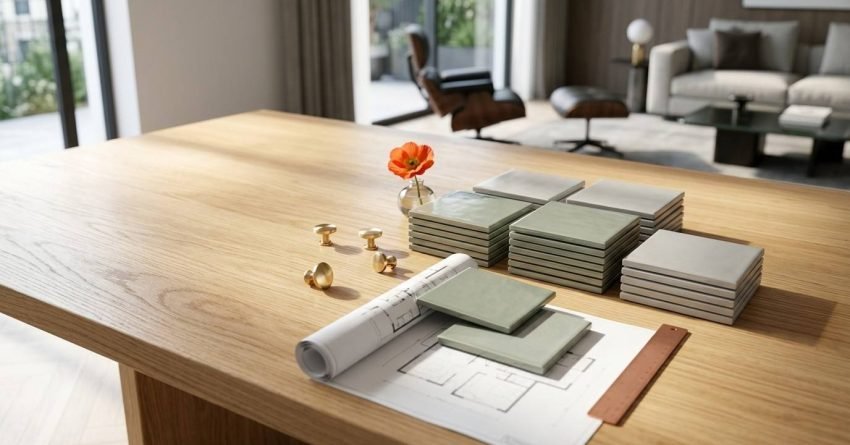
The 60-30-10 rule divides your flooring and design choices into three proportions: 60% dominant colour or material, 30% secondary elements, and 10% accent features. This simple formula eliminates guesswork and creates cohesive, visually balanced spaces every time.
Whether you’re selecting bathroom tiles, planning a full renovation, or coordinating flooring with existing décor, this principle provides a reliable framework. It works for colour schemes, material selection, and budget allocation.
We use this guide to show Sydney homeowners how to apply the 60-30-10 rule to flooring choices, bathroom renovations, and renovation budgeting, helping you make confident decisions that look professional and stay within budget.
What Is the 60-30-10 Rule in Interior Design?
The 60-30-10 rule is a foundational design principle that creates visual harmony by distributing colours, materials, or elements in a specific ratio. 60% represents your dominant element, 30% your secondary element, and 10% your accent features.
This ratio prevents spaces from feeling chaotic or monotonous. It gives your eye a clear focal point while maintaining enough variety to keep the design interesting. Professional interior designers have used this formula for decades because it consistently produces balanced, aesthetically pleasing results.
The rule applies to virtually any design decision. You can use it for wall colours, flooring materials, furniture selections, or the distribution of textures throughout a room. Its versatility makes it particularly valuable for homeowners tackling renovations without professional design training.
The Origins of the 60-30-10 Colour Principle
The 60-30-10 rule originated in traditional interior design and colour theory. Designers observed that spaces with roughly these proportions felt naturally balanced to the human eye.
The principle draws from basic colour wheel relationships and the psychology of visual perception. Our brains process dominant elements first, then secondary elements, and finally small accent details. The 60-30-10 ratio mirrors this natural visual hierarchy.
Over time, the rule expanded beyond colour to encompass materials, textures, and spatial planning. Today, we apply it to everything from tile selections to budget allocation.
How the Rule Creates Visual Balance
Visual balance occurs when no single element overwhelms a space while still maintaining a clear design direction. The 60-30-10 ratio achieves this through deliberate proportion control.
Your 60% dominant element establishes the room’s overall character. It’s what people notice first and remember most. This could be your main floor colour, primary wall treatment, or largest surface area.
The 30% secondary element supports and complements the dominant choice. It adds depth without competing for attention, working as the supporting layer that makes the dominant choice look better.
Your 10% accent provides visual punctuation. Small but impactful details, like a feature tile, metallic fixture, or bold colour pop, create interest and personality without disrupting the overall harmony.
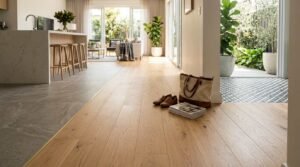
Applying the 60-30-10 Rule to Flooring Choices
Flooring typically represents the largest continuous surface in any room. Applying the 60-30-10 rule to your flooring decisions ensures your floors anchor the space appropriately while allowing other design elements to shine.
For open-plan homes common throughout Sydney, this approach becomes even more critical. Your flooring choices need to flow seamlessly between zones while still defining distinct areas.
The rule helps you avoid two common flooring mistakes: choosing materials that are too uniform, which creates visual boredom, or too varied, which creates visual chaos.
The 60% – Your Dominant Flooring Selection
Your dominant flooring covers the majority of your floor space. In most homes, this means main living areas, hallways, and primary bedrooms share a consistent flooring material and colour.
Neutral tones work best for this 60%. Think warm timber tones, soft greys, or natural stone colours. These foundations support virtually any furniture or décor style and won’t date quickly.
For Sydney homes, we recommend materials that handle humidity and temperature fluctuations well. Engineered timber, quality porcelain tiles, or polished concrete all perform reliably in our climate while providing that essential neutral base.
The dominant flooring should feel cohesive throughout connected spaces. When someone walks through your home, the 60% creates a visual thread that ties everything together.
The 30% – Secondary Flooring and Transitions
Secondary flooring elements occupy roughly 30% of your total floor space. These typically appear in wet areas, feature zones, or transition spaces between different functional areas.
Bathrooms, laundries, and kitchens often feature different flooring than living areas for practical reasons. This natural separation provides an opportunity to introduce your secondary material or colour, and the transition between a laundry renovation and adjoining spaces is one of the first decisions worth resolving early.
Your 30% should complement, not clash with, your dominant flooring. If your main floors are warm timber tones, tiles in complementary warm neutrals or subtle patterns that echo the timber’s natural variation work well.
Transition strips, borders, and threshold details also fall into this category. These small but visible elements help define zones while maintaining visual flow.
The 10% – Accent Details and Feature Elements
Accent flooring represents just 10% of your total floor area but delivers outsized visual impact. These are the details that make your space memorable and personal.
Feature tiles in an entry foyer, a decorative border in a bathroom, or a bold pattern in a powder room all qualify as accent flooring. These elements draw the eye and create focal points.
This is where you can take design risks. A striking geometric pattern, a bold colour, or an unusual material works beautifully in small doses, since the limited area prevents these choices from overwhelming the space.
We think of accent flooring as jewellery for your home. It should enhance and elevate the overall design without dominating the conversation.
The 60-30-10 Rule for Bathroom Flooring Design
Bathrooms present unique opportunities to apply the 60-30-10 rule within a single room. The combination of floor tiles, wall tiles, cabinetry, and fixtures creates a natural framework for this proportional approach.
A well-designed bathroom feels cohesive yet interesting. The 60-30-10 rule prevents the common mistake of selecting too many competing elements, or conversely, creating a space that feels flat and uninspired.
For Sydney bathroom renovations, this framework also helps manage costs. Understanding which elements deserve premium investment and which can be more budget-conscious leads to smarter purchasing decisions.
Floor Tiles as Your Dominant 60%
In most bathrooms, floor tiles and the lower portions of walls represent your dominant 60%. This area sets the room’s foundational tone and should feature your most versatile, timeless selection.
Choose floor tiles that balance aesthetics with practicality. Slip resistance, water absorption rates, and durability matter as much as appearance. Large-format tiles in neutral tones create a sense of spaciousness while minimising grout lines.
Popular choices for Sydney bathrooms include natural stone-look porcelain, concrete-effect tiles, and classic subway tiles in neutral configurations. These options provide the visual weight appropriate for your dominant element while remaining practical for wet areas.
Your dominant tile selection should coordinate with adjacent flooring in hallways or bedrooms. This connection maintains visual flow when bathroom doors are open.
Wall Tiles and Cabinetry as the 30%
Wall tiles above the splash zone and bathroom cabinetry typically comprise your secondary 30%. These elements support your floor tile selection while adding visual interest and functional storage.
Your 30% can introduce subtle pattern or colour variation. A different tile format on feature walls, a slightly warmer or cooler tone in your cabinetry, or textured tiles that catch light differently all work well here.
Vanity cabinetry represents a significant visual element in most bathrooms. Timber-look finishes, painted surfaces, or stone-topped units should complement your dominant floor tiles without matching exactly.
This secondary layer adds depth to your bathroom design. It prevents the space from feeling one-dimensional while maintaining the cohesive foundation established by your dominant elements.
Fixtures, Tapware, and Accents as the 10%
Your bathroom’s 10% accent elements include tapware, showerheads, towel rails, mirrors, and decorative accessories. These finishing touches define your bathroom’s personality and style direction.
Metallic finishes make excellent accents. Brushed nickel, matte black, brushed brass, or chrome tapware creates visual punctuation against neutral tiles and cabinetry. Consistency in your metallic finish throughout the bathroom strengthens this accent impact.
A practical example: a Sydney bathroom with cream floor tiles as the dominant 60%, white subway wall tiles as the secondary 30%, and brushed brass tapware and a round mirror as the 10% accent achieves the proportional balance the rule describes, without needing to overthink the palette.
The 10% is where trends can safely appear. While your dominant and secondary elements should remain relatively timeless, accent pieces can reflect current styles without requiring expensive replacement when fashions change.
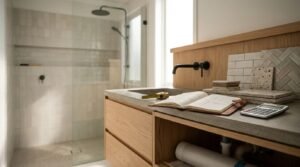
Budgeting Your Bathroom Renovation Using 60-30-10
The 60-30-10 rule extends beyond aesthetics into practical budget allocation. This framework helps Sydney homeowners distribute renovation funds strategically, ensuring money goes where it delivers the most value.
Many first-time renovators overspend on visible finishes while underbudgeting for essential structural work. The 60-30-10 approach prevents this imbalance.
Understanding where renovation dollars should flow helps you make informed decisions when quotes arrive and prevents costly mid-project changes, particularly across the planning and budget allocation stages of a wider whole-home renovation.
Allocating 60% to Core Structural and Labour Costs
Approximately 60% of your bathroom renovation budget should cover structural work, plumbing, electrical, waterproofing, and skilled labour. These elements form the foundation that everything else depends upon.
Waterproofing alone represents a critical investment. Failures here lead to expensive remediation, potential structural damage, and health hazards from mould growth. Quality waterproofing by licensed professionals is non-negotiable.
Plumbing and electrical work must meet the National Construction Code and Australian plumbing standards. Cutting corners here creates safety risks and compliance issues that can affect property value and insurance coverage.
Labour costs reflect expertise and reliability. Experienced tradespeople complete work correctly the first time, coordinate effectively with other trades, and solve problems efficiently.
Dedicating 30% to Quality Materials and Finishes
Your secondary 30% covers tiles, cabinetry, benchtops, and other visible materials. This allocation allows for quality selections without overextending your budget.
Within this 30%, prioritise materials that impact daily use. A quality vanity with soft-close drawers and durable surfaces improves your bathroom experience for years. Tiles that clean easily and resist staining reduce long-term maintenance.
Balance quality with value. Mid-range tiles from reputable suppliers often perform identically to premium options at significantly lower cost, so we suggest reserving premium spending for high-touch, high-visibility elements.
Consider longevity when selecting materials. A slightly higher upfront investment in durable finishes often proves more economical than replacing cheaper alternatives within a few years.
Reserving 10% for Premium Upgrades and Contingencies
The final 10% serves two purposes: funding premium accent upgrades and providing contingency for unexpected costs. Both functions protect your renovation’s success.
Premium upgrades might include upgraded tapware, a frameless shower screen, heated towel rails, or smart bathroom technology. These elements enhance daily comfort and can add value when selling.
Contingency funds are essential. Older Sydney homes frequently reveal hidden issues once walls open, including deteriorated framing, outdated plumbing, or inadequate electrical capacity.
When a renovation proceeds without major surprises, contingency funds can be redirected toward those premium upgrades initially considered optional.
Common Mistakes When Using the 60-30-10 Rule
Understanding the rule is one thing; applying it correctly is another. Several common mistakes undermine the 60-30-10 framework’s effectiveness, leaving homeowners with results that feel unbalanced or disconnected.
Recognising these pitfalls before you begin helps you avoid costly corrections and ensures your renovation achieves the cohesive result you’re seeking.
Most mistakes stem from either overthinking the process or not thinking it through enough. The 60-30-10 rule works best when applied thoughtfully but not obsessively.
Overcomplicating Colour and Material Choices
Some homeowners interpret the rule as requiring exactly three distinct colours or materials. This literal interpretation often creates busy, disjointed spaces.
Your 60%, 30%, and 10% can include variations within each category. Your dominant 60% might include two similar neutral tones, and your 30% might feature tiles with subtle pattern variation. Rigid adherence to “exactly three elements” misses the rule’s intent, and some designers even extend it to a 60-30-10-5 variation for spaces that need an extra layer of texture.
The goal is proportional balance, not mathematical precision. A bathroom with cream floor tiles, white wall tiles, and brushed brass fixtures follows the rule even though “cream” and “white” are closely related.
Simplicity usually wins. When in doubt, we reduce rather than add complexity.
Ignoring Flow Between Rooms
Bathrooms don’t exist in isolation. Your 60-30-10 selections should consider adjacent spaces, particularly in open-plan homes or when bathroom doors remain open.
Jarring transitions between rooms undermine overall home cohesion. A bathroom with cool grey tones adjacent to a bedroom with warm timber floors creates visual conflict every time you walk between spaces.
Consider sightlines from hallways, bedrooms, and living areas. Your bathroom’s dominant elements should complement what’s visible from these connected spaces.
This doesn’t require matching everything. Complementary relationships, such as warm with warm, cool with cool, or deliberate contrast at defined thresholds, maintain flow while allowing each space its own character. This principle becomes especially important when coordinating finishes across multiple rooms in a home extension, where sightlines multiply across an expanded floor plan.
Underestimating the 10% Accent Impact
The smallest proportion delivers disproportionate visual impact. Underinvesting in your 10% or selecting accents carelessly undermines your entire design.
Cheap tapware, mismatched hardware, or generic accessories drag down quality materials around them. Your eye naturally gravitates to these small details, making their quality immediately apparent.
Conversely, well-chosen accents elevate modest materials. Quality brushed brass tapware makes standard white tiles feel intentional and sophisticated, and a beautiful mirror transforms a simple vanity into a design statement.
We encourage investing thoughtfully in your 10%. These elements often cost less in absolute terms while delivering significant aesthetic returns.
Extending the Rule to Furniture and Soft Furnishings
While flooring and bathroom tiling are the clearest applications, the same 60-30-10 logic extends to furniture, cushions, curtains, and other soft furnishings throughout a renovated home. Your dominant 60% might be a neutral sofa and rug combination, your 30% a complementary armchair or cabinetry tone, and your 10% a scatter cushion or artwork accent.
Applying the ratio consistently across flooring, fixtures, and furnishings creates a home that feels intentional from room to room rather than styled in isolated pockets. It’s a small mental checklist that pays off through every stage of a renovation.
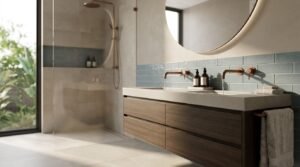
How Sydney Homeowners Can Apply the 60-30-10 Rule
Sydney’s unique characteristics, including abundant natural light, variable climate, and distinct architectural styles, influence how the 60-30-10 rule applies locally. Understanding these factors helps you make selections that work specifically for your home.
Local material availability, trade expertise, and renovation timelines also shape practical application. Working with Sydney-based professionals who understand these factors streamlines your project.
The rule’s principles remain universal, but successful implementation requires local context.
Working With Sydney’s Natural Light Conditions
Sydney homes typically receive abundant natural light, particularly in north-facing rooms. This light intensity affects how colours and materials appear throughout the day.
Strong natural light can wash out pale colours and intensify bold ones. We recommend testing tile and paint selections in the actual room at different times of day before committing, since morning light differs significantly from afternoon light.
Reflective surfaces, including glossy tiles, polished stone, and metallic fixtures, behave differently under Sydney’s bright conditions than in showroom lighting. Consider matte or honed finishes if glare concerns you.
South-facing bathrooms receive softer, more consistent light. These spaces can handle slightly warmer tones without appearing yellow or orange.
Selecting Materials Suited to Sydney’s Climate
Sydney’s humidity, temperature variations, and coastal salt air affect material performance. Your 60-30-10 selections should account for these environmental factors.
Porcelain tiles absorb significantly less moisture than natural stone, which makes them the stronger performer in wet areas for most Sydney applications. Natural stone remains beautiful but demands proper sealing and ongoing care.
Timber cabinetry requires appropriate finishes to handle bathroom humidity. Engineered timber or quality laminate often proves more practical than solid timber in wet environments.
Metallic fixtures should carry appropriate ratings for humid environments. Quality tapware from reputable manufacturers includes appropriate internal components and finishes for bathroom conditions.
Coordinating With Local Renovation Timelines
Sydney’s construction industry experiences seasonal demand fluctuations and trade availability variations. Planning your renovation timeline realistically helps ensure quality outcomes.
We recommend booking trades well in advance, particularly for spring and summer renovations when demand peaks. Quality tilers, plumbers, and electricians maintain busy schedules, and last-minute bookings often mean compromising on your preferred professionals.
Material lead times vary significantly. Imported tiles, custom cabinetry, and specialty fixtures may require six to twelve weeks for delivery, so factoring these timelines into your project planning matters.
Weather affects certain renovation stages. Waterproofing requires appropriate conditions to cure correctly, and we discuss seasonal considerations with clients during planning.
Conclusion
The 60-30-10 rule transforms overwhelming design decisions into manageable, confident choices. Whether you’re selecting bathroom tiles, coordinating flooring throughout your home, or allocating your renovation budget, this proportional framework delivers balanced, professional results.
Understanding how to apply these principles specifically to Sydney conditions our natural light, climate, and local renovation landscape- ensures your selections perform as beautifully in reality as they appeared in the showroom.
We’re ready to help you apply the 60-30-10 rule to your bathroom renovation. Sydney Home Renovation provides transparent cost planning, expert material guidance, and skilled workmanship to bring your vision to life on budget and on schedule. Contact us to discuss your project.
Frequently Asked Questions
What does the 60-30-10 rule mean for flooring?
The 60-30-10 rule for flooring means allocating 60% of your floor space to a dominant material or colour, 30% to secondary flooring in wet areas or feature zones, and 10% to accent details like decorative borders or feature tiles.
Can I use the 60-30-10 rule in a small bathroom?
Yes, the 60-30-10 rule works excellently in small bathrooms. The proportions scale naturally, with dominant floor and wall tiles at 60%, cabinetry and secondary tiles at 30%, and tapware and accessories at 10%.
How do I choose colours using the 60-30-10 rule?
Start with your dominant 60% in a neutral tone you’ll live with long-term. Select your 30% secondary colour to complement this foundation, then choose your 10% accent colour for visual interest.
Does the 60-30-10 rule apply to renovation budgets?
Absolutely. Roughly 60% goes to structural work, labour, plumbing, and electrical, 30% to quality materials like tiles and cabinetry, and 10% to premium upgrades and contingency funds.
What flooring works best as the dominant 60%?
Neutral-toned flooring in durable materials works best. Engineered timber, large-format porcelain tiles, or polished concrete in warm or cool neutrals provide versatile foundations that resist trend-driven obsolescence.
How do accent tiles fit into the 10%?
Accent tiles appear in limited areas, such as a feature strip, decorative border, or small feature wall. Their restricted coverage allows bolder patterns or textures without overwhelming the space.
Should I hire a professional to apply this rule?
Professional guidance helps with material selection, colour coordination, and practical application. Renovation contractors understand how these proportions translate into actual material quantities and budget allocation.


