
Hidden bathroom renovation costs add 15–30% to most Sydney projects. These unexpected expenses include structural repairs, plumbing upgrades, waterproofing remediation, asbestos removal, and council permit delays that rarely appear in initial quotes.
Understanding these hidden costs before you start protects your budget and timeline. Sydney’s older housing stock, strict compliance requirements, and competitive trade market create unique cost pressures that catch first-time renovators off guard.
This guide breaks down every hidden cost category, explains why each occurs, and shows you exactly how to budget for them. You’ll find the warning signs, the questions to ask contractors, and the contingency strategies that keep renovations on track.
What Are Hidden Bathroom Renovation Costs?
Hidden bathroom renovation costs are expenses that emerge during a project but were never included in your original quote or budget. They are usually impossible to predict until work begins and walls come down, not because contractors are dishonest, but because the true condition of a bathroom’s structure, plumbing, and electrical systems only becomes visible after demolition.
Here is how the main categories break down across a typical Sydney project.
| Hidden Cost Category | Typical Added Cost | When It Surfaces |
| Waterproofing remediation | $1,500–$4,000 | After tile removal |
| Structural and water damage repair | $500–$10,000 | During demolition |
| Plumbing upgrades and relocation | $2,000–$8,000 | At rough-in stage |
| Electrical compliance and switchboard | $1,500–$4,000 | At rough-in stage |
| Asbestos testing and removal | $500–$10,000 | Before or during demolition |
| Council permits and approvals | $200–$1,000 plus 2–8 weeks | Pre-construction |
| Ventilation upgrades | $400–$1,500 | At rough-in stage |
Defining Hidden Costs vs. Quoted Costs
Quoted costs cover the work you can see and plan for: new tiles, fixtures, vanities, labour for installation, and standard plumbing connections. Your contractor prices these based on visible conditions and standard assumptions.
Hidden costs emerge when those assumptions prove wrong. The subfloor has water damage, the pipes are galvanised steel that needs replacing, or the electrical wiring falls short of current standards. These discoveries happen after demolition, when your project is already underway.
The distinction matters for budgeting. Quoted costs are fixed or closely estimated, while hidden costs demand contingency planning because their exact nature and extent stay unknown until work progresses.
Why Hidden Costs Catch Sydney Homeowners Off Guard
Sydney’s housing market creates specific conditions that increase hidden cost risk. Many homes were built between 1950 and 1980, an era with different building standards, materials, and waterproofing practices.
Older Sydney homes commonly contain asbestos in wall linings, floor tiles, and cement sheeting. Plumbing systems frequently use galvanised pipes that have corroded internally, and waterproofing membranes have often failed after decades of use.
First-time renovators typically budget based on the visible scope. They see dated tiles and an old vanity, then price replacement costs, but they never see the rotted timber framing behind those tiles or the non-compliant electrical work buried in the walls.
Property investors hit the same wall, particularly with properties carrying deferred maintenance or unpermitted prior work.
The Most Common Hidden Costs in Bathroom Renovations
Certain hidden costs appear repeatedly across Sydney bathroom renovations. Understanding these categories helps you anticipate expenses and ask the right questions before work begins.
Structural and Water Damage Repairs
Water damage ranks among the most expensive hidden costs in bathroom renovations. Bathrooms are wet areas by design, and decades of moisture exposure take a toll on surrounding structures.
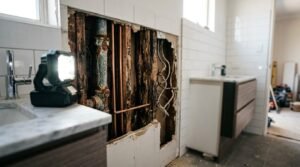
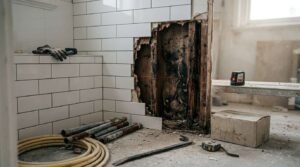
Common discoveries include rotted timber framing around showers, deteriorated wall studs behind tiles, and damaged floor joists beneath the subfloor. These issues stay invisible until demolition removes surface materials.
Repair costs vary dramatically with damage extent. Minor timber replacement adds $500–$1,500 to a project, while extensive structural repairs across multiple walls and floor sections push past $5,000–$10,000, a pattern consistent with Master Builders Australia industry cost reporting. Sydney’s coastal humidity and older ventilation standards compound this risk significantly.
Plumbing Upgrades and Pipe Relocation
Plumbing hidden costs come from two sources: existing system condition and layout changes. Both hit your renovation budget hard.
Older Sydney homes frequently have galvanised steel pipes that have corroded internally, restricting water flow and eventually failing. Most plumbers replace these during renovation rather than connecting new fixtures to deteriorating pipework.
Pipe replacement runs $2,000–$8,000 for significant upgrades in older homes, depending on accessibility and whether pipes travel through walls or beneath concrete slabs.
Layout changes create additional costs. Moving a toilet, relocating a shower, or repositioning a vanity requires new pipe runs, often involving cuts into floors, walls, and sometimes concrete slabs.
Sewer line condition presents a further risk. Older clay or earthenware pipes can suffer from root intrusion, cracks, or joint failures, and a CCTV drain inspection before renovation identifies these early.
Electrical Rewiring and Compliance Upgrades
Electrical work in bathrooms meets strict Australian standards under AS/NZS 3000. Older installations frequently fall short of current requirements, triggering mandatory upgrades during renovation.
Common compliance issues include inadequate circuit protection, missing safety switches, incorrect cable sizing, and improper fixture placement relative to water sources. Bathroom electrical upgrades typically cost $1,500–$4,000 depending on scope, covering new circuits, safety switch installation, compliant lighting, and exhaust fan wiring.
Switchboard upgrades represent a higher hidden cost. Older homes with fuse boxes that cannot accommodate modern safety switches face switchboard replacement, adding $1,000–$2,500 to the project.
Heated towel rails, underfloor heating, and spa baths each need dedicated circuits, so any of these additions triggers further electrical work when existing capacity falls short.
Waterproofing Failures and Remediation
Waterproofing membrane failure is extremely common in older Sydney bathrooms. Original waterproofing degrades, gets installed poorly, or simply reaches the end of its service life.
AS 3740:2021 mandates waterproofing in all wet areas. When existing waterproofing has failed, complete removal and replacement becomes a compliance requirement rather than a choice.
Remediation involves stripping back to the substrate, repairing water-damaged materials, applying a new membrane, and allowing proper curing time before tiling. Costs land between $1,500–$4,000 depending on bathroom size and substrate condition.
Failed waterproofing causes secondary damage. Water penetration into wall cavities and floor structures creates the structural damage described above, which means the waterproofing cost itself often looks modest next to repairing what the failure caused.
Ventilation and Exhaust Compliance Upgrades
Ventilation is the hidden cost almost nobody budgets for, and I see it surprise homeowners in nearly every pre-2000 bathroom. The National Construction Code requires mechanical exhaust ventilation in bathrooms without adequate natural ventilation, and many older Sydney bathrooms rely on a small window that no longer satisfies the requirement.
Installing a compliant exhaust fan ducted to the exterior costs $400–$1,500 depending on ceiling access, duct run length, and whether roof penetration is needed. Fans that vent into a roof cavity rather than outside fail inspection and need rework.
Poor ventilation also explains why the waterproofing failed in the first place. Trapped moisture attacks membranes, grout, and framing continuously, so upgrading ventilation protects everything you just paid to replace.
Asbestos Testing and Removal
Asbestos-containing materials were common in Australian construction until the mid-1980s, with a full national ban taking effect in 2003. Sydney homes built before 1990 carry elevated asbestos risk, particularly in bathrooms.
Common locations include fibro wall linings, vinyl floor tiles, tile adhesive, cement sheeting behind tiles, and pipe lagging. These materials stay safe when undisturbed but turn hazardous once cut, drilled, or demolished.
Testing costs $50–$150 per sample, and most contractors test suspicious materials before providing final quotes.
Asbestos removal costs vary with material type, quantity, and accessibility. Small amounts of non-friable asbestos add $500–$1,500 to a project, while extensive removal exceeds $5,000–$10,000 under the licensing framework set out by SafeWork NSW. Only licensed removalists handle quantities over 10 square metres, and disposal requires approved facilities with proper documentation.
Council Permits and Approval Delays
Not all bathroom renovations require council approval, but many do. Sydney councils generally require development approval for structural changes, plumbing modifications beyond like-for-like replacement, and work affecting building classification, with requirements varying between local government areas.
Permit application fees range from $200–$1,000 depending on work scope and council. The real cost sits in the delay: approval timeframes run 2–8 weeks, and your project waits.
Unpermitted work creates future problems. Building and pest inspections at sale identify non-compliant work, and rectification costs dwarf the original permit expense.
Heritage listings and conservation-area controls add another layer entirely. Where a property sits within a heritage conservation area, even internal bathroom work touching original fabric attracts additional assessment, and councils often require a heritage impact statement prepared by a consultant.
That documentation adds $1,000–$3,000 and several weeks before any trade sets foot on site. Flood-prone and bushfire-prone land carries its own compliance overlays that reach bathroom work through drainage and material specification.
What Hidden Costs Look Like at Each Budget Level
Understanding how hidden costs scale across different project sizes helps you set realistic contingencies from the start.
| Budget Tier | Typical Quoted Cost | Hidden Cost Range (15–30%) | Common Triggers |
| Budget renovation | $10,000–$15,000 | $1,500–$4,500 | Waterproofing remediation, minor timber repairs, electrical safety switch |
| Mid-range renovation | $20,000–$35,000 | $3,000–$10,500 | Plumbing upgrades, asbestos removal, switchboard replacement |
| Premium renovation | $40,000–$70,000 | $6,000–$21,000 | Structural repairs, full pipe replacement, slab penetrations, heritage compliance |
Budget renovations in pre-1980 homes carry the highest proportional hidden cost risk. A $12,000 quoted job reaches $18,000–$20,000 once asbestos testing, waterproofing remediation, and a safety switch upgrade land on the invoice.
Mid-range projects follow the same pattern at a larger scale. A $28,000 quote on a 1960s home commonly settles near $35,000 after galvanised pipe replacement, a switchboard upgrade, and ventilation compliance, and that outcome still counts as a well-managed renovation rather than a blowout.
Premium renovations carry higher absolute hidden costs but proportionally similar risk. The difference is that premium projects usually involve more thorough pre-quote inspections, which reduces surprise discoveries mid-project.
How Bathroom Size Changes Your Hidden Cost Exposure
Footprint drives hidden cost exposure more than most homeowners expect, because waterproofing, tiling, and demolition all scale with area while fixed costs like permits and switchboard work do not.
| Bathroom Size | Typical Footprint | Waterproofing Remediation | Total Hidden Cost Exposure |
| Powder room | 2–3 m² | $800–$1,500 | $1,500–$4,000 |
| Standard bathroom | 4–6 m² | $1,500–$3,000 | $3,000–$9,000 |
| Large or ensuite pair | 8–12 m² | $3,000–$5,500 | $6,000–$18,000 |
Small bathrooms carry a hidden trap of their own. Tight footprints leave no room to work around a discovery, so a single rotted stud in a 2 m² powder room stalls every following trade in a way it never would in a larger space.
Labour Costs That Blow Out Bathroom Budgets
Labour represents 40–60% of most bathroom renovation costs, a split reflected across the residential renovation data published by the Housing Industry Association. Hidden labour expenses emerge from scheduling challenges, specialist requirements, and coordination complexity.
Tradesperson Availability and Scheduling Gaps
Sydney’s construction market runs under significant demand pressure. Skilled tradespeople carry waiting lists extending weeks or months, which affects both project timing and cost.
Scheduling gaps occur when one trade finishes and the next trade sits unavailable, leaving your project idle. Extended timelines raise costs through longer temporary facility hire, material storage, and site revisit charges.
Priority booking carries a premium. Urgent scheduling runs 20–50% above standard rates once a project falls behind and trades are needed quickly.
How Timeline Blowouts Multiply Your Costs
Every extra week a bathroom renovation runs adds costs beyond the obvious. A single-bathroom household paying $200–$300 per week for portable toilet hire and gym access watches those costs double or triple when a three-week project stretches to six or eight weeks.
Material storage costs accumulate when deliveries arrive before the site is ready. Some contractors charge $150–$300 per day for site revisits when scheduling gaps force them to return.
The compounding effect is what catches people out. A two-week delay waiting on a plumber pushes the tiler past their next booked job, and that tiler’s next availability sits three weeks out rather than three days.
By the time the trade sequence resets, a two-week delay has become five weeks of accumulated hire costs, storage fees, and revisit charges. This is why I treat schedule protection as a budget line rather than an afterthought.
Specialist Trades You Didn’t Budget For
Standard bathroom renovation quotes include plumbers, electricians, tilers, and general labourers. Specialist trades sit outside these standard inclusions.
Waterproofing specialists handle complex membrane applications where challenging substrates or previous failures demand expert attention. Glaziers become necessary for custom shower screen sizing or window modifications.
Structural engineers step in when load-bearing walls are affected, or significant water damage raises structural questions, and engineering reports add $500–$1,500 to project costs. Asbestos assessors and licensed removalists operate independently from your main renovation contractor, representing additional specialist costs in older homes.
Project Management and Coordination Fees
Coordinating multiple trades means scheduling work sequences, managing material deliveries, handling inspections, and resolving issues as they surface. Some contractors include project management in their quotes while others charge separately, typically 10–20% of project value.
Self-managed renovations shift coordination to you. That saves management fees but demands significant time and construction knowledge, and mistakes in scheduling or sequencing create costly delays.
Complex renovations with multiple hidden cost discoveries demand the most intensive management.
Material and Fitting Cost Surprises
Materials and fittings represent 30–40% of bathroom renovation costs. Hidden expenses in this category stem from wastage, availability issues, and specification changes.
Tile Wastage and Cutting Allowances
Tile quotes include a wastage allowance, but actual wastage regularly exceeds estimates. Standard allowances run 10–15% for simple layouts.
Diagonal patterns and feature walls require 20–25% additional tiles, while herringbone and chevron patterns waste 30% or more, in line with installation guidance from the Australian Tile Council.
Tile availability affects wastage costs directly. Running short on a discontinued or out-of-stock tile forces difficult choices: accepting visible batch variations, selecting alternative tiles, or waiting for restocks, all with cost implications.
Large-format tiles create specific challenges. Cuts near edges produce unusable offcuts, and substrate imperfections demand additional preparation before a single tile goes down.
Fixture Upgrades and Lead Times
Fixture selection evolves during renovation. What seemed acceptable during planning feels inadequate once the space takes shape, and mid-project upgrades carry cost premiums beyond the price difference.
Plumbing rough-in needs modification for different fixture dimensions, and electrical requirements change for upgraded features. Lead times for premium fixtures catch many renovators off guard.
Australian stock of international brands stays limited, and special orders take 6–12 weeks, stalling projects or forcing alternative selections. Discontinued tapware or accessories make matching impossible, sometimes requiring full fixture replacement for a consistent appearance.
Supply Chain Delays and Price Increases
Material prices fluctuate with supply chain conditions, currency movements, and demand cycles. Quotes provided months before work begins do not always reflect current pricing, and extended project timelines increase price exposure.
Building material costs across the Asia-Pacific region continue to move with global commodity conditions tracked in the World Bank commodity price data. Locking in material prices early delivers budget certainty but requires storage solutions and upfront payment, while delaying purchases keeps flexibility and accepts price risk.
Site Access and Preparation Costs
Before renovation work begins, your bathroom needs preparation and access. These preliminary costs often fall outside standard quotes.
Demolition and Waste Removal
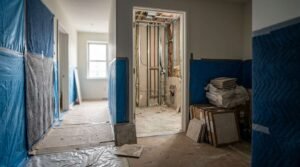
Demolition scope drives cost directly. Stripping a bathroom to bare studs differs significantly from removing only surface finishes, and your quote must specify demolition extent clearly.
Waste removal costs depend on volume and material type. General construction waste attracts standard disposal rates, while asbestos-containing materials require licensed disposal at significantly higher cost.
Skip bin hire runs $300–$600 for bathroom renovations, with multiple bins needed for larger projects or asbestos separation. Unexpected demolition discoveries such as multiple flooring layers, additional wall linings, or concealed fixtures increase removal time and waste volume.
Strata and Apartment Renovation Costs
Sydney’s apartment and strata market creates access challenges that add meaningful cost to bathroom renovations. Building management restricts work hours, elevator usage, and material storage, and common area protection requirements add time and materials to every delivery.
Upper-floor bathrooms without elevator access require manual material handling. Carrying tiles, vanities, and fixtures up multiple flights adds labour cost, and some contractors apply per-floor surcharges.
Body corporate approval, heritage permits, and specific work conditions in strata buildings all affect project logistics and cost. Narrow hallways and tight doorways slow progress significantly, and what takes one day with good access takes two or three days with restrictions.
Temporary Facilities During Renovation
Bathroom renovations remove essential facilities for the project duration. Single-bathroom homes need temporary solutions, with portable toilets costing $150–$300 per week and gym memberships or neighbour arrangements providing shower access.
These costs accumulate across multi-week projects. Some contractors include temporary facility provisions in their quotes while others expect homeowners to make their own arrangements, so clarify this before signing.
Living elsewhere during renovation removes daily disruption but adds accommodation cost. For extensive renovations, temporary relocation proves more practical than managing around active construction.
How to Budget for Hidden Bathroom Renovation Costs
Effective budgeting acknowledges uncertainty while giving you practical frameworks for financial planning.
Setting a Realistic Contingency Fund
Industry standard recommends 15–20% contingency for bathroom renovations, applied to your total project budget rather than just the quoted amount. Older homes built before 1980 warrant 20–25% contingency given elevated risk of structural issues, asbestos, and outdated systems.
Bathrooms with prior DIY work or unpermitted modifications carry higher hidden cost risk, so we budget 25–30% contingency for these situations. Contingency funds stay genuinely available only when you keep them liquid and resist allocating them to wishlist upgrades.
Unused contingency is not wasted money. It returns to your pocket or funds genuine improvements rather than emergency repairs.
Getting Detailed Quotes That Minimise Surprises
Quote detail correlates directly with budget accuracy. Vague quotes hide assumptions that become hidden costs once reality differs.
Request itemised quotes breaking down labour, materials, and specific tasks, and confirm exactly what sits inside and outside the scope. Multiple quotes give you comparison points, and significant price variations usually signal different scope assumptions rather than different profit margins.
Pre-quote inspections reduce hidden cost risk. Contractors who inspect thoroughly before quoting produce more accurate estimates than those working from photos or a brief walk-through.
GST, Quote Validity and Payment Schedules
Three commercial details cause more budget confusion than any structural discovery. First, confirm whether the quoted figure includes GST, because a $30,000 exclusive quote is a $33,000 commitment.
Second, check the quote’s validity period. Most Sydney builders hold pricing for 30–90 days, and a quote accepted six months later gets repriced against current material and labour rates.
Third, read the payment schedule against the work stages. Progress claims tied to completed milestones protect you far better than calendar-based instalments, and deposits above 10% of contract value are restricted for residential building work in NSW.
Understanding Variation Clauses Before You Sign
A variation clause is the contract mechanism that lets your contractor charge for work beyond the original scope. Understanding how yours operates before you sign prevents disputes once hidden costs surface.
Most variation clauses require written approval before additional work proceeds. Ask your contractor what dollar threshold triggers a formal variation notice, how quickly they communicate discoveries, and what documentation supports additional charges.
Contracts that allow verbal variations or open-ended scope changes carry the highest budget risk. Written specifications detailing exactly what sits in scope protect both parties when unexpected conditions arise.
Builder Warranties and Insurance Gaps
Builder warranties and home warranty insurance cover defective work, not pre-existing conditions discovered during renovation. Understanding that distinction prevents budget surprises once hidden costs emerge.
In NSW, home building compensation insurance is mandatory for residential building work over $20,000. This protects you when a contractor becomes insolvent or fails to complete work, but it never covers repairing pre-existing structural damage, failed waterproofing, or asbestos removal.
Budget for those separately, and confirm with your contractor exactly what their warranty covers before work begins.
Funding a Budget Shortfall Mid-Project
Even well-planned renovations occasionally exceed their contingency, and how you fund the gap matters as much as the gap itself. The worst outcome is a stalled site, because paused projects accumulate hire costs, storage fees, and rescheduling premiums while nothing gets built.
Homeowners typically cover shortfalls three ways: drawing on an offset or redraw facility, a construction loan variation where a lender is already involved, or staging non-critical work such as a heated towel rail or custom joinery into a later phase. Staging is usually the cheapest option, because deferring finishes costs nothing while deferring waterproofing costs everything.
Discuss shortfall scenarios with your contractor before demolition. Builders who plan for the possibility sequence work so that compliance-critical items are completed first, and discretionary items sit last.
Questions to Ask Your Contractor Before Signing
Specific questions reveal how contractors handle hidden costs. Ask how they respond to discoveries during demolition, whether they stop and requote or hold authority to proceed with minor repairs.
Confirm their communication process for significant findings. Inquire about their experience with homes similar to yours, because contractors familiar with your property era anticipate common issues and price accordingly.
Request references from similar projects, since speaking with previous clients shows you how hidden costs got handled in practice. Ask about their trade network too, because contractors with established relationships schedule specialists quickly when needed.
Red Flags That Signal Hidden Costs Ahead
Certain warning signs point to elevated hidden cost risk. Recognising these flags helps you budget appropriately and ask targeted questions.
Every flag below is something you can check yourself before a single contractor visits.
Warning Signs in Older Sydney Homes
Visible water staining points to moisture problems extending beyond surface damage. Stains on ceilings below bathrooms, bubbling paint, and musty odours all indicate water penetration.
Soft or spongy floors near wet areas signal subfloor damage that typically extends beyond the visible soft spot. Dated electrical fixtures such as two-pin power points, missing safety switches, and surface-mounted wiring point to upgrade requirements.
Fibro wall linings in pre-1990 homes need asbestos testing before any work proceeds, and we assume asbestos presence until testing proves otherwise. Previous patch repairs indicate underlying issues that nobody addressed properly.
Silicone over grout, paint over tiles, and obvious repairs all flag problems that resurface during renovation.
Quote Gaps That Lead to Budget Blowouts
Unusually low quotes often exclude items that competitors include. Compare quotes line by line to identify what is missing rather than assuming the lowest price represents the best value.
Vague material allowances signal potential upgrades, because a “tiles to $50/sqm allowance” means anything above that figure adds to your cost. Quotes excluding waterproofing, electrical work, or structural repairs shift those costs to you as variations.
Missing permit costs point to either non-compliant work or additional expenses you bear separately. No mention of contingency handling indicates inexperience, because experienced contractors acknowledge hidden cost possibility and explain how they manage them.
Conclusion
Hidden bathroom renovation costs are a predictable challenge, not an unavoidable disaster. Homeowners who understand the common categories, budget appropriate contingencies, and ask detailed questions before work begins turn uncertainty into managed risk, and they protect the resale value a well-executed bathroom delivers.
The difference between a stressful renovation and a successful one comes down to preparation. Homeowners who accept hidden cost reality and plan for it finish with budgets intact and expectations met.
We help Sydney homeowners navigate bathroom renovations with transparent pricing and honest conversations about potential hidden costs. Contact Sydney Home Renovation for a detailed consultation that addresses your specific property conditions and gives you realistic budget guidance for your bathroom project.
Frequently Asked Questions
What percentage should I add for hidden bathroom renovation costs?
Budget 15–20% contingency for standard renovations. Older homes built before 1980 warrant 20–25%. Properties with prior DIY work or unknown renovation history need 25–30%.
Are hidden costs more common in older Sydney homes?
Yes. Homes built before 1980 carry significantly higher exposure, including asbestos materials, galvanised plumbing, outdated electrical systems, failed waterproofing, and structural damage from decades of moisture.
Can a fixed-price contract protect me from hidden costs?
Fixed-price contracts deliver certainty for a defined scope but exclude unforeseen conditions. Most contracts include variation clauses for demolition discoveries, so read the terms carefully before signing.
What hidden costs are most often missed in bathroom quotes?
Waterproofing remediation, electrical compliance upgrades, and structural repairs get excluded from initial quotes most frequently. These items only become apparent after demolition reveals existing conditions.
How do I know if my bathroom has asbestos?
Homes built before 1990 carry asbestos risk in wall linings, floor tiles, tile adhesive, and cement sheeting. Professional testing costs $50–$150 per sample and gives you definitive identification.
Should I get a building inspection before renovating my bathroom?
Pre-renovation inspections identify potential hidden costs before you commit. Inspectors assess structural condition, identify moisture damage, and flag compliance issues that affect your budget.
How much do renovation delays add to my costs?
Delays add $200–$300 per week in temporary facilities alone, plus storage and site revisit charges. A two-week trade gap commonly compounds into four or five weeks of accumulated cost.
Does my quote include GST, and how long does it stay valid?
Always confirm GST inclusion, since it shifts a $30,000 quote to $33,000. Most Sydney builders hold pricing for 30–90 days before repricing against current rates.
How can I avoid cost blowouts during my bathroom renovation?
Request detailed itemised quotes, budget appropriate contingency funds, ask how contractors handle discoveries, and confirm clear communication protocols for scope changes.


